YOKAI.JP
Yomi (Land of the Dead) 死者の国と、桃の魔除け ── 黄泉

イザナギ·イザナミ·黄泉醜女·黄泉比良坂。日本神話の死の国

死者の国と、
桃の魔除け ── 黄泉

Yomi (Land of the Dead) · よみ

Also known as: 黄泉国 / 黄泉比良坂

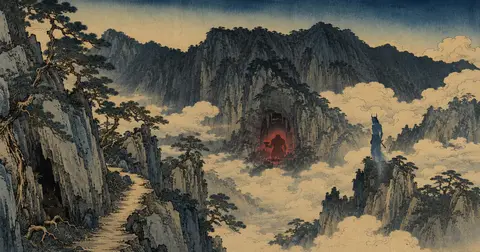
日本の神話において、死者の行きつく国 ── それが「黄泉(よみ)」である。地の底深くにあるとされるこの暗い国は、『古事記』が伝える、哀しくも壮絶な物語の舞台となった。

亡き妻を慕って死者の国へ向かった男神イザナギと、変わり果てた女神イザナミ。そして、追いすがる鬼女を、わずか三つの桃の実が退ける ── 日本人が今も節分などで親しむ「桃の魔除け」は、この神話にその源をもつといわれる。本稿は、生と死の境を定めたこの神話を、『古事記』に沿ってたどる。

死者の国、
黄泉

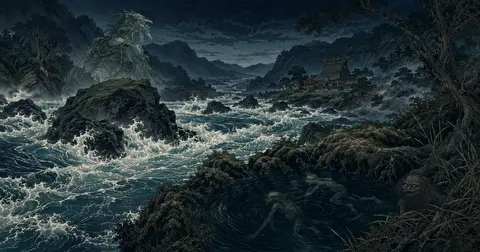
黄泉は、日本神話における死者の世界である。「よみ」という言葉は「闇(やみ)」に通じるとも、地下の「夜見(よみ)」の国を意味するともいわれ、いずれにせよ、光のとどかぬ暗い死の国として思い描かれてきた。古代の人々にとって、そこは一度その国の食べ物を口にすれば二度と帰れなくなる ──「黄泉竈食(よもつへぐい)」と呼ばれる、後戻りのできぬ世界であった。

この国が神話のなかで決定的な意味をもつのは、国生み·神生みをなしとげた二柱の神 ── イザナギとイザナミの物語の、悲劇的な転回点となるからである。生と死、この世とあの世の境がいかにして定められたのか。その起源が、黄泉をめぐる物語に語られている。

イザナギ、
亡き妻を追う

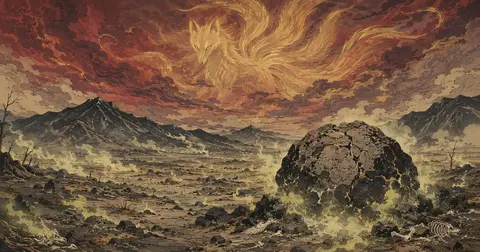
イザナギとイザナミは、天つ神の命を受けて日本の島々を生み、さらに数多くの神々を生んだ、創造の夫婦神である。だが、その神生みの果てに、悲劇は訪れた。イザナミは火の神を生んだことがもとで命を落とし、比婆山(ひばやま)に葬られた。創造の喜びの果てに訪れた、思いがけぬ死 ── それが、黄泉の物語の発端であった。最愛の妻を失ったイザナギは、その死を受け入れることができず、妻を連れ戻そうと、ついに黄泉国へと足を踏み入れる。

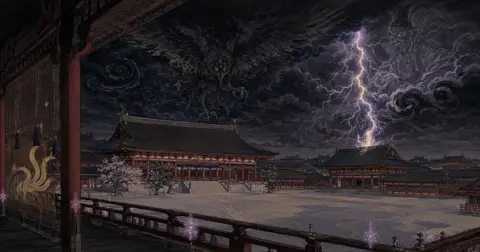
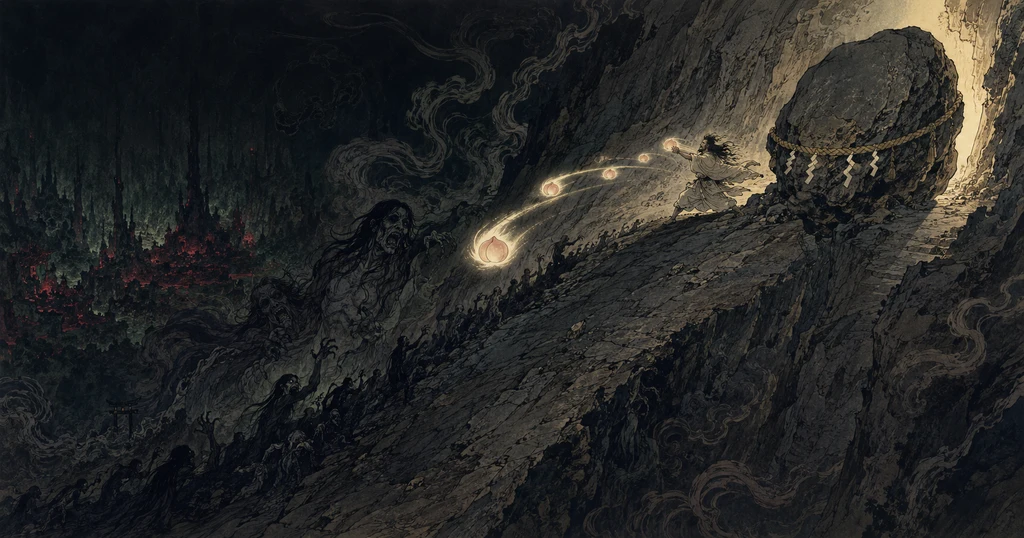
闇のなかでまみえた妻は、すでにこの世に帰れぬ身であった。それでもイザナミは、黄泉の神に相談すると告げ、「その間、決して私の姿を見ないでください」とイザナギに言い残す。だが、あまりに長く待たされたイザナギは、こらえきれずに火を灯してしまう。照らし出された妻の体は、すでに変わり果て、全身から雷(いかづち)を生じていた。あまりの恐ろしさに、イザナギは一目散に逃げ出した。見てはならぬものを見てしまった夫の、破られた約束 ── ここから、二神の壮絶な追走が始まる。

黄泉醜女と、
三つの桃

姿を見られ、辱められたイザナミの怒りは凄まじかった。
Yomotsushikome

よもつしこめ

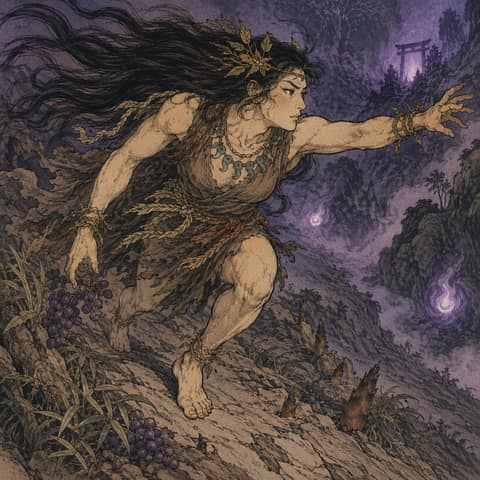
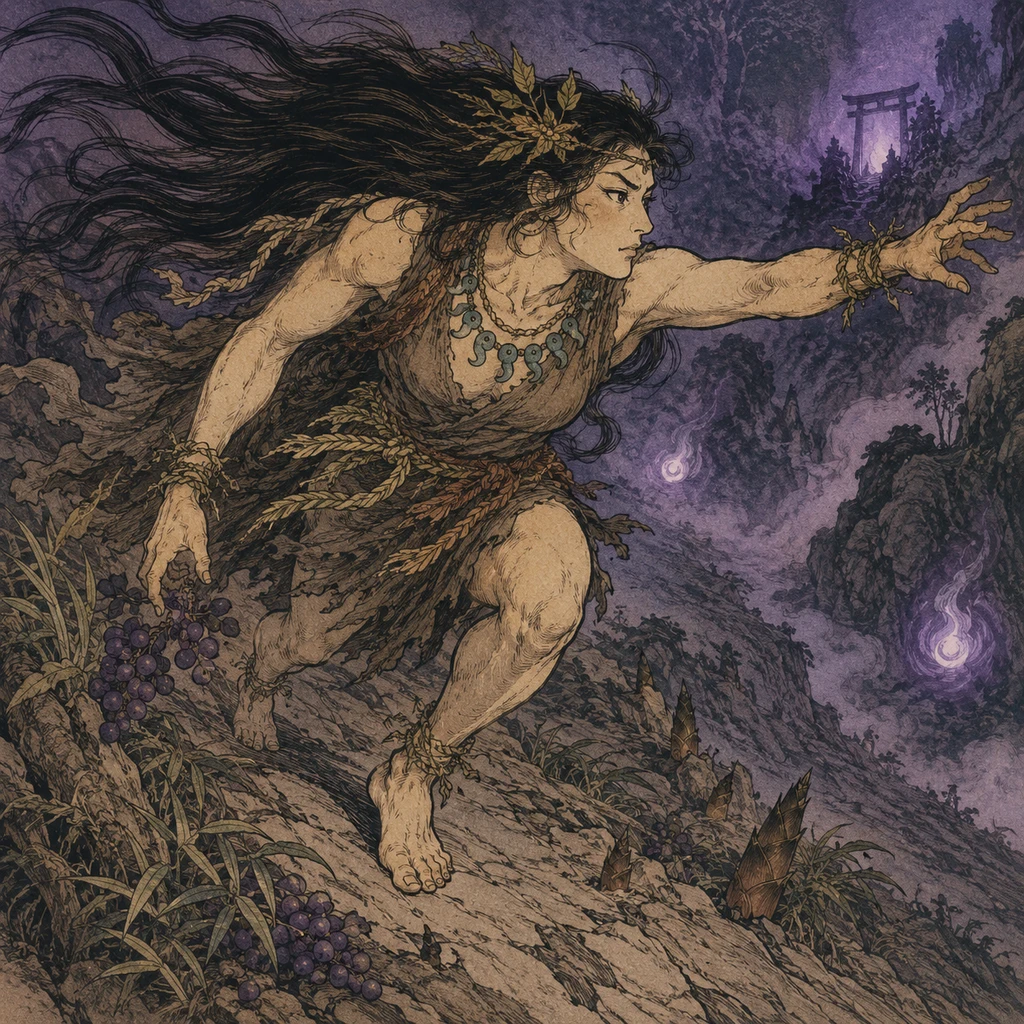
Yomotsushikome is a female demon-deity of the underworld (Yomi) appearing in Japan's oldest mythological texts, the *Kojiki* (712) and the *Nihon Shoki* (720). In the *Kojiki*, she is recorded as "Yomotsushikome," while the *Nihon Shoki* uses different notations such as "Yomotsuhisame," even mentioning "eight Yomotsuhisame" in plural form. When Izanagi-no-Mikoto descended to the land of the dead and saw the rotting corpse of his wife, Izanami-no-Mikoto, she was enraged by his gaze and dispatched pursuers from the underworld to hunt him down. Yomotsushikome served as the first of three waves of pursuers, alongside the Eight Thunder Deities (Yakusa-no-Ikazuchi) and the Underworld Army (Yomotsuikusa). Izanagi threw down his black vine headdress, which turned into grapes to distract her, and then broke off the teeth of his hair comb, which turned into bamboo shoots to delay her again. Finally, at Yomotsu Hirasaka, he repelled her by throwing three peaches (Ookamuzumi-no-Mikoto). This is the origin story of the warding power of peaches in *Kiki* mythology.

Read more

黄泉醜女は、死の国に棲む恐ろしい鬼女である。その名の「醜(しこ)」は、たけだけしく恐ろしいものを意味する。激怒したイザナミは、この黄泉醜女(よもつしこめ)を遣わして、逃げるイザナギを追わせた。鬼女の追跡は執拗をきわめる。イザナギは髪飾りや櫛を投げて山ぶどうや筍を生じさせ、それを醜女が食べる隙に逃げのびようとするが、なおも追っ手は迫ってくる。

そして、現世との境である黄泉比良坂(よもつひらさか)の坂本まで来たとき、イザナギは最後の手段に出る。坂のふもとに生えていた桃の木から、桃の実を三つもぎ取って投げつけると、追っ手はことごとく退散した。イザナギはこの桃に「意富加牟豆美命(おおかむづみのみこと)」という神の名を与え、「人々が苦しみ患うとき、自分を助けたように助けてやってほしい」と告げた。桃が魔を祓う力をもつとされる信仰の源流は、この神話にあるといわれる。もっとも、桃を聖なる果実とする観念そのものは、古く中国から伝わったものとされる。仙人の食べる「仙果」として不老長寿をもたらし、邪気を祓うとされた桃の霊力が、日本の神話のなかで、死の国の鬼女を退ける武器となったのである。

千引岩と、
生死の境

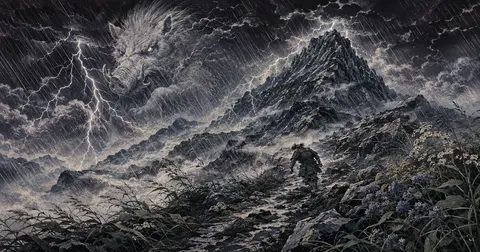
桃で追っ手を退けたイザナギだったが、最後には、怒り狂ったイザナミ自身が追ってきた。

イザナギは、千人がかりでようやく動かせるほどの巨石「千引(ちびき)の石」を引いてきて、黄泉比良坂を塞いだ。この石を境に、二神は永遠に引き裂かれる。石を隔てて、イザナミは「あなたの国の人を、一日に千人くびり殺す」と告げ、イザナギは「ならば、私は一日に千五百の産屋(うぶや)を建てよう」と応えた

この問答こそが、人がかならず死に、それでもなお新たな命が生まれつづける ── そのことわりの起源とされる。死者の数を生者の数が上回るように定められたこの瞬間に、生と死のあいだの、揺るぎない境界が引かれたのである。この黄泉比良坂の伝承地は、島根県松江市東出雲町の揖屋(いや)に伝えられ、今も「千引きの磐座(いわくら)」と呼ばれる岩が残る

桃の魔除けは、
今も

黄泉の物語が後世に遺したもののなかで、最も身近に生きつづけているのが「桃の魔除け」である。

イザナギを救った桃は、邪気を祓い、魔を退ける聖なる果実として、長く信じられてきた。鬼を退治する昔話の主人公が桃から生まれた「桃太郎」であることも、ひな祭り(桃の節句)に桃の花を飾る習わしも、その根にはこの黄泉神話の記憶がある。目に見えぬ災いを、桃の力で遠ざける ── 古代の人々が死の国の物語に託したその願いは、形を変えながら、今も日本の暮らしのなかに息づいている。

死とは何か、生とは何か。その問いに、日本の神話は、黄泉という暗い国の物語をもって答えた。そして同時に、その闇を払う一条の光として、桃の実を私たちに手渡したのである。
All yokai of Yomi (Land of the Dead)3

Complete list of yokai linked to Yomi (Land of the Dead), including those not featured in the article above.

  • Izanagi

    Izanagi

    Legendary

    Izanagi

    Izanagi no Mikoto, ancestral god of creation, land-birth, and purification

    Deity / divine spiritIzanagi Jingu in Awaji, Hyogo / Taga Taisha in Shiga / mythically, Takamagahara and the final generation of the Age of the Gods

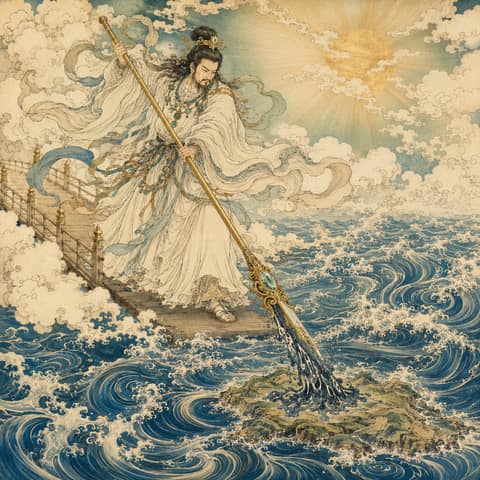
    The Seven Generations of the Gods and the cosmology of creation. The basic account covers land-birth and god-birth. Looking more closely, the Seven Generations of the Gods form a creation sequence in their own right. The Kojiki says that after heaven and earth open, the three creator deities and the Separate Heavenly Deities appear, followed by the divine generations beginning with Kuni-no-tokotachi. The line moves from solitary, abstract deities toward paired gods, then finally reaches Izanagi and Izanami as husband and wife. Myth moves from abstraction into relation, sex, marriage, and birth. Their marriage and the birth of the land are the decisive passage from divine potential into a concrete world. The Floating Bridge, the jeweled spear, and Onogoro Island. The scene in which the two gods stand on the Floating Bridge of Heaven and stir the sea with Ame-no-nuboko is one of the most important images in ancient Japanese cosmology. The bridge joins heaven and earth as a vertical world axis. The spear is an instrument of creation. Brine hardening into an island marks the passage from liquid to solid, from formlessness to form. Onogoro Island means something close to an island that congealed by itself, suggesting that creation is not only divine command but also natural self-formation. The scene can be read beside Pangu's separation of heaven and earth, the Indian cosmic egg, and Eurasian myths of stirring primordial waters. The descent to Yomi, an early East Asian Orpheus myth. Izanagi's descent to Yomi, his broken taboo, and his flight from the dead belong to the mythic type in which someone enters the underworld to recover a lost wife and fails after violating a prohibition. The Greek story of Orpheus and Eurydice is the most famous example, while Izanagi's version, written in the Kojiki in 712, is one of East Asia's earliest textual witnesses to the type. The stolen glimpse, the broken command, the pursuing dead, and the protective peaches all echo underworld narratives from India, China, and Europe, suggesting deep affinities across ancient Eurasian religious imagination. Misogi, the origin myth of Shinto purification. After escaping Yomi, Izanagi washes away its pollution at Awagihara. This is the origin myth of misogi and harae. Gods are born as he removes garments and objects from his body; sea deities are born as he washes in the stream; finally, the highest deities emerge from his eyes and nose. The structure binds body, impurity, purity, and divine birth together. The hand-washing before shrine worship, the Nagoshi no Oharae summer purification, and ritual ablutions before major ceremonies all find a mythic source here. Eda Shrine and Izanagi Jingu honor him as the ancestral deity of purification, showing how an ancient myth continues inside living Shinto practice. The Three Precious Children and ancient Japan's cosmic order. Izanagi divides the sky, night, and sea among the Three Precious Children. Amaterasu Omikami receives Takamagahara, the realm of heaven, daylight, and light. Tsukuyomi no Mikoto receives the realm of night, quiet, and calendrical rhythm. Susanoo no Mikoto receives the sea plain, the ocean and its violent force. This threefold division is not only a mythic plot point. It later supports the legitimacy of the imperial line and Ise Shinto. Medieval, early modern, and modern political thought in Japan repeatedly return to this narrative. It is a central line running through Japanese ideas of state, religion, and cosmic order. Taga Taisha, Izanagi Jingu, and Eda Shrine. The three major sacred places of Izanagi correspond to different moments in the myth. Izanagi Jingu in Awaji marks the beginning of land-birth, the marriage of the two gods, and Izanagi's hidden palace. Eda Shrine in Miyazaki marks Awagihara, purification, and the birth of the Three Precious Children. Taga Taisha in Shiga became a popular early modern shrine of long life and vitality. Together these sites turn the sequence of creation, purification, and longevity into geography and pilgrimage, sustaining Izanagi worship across Japan. Motoori Norinaga's Kojiki-den and the formation of kokugaku. Motoori Norinaga, the Edo-period kokugaku scholar, completed the forty-four-volume Kojiki-den in 1798, using rigorous philology and historical linguistics to interpret the Kojiki, including the myths of Izanagi. Debate continues over whether such myths should be read as history, symbolic narrative, or cultural memory, but Norinaga's method laid an important foundation for modern Japanese humanities. Izanagi therefore extends beyond myth alone. He belongs to the intellectual history of kokugaku, Shinto, modern national thought, and postwar folklore studies, and remains a symbolic figure in Japanese religion, scholarship, politics, and culture.

  • Izanami

    Izanami

    Legendary

    Izanami

    Izanami no Mikoto, Ancient Mother Goddess of Birth and Death

    Deity / divine spiritHana no Iwaya Shrine in Kumano, Mie Prefecture, as a burial tradition / Mount Hiba in Hiroshima and Shimane, as a second burial tradition / Izanami-related shrines in Awaji

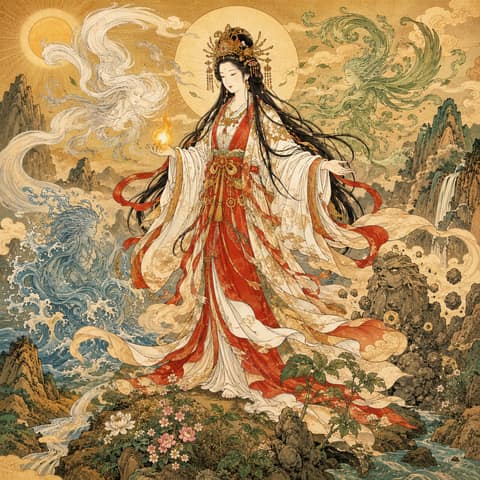
    The cycle of birth and death: the nature of an ancient mother goddess. The basic profile described Izanami's mythic role; the deeper issue is that she embodies birth and death in a single archaic mother figure. Izanami gives birth to the Oyashima islands and thirty-five nature deities, and even on her deathbed continues to produce gods of mines, earth, and grain from her vomit, urine, and excrement. This resembles the ambivalence of mother goddesses across the ancient world, such as Gaia in Greece, Inanna in Sumer, or Kali in India: the one who gives life also contains death. Izanami is more than a creator deity. She joins birth and death, the living world and the underworld, purity and pollution into one Japanese variation of the archaic mother goddess. Kagutsuchi's birth and the symbolism of fire. Izanami dies because she gives birth to the fire god Kagutsuchi, an event of major symbolic force in ancient Japanese cosmology. Fire begins civilization: forging, pottery, cooking. Yet fire also brings destruction and death. In ancient societies, childbirth itself could threaten a woman's life, and the myth binds those dangers together. Kagutsuchi is born, Izanami dies, and from her dead or dying body arise deities of mines, earth, and grain. This chain makes the material foundations of civilization, metallurgy, agriculture, land-making, emerge from the sacrifice of the mother goddess. The myth gives a stark expression to an ancient worldview: civilization stands on the body of the mother. Yomi no Kuni and the queen of the dead. After burial, Izanami reigns as queen of Yomi no Kuni. This is an unusual structure in ancient myth. Chinese underworlds are often ruled by male figures such as Fengdu or the Lord of Mount Tai; India has Yama, and Greece has Hades. In Japanese myth, however, the realm of the dead is ruled by the former creation goddess. Izanami's rule over Yomi shows the close ancient Japanese linkage of woman, death, and underworld. Later images of Enma, Jizo, and the Sanzu River grow in soil prepared by this imagination of the dead. The idea of death as a feminine principle is one of the most striking points for comparative religion. The burial debate: Izumo and Kumano. The Kojiki names Mount Hiba, on the Izumo-Hoki border, as Izanami's burial place, while a variant in the Nihon Shoki names Kumano in Kii. The two traditions map onto two religious geographies. The Izumo line, Shobara in Hiroshima, Yasugi in Shimane, and Higashi-Izumo in Matsue, connects with Izumo ritual lineages and faith in Ne no Katasukuni. The Kumano line, Hana no Iwaya in Mie and Kumano Hayatama Taisha in Wakayama, connects with Kumano Sanzan worship, Fudaraku sea-crossing beliefs, and Pure Land imagination. Izumo lies to the north, facing the Sea of Japan; Kumano lies to the south, facing the Pacific. Together the two burial traditions form a core problem in the religious geography of ancient Japan. Hana no Iwaya Shrine and ancient iwakura worship. Hana no Iwaya Shrine in Kumano, Mie, is named in the Nihon Shoki as Izanami's burial place and is one of Japan's oldest shrines; it has no shrine hall and worships a forty-five-meter sacred rock as its divine body. Iwakura worship is an old Japanese mode of nature veneration in which trees, boulders, waterfalls, and mountain peaks are treated as places where divine spirits dwell. Later shrine architecture grew out of such natural sacred places, and Hana no Iwaya preserves an especially ancient layer by having no main building. The Otsunakage rite, held on February 2 and October 2, hangs a rope about 170 meters long from the sacred rock to the precincts; it is a rare living folk practice that carries ancient rock worship into the present. "One thousand a day, fifteen hundred a day": the cosmology of life and death. The exchange at Yomotsu Hirasaka is the moment when Japanese myth fixes the order of life and death. Izanami says she will kill one thousand people a day; Izanagi answers that he will cause fifteen hundred to be born. The scene is grief after marital separation, but also a cosmic declaration that death and life, underworld and this world, feminine and masculine principles will stand in permanent tension. Death counts one thousand; birth counts fifteen hundred. Life exceeds death. That inequality becomes a religious expression of life's continuation. Japanese myth does not remain a simple tragedy; it turns the dialectic of life and death into cosmology. Izanami reevaluated in the twenty-first century. Postwar feminist myth studies and cultural criticism have moved beyond reading Izanami only as a victim of patriarchal myth. They also understand her as an embodiment of the ancient mother goddess who unites birth, death, and the underworld. Motoori Norinaga's Kojiki-den, completed in 1798, laid the philological foundation; later comparative mythologists such as Orikuchi Shinobu, Obayashi Taryo, and Yoshida Atsuhiko added new interpretive layers. In the twenty-first century, Izanami is no longer merely a mythic character. She has become an image of the feminine root of Japanese myth and of cosmic order as mother, continuing to shape religion, scholarship, and cultural imagination.

  • Yomotsushikome

    Yomotsushikome

    Legendary

    よもつしこめ

    Underworld Pursuer of the Kojiki: Yomotsushikome

    Divine Spirit/DeityYomi (Mythology) / Yomotsu Hirasaka Lore Site (Higashi-Izumo-cho Iya, Matsue City, Shimane Prefecture)

    The Position of Grotesque Deities in Kiki Mythology. While the basic description touches on the accounts in the *Kojiki* and *Nihon Shoki*, the deep dive explores Yomotsushikome's position as a "grotesque deity" within the mythological system. Deities in *Kiki* mythology are broadly classified into three layers: (1) Takamagahara lineage (heavenly/pure deities), (2) Ashihara-no-Nakatsukuni lineage (earthly/indigenous deities), and (3) Yomi lineage (deities of the dead/grotesque deities). Yomotsushikome belongs to the third lineage, forming a cohesive system alongside Izanami (the goddess stationed in Yomi), the Eight Thunder Deities, and the Underworld Army. *Kiki* mythology is not a simple dualism of good and evil; it possesses a three-tiered structure of "life, purity, and light" versus "death, impurity, and darkness," where grotesque deities are positioned as essential entities upholding the order of the underworld. Etymology of "Shiko"—The Semantic Field of Ancient Japanese. Interpreting "shiko" as "ugly" is a reductive interpretation from the Middle Ages onwards. In ancient Japanese, "shiko" was a rich word connoting "strength, hardness, and terror." Cognate words like "shikobuchi" (rocky abyss) and "shikofune" (sturdy boat) express the hardness of coastal rocks. "Shikome" was not merely an "ugly woman" but understood as a "hard, strong, and terrifying female demon-deity." The names of ancient deities tended to be based on "spiritual power and function" rather than "visual features," positioning Yomotsushikome as a "female demon-deity with terrifying power governing death." The fixed image of a "flesh-rotting, fanged hideous hag" in medieval picture storytelling is a later reconstruction distinct from her original mythological figure. East Asian Comparison of Peach Warding Beliefs. The episode of Izanagi using peaches to repel Yomotsushikome serves as a key subject in comparative religion regarding East Asian warding culture. In Chinese Taoism, warding off evil spirits using peach wood swords, peach charms, peach seals, and peach offerings was systematized and widely spread to East Asian regions. The magical power of the peach repeatedly used in Japanese court rituals (Tsuina, Tango no Sekku, Momo no Sekku) was formed through the complex intertwining of the Izanagi myth in the *Kojiki* and Chinese Taoist peach worship. This is a classic example of how ancient Japan constructed its unique system while assimilating the religious cultures of the Chinese mainland and the Korean peninsula. The Pursuit Tale as a Narrative Type. A hero escaping from the land of the dead by throwing magical items that transform to delay pursuers—this is known in world mythology as the "Magic Flight" motif, a widely distributed narrative type. Similar tales exist in the Greek myth of Orpheus and Eurydice, Eastern European folklore of Baba Yaga, and Native American creation myths, demonstrating a universal structure of ancient human concepts of the underworld and escape narratives. The tale of Izanagi and Yomotsushikome holds exceptionally high comparative mythological value as one of the oldest literary records of this global narrative type in East Asia. The Geography of Yomotsu Hirasaka—Relationship with the Izumo Belief Sphere. The modern estimated site of Yomotsu Hirasaka in Higashi-Izumo-cho Iya, Matsue City, Shimane Prefecture, is located in the core region of the ancient Izumo belief sphere, alongside the Izumo Kuni-no-Miyatsuko stronghold, Kumano Taisha, and Kamiarizuki legends. In the *Kojiki* and *Nihon Shoki*, Izumo is depicted as the intersection of the three mythological layers—Takamagahara, Ashihara-no-Nakatsukuni, and Yomi—and placing the "entrance to Yomi" in Izumo was no coincidence. It reflects Izumo's status as the religious center for "death, the otherworld, and Ne-no-Katasukuni" in ancient Japan. Myths involving Okuninushi, Susanoo, Izanagi, and Izanami intersect in this region, serving as the key to deciphering ancient religious geography. Reduction Since the Middle Ages and Modern Renewed Interest. In medieval sermons, picture storytelling, Noh, and Joruri theater, Yomotsushikome was fixed into the image of a "flesh-rotting, fanged hideous hag," losing the original ancient semantic field of a "strong female demon-deity." However, since the 2010s, amidst a renewed interest in Japanese mythology, re-evaluations based on findings in ancient linguistics, mythology, and archaeology are progressing. Modern subcultures such as the *Megami Tensei* game series, *Record of Ragnarok* manga, and *Demon Slayer* anime functionally reconstruct ancient mythological materials, thereby reintroducing the mythological worlds of Yomotsushikome, the Underworld Army, and Yomi to younger generations. This is a symbolic example of cultural historical circulation from ancient to modern times. Positioning as "Japan's Oldest Yokai". Yomotsushikome is a female demon-deity appearing in the *Kojiki* (712 CE), Japan's oldest extant book, giving her a unique status not just as a "post-Heian yokai" but as a "grotesque deity recorded in the original texts of Japanese mythology." Predating the yokai systems involving oni, tengu, and kappa that formed from the Middle Ages onwards—in an era where the boundary between ancient gods (kami) and yokai was still undifferentiated—she is a core subject for tracing the origins of yokai studies. Dismantling the binary opposition of "is it a god or a yokai?", she serves as an excellent starting point for examining the rich, multi-layered nature of ancient Japan's grotesque deities.

Read on ── other regions