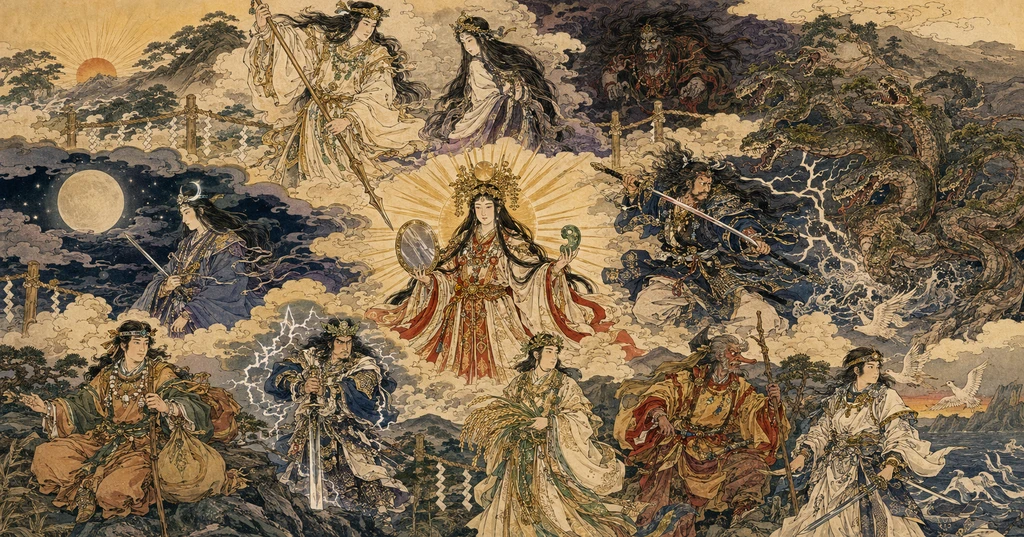
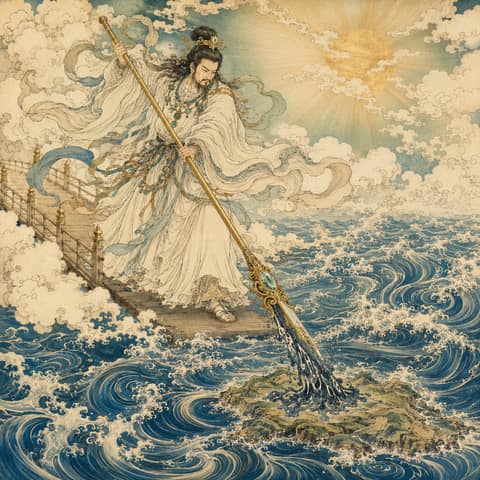
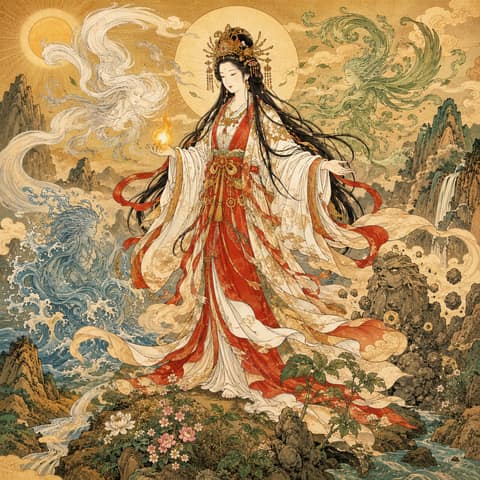
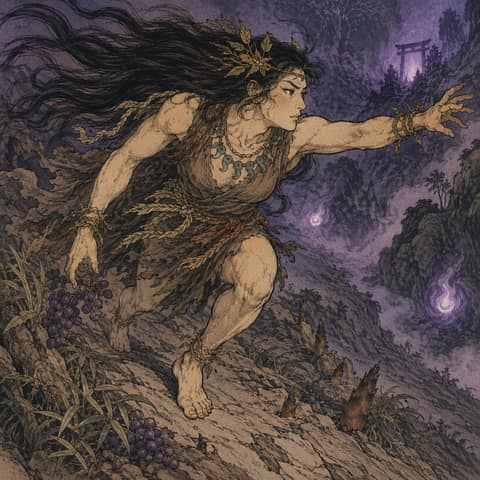
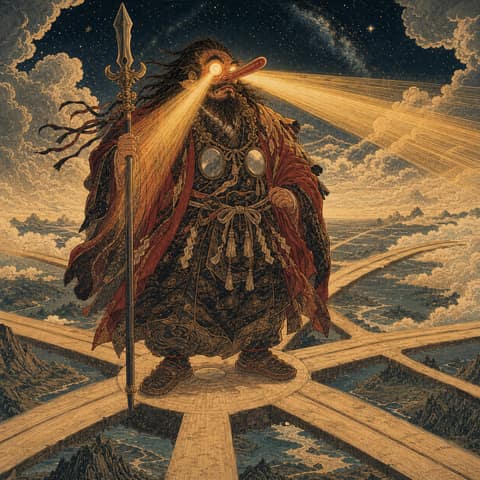
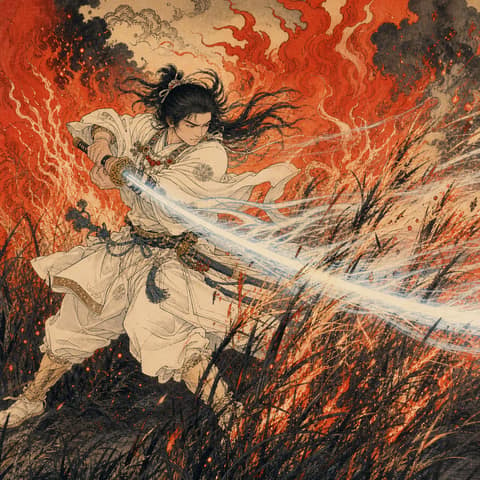
The Position of Grotesque Deities in Kiki Mythology. While the basic description touches on the accounts in the *Kojiki* and *Nihon Shoki*, the deep dive explores Yomotsushikome's position as a "grotesque deity" within the mythological system. Deities in *Kiki* mythology are broadly classified into three layers: (1) Takamagahara lineage (heavenly/pure deities), (2) Ashihara-no-Nakatsukuni lineage (earthly/indigenous deities), and (3) Yomi lineage (deities of the dead/grotesque deities). Yomotsushikome belongs to the third lineage, forming a cohesive system alongside Izanami (the goddess stationed in Yomi), the Eight Thunder Deities, and the Underworld Army. *Kiki* mythology is not a simple dualism of good and evil; it possesses a three-tiered structure of "life, purity, and light" versus "death, impurity, and darkness," where grotesque deities are positioned as essential entities upholding the order of the underworld.
Etymology of "Shiko"—The Semantic Field of Ancient Japanese. Interpreting "shiko" as "ugly" is a reductive interpretation from the Middle Ages onwards. In ancient Japanese, "shiko" was a rich word connoting "strength, hardness, and terror." Cognate words like "shikobuchi" (rocky abyss) and "shikofune" (sturdy boat) express the hardness of coastal rocks. "Shikome" was not merely an "ugly woman" but understood as a "hard, strong, and terrifying female demon-deity." The names of ancient deities tended to be based on "spiritual power and function" rather than "visual features," positioning Yomotsushikome as a "female demon-deity with terrifying power governing death." The fixed image of a "flesh-rotting, fanged hideous hag" in medieval picture storytelling is a later reconstruction distinct from her original mythological figure.
East Asian Comparison of Peach Warding Beliefs. The episode of Izanagi using peaches to repel Yomotsushikome[1] serves as a key subject in comparative religion regarding East Asian warding culture. In Chinese Taoism, warding off evil spirits using peach wood swords, peach charms, peach seals, and peach offerings was systematized and widely spread to East Asian regions. The magical power of the peach repeatedly used in Japanese court rituals (Tsuina, Tango no Sekku, Momo no Sekku) was formed through the complex intertwining of the Izanagi myth in the *Kojiki* and Chinese Taoist peach worship. This is a classic example of how ancient Japan constructed its unique system while assimilating the religious cultures of the Chinese mainland and the Korean peninsula.
The Pursuit Tale as a Narrative Type. A hero escaping from the land of the dead by throwing magical items that transform to delay pursuers—this is known in world mythology as the "Magic Flight" motif, a widely distributed narrative type. Similar tales exist in the Greek myth of Orpheus and Eurydice, Eastern European folklore of Baba Yaga, and Native American creation myths, demonstrating a universal structure of ancient human concepts of the underworld and escape narratives. The tale of Izanagi and Yomotsushikome holds exceptionally high comparative mythological value as one of the oldest literary records of this global narrative type in East Asia.
The Geography of Yomotsu Hirasaka—Relationship with the Izumo Belief Sphere. The modern estimated site of Yomotsu Hirasaka in Higashi-Izumo-cho Iya, Matsue City, Shimane Prefecture[1], is located in the core region of the ancient Izumo belief sphere, alongside the Izumo Kuni-no-Miyatsuko stronghold, Kumano Taisha, and Kamiarizuki legends. In the *Kojiki* and *Nihon Shoki*, Izumo is depicted as the intersection of the three mythological layers—Takamagahara, Ashihara-no-Nakatsukuni, and Yomi—and placing the "entrance to Yomi" in Izumo was no coincidence. It reflects Izumo's status as the religious center for "death, the otherworld, and Ne-no-Katasukuni" in ancient Japan. Myths involving Okuninushi, Susanoo, Izanagi, and Izanami intersect in this region, serving as the key to deciphering ancient religious geography.
Reduction Since the Middle Ages and Modern Renewed Interest. In medieval sermons, picture storytelling, Noh, and Joruri theater, Yomotsushikome was fixed into the image of a "flesh-rotting, fanged hideous hag," losing the original ancient semantic field of a "strong female demon-deity." However, since the 2010s, amidst a renewed interest in Japanese mythology, re-evaluations based on findings in ancient linguistics, mythology, and archaeology are progressing. Modern subcultures such as the *Megami Tensei* game series, *Record of Ragnarok* manga, and *Demon Slayer* anime functionally reconstruct ancient mythological materials, thereby reintroducing the mythological worlds of Yomotsushikome, the Underworld Army, and Yomi to younger generations. This is a symbolic example of cultural historical circulation from ancient to modern times.
Positioning as "Japan's Oldest Yokai". Yomotsushikome is a female demon-deity appearing in the *Kojiki* (712 CE), Japan's oldest extant book, giving her a unique status not just as a "post-Heian yokai" but as a "grotesque deity recorded in the original texts of Japanese mythology." Predating the yokai systems involving oni, tengu, and kappa that formed from the Middle Ages onwards—in an era where the boundary between ancient gods (kami) and yokai was still undifferentiated—she is a core subject for tracing the origins of yokai studies. Dismantling the binary opposition of "is it a god or a yokai?", she serves as an excellent starting point for examining the rich, multi-layered nature of ancient Japan's grotesque deities.
Character Profile
This section is our own creative profile for storytelling. It is not historical fact or scholarship.
Yokai Type - Traditional Yokai
Category - Deities & Divine Spirits
Rarity - Legendary
Personality - A faithful pursuer executing Izanami's will as a divine spirit of the underworld. Following the original meaning of the ancient word "shiko," she is a "strong, hard, and terrifying female demon-deity"—not merely a villain, but a divine entity upholding the order of the underworld.
Compatibility - Deeply connected to Shinto and classical scholars tracing the texts of the *Kojiki* and *Nihon Shoki*, those who value peaches, grapes, and bamboo shoots as warding charms, and pilgrims visiting mythological sacred sites like Izumo and Yomotsu Hirasaka. Resonates anciently with those who hold an awe of death, impurity, and darkness.
Abilities - Pursuit from Yomi to Ashihara-no-NakatsukuniDelayed by magical warding items (devouring grapes and bamboo shoots)Coordinated subjugation with the Eight Thunder Deities and the Underworld ArmyDivine fragility of being repelled by three peachesGuarding the underworld as a divine spirit of the deadMythological power residing in the texts of the Kojiki and Nihon Shoki
Weaknesses - Peaches (Ookamuzumi-no-Mikoto), grapes born from the black headdress, bamboo shoots born from the comb teeth, the Chibiki Rock of Yomotsu Hirasaka (sealing Yomi), Amida Nembutsu, classical Shinto purification
Habitat - Yomi / Yomotsu Hirasaka (modern lore site in Higashi-Izumo-cho Iya, Matsue City, Shimane Prefecture) / The texts of the Kojiki and Nihon Shoki / Sacred sites within the Izumo Kuni-no-Miyatsuko sphere / Modern shrine festivals / Subculture spaces like Megami Tensei