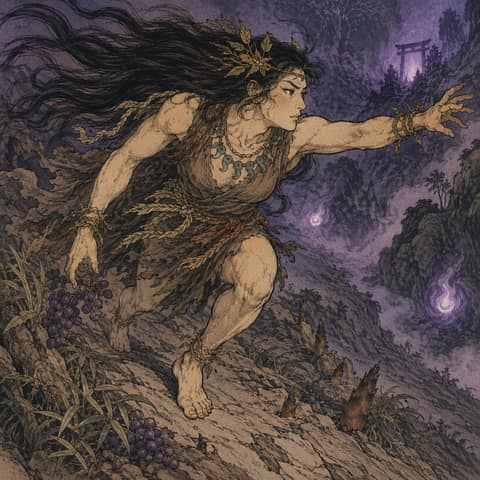
The ancient mythic type of the tragic hero. The general entry covered Yamato Takeru's myth. Here the focus is the ancient pattern of the tragic hero. Yamato Takeru is a rare heroic deity who unites the tragic hero, short-lived warrior, father-son conflict, sacrificial love, and ascent after death in a single figure[1]. He begins with fratricide, is rejected by his father and sent on campaigns, survives through his wife's sacrifice, and dies from a mountain god's curse. That arc is structurally close to tragic heroes across the ancient world, including Heracles, Sigurd, and Arjuna. It is a Japanese form of a widespread story pattern: the fate, suffering, and heavenly transformation of the hero.
Father-son conflict and the myth of heroic exile. Yamato Takeru is estranged from Emperor Keiko and repeatedly ordered to go on distant campaigns[1]. In comparative mythology, this belongs to the broad pattern of a dangerous son being exiled, tested, and made to conquer. Stories in which a father or ruler sends such a figure away are often compared with traditions surrounding David, Sigurd, and Zheng He, and they reflect questions of patriarchy, succession, and kingship. The tale marks the killing of the brother as a failure of human restraint, yet it also shows the father's coldness. That double structure gives the story a tragic intelligence beyond simple good and evil.
Disguise as a young woman: strategy turned into myth. In the Kumaso episode, Yamato Takeru disguises himself as a young woman, enters the enemy camp, and kills the chieftain[1]. The scene is a memorable mythic rendering of military strategy, disguise, and surprise attack. Yet the female disguise is more than tactics. In ancient Japanese myth and folklore, reversal, thresholds, and the crossing of gendered boundaries can be sources of ritual power and sacred danger. Yamato Takeru's disguise can therefore be read not simply as deception but as an act that embodies the magical force of inversion. It also stands as a mythic ancestor to later religious and theatrical traditions of cross-gender performance in kagura, noh, and kabuki.
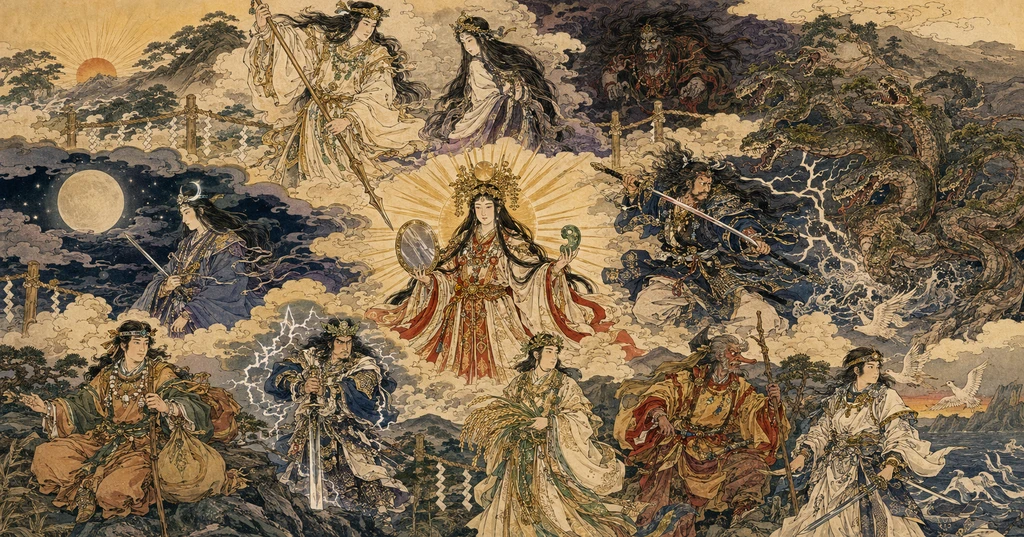
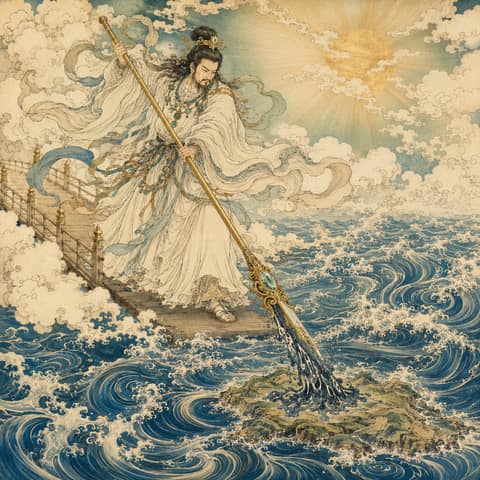
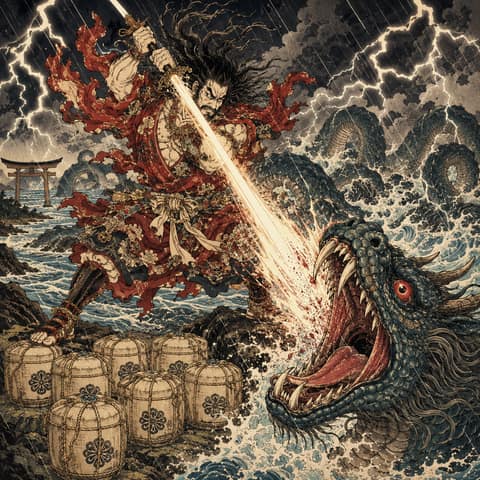
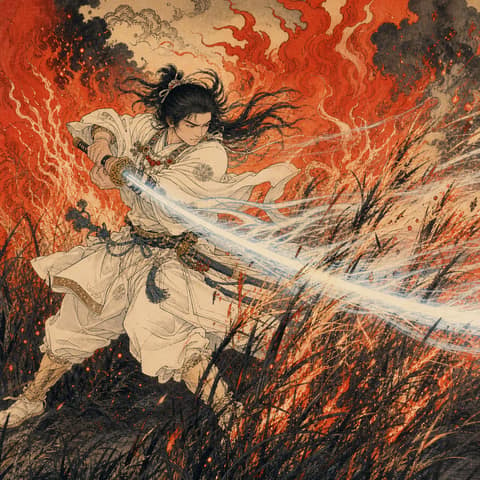
The Kusanagi sword and the Three Sacred Treasures. Yamato Takeru receives the Kusanagi sword from Yamato-hime, escapes the Yaizu fire with it, and after his death the sword is enshrined at Atsuta Jingu[1]. Kusanagi is one of the Three Sacred Treasures at the core of ancient Japanese royal legitimacy. Its transmission runs from Susanoo's defeat of Yamata no Orochi, to presentation to Amaterasu, to the heavenly descent of Ninigi, to Yamato-hime, to Yamato Takeru, and finally to Atsuta Jingu. Through that chain, myth, sacred object, and imperial lineage are joined in material and religious form. Yamato Takeru is one of the few figures who actually uses a sacred treasure in battle, making him a symbol of the union of artifact, hero, and state.
Ototachibana-hime's sea sacrifice and the origin of Azuma. Ototachibana-hime's self-sacrifice at sea and Yamato Takeru's cry, "Azuma haya," are treated as the mythic origin of Azuma, the eastern lands and eastern Japan[1]. Ancient myth did not only entertain; it gave meaning to names, geography, land, and local custom. Here a woman's sacrifice becomes attached to the name of the entire east. Hashirimizu Shrine in Yokosuka still enshrines Ototachibana-hime, showing that the episode continues not only in texts but also in place names, worship, and local memory.
The death poem and ancient Japanese longing for home. The death poem Yamato Takeru sings at Nobono, "Yamato wa kuni no mahoroba," has long been cherished as one of ancient Japan's foundational expressions of homeland, longing, and love of country[1]. Mahoroba means an excellent, beautiful place, and the word condenses an early feeling for the homeland and the land itself. It influenced later waka traditions such as the Man'yoshu, Kokinshu, and Shinkokinshu. The structure is powerful: a hero at the edge of death praises the place he longs to return to. In modern Japan, the poem has continued to appear in education, literature, music, and public speech.
The white-bird legend and ancient Japanese ideas of ascent and rebirth. After death, Yamato Takeru becomes a white bird, rises from his tomb, passes through Kotohiki-no-hara in Yamato and Shiki in Kawachi, and flies high into the sky[1]. The legend is a representative example of the ancient Japanese idea that a hero may ascend and be transformed after death. In early Japan, the white bird could be imagined as a bearer of souls or a messenger of the gods. Beliefs in the dead soul becoming a bird and rising to the sky also have affinities with northern Asian, Siberian, and Korean ideas of birds, funerary practice, and the soul. The image later resonated with Pure Land faith, Shinto views of death, warrior ethics, and even the spiritual culture around the kamikaze special attack corps. It is not merely an ending to a hero tale. It is one of the narratives through which ancient Japan thought about death, religion, and beauty.
Yamato Takeru in the twenty-first century. Today Yamato Takeru remains a subject of ancient-history research, local tourism, Shinto worship, and popular culture. Visits to Nobono, Kotohiki-no-hara, Atsuta Jingu, Yaizu Shrine, and Hashirimizu Shrine continue. He is repeatedly reshaped in works such as the game Okami, the 1994 film Yamato Takeru, and manga including Demon Slayer. Across more than two millennia of cultural memory, he has remained a symbol of the tragic hero, the short-lived warrior, love and sacrifice, and ascent after death. From political emphasis in prewar State Shinto, through postwar cultural reinterpretation, to plural retellings in the twenty-first century, he is a model case of how an ancient divine figure can keep entering modern culture.
Character Profile
This section is our own creative profile for storytelling. It is not historical fact or scholarship.
Yokai Type - Kami
Category - Deities & Divine Spirits
Rarity - Legendary
Personality - He brings together the sorrow of a lonely prince rejected by his father, the courage and courtesy of a warrior who receives a name from Kumaso Takeru, the grief of losing Ototachibana-hime, longing for Yamato, and the human fragility of one who finally falls to a mountain god's curse.
Compatibility - He is close to those who revere tragic heroes, martial courage, love and sacrifice, and longing for home; to travelers who visit Atsuta Jingu, Nobono, Yaizu, and Hashirimizu; and to those drawn to the Kusanagi sword, the white-bird legend, and ancient Japanese ideas of ascent and rebirth.
Abilities - Dismember his elder brother Oousu with superhuman strengthUse female disguise and youthful appearance for surprise attackCompel Kumaso Takeru to grant him a name at the moment of deathWield the Kusanagi sword, one of the Three Sacred Treasures, to escape a grass fireInherit sacred objects from Yamato-himeSubdue wide regions including Kumaso, Izumo, and the eastern provincesSurvive the sea god's rage through Ototachibana-hime's sacrificeBecome a white bird after death and ascend in flightLeave the death poem beginning Yamato wa kuni no mahoroba
Weaknesses - The guilt of killing his brother Oousu and the estrangement from his father; the physical and mental exhaustion of continuous campaigns; the curse brought by boasting against and dismissing the deity of Mount Ibuki; the fate that causes sacrifices such as Ototachibana-hime and the lone pine of Otsu-no-saki; and his lonely death from illness at Nobono.
Habitat - The Nobono tomb and Nobono Shrine in Kameyama, Mie; Kotohiki-no-hara Shiratori Mausoleum in Gose, Nara; Karusato Otsuka Kofun or Shiratori Mausoleum Kofun in Habikino, Osaka; Atsuta Jingu in Nagoya, where Kusanagi is enshrined; Yaizu Shrine in Yaizu, Shizuoka; Hashirimizu Shrine in Yokosuka, Kanagawa; and Yamato Takeru shrines and white-bird legend sites across Japan.