YOKAI.JP

倭姫命

やまとひめのみこと

倭姫命

倭姫命

Their soul is listening — speak, and they will answer.

Basic Description

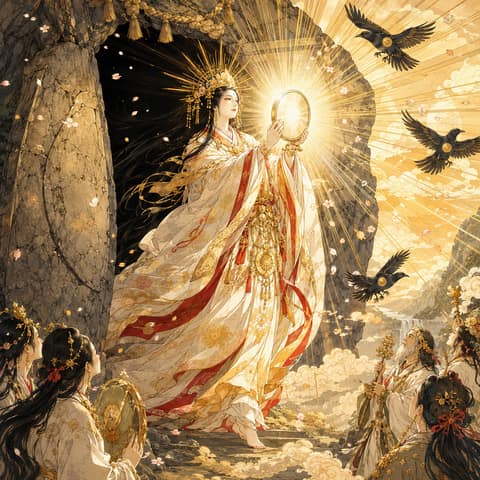
Yamatohime-no-Mikoto is traditionally known as the imperial daughter of the 11th Emperor Suinin, who succeeded Toyouke-irihime-no-Mikoto as the mitsueshiro (divine representative) serving Amaterasu Omikami. According to the official history of the Jingu Administration, she enshrined the great goddess, departed from Yamato Province, and toured through regions such as Iga, Omi, and Mino before entering Ise Province. There, following divine will, she established the Kotai Jingu (Naiku) along the banks of the Isuzu River. She is neither a ferocious yokai nor someone who commands deities. Instead, she is a divine spirit who listens to the divine will, selects the land, and organizes the forms of rituals, thereby re-anchoring unseen divine authority into the human world. Yamatohime's name is easily confused with the later Saio (Imperial Princess) system, but her role in legend is far more fundamental. She stands at the vanguard before the system of Ise Jingu became visible in history, narrated as the guide who binds shrines, rivers, forests, purification rituals, and divine offerings into a single cohesive order. Although a mythical imperial princess, Yamatohime's contours are extremely practical. Judging which land can welcome the deity, which water to use for purification, and what rituals to place at specific times of the year—these judgments form the very essence of her spiritual character. Thus, rather than being a peripheral deity to Amaterasu Omikami, Yamatohime can be read as a deity who personifies the very moment the sacred site of Ise was established. Today, the Yamatohime-gu, dedicated to her, rests quietly in the forests of Mount Kurata, midway along the Miyuki Road connecting the Naiku and Geku in Kusube-cho, Ise City. Yamatohime's story is the linchpin of the Ise faith, seamlessly connecting the enshrinement of Amaterasu Omikami, the founding of Ise Jingu, and the origins of purification and ritual order.

Folklore & Legends

The legend of Yamatohime is not a travelogue of a single princess, but a mythological geographical narrative exploring where and how to enshrine Amaterasu Omikami. According to the explanations of the Jingu Administration, during the reign of Emperor Sujin, Toyouke-irihime-no-Mikoto enshrined the great goddess in Kasanui Village in Yamato, and during Emperor Suinin's reign, Yamatohime inherited that duty. She departed Yamato bearing the great goddess, and after touring various regions, finally entered Ise. The crucial point here is that Yamatohime does not select the land as a conqueror, but listens to the land as a mitsueshiro following the divine words. Ise is described as a beautiful country rich with the bounties of the sea and mountains, where the waves of Tokoyo (the eternal world) lap against the shores, and there the shrine to Amaterasu Omikami is firmly established.

Based on the "Kotai Jingu Gishikicho" (Ritual Book of the Grand Shrine), the shrine's history preserves fourteen historical sites related to Yamatohime's tour. Names like the Mimuro of Miwa, Uda, Iga, Omi's Sakata, Mino's Ikuragawa, Kuwana, Suzuka, Fujikata, and Iino resonate with the later "Moto-Ise" (Former Ise) faith, carving a path on the map tracing the divine spirit before it settles into a single shrine. Such a touring narrative does not merely record the movement of ancient kingship. It reveals a structure where every time a mountain, river, sea, or border is crossed, the rituals for Amaterasu Omikami are re-linked with the memories of the land, and the center called Ise gradually draws in the surrounding sacred sites.

Yamatohime's tour is not confined to a single location even within Ise. The histories of the Betsugu (auxiliary shrines) of Jingu retain legends such as Yamatohime building a shrine for the great goddess at Takihara-no-miya, and the Izawa-no-miya being connected to her tour of Shima. Rather than documents that merely reconstruct historical movements, these are traditions that retell the expansion of Ise Jingu's ritual sphere to the upper reaches of rivers, seashores, and islands through the footsteps of Yamatohime. She is the deity who not only discovered a single sacred site but also connected the peripheries that make a sacred site truly sacred.

Yamatohime is also narrated as the figure who established the ritual system after the enshrinement. The Jingu Administration explains that after founding Kotai Jingu, Yamatohime established annual rituals such as the Kanname-sai and the rules of purification, laying the foundations of Jingu. Here, her power does not manifest as direct force like thunder or swords, but as the norms maintaining purity, the procedures for preparing offerings, and the boundary lines separating the sacred realm from the secular world. Behind the solemnity of Ise Jingu, there overlaps the memory of Yamatohime meticulously giving form to "where to enshrine," "what to purify," and "who shall serve."

The Yamatohime-gu, where Yamatohime is enshrined, is not a shrine building that has continued unchanged since ancient times, but a relatively new auxiliary shrine approved as a Betsugu in the 10th year of Taisho (1921), with its enshrinement festival held in the 12th year of Taisho (1923). This novelty does not weaken the legend of Yamatohime. On the contrary, as a place where ancient mythological memories are re-enshrined in modern Ise, the forest of Mount Kurata creates a quiet nexus midway along the road connecting the Naiku and Geku. Yamatohime is not the light of Amaterasu Omikami itself, but the guide who found the place where that light could dwell on earth, a deity symbolizing the posture that humans must prepare in order to enshrine the divine.

Related Yokai

Yokai deeply tied to this one in legend.

Detailed Analysis

Yamatohime appears as the mitsueshiro who guided Amaterasu Omikami to Ise. A mitsueshiro is not a vessel that controls the divine, but a being that serves the divine will and receives its destination in the human world. Her journey is not an escape far from the Yamato court. It is a tour to search for where the great goddess should be enshrined, to read the physiognomy of the land, to cross through provinces, and to find the center where the deity can settle in peace.

In the official history of the Jingu Administration, Yamatohime left Yamato, passed through Iga, Omi, and Mino, and entered Ise Province. Ise, the endpoint of her journey, is not a mere destination. It was chosen as a land capable of quietly receiving the divine authority of Amaterasu Omikami, where clear water descends from the mountains to form the Isuzu River flowing to the sea, where the ocean opens to Tokoyo, and where the forests envelop the shrine. The expression "the upper reaches of the Isuzu River" found in the history of the Naiku perfectly illustrates Yamatohime's power. She is not a hero who calls back the light, but a deity who searches for a place where the light can remain without becoming muddied.

Therefore, Yamatohime's spiritual power resides in "selection" and "order." Dividing the sacred realm from the secular world, maintaining purification and abstinence, and ensuring the rules of offerings and festival days are not disrupted. The Jingu Administration explains that after creating Kotai Jingu, Yamatohime established the systems of rituals and purification, building the foundation of the shrine. There is a different kind of tension here from the sudden bizarre occurrences often found in yokai tales. Unseen things become unruly if not welcomed correctly. Sacred things exhaust people if placed in the wrong location. Yamatohime knows that boundary and measures the distance between the divine and humans.

Her presence manifests not as a loud oracle, but as a stillness that makes one stop at a fork in the road. The sound of water suddenly becoming clear, the wind changing at the entrance of a forest, words becoming sparse before an old shrine ground. To those who do not misread such small signs, Yamatohime indicates the next step. Conversely, to those who rush to conclusions, who try to paint over sacred sites with their own desires, or who disregard purification as a troublesome formality, the road will feel long, as if wandering in circles. Her protection is not in speed, but in correct anchoring.

When understanding Yamatohime, it is best not to separate the three roles: the priestess who hears oracles, the traveling imperial princess, and the institutionalizer who creates the shrine system. The enumeration of her historical touring sites shows that she is not a deity of a single point, but a being who sanctifies the road itself. A road can be a symbol of being lost, but for Yamatohime, it is a process of discernment. The lands she passed through were not failed places. They were necessary memories to confirm the conditions for welcoming the deity one by one, heading toward the conclusion called Ise. Therefore, her story is better suited to the repetition of stopping, purifying, and walking again, rather than flashy moments of victory.

For those who pray, Yamatohime is less a "deity who grants wishes" and more a "deity who teaches where wishes should be placed." When one wishes to rebuild the foundations of work, home, relationships, or study, she does not bring sudden change, but guides people toward preparing the environment, restoring order, and washing away unnecessary impurities. Before asking what to seek before the deity, she makes you question with what state of mind and body you stand before the deity. That strictness is also Yamatohime's gentleness.

The Yamatohime-gu in Kusube-cho, Ise City, rests quietly in the forest of Mount Kurata, midway along the Miyuki Road connecting the Naiku and Geku. Although established as a Betsugu (auxiliary shrine) in the Taisho era as a new shrine, the deity enshrined there touches the oldest layers of the Ise faith. This overlapping of old and new befits Yamatohime's figure. She is not a legend closed in the past, but a memory that exists to continuously renew the places where deities are enshrined. The deity who established the shrine at the end of her journey still quietly asks in today's noisy world, "Where should the heart be calmed?" The time spent listening closely to that question itself becomes a pilgrimage to Yamatohime.

Character Profile

This section is our own creative profile for storytelling. It is not historical fact or scholarship.

Yokai Type
Kami
Rarity
Divine
Personality
A tranquil, Saio-like divine spirit with an exceptional ability to listen. Rather than pushing her own judgment forward, she reads the divine will, the atmosphere of the land, and any disturbances in purity, selecting the most appropriate place and procedures. Though gentle, she is strict with those who disregard the order of rituals.
Compatibility
Highly compatible with those wanting to solidify the foundations of their land, home, or work, those who can persistently continue long preparations, and those who value the correct place and order over flashy success. She also responds well to those who view shrines and historical sites on their travels not as tourist spots, but as layers of memory.
Abilities
Bearing Divine WillSelecting Sacred DomainsTouring GuidanceEstablishing Purification RulesRitual OrderReading the Atmosphere of the LandErecting Boundaries of Purity
Weaknesses
Vulnerable to hastily concluding the divine will, disregarding purity and formalities, or consuming touring sites merely as sightseeing attractions. Struggles to manifest her power in situations requiring rough, immediate effects.
Habitat
Ise Province, Isuzu River basin, Kotai Jingu (Ise Jingu Naiku), Yamatohime-gu, and the touring routes of Moto-Ise legends.
For more detailed information and diagnosis results about 五十鈴川へ導いた御杖代・倭姫命, please click here.

Sources & References

3
  1. 倭姫宮(皇大神宮別宮)神宮司庁(伊勢神宮) [神社公式資料]倭姫命を祭神とする倭姫宮の公式解説。御杖代、伊勢巡行、皇大神宮創建、祭祀・斎戒の制、倭姫宮の大正期成立を説明する。
  2. 神宮の歴史神宮司庁(伊勢神宮) [神社公式資料]豊鍬入姫命から倭姫命への継承、伊賀・近江・美濃を経る巡行、伊勢での皇大神宮創祀、皇太神宮儀式帳の巡行旧跡を説明する伊勢神宮公式資料。
  3. 皇大神宮(内宮)神宮司庁(伊勢神宮) [公式資料] Reference皇大神宮が五十鈴川のほとりに鎮まり、天照大御神を祀ることを説明する伊勢神宮公式ページ。

Interested in this type of yokai?

Discover the yokai most similar to your personality with our yokai diagnosis

Start Yokai Diagnosis

Meet your guardian yokai at the shrine

Draw an omikuji fortune and discover the yokai watching over you today.