YOKAI.JP
Kotai Jingu (Ise Inner Shrine) 妖怪の棲まぬ聖域 ── 伊勢神宮内宮

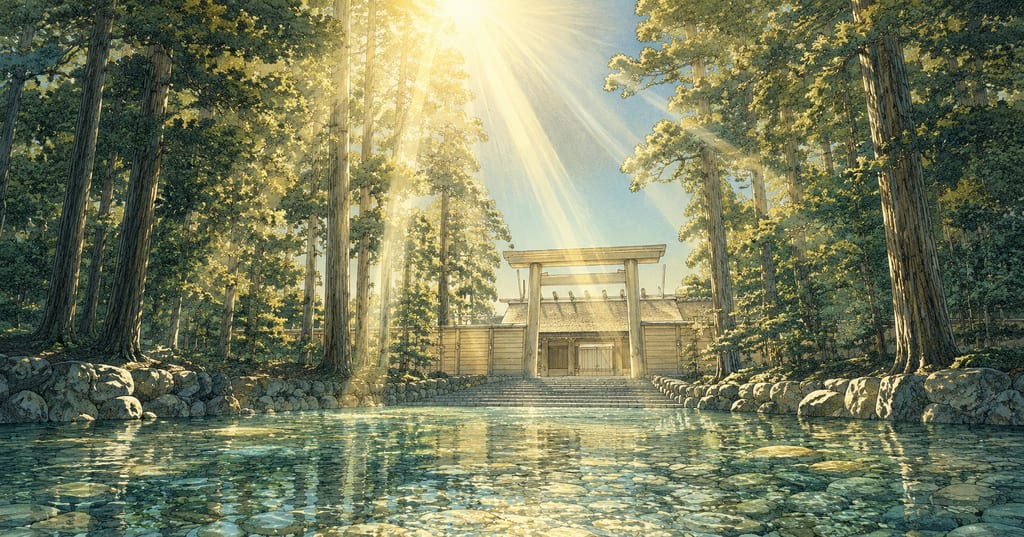
天照大御神·式年遷宮·お蔭参り。清浄が魔を寄せつけぬ神域の頂点

妖怪の棲まぬ聖域 ── 伊勢神宮内宮

Kotai Jingu (Ise Inner Shrine) · こうたいじんぐう

View on map

伊勢神宮は、日本人にとって特別な社である。天皇が祈り、年間数百万の人が訪れ、二十年に一度すべての社殿が建て替えられる ── 日本の神々の頂点に立つ聖地。だが妖怪事典という視点から眺めると、伊勢は奇妙なほど「空白」の地に見える。これほどの大社でありながら、ここに伝わるのは天照大御神ただ一柱。鬼も、化け物も、夜の怪も、ほとんど語られない。

なぜ、日本最大の聖地に妖怪がいないのか。本稿はこの逆説から出発し、伊勢が魔も穢れも寄せつけぬ「清浄」をどう保ってきたか、そしてその聖性に庶民がいかに熱狂したかをたどる。

天照大御神の宮 ── 神々の中心

伊勢神宮の中心は、五十鈴川のほとりに鎮まる内宮(皇大神宮)である。祭神は天照大御神(あまてらすおおみかみ)── 高天原を統べる太陽の神にして、皇室の祖神とされる、日本神話の最高神である。
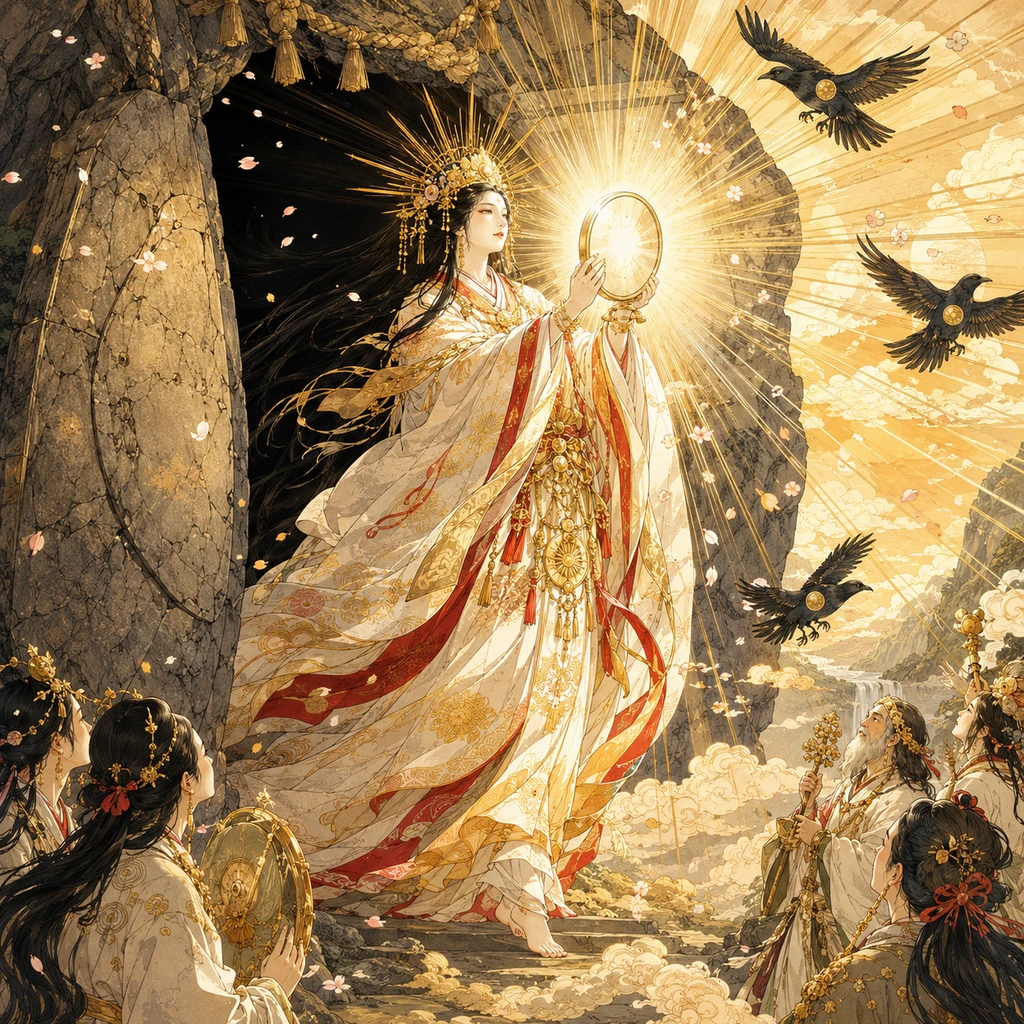
Amaterasu-Omikami

あまてらすおおみかみ

Amaterasu-Omikami is the sun goddess appearing in the *Kojiki* (712) and *Nihon Shoki* (720). She is the eldest of the Three Precious Children, born from the left eye of her father, Izanagi-no-Mikoto, when he performed a purification ritual (misogi) at Ahakihara to cleanse himself of the impurities of the underworld (Yomi). In the *Kojiki*, her name is written as "Amaterasu-Omikami" (天照大御神 / 天照大神); in the *Nihon Shoki*, she is referred to as "Sun Goddess," "Ohohirume-no-Muchi," and "Amaterasu-Omikami." The divine name chanted by Shinto priests before the altar at Ise Jingu is "Amaterashimasu-Sume-Okami." Entrusted by her father with the rule of Takamagahara (the High Plain of Heaven), she was enraged by the violent acts of her younger brother Susanoo-no-Mikoto in Takamagahara and hid in the Heavenly Rock Cave (Amano-Iwato), plunging the world into darkness. This "Hiding in the Rock Cave" episode is one of the greatest stories in Japanese mythology. After being lured out of the cave by the wisdom and dances of the eight million gods, she bestowed the Three Sacred Treasures (the Yata no Kagami mirror, the Yasakani no Magatama jewel, and the Kusanagi sword) upon her grandson Ninigi-no-Mikoto, sending him down to govern Ashihara-no-Nakatsukuni (the Central Land of Reed Plains). Thus, she became the ancestral deity of Emperor Jimmu and the successive imperial lineage. With her primary enshrinement at the Inner Shrine of Ise Jingu (Kotaijingu), she has been revered as Japan's supreme deity from ancient times to the present.

Read more

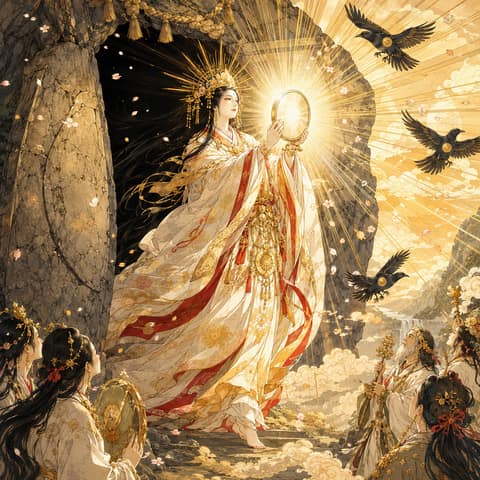
天照大御神をめぐる神話のうち、最もよく知られるのが天岩戸の挿話である。弟・須佐之男命の乱暴に心を痛めた天照大御神が天岩戸に隠れると、世界は闇に包まれた。困り果てた神々は岩戸の前で祭りを催し、天宇受売命の舞に誘われて天照がわずかに顔をのぞかせた瞬間、ふたたび世に光が戻ったという。太陽の神の隠れと再生を語るこの神話は、闇に対する光、穢れに対する清浄という、のちの伊勢信仰の核にある主題を、すでに先取りしている。

伊勢神宮は内宮だけではない。衣食住を司る豊受大御神(とようけのおおみかみ)を祀る外宮(豊受大神宮)を擁し、両正宮を中心に、別宮・摂社・末社あわせて百二十五の社からなる広大な宮域を形づくる。月の神・月読命を祀る月読宮もまた、内宮の別宮の一つである。伊勢はいわば、神々が整然と配置された一つの宇宙であった。

倭姫命、
神の鎮まる地を求めて

天照大御神は、はじめから伊勢にいたわけではない。社伝によれば、もとは宮中に祀られていた神を、ふさわしい鎮座の地を求めて各地へ遷したという。その旅を担ったのが、皇女・倭姫命(やまとひめのみこと)である。倭姫命は天照大御神の神魂を鎮める地を求めて諸国を巡行し、垂仁天皇の代に伊勢へ至って鎮座させたと伝わる。

この巡行の途上で神が仮に祀られた各地は、のちに「元伊勢」と呼ばれ、今も全国に点在する。神がさまよい、土地を選び、ようやく落ち着いた ── その終着点が、五十鈴川の清流のほとりであった。なぜ伊勢だったのか。清らかな川が流れ、海と山に守られたこの地が、神の鎮まる「清浄」の条件を満たしていたからだと語られる。

道を照らす神 ── 猿田彦

伊勢の地には、天照大御神を迎える以前から鎮まっていた神がいる。猿田彦(さるたひこ)── 天孫降臨のとき、天から降る瓊瓊杵尊(ににぎのみこと)を道案内した、国つ神にして「導きの神」である。

猿田彦は、役目を終えたのち伊勢の五十鈴川の川上に鎮まったと伝わり、伊勢市宇治浦田の猿田彦神社を本拠とする。鼻が長く、背が高く、目が赤く輝くというその異形の姿は、のちの天狗の原型の一つとも言われる。神域の入口で道を照らし、邪なものを退ける ── 猿田彦は、伊勢という聖域を守る門番のような存在でもあった。導きの神が地を清め、太陽の神がそこに鎮まる。伊勢の聖性は、こうした神々の重なりの上に成り立っている。

二十年に一度、
宮は若返る

伊勢の清浄を支えるのは、神話だけではない。世界にも類を見ない、徹底した「更新」の仕組みがある ── 式年遷宮である。

式年遷宮は、原則として二十年ごとに、内宮・外宮の正殿をはじめ諸社殿を新たに建て替える制度で、持統天皇四年(六九〇)に第一回が行われた。隣り合う敷地に寸分たがわぬ社殿を建て、神を遷し、古い社殿は解く。千三百年にわたり、伊勢は二十年ごとに姿を新しくしつづけてきた。古びることなく、つねに若々しくあること ──「常若(とこわか)」と呼ばれるこの思想は、穢れや老いを溜めこまず、絶えず清浄を更新する装置にほかならない。

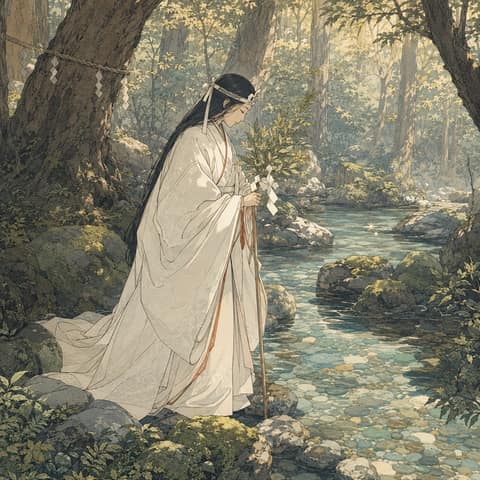
清浄を守る仕組みは、ほかにもあった。古代の伊勢では天皇以外が幣帛を捧げることを禁じる「私幣禁断」が厳格に守られ、たやすく人の願いを受けつけぬ聖域として隔てられていた。参拝者は五十鈴川の流れで手を清め、身を浄めてから神前に進む。穢れを断ち、魔を寄せつけぬ ── 伊勢が妖怪の棲まぬ地であったのは、偶然ではなく、幾重もの仕組みによって清浄が守られてきた結果だったのである。

お蔭参りの熱狂 ── 犬さえ伊勢を目指した

隔てられた聖域も、時代がくだると庶民に開かれていく。中世以降、御師(おんし)と呼ばれる神職が全国を回って伊勢信仰を広め、江戸時代には「一生に一度は伊勢へ」が庶民の願いとなった。

そして、ときに熱狂が爆発した。お蔭参りである。およそ六十年の周期で、伊勢神宮へ向かう爆発的な集団参拝が起こり、明和八年(一七七一)には二百万人規模に達したという。さらに古くは宝永二年(一七〇五)にも三百三十万から三百七十万人規模のお蔭参りが起きたと伝わる。異なる地方、異なる身分の人々が、伊勢へ向かう道中で同じ体験を分かちあう ── お蔭参りは、藩や階級の壁を越えて「日本人」という共通の感覚を育てる場でもあった、と指摘される。さらに驚くべきは、奉公人や子供が主人や親に無断で参拝に出る「抜け参り」が、社会から黙認され、むしろ賞賛されたことである。伊勢へ向かうことは、日常の主従や親子の秩序すら一時的に超える、聖なる行いとされた。

極めつきは「お蔭犬」だ。飼い主の代わりに、犬が伊勢参りをしたという ── 首にしめ縄や銭をつけられた犬が、道中の人々に世話されながら伊勢を目指し、無事に帰ってきたという記録が残る。人も、子も、犬さえも伊勢を目指した。妖怪を寄せつけぬ清浄の宮は、その清らかさゆえに、これほどの信仰を惹きつけたのである。

妖怪の棲まぬ聖域

なぜ、日本最大の聖地に妖怪がいないのか。

答えは、伊勢が「妖怪を必要としない場所」だったからである。妖怪とは多くの場合、境界や闇、穢れや祟りの生まれるところに立ち現れる。だが伊勢は、式年遷宮で絶えず若返り、五十鈴川の流れで穢れを洗い、私幣禁断で雑多な願いを退けてきた。魔の入りこむ隙そのものを、幾重もの仕組みで塞ぎつづけた地である。妖怪が棲まないのは、伊勢の貧しさではなく、その聖性の極限を示している。

同じ三重の地でも、鈴鹿の峠には鬼が現れ、海辺には海の怪が語られる。聖と怪は、一つの国のなかで背中合わせに息づいている。三重県全体の妖怪文化については、三重県の妖怪事典も併せて読まれたい。神の宮と鬼の峠 ── その対照のなかにこそ、伊勢の聖性は際立つのである。
All yokai of Kotai Jingu (Ise Inner Shrine)4

Complete list of yokai linked to Kotai Jingu (Ise Inner Shrine), including those not featured in the article above.

  • Omoikane

    Omoikane

    Divine

    omoikane-no-kami

    Omoikane, God of Wisdom Who Devises the Rock Cave Plan

    Deity / Divine SpiritTakamagahara / Togakushi Shrine Chusha (Nagano City, Nagano Pref.) / Chichibu Shrine (Chichibu City, Saitama Pref.)

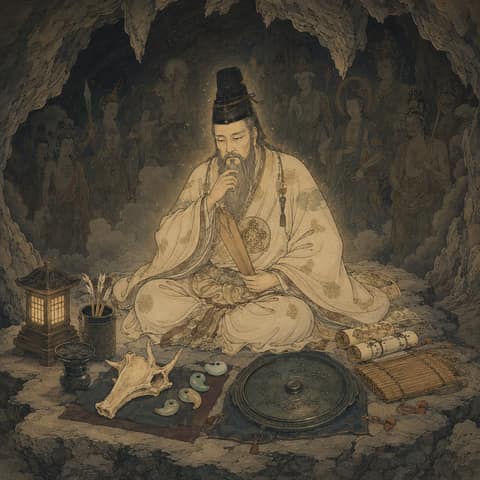
    Omoikane, who formulates the plan for the rock cave, is the god who was first commanded to "think" in the darkness. When Amaterasu-Omikami hid in the Heavenly Rock Cave and the world was filled with calamity, the Kojiki recounts that the myriads of gods gathered at Ame-no-Yasukawara and there bade Omoikane, child of Takamimusubi-no-kami, to ponder. Amaterasu is at the center of the crisis, Ame-no-tajikarao is the one who reaches out at the end, and Ame-no-uzume is the one who turns the situation with her dance. However, it is Omoikane who places them all within the same strategy. He is not just a "god of wisdom," but the architect of crisis management. Omoikane's wisdom manifests not as quiet abstraction, but as highly specific procedural arrangements. After his deliberation, he has the long-crowing roosters of Tokoyo crow, takes hard rocks and iron of heaven, seeks the smith Amatsu-mara, has Ishikoridome make a mirror, has Tamanoya make magatama jewels, and tasks Ame-no-koyane and Futodama with divination, reciting norito prayers, and holding gohei offerings. These are not disjointed props. Just as Kokugakuin University's artifact commentary reads the Heavenly Rock Cave myth as an origin tale of rituals equipped with mirrors, jewels, cloth, iron products, and divination bones, Omoikane's plan is the compositional power to organize ritual technology into a single drama. The core of this compositional power is not in "persuading" Amaterasu, but in creating a situation where she approaches the doorway on her own. The mirror shows Amaterasu a strange presence outside, the jewels and cloth decorate the sacred space, the prayers establish order as words, and the dance and laughter break the enclosed atmosphere. Ame-no-tajikarao hides beside the door, but the only moment he can act is when Amaterasu attempts to step outside slightly. In other words, Omoikane's strategy is not one of coercion. It is a strategy to arrange the conditions that change the opponent's consciousness, creating a single point where the final force can act. It is significant that the Kokugakuin University annotations connect the meaning of Omoikane's name to "possessing the wisdom of deep thought" from an alternate account in the Nihon Shoki. Thoughtfulness is not merely having a lot of knowledge. It is the ability to read the situation, the stakeholders, and the procedures, thinking about what order of actions will cause the maximum change with the minimum destruction. At the Heavenly Rock Cave, merely breaking the stone door with military force was not the solution. The sun goddess's reappearance had to be established as a ritual, a council, a laugh, and the act of looking into a mirror. Omoikane is the god who reads that totality. His reappearance during the Descent of the Heavenly Grandson shows that this god's wisdom was not a one-time cleverness. Amaterasu-Omikami adds Tokoyo-no-omoikane-no-kami, Ame-no-tajikarao, and Ame-no-ishikadowake-no-kami alongside the sacred treasures, and commands that the mirror be worshipped as her own spirit. Furthermore, Omoikane is given the role of "taking charge of preceding affairs and governing." The god who assembled the ritual before the rock cave takes charge of the rituals centered around the mirror on earth, and engages in governance. Here, "thinking" transitions from mythological crisis response to the intellect of operating institutions. Ame-no-yagokoro-omoikane-no-mikoto at the Chusha of Togakushi Shrine preserves this character as a tactical god within mountain worship. The official history states the Chusha's deity is Ame-no-yagokoro-omoikane-no-mikoto, describing him as the god who originated the Iwato Kagura (sacred dance) during the Heavenly Rock Cave event. Here, Omoikane is not simply a smart god, but the inventor of rituals including performing arts. The Iwato Kagura belongs not only to Uzume who danced it, but also to the wisdom of Omoikane who constructed that setting. The Chusha's faith in academic success and business prosperity can be read as a faith in the power to synergize multiple conditions, beyond the simple wish that wisdom works well for exams or commerce. Yagokoro-omoikane-no-mikoto at Chichibu Shrine provides further political and regional context. The official page identifies this god as the ancestral god of politics, scholarship, industry, and good fortune, marking Chichibu-hiko-no-mikoto's enshrinement of his ancestral god as the origin of the shrine. The combination of politics, scholarship, and industry is very close to Omoikane's essence. Politics is the intellect to position people, scholarship is the intellect to establish logic, and industry is the intellect to actualize materials and techniques. The god who combined mirrors, jewels, iron, divination, and personnel allocation at the Heavenly Rock Cave being worshipped as the ancestral god of these three domains in later eras shows a perfect alignment between his mythological deeds and his divine virtues in faith. Reducing Omoikane to a light metaphor like "brain trust" obscures the gravity of the myth. He is a god who, when darkness covered the world, did not fight the darkness itself, but designed a space so the world could regain its brightness on its own. Amaterasu, Uzume, Tajikarao, the mirror maker, the jewel maker, norito, divination, and the sakaki tree—only when all of these are aligned does the rock cave open. Omoikane's power is not individual cleverness, but the power to weave multiple forces into a single restoration. What is needed in a deadlocked situation is neither shouting nor destruction, but the intellect to find the sequence. Omoikane is the god of that quiet sequence.

  • Ame-no-koyane

    Ame-no-koyane

    Divine

    ame-no-koyane

    Ame-no-koyane, Ritual God Reciting Prayers at the Rock Cave

    Deity / Divine SpiritTakamagahara / Kasuga Taisha (Kasugano-cho, Nara City, Nara Pref.) / Isuzunomiya (Ise City, Mie Pref., Inner Shrine of Ise Jingu)

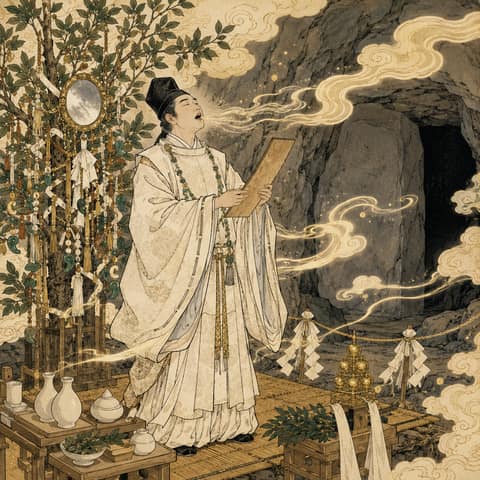
    Ame-no-koyane, who recites norito before the rock cave, is the god in charge of the "voice" in the Heavenly Rock Cave myth. When Amaterasu-Omikami hid in the cave and the gods gathered at Ame-no-Yasukawara, Omoikane's plan could not succeed with just mirrors and jewels. In the Kojiki, Ame-no-koyane and Futodama-no-mikoto were summoned, prepared divination using the shoulder bone of a stag from Mount Amanokagu and Hahaka wood, and after hanging jewels, a mirror, and cloth on a sacred sakaki tree, Futodama held the gohei while Ame-no-koyane fervently recited the Futonoritogoto. Here lies the essence of this god. Through norito, Ame-no-koyane transforms the items prepared by the gods into acts performed before the divine. The scene at the Heavenly Rock Cave is often told with a focus on Ame-no-uzume's dance and Ame-no-tajikarao's strength. However, before the dance and the strength, the space is prepared as a ritual. The deer bone divination is a method to ask divine will, the mirror, jewels, and cloth are sacred signs, and the sakaki tree is the medium upon which they are hung. When Kokugakuin University's artifact commentary reads the myth as an origin tale of ancient rituals, Ame-no-koyane is at its center, taking the role of establishing the ritual as "words." Norito is not an explanation. It is a vocal technology that arranges the state of the world towards the divine. The contrast with Futodama is also important. Futodama holds the gohei, while Ame-no-koyane recites the norito. The ritual is first completed when what is held in the hand is combined with the words spoken from the mouth. With objects alone, it remains a silent offering; with words alone, it lacks form. Ame-no-koyane's norito binds Futodama's gohei, Ishikoridome's mirror, Tamanoya's jewels, Uzume's dance, and Tajikarao's hiding into a single space. He is not a god who performs conspicuous actions, but a god who unifies the meaning of the space. Kokugakuin University annotations note that in the Descent of the Heavenly Grandson, Ame-no-koyane is recorded as the ancestor of the Nakatomi muraji, descending as one of the Itsutomonoo accompanying Ninigi-no-mikoto. This is highly significant. The god who recited norito at the Heavenly Rock Cave becomes the ancestral god of the Nakatomi clan on earth, bearing the origin of the priestly function. Because the Nakatomi clan later connects to the Fujiwara clan, Ame-no-koyane is not merely a supporting character in an old myth, but a divine figure deeply involved with ancient state rituals and words, and further with the tutelary faith of aristocratic society. Ame-no-koyane at Kasuga Taisha conveys this lineage in its most visible form. The official history states that in the second year of Jingo-Keiun (768), a main sanctuary was built at the foot of Mount Mikasa for Takemikazuchi, Futsunushi, Ame-no-koyane, and Himegami. Alongside the martial gods of Kashima and Katori, Ame-no-koyane and Himegami constitute the Kasuga deities. Furthermore, Kasuga Taisha received reverence from emperors and retired emperors since ancient times, receiving many offerings as the tutelary shrine of the Fujiwara clan. Ame-no-koyane's norito expands into the prayers of the state and the clan at the Kasuga shrine. The power of Ame-no-koyane cannot be taken lightly as simply a "god of words." In myth, words create the space, invoke divine will, determine the meaning of objects, and support the order of the community. To bring Amaterasu out of the rock cave, not just a commotion but the legitimacy of a ritual was required. Norito is an utterance to "re-establish order" in a world sunken in darkness. Ame-no-koyane is the god responsible for that utterance, changing the direction of the world through voice. Seen in a modern light, Ame-no-koyane resonates deeply with domains where words build trust in a space, such as writing, oaths, prayers, hosting, legal affairs, ceremony design, and research presentations. Not raising one's voice, but arranging one's words. Not shouting a passing thought, but stating it in the correct order. Ame-no-koyane, who bundled the gods' powers into a ritual before the Heavenly Rock Cave, is a god who reminds us of the gravity of presenting words before the divine, especially in an age where words tend to be taken lightly. Moreover, Ame-no-koyane's mythological strength also lies in the fact that norito is not "personal words" but "words of the community." The norito recited before the Heavenly Rock Cave is not the emotional expression of the single deity Ame-no-koyane. It is a voice that bears all the ritual implements, divination, dance, laughter, and strength prepared by the myriads of gods, presenting the consensus of the gods to Amaterasu-Omikami. That is precisely why those words represent the space and correct the space. His later development as the ancestral god of the Nakatomi clan is also connected to this character of "speaking before the divine on behalf of the community." Ame-no-koyane is the god who elevates words from personal talent to the public nature of ritual.

  • 倭姫命

    倭姫命

    Divine

    やまとひめのみこと

    五十鈴川へ導いた御杖代・倭姫命

    神霊・神格伊勢国(三重県伊勢市)/倭姫宮・皇大神宮(伊勢神宮内宮)

    Yamatohime appears as the mitsueshiro who guided Amaterasu Omikami to Ise. A mitsueshiro is not a vessel that controls the divine, but a being that serves the divine will and receives its destination in the human world. Her journey is not an escape far from the Yamato court. It is a tour to search for where the great goddess should be enshrined, to read the physiognomy of the land, to cross through provinces, and to find the center where the deity can settle in peace. In the official history of the Jingu Administration, Yamatohime left Yamato, passed through Iga, Omi, and Mino, and entered Ise Province. Ise, the endpoint of her journey, is not a mere destination. It was chosen as a land capable of quietly receiving the divine authority of Amaterasu Omikami, where clear water descends from the mountains to form the Isuzu River flowing to the sea, where the ocean opens to Tokoyo, and where the forests envelop the shrine. The expression "the upper reaches of the Isuzu River" found in the history of the Naiku perfectly illustrates Yamatohime's power. She is not a hero who calls back the light, but a deity who searches for a place where the light can remain without becoming muddied. Therefore, Yamatohime's spiritual power resides in "selection" and "order." Dividing the sacred realm from the secular world, maintaining purification and abstinence, and ensuring the rules of offerings and festival days are not disrupted. The Jingu Administration explains that after creating Kotai Jingu, Yamatohime established the systems of rituals and purification, building the foundation of the shrine. There is a different kind of tension here from the sudden bizarre occurrences often found in yokai tales. Unseen things become unruly if not welcomed correctly. Sacred things exhaust people if placed in the wrong location. Yamatohime knows that boundary and measures the distance between the divine and humans. Her presence manifests not as a loud oracle, but as a stillness that makes one stop at a fork in the road. The sound of water suddenly becoming clear, the wind changing at the entrance of a forest, words becoming sparse before an old shrine ground. To those who do not misread such small signs, Yamatohime indicates the next step. Conversely, to those who rush to conclusions, who try to paint over sacred sites with their own desires, or who disregard purification as a troublesome formality, the road will feel long, as if wandering in circles. Her protection is not in speed, but in correct anchoring. When understanding Yamatohime, it is best not to separate the three roles: the priestess who hears oracles, the traveling imperial princess, and the institutionalizer who creates the shrine system. The enumeration of her historical touring sites shows that she is not a deity of a single point, but a being who sanctifies the road itself. A road can be a symbol of being lost, but for Yamatohime, it is a process of discernment. The lands she passed through were not failed places. They were necessary memories to confirm the conditions for welcoming the deity one by one, heading toward the conclusion called Ise. Therefore, her story is better suited to the repetition of stopping, purifying, and walking again, rather than flashy moments of victory. For those who pray, Yamatohime is less a "deity who grants wishes" and more a "deity who teaches where wishes should be placed." When one wishes to rebuild the foundations of work, home, relationships, or study, she does not bring sudden change, but guides people toward preparing the environment, restoring order, and washing away unnecessary impurities. Before asking what to seek before the deity, she makes you question with what state of mind and body you stand before the deity. That strictness is also Yamatohime's gentleness. The Yamatohime-gu in Kusube-cho, Ise City, rests quietly in the forest of Mount Kurata, midway along the Miyuki Road connecting the Naiku and Geku. Although established as a Betsugu (auxiliary shrine) in the Taisho era as a new shrine, the deity enshrined there touches the oldest layers of the Ise faith. This overlapping of old and new befits Yamatohime's figure. She is not a legend closed in the past, but a memory that exists to continuously renew the places where deities are enshrined. The deity who established the shrine at the end of her journey still quietly asks in today's noisy world, "Where should the heart be calmed?" The time spent listening closely to that question itself becomes a pilgrimage to Yamatohime.

  • Amaterasu-Omikami

    Amaterasu-Omikami

    Legendary

    あまてらすおおみかみ

    Supreme Deity of Takamagahara

    Divine Spirit / DeityInner Shrine of Ise Jingu (Kotaijingu, present-day Ise City, Mie Prefecture) / Amano-Iwato Shrine (present-day Takachiho, Nishiusuki District, Miyazaki Prefecture) / Mythologically: Takamagahara (High Plain of Heaven), Eldest of the Three Precious Children

    The Peculiarity of Japanese Mythology: Sun God = Female. While the base description touched on the primary myths of Amaterasu-Omikami, this detailed explanation delves into the comparative religious peculiarity of Japanese mythology in making the sun god female. Sun deities in ancient world mythologies—such as Greece's Apollo, Egypt's Ra, India's Surya, Inca's Inti, and Babylonia's Shamash—are predominantly male. On the other hand, female sun deities like Japan's Amaterasu, Norse's Sól, Baltic's Saulė, and some in Eastern Europe are relatively rare. In post-war Japanese mythological studies, scholars like Takeshi Matsumae proposed the male deity theory, stating that "the archetype of Amaterasu was various male sun gods (Amateru deities) who were later feminized," which became a central controversy. If we adopt this theory, the feminization of the sun god can be read as a unique deification process that advanced within the kingship, religion, and agricultural rituals of ancient Japan. The "Hiding in the Rock Cave" Tale ── Comparative Religion of Sun Disappearance Myths. The "Hiding in the Rock Cave" tale, where Amaterasu-Omikami hides in a cave and plunges the world into darkness, is a prime example of "sun disappearance and rebirth" in world mythology. Myths recounting the disappearance and rebirth of the sun—such as the Aten faith of ancient Egypt, Surtr in Norse myth, the Hittite sun god disappearance myth, and the Baltic sun god rebirth myths—are widely distributed as religious responses to the winter solstice, solar eclipses, and agricultural cycles in ancient farming societies. Amaterasu's seclusion is interpreted as the origin myth of Shinto kagura and ritual ceremonies, where "ritual tools like Ame-no-Uzume's kagura dance, the Yata mirror, jewels, evergreen trees, and the eternal bird (announcing the eternal dawn)" summon the sun god from the cave. As the root myth of religious rituals like the ancient Japanese winter solstice festival, Niiname-no-Matsuri, and Kanname-no-Matsuri, it holds cosmological significance far beyond a simple heroic tale. The Three Sacred Treasures ── The Unity of Kingship and Religion. The Three Sacred Treasures (the Yata mirror, Yasakani jewel, and Kusanagi sword) that Amaterasu-Omikami bestowed upon Ninigi during the heavenly descent symbolize the unity of kingship, religion, and mythology in ancient Japan. The Yata mirror embodies sunlight and Amaterasu's spirit; the jewel is a symbol of spiritual power and prayer in ancient Japanese religion; and the Kusanagi sword is a symbol of martial power and rule obtained through Susanoo's slaying of the Eight-Headed Serpent. The Three Sacred Treasures became the core of ancient imperial enthronement rituals and continue to function as the central apparatus of imperial succession ceremonies to this day. They are devices embodying the unique continuity of myth and politics in ancient Japan, where mythological narratives exert a sustained influence on modern political systems and state rituals. Ise Jingu and the Shikinen Sengu ── Two Thousand Years of Succession. The Inner Shrine of Ise Jingu (Kotaijingu) is the sacred site enshrining Amaterasu-Omikami from ancient times to the present. Through the "Shikinen Sengu" (the ritual of completely rebuilding the shrine buildings every 20 years), which began in the 4th year of Empress Jito (690 CE), ancient architectural techniques, rituals, and Shinto culture have been passed down for over 1,300 years. This is a unique philosophy of succession that "embodies eternity through newness"—realizing an "eternity as constant rebirth" through periodic wooden reconstruction, in contrast to the "unchanging eternity" of ancient stone temples. The Shikinen Sengu continues in the 21st century, with the 62nd iteration conducted in 2013. It is a rare phenomenon in world religious history that embodies the essential views of time, eternity, and renewal in ancient Shinto. The Imperial Lineage and the Basis of Ancient State Legitimacy. As the ancestral deity of the ancient imperial lineage, Amaterasu-Omikami has been at the core of the basis of legitimacy for the Japanese state from ancient times to the present. The genealogy from Emperor Jimmu to successive emperors to the modern emperor was established through five generations from Amaterasu, functioning as an apparatus to guarantee the continuity between ancient myth and the ancient state. This is a prime example of establishing legitimacy through a founding myth of an ancient state, alongside China's Mandate of Heaven, Korea's Dangun myth, Rome's Aeneas myth, and Britain's Brutus myth. She has a complex religious and political history, having been emphasized and politically utilized as the core of State Shinto in pre-war Japan, and undergoing a history of re-evaluation and depoliticization under the post-war system of separation of church and state and popular sovereignty. Ise Shinto, Ryobu Shinto, and Yoshida Shinto ── History of Medieval Shinto Thought. In medieval Japan, faith in Amaterasu-Omikami gave rise to multiple ideological systems such as Ise Shinto, Ryobu Shinto, Yoshida Shinto, and Suika Shinto. Ise Shinto (Kamakura-Muromachi periods) was formed by Ise priesthood lineages like the Watarai and Arakida families, producing Shinto scriptures like the "Shinto Gobusho." Ryobu Shinto (Kamakura period) was a syncretism with Shingon Esoteric Buddhism, centered on the "Honji Suijaku" theory that identified Amaterasu with Mahavairocana (Dainichi Nyorai). Yoshida Shinto (Muromachi period) was a unique system formed by Kanetomo Yoshida (1435-1511), advocating "Yuiitsu Shinto," which positioned Shinto above Buddhism and Confucianism. Suika Shinto (Edo period) was a system integrating Confucianism, Neo-Confucianism, and Shinto by Ansai Yamazaki (1618-1682), emphasizing Shinto ethics centered on Amaterasu. These medieval and early modern Shinto thoughts evolved around Amaterasu-Omikami as their central axis, playing a decisive role in the formation of Japan's indigenous religious philosophy. Amaterasu-Omikami in the 21st Century ── From National Tutelary Deity to Individual Spirituality. Under the post-war constitutional system of separation of religion and state and popular sovereignty, Amaterasu-Omikami has been redefined from a political status as the "core of pre-war State Shinto" to a religious status as the "tutelary deity of the entire nation and the spiritual pillar of individuals." With over 8 million annual visitors to Ise Jingu, the nationwide distribution of Jingu Taima (amulets) centered on Ise Jingu, and the organizational structure of Shinto groups and the Association of Shinto Shrines, faith in Amaterasu remains at the foundation of Japanese daily religious life in the 21st century. At the same time, she has become a modern icon repeatedly reimagined in subcultures, games, and manga, making this a rare case where ancient myth and the spiritual culture of modern Japanese people maintain continuity across two millennia. Beyond merely a deity appearing in myths, she is a presence that holds sustained meaning as a core symbol running through the entirety of Japanese culture.

Read on ── other regions