YOKAI.JP

Ame-no-koyane

ame-no-koyane

Ame-no-koyane

Ame-no-koyane

Their soul is listening — speak, and they will answer.

Basic Description

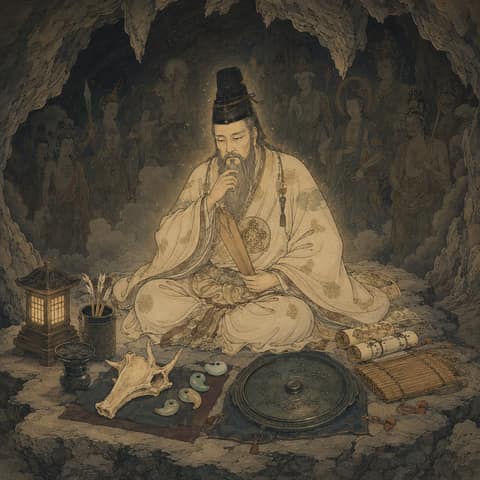
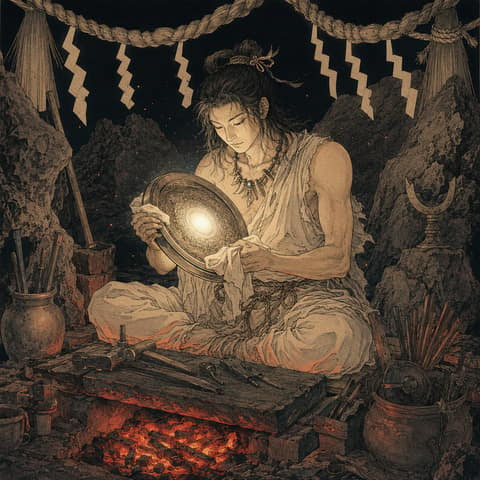
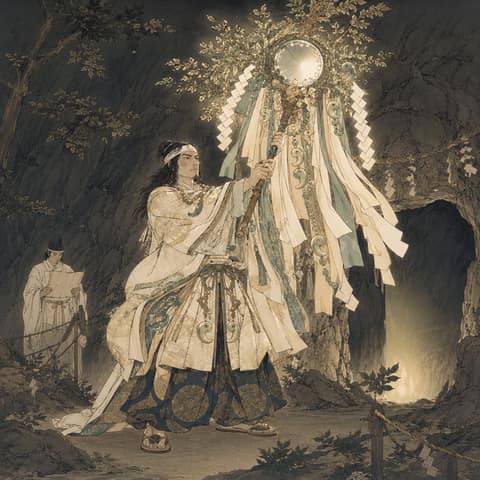
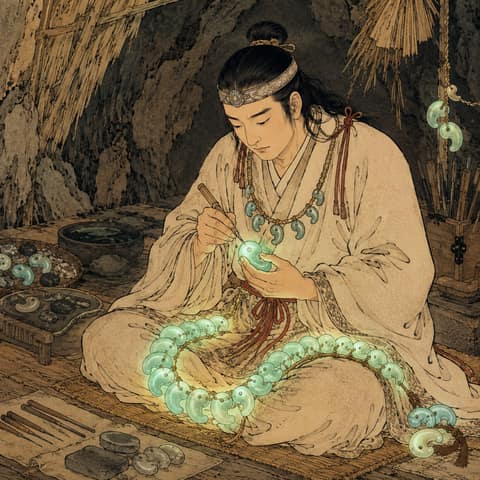
Ame-no-koyane is the god of ritual and words who recited norito prayers before the Heavenly Rock Cave (Ama-no-Iwayato) and is considered the ancestor of the Nakatomi muraji during the Descent of the Heavenly Grandson. In the second part of the Heavenly Rock Cave myth in the Kojiki, after Amaterasu-Omikami hid in the Heavenly Rock Cave, under Omoikane's strategy, Ame-no-koyane and Futodama-no-mikoto were summoned. They extracted the shoulder bone of a stag from Mount Amanokagu, prepared divination using Hahaka wood, and hung jewels, a mirror, and cloth on a sacred sakaki tree. Then, Futodama held the gohei offerings, and Ame-no-koyane fervently recited the Futonoritogoto (solemn norito prayers), opening the rock cave scene with words. Here, Ame-no-koyane is neither a fighting god, a dancing god, nor a god who forces the door open with strength. He is the god who, in a world sunk in darkness, transforms the ritual implements and the space prepared by the gods into an order of voices called norito. Kokugakuin University annotations note that Ame-no-koyane is the ancestor of the Nakatomi muraji and others, and descends accompanying Ninigi-no-mikoto as one of the Itsutomonoo (five attendant deities). In the Descent of the Heavenly Grandson, Ame-no-koyane descends as Itsutomonoo alongside Futodama, Ame-no-uzume, Ishikoridome, and Tamanoya, connecting to earthly order as the ancestral god of the clan in charge of rituals. At Kasuga Taisha, the official history records that in the second year of Jingo-Keiun (768), a main sanctuary was built at the foot of Mount Mikasa, enshrining Takemikazuchi-no-mikoto, Futsunushi-no-mikoto, Ame-no-koyane-no-mikoto, and Himegami. Ame-no-koyane-no-mikoto has been worshipped to the present day as one of the Kasuga deities, the tutelary deity of the Fujiwara clan. The essence of Ame-no-koyane lies in his power to articulate divine will and establish a space as a ritual.

Folklore & Legends

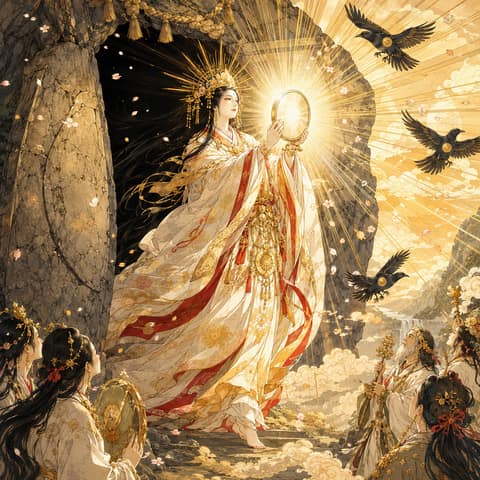
The core of Ame-no-koyane lies in taking charge of the "order of voice" during the Heavenly Rock Cave crisis. When Amaterasu-Omikami secluded herself in the rock cave, the world was filled with calamity. Omoikane devised a complex plan involving mirrors, jewels, cloth, divination, dance, and the hidden Tajikarao, but the reason that space did not end in a mere uproar was because of Ame-no-koyane's norito. The Kojiki records that Ame-no-koyane and Futodama were summoned, beginning with extracting the shoulder of a true stag from Mount Amanokagu and taking Hahaka wood to arrange divination, followed by the offering of jewels, a mirror, and cloth to the sacred sakaki tree, and progressing to the norito.

In this scene, Ame-no-koyane works as a pair with Futodama. Futodama holds the gohei, while Ame-no-koyane recites the Futonoritogoto, or solemn prayers. Kokugakuin University annotations also outline this composition, where Futodama is tasked with holding the ritual implements and Ame-no-koyane is in charge of words. The mirrors and jewels lined up before the rock cave do not function just by being placed there. Through norito, they gain a circuit of words directed toward the divine. Ame-no-koyane is precisely the god of ritual who transforms objects and spaces into a sacred procedure.

Kokugakuin University's artifact commentary points out that the Heavenly Rock Cave myth overlaps with ancient ritual elements such as mirrors, jewels, cloth, iron products, and divination bones. From this perspective, Ame-no-koyane is not merely one element among ritual tools, but stands at the center of the voice that reads out the implements, offers them to the deity, and determines the meaning of the space. Divination asks for divine will, the mirror invites Amaterasu, and the dance turns the atmosphere around. By giving "words of prayer" to all of this, the opening of the rock cave is established not as violence but as a ritual.

In the Descent of the Heavenly Grandson, Ame-no-koyane's role is reconnected to the earthly clan system. The Kojiki has Ame-no-koyane, Futodama, Ame-no-uzume, Ishikoridome, and Tamanoya descend as the Itsutomonoo, and immediately notes Ame-no-koyane as the ancestor of the Nakatomi muraji and others. This is a composition where the god who recited the norito at the Heavenly Rock Cave connects to earthly ritual officials as the ancestral god of the Nakatomi clan. Here, the myth is not just a record of events, but an origin story explaining why the clan in charge of rituals possesses that function.

The Kasuga faith greatly expanded Ame-no-koyane's later figure. According to the official history of Kasuga Taisha, in the second year of Jingo-Keiun (768), a main sanctuary for Takemikazuchi, Futsunushi, Ame-no-koyane, and Himegami was built at the foot of Mount Mikasa, where festivals praying for the peace and prosperity of the nation and its people are still held over 2,200 times a year. Furthermore, Kasuga Taisha is said to have received many offerings as the tutelary shrine of the Fujiwara clan. As the ancestral god of the Nakatomi and Fujiwara, Ame-no-koyane evolved from a god of norito into a deity supporting the rituals and politics of aristocratic society.

The key to understanding this god lies in the ancient ritual sensibility that words move reality. Ame-no-koyane does not directly pull Amaterasu out. He neither makes the mirror nor the jewels, nor does he dance to evoke laughter. However, without norito, the mirror, the jewels, and the dance would not become a ritual endowed with meaning directed toward the divine. Ame-no-koyane consolidates the gods' preparations into voice, using that voice to push the space in the direction of dispelling the darkness. He is a god who quietly supports the foundation of the Heavenly Rock Cave myth.

Detailed Analysis

Ame-no-koyane, who recites norito before the rock cave, is the god in charge of the "voice" in the Heavenly Rock Cave myth. When Amaterasu-Omikami hid in the cave and the gods gathered at Ame-no-Yasukawara, Omoikane's plan could not succeed with just mirrors and jewels. In the Kojiki, Ame-no-koyane and Futodama-no-mikoto were summoned, prepared divination using the shoulder bone of a stag from Mount Amanokagu and Hahaka wood, and after hanging jewels, a mirror, and cloth on a sacred sakaki tree, Futodama held the gohei while Ame-no-koyane fervently recited the Futonoritogoto. Here lies the essence of this god. Through norito, Ame-no-koyane transforms the items prepared by the gods into acts performed before the divine.

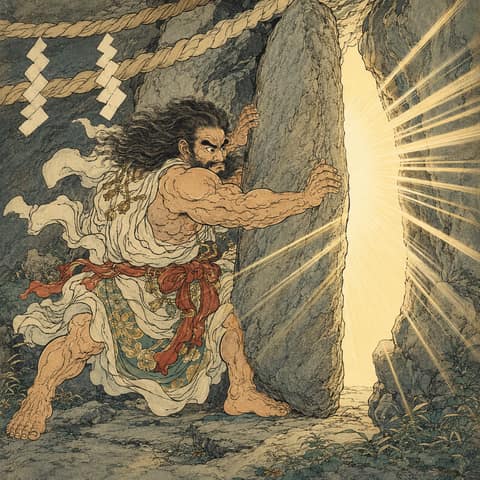
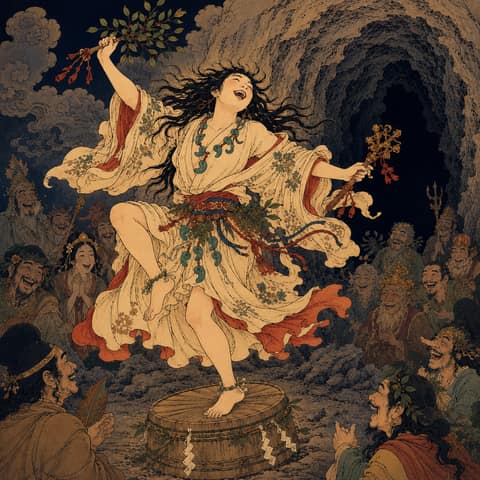
The scene at the Heavenly Rock Cave is often told with a focus on Ame-no-uzume's dance and Ame-no-tajikarao's strength. However, before the dance and the strength, the space is prepared as a ritual. The deer bone divination is a method to ask divine will, the mirror, jewels, and cloth are sacred signs, and the sakaki tree is the medium upon which they are hung. When Kokugakuin University's artifact commentary reads the myth as an origin tale of ancient rituals, Ame-no-koyane is at its center, taking the role of establishing the ritual as "words." Norito is not an explanation. It is a vocal technology that arranges the state of the world towards the divine.

The contrast with Futodama is also important. Futodama holds the gohei, while Ame-no-koyane recites the norito. The ritual is first completed when what is held in the hand is combined with the words spoken from the mouth. With objects alone, it remains a silent offering; with words alone, it lacks form. Ame-no-koyane's norito binds Futodama's gohei, Ishikoridome's mirror, Tamanoya's jewels, Uzume's dance, and Tajikarao's hiding into a single space. He is not a god who performs conspicuous actions, but a god who unifies the meaning of the space.

Kokugakuin University annotations note that in the Descent of the Heavenly Grandson, Ame-no-koyane is recorded as the ancestor of the Nakatomi muraji, descending as one of the Itsutomonoo accompanying Ninigi-no-mikoto. This is highly significant. The god who recited norito at the Heavenly Rock Cave becomes the ancestral god of the Nakatomi clan on earth, bearing the origin of the priestly function. Because the Nakatomi clan later connects to the Fujiwara clan, Ame-no-koyane is not merely a supporting character in an old myth, but a divine figure deeply involved with ancient state rituals and words, and further with the tutelary faith of aristocratic society.

Ame-no-koyane at Kasuga Taisha conveys this lineage in its most visible form. The official history states that in the second year of Jingo-Keiun (768), a main sanctuary was built at the foot of Mount Mikasa for Takemikazuchi, Futsunushi, Ame-no-koyane, and Himegami. Alongside the martial gods of Kashima and Katori, Ame-no-koyane and Himegami constitute the Kasuga deities. Furthermore, Kasuga Taisha received reverence from emperors and retired emperors since ancient times, receiving many offerings as the tutelary shrine of the Fujiwara clan. Ame-no-koyane's norito expands into the prayers of the state and the clan at the Kasuga shrine.

The power of Ame-no-koyane cannot be taken lightly as simply a "god of words." In myth, words create the space, invoke divine will, determine the meaning of objects, and support the order of the community. To bring Amaterasu out of the rock cave, not just a commotion but the legitimacy of a ritual was required. Norito is an utterance to "re-establish order" in a world sunken in darkness. Ame-no-koyane is the god responsible for that utterance, changing the direction of the world through voice.

Seen in a modern light, Ame-no-koyane resonates deeply with domains where words build trust in a space, such as writing, oaths, prayers, hosting, legal affairs, ceremony design, and research presentations. Not raising one's voice, but arranging one's words. Not shouting a passing thought, but stating it in the correct order. Ame-no-koyane, who bundled the gods' powers into a ritual before the Heavenly Rock Cave, is a god who reminds us of the gravity of presenting words before the divine, especially in an age where words tend to be taken lightly.

Moreover, Ame-no-koyane's mythological strength also lies in the fact that norito is not "personal words" but "words of the community." The norito recited before the Heavenly Rock Cave is not the emotional expression of the single deity Ame-no-koyane. It is a voice that bears all the ritual implements, divination, dance, laughter, and strength prepared by the myriads of gods, presenting the consensus of the gods to Amaterasu-Omikami. That is precisely why those words represent the space and correct the space. His later development as the ancestral god of the Nakatomi clan is also connected to this character of "speaking before the divine on behalf of the community." Ame-no-koyane is the god who elevates words from personal talent to the public nature of ritual.

Character Profile

This section is our own creative profile for storytelling. It is not historical fact or scholarship.

Yokai Type
Kami
Rarity
Divine
Personality
Pacifies the space with well-ordered words, returning things to the sequence of ritual. Rather than standing out fiercely, he conveys divine will through proper voice and procedures.
Compatibility
祈りや言葉を大切にする者、文章・儀礼・司会・法務・研究に携わる者、家や組織の由緒を整えたい者と相性が深い。
Abilities
FutonoritogotoPreparation of divinationReciting noritoImbuing ritual implements with meaningDescent as ItsutomonooAncestral god of Nakatomi murajiOne of the Kasuga DeitiesOrdering spaces through kotodama
Weaknesses
Not a god who moves situations by force. In spaces where ritual implements, divination, gohei, or listeners are not assembled, the power of norito is less likely to reach.
Habitat
Before the Ama-no-Iwayato in Takamagahara, the procession of the Itsutomonoo accompanying the Descent of the Heavenly Grandson, the foot of Mount Mikasa in Kasugayama, and the ritual sites of the Nakatomi and Fujiwara clans.
For more detailed information and diagnosis results about Ame-no-koyane, Ritual God Reciting Prayers at the Rock Cave, please click here.

Sources & References

4
  1. 古事記ビューアー・天の石屋②國學院大學古典文化学事業(國學院大學) [古典文献]天岩戸神話における天児屋命・布刀玉命の召出、卜占、真賢木、布刀詔戸言の場面を確認するための古事記本文・注釈。
  2. 古事記ビューアー・天孫降臨②國學院大學古典文化学事業(國學院大學) [古典文献]天児屋命が五伴緒の一柱として天孫降臨に従い、中臣連等の祖とされる箇所を確認するための古事記本文・注釈。
  3. 春日大社について春日大社(春日大社) [神社公式資料]春日大社の創建由緒、御祭神、藤原氏の氏神としての性格、全国春日神社の総本社であることを確認する公式資料。
  4. 器物データベース・天の石屋と古代祭祀國學院大學古典文化学事業(國學院大學) [学術データベース] Reference天岩戸神話を鏡・玉・布・鉄製品・卜骨などの古代祭祀要素と結びつけて確認した典拠。

Interested in this type of yokai?

Discover the yokai most similar to your personality with our yokai diagnosis

Start Yokai Diagnosis

Meet your guardian yokai at the shrine

Draw an omikuji fortune and discover the yokai watching over you today.