YOKAI.JP

Ame-no-tajikarao

ame-no-tajikarao

Ame-no-tajikarao

Ame-no-tajikarao

Their soul is listening — speak, and they will answer.

Basic Description

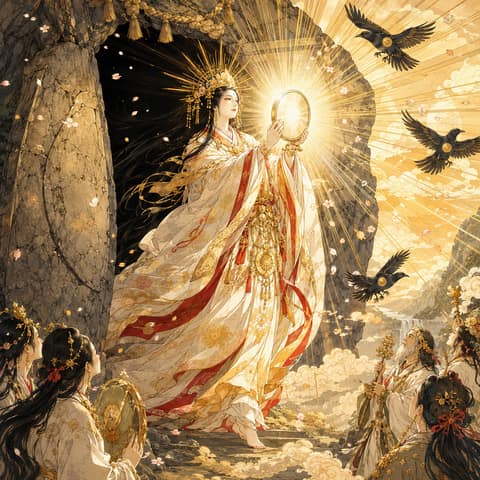
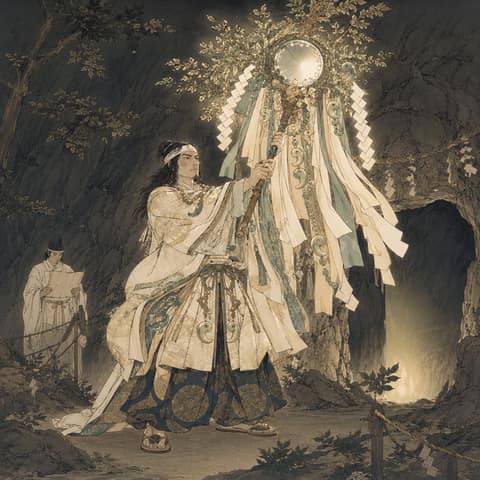
Ame-no-tajikarao is a god of strength who appears in "The Heavenly Rock Cave" and "The Descent of the Heavenly Grandson" in the first volume of the Kojiki. The Kokugakuin University Deity Name Database notes his reading as "Ame-no-tajikarao-no-kami", and details that he is written as Tajikarao-no-kami or Ame-no-tajikarao-no-kami in the Nihon Shoki, and Ame-no-tajikarao-no-kami in the Kogo Shui. His name is often interpreted as "the male god of the heavenly realm with exceptional hand strength," but he is not merely a god of physical brawn. In the scene where Amaterasu-Omikami hides in the Heavenly Rock Cave (Ama-no-Iwayato) and plunging the world into darkness, the moment Ame-no-koyane-no-mikoto and Futodama-no-mikoto present a mirror and Amaterasu approaches the entrance, Ame-no-tajikarao, who had been hiding to the side, takes her hand and pulls her out. With this single action, Takamagahara and Ashihara-no-nakatsukuni are illuminated once again. In other words, Ame-no-tajikarao's strength is not violence, but the decisive power to open a closed sacred boundary at the right moment, restoring light and order. The myth of the Heavenly Rock Cave intertwines the wisdom of Omoikane, the dance of Ame-no-uzume, the ritual implements of mirrors, jewels, and cloth, and the shimenawa (sacred rope) of Futodama-no-mikoto. Ame-no-tajikarao serves as the grand finale, bearing the role of moving the enclosed sun goddess to the outside world. In the section on the Descent of the Heavenly Grandson, he is added as an accompanying deity to the three sacred treasures, along with Tokoyo-no-omoikane-no-kami and Ame-no-ishikadowake-no-kami, and is recorded as the god enshrined in Sana-no-agata. Togakushi Shrine in Nagano Prefecture enshrines Ame-no-tajikarao-no-mikoto as the deity of its Okusha (inner shrine), passing down to this day the legend of his divine power that opened the Heavenly Rock Cave and how the thrown rock door became Mount Togakushi. Rather than an anomaly, he exists as a divine figure who shatters the mythological state of closure.

Folklore & Legends

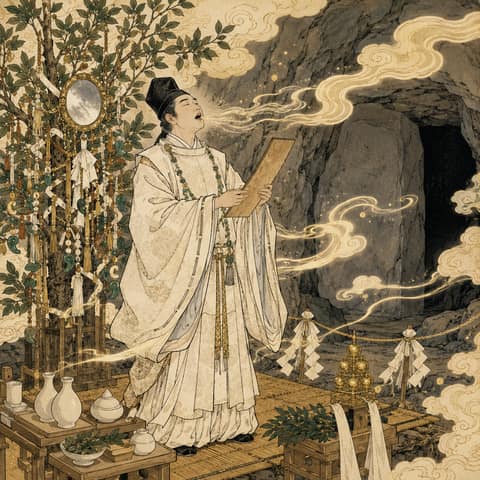
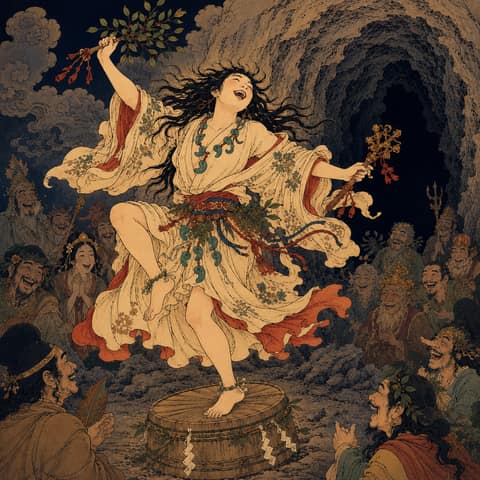
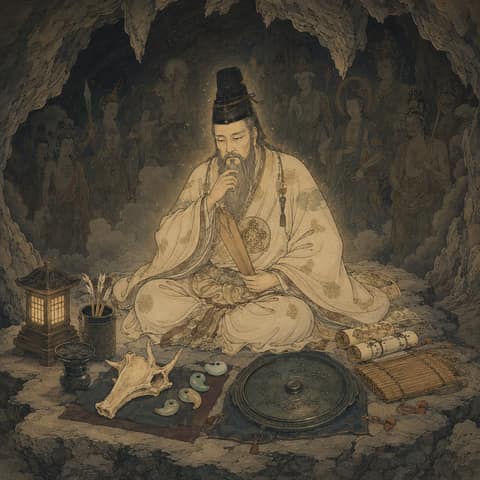
The core of Ame-no-tajikarao lies in the fact that he is the god responsible for the "final moment" in the Heavenly Rock Cave myth. After Amaterasu hides in the cave, the myriads of gods mobilize the wisdom of Omoikane, long-crowing roosters, mirrors, magatama jewels, cloth, norito (prayers), and the dance of Ame-no-uzume to guide the enclosed sun goddess outside. Kokugakuin University's "The Heavenly Rock Cave and Ancient Rituals" interprets this myth as an origin tale for rituals involving mirrors, jewels, cloth, iron implements, and divination bones, pointing out the possibility that it incorporates multiple ritual elements that developed from the Yayoi to the Kofun periods. Within that complex ritual apparatus, Ame-no-tajikarao is neither the god who plans the preparations, nor the god who makes the mirror, nor the god who dances. He simply hides beside the door, waiting for the moment when Amaterasu "slightly opens the door and peers at her reflection in the mirror." Then, he takes her hand and pulls her out. The dramatic resolution of the myth is completed by this god, who combines the conditions prepared by wisdom and ritual with a single, physical burst of action.

In the main text of the Kojiki, immediately following Ame-no-tajikarao's action, Futodama-no-mikoto stretches a shirikumena (shimenawa) behind Amaterasu-Omikami and declares, "You may not return further inside than this." Here, Ame-no-tajikarao's act of "pulling out" is locked into an irreversible order by the shimenawa. Amaterasu's return is not merely a rescue drama; it is the moment the state of the world switches from reclusion to reappearance, from darkness to light, and from chaos to ritual order. The Kokugakuin University annotations note that in the main text of the seventh stage of the Nihon Shoki, it is described as Tajikarao-no-kami taking Amaterasu's hand and pulling her out, while in the first variant (Issho 3), it is described as Ame-no-tajikarao-no-kami standing by the rock door and pulling it completely open. This difference indicates that the god's action applies to both "taking the hand" and "opening the rock door." Acting upon both the divine body and the door, the god and the boundary, was Ame-no-tajikarao's role.

The fact that his story does not end with the Heavenly Rock Cave scene elevates Ame-no-tajikarao from a minor deity of super strength in a single episode to a linchpin of the mythological system. In the second section of the Descent of the Heavenly Grandson, alongside the descent of the five attendant deities (Ame-no-koyane, Futodama, Ame-no-uzume, Ishikoridome, and Tamanoya) and the eight-span mirror, magatama, and Kusanagi sword, Tokoyo-no-omoikane-no-kami, Ame-no-tajikarao, and Ame-no-ishikadowake-no-kami are added as accompanying deities. The text further states that the mirror should be worshipped as the spirit of Amaterasu-Omikami, and records that Ame-no-tajikarao is enshrined in Sanana-no-agata. Here, the gods of the rock cave myth are not one-off characters whose purpose ends after bringing Amaterasu out, but are connected to the Heavenly Grandson's rule over the earth and the establishment of Ise ritual practices. Ame-no-tajikarao's power was not only the mythological brawn that ended the darkness, but also the boundary-shifting power accompanying the ritual system that moved the mirror—the spirit of Amaterasu—down to earth.

The most famous site of his worship is Togakushi Shrine in Nagano City, Nagano Prefecture. According to its official history, the five shrines of Togakushi enshrine deities related to the Heavenly Rock Cave myth from Takamagahara, with Ame-no-tajikarao-no-mikoto as the deity of the Okusha. The history passes down the legend that when Amaterasu slightly opened the rock door, Tajikarao-no-mikoto pushed the door open and welcomed the Great Goddess, and that the rock door he threw fell to the lower world and became Mount Togakushi. With Omoikane enshrined at the Chusha (middle shrine) and Ame-no-uzume at the Hinomiko-sha, the role division of the Heavenly Rock Cave myth is arranged geographically across the mountains of Togakushi. The "door" in the myth here becomes the mountain itself, and Ame-no-tajikarao evolved from the god who opened the closed stone door into the principal deity of Shugendo and mountain worship centered around the sacred Mount Togakushi.

Regarding the meaning of his name, the Kokugakuin University Deity Name Database cites both the theory that it is "the deification of arm strength" and the theory that he is "an ideological god created narratively." These two are not contradictory. Ame-no-tajikarao is certainly the god of "hand strength," and is widely worshipped today for divine virtues such as good fortune, fulfillment of wishes, and victory in sports. However, his function in the myth was not to flaunt power itself, but to open the door that enclosed the world and shift it to an order where Amaterasu would never hide again. His power does not run wild; it only changes the world when perfectly synchronized with ritual preparation, words, dance, the mirror, and the rope. Therein lies the unique position Ame-no-tajikarao occupies within ancient mythology.

Related Yokai

Yokai deeply tied to this one in legend.

Detailed Analysis

Merely calling Ame-no-tajikarao a "god of strength" fails to capture his true sharpness. In the Kojiki's Heavenly Rock Cave ③, he takes action at the precise moment when the myriads of gods are making noise, Ame-no-uzume is dancing, Ame-no-koyane and Futodama present the mirror, and Amaterasu-Omikami begins to peek out from inside the door. Ame-no-tajikarao is not a director controlling the scene. After the wisdom of Omoikane, the laughter-inducing dance of Ame-no-uzume, and the prayers and mirror of Ame-no-koyane and Futodama have all accumulated, only he, hiding on the sidelines, directly takes the goddess's hand. In mythology, "touching" carries heavy weight. He does not forcibly drag the sun goddess out, but rather seizes the slight movement of her leaning outwards, securing her on the side of the world. His power is both physical brawn and the ability to read the exact right moment.

The resolution of the Heavenly Rock Cave myth is structured as a collaborative effort by multiple gods. As pointed out by Kokugakuin University's Artifact Database, this scene layers elements of ancient rituals such as divination bones, forging, mirrors, jewels, cloth, and sakaki branches. Omoikane thinks, Ishikoridome makes the mirror, Tamanoya makes the magatama, Ame-no-koyane and Futodama handle the ritual and words, and Ame-no-uzume directs Amaterasu's enclosed consciousness to the outside through laughter and dance. Within this entirety, Ame-no-tajikarao bears the shortest and most irreversible action. For prepared rituals to change reality, a physical body to "open" was needed at the very end. Therefore, his divinity lies not in solitary super strength, but in the final point where ritual makes contact with the world.

In the Kojiki, immediately after Ame-no-tajikarao takes Amaterasu's hand and pulls her out, Futodama stretches a shirikumena (shimenawa) behind her and declares, "You may not return further inside than this." This sequence is crucial. Because opening and making return impossible are continuous. The restoration of light cannot be achieved merely by opening the door temporarily. It was necessary to end the state of self-confinement and seal that boundary with a sacred rope so that darkness would not cover the world again. Ame-no-tajikarao is the god who lays his hand on the boundary between the inside and outside of the rock cave, darkness and light, retreat and reappearance, completing the mythological "restoration of light" by pairing with Futodama's rope.

Taking into account the variant traditions in the Nihon Shoki lineage, this god's actions become even more multi-dimensional. Kokugakuin University's annotation on Heavenly Rock Cave ③ introduces that in the main text of the Nihon Shoki's seventh stage, it is depicted as Tajikarao-no-kami catching Amaterasu's hand and pulling her out, while in the first variant (Issho 3), it is depicted as Ame-no-tajikarao-no-kami standing by the rock door and pulling it completely open. If the Kojiki focuses on the "divine hand," the Nihon Shoki variant shifts the focus to the "rock door" itself. In either case, he is the god who breaks the blockage. Whether the object is the hand of a god or a door of stone, Ame-no-tajikarao's action lies in breaking through boundaries. The "hand" included in his name can be read not merely as a symbol of muscular strength, but as an organ that directly intervenes between the divine and the world.

His reappearance in the Descent of the Heavenly Grandson ② reconnects the scene of the Heavenly Rock Cave to the Ise ritual system. In the main text, in addition to the descent of the five attendant deities, the eight-span mirror, magatama, and Kusanagi sword, Tokoyo-no-omoikane-no-kami, Ame-no-tajikarao, and Ame-no-ishikadowake-no-kami are added as accompanying deities. It further notes that the mirror should be worshipped as the spirit of Amaterasu-Omikami, and that Ame-no-tajikarao is enshrined in Sanana-no-agata. Here, he transitions from the hero of the momentary opening of the rock cave to a member of the ritual order that transfers Amaterasu's spirit to the earth. If Omoikane supports ritual and governance, and Ame-no-ishikadowake is stationed as the god of the gates, Ame-no-tajikarao is the power that supports the boundary transition when the sacred treasures descend from heaven to earth. The hand that opened the Heavenly Rock Cave is now added to the procession of sacred treasures descending from Takamagahara to Ashihara-no-nakatsukuni.

Togakushi Shrine is a sacred site that transformed this mythological role into the shape of a mountain. According to its official history, Togakushi Shrine enshrines deities related to the Heavenly Rock Cave myth from Takamagahara, with Ame-no-tajikarao-no-mikoto enshrined at the Okusha, Ame-no-yagokoro-omoikane-no-mikoto at the Chusha, and Ame-no-uzume-no-mikoto at the Hinomiko-sha. This is a structure where the mythological casting is deployed across the five shrines of Togakushi. Furthermore, the legend that the rock door pushed open by Tajikarao-no-mikoto fell to the lower world and became Mount Togakushi connects the very place name "Togakushi" (hidden door) to the memory of the Heavenly Rock Cave. The door that opened for only an instant in the Kojiki remains as a mountain in Togakushi. Ame-no-tajikarao is also the god who converts unseen events in Takamagahara into a mountain worship practice that people can climb and visit.

In modern times, it is natural, given the meaning of his name, that Ame-no-tajikarao is worshipped as a god of good fortune, fulfillment of wishes, bountiful harvests, and victory in sports. However, the power referred to here is not the power to simply pin down an opponent. In the story of the Heavenly Rock Cave, had he merely destroyed the door with sheer force, Amaterasu likely would not have returned. Only when wisdom, ritual implements, laughter, mirrors, and words are aligned, and Amaterasu herself turns her consciousness outward, does Ame-no-tajikarao's hand change the world. Therefore, praying to this god is not about wishing for a blind breakthrough, but rather praying for the power to take the final step without hesitation after all preparations are complete. There is a closed door. But at the same time, there is a power waiting before the door. Ame-no-tajikarao is the god of that quiet standby and the decisive hand.

Character Profile

This section is our own creative profile for storytelling. It is not historical fact or scholarship.

Yokai Type
Kami
Rarity
Divine
Personality
Waits in silence for the right moment, pouring his entire strength only into the instant a decision must be made. Does not stand at the center of the commotion, but never shrinks from the responsibility of opening closed spaces.
Compatibility
迷いを断ち切りたい者、停滞した仕事や関係を動かしたい者、競技や鍛錬に打ち込む者、戸隠や伊勢の神話を旅する者と相性が深い。
Abilities
Opening the Heavenly Rock CavePulling out the divine handBreaking through boundariesDivine power of restoring lightLying in wait for the right momentAccompanying the Descent of the Heavenly GrandsonEnshrined in Sana-no-agataMount Togakushi worship
Weaknesses
Not a god who makes plans himself; he exerts his power only after Omoikane's wisdom, Ame-no-uzume's dance, the mirror, and prayers are ready. If he misjudges the timing, his power becomes mere violence.
Habitat
Beside the door of the Heavenly Rock Cave in Takamagahara, the procession of sacred treasures accompanying the Descent of the Heavenly Grandson, Sana-no-agata mentioned in the Kojiki, and the deep cedar avenues of Togakushi Shrine's Okusha.
For more detailed information and diagnosis results about Ame-no-tajikarao, the God of Strength Who Opens the Rock Cave, please click here.

Sources & References

5
  1. 神名データベース・天手力男神國學院大學古典文化学事業(國學院大學) [学術データベース]天手力男神の読み、異表記、登場箇所、名義解釈を確認した典拠。
  2. 古事記ビューアー・天の石屋③國學院大學古典文化学事業(國學院大學) [古典本文・注釈]天照大御神を手力男神が引き出す場面、尻久米縄、日本書紀異伝を確認した典拠。
  3. 古事記ビューアー・天孫降臨②國學院大學古典文化学事業(國學院大學) [古典本文・注釈]天孫降臨における手力男神、常世思金神、天石門別神、神宝、佐那々県を確認した典拠。
  4. 戸隠神社の歴史戸隠神社(戸隠神社) [神社公式資料]戸隠神社奥社の祭神、天岩戸開きと戸隠山伝説、神徳を確認した公式資料。
  5. 器物データベース・天の石屋と古代祭祀國學院大學古典文化学事業(國學院大學) [学術データベース]天岩戸神話を鏡・玉・布・鉄製品・卜骨などの古代祭祀要素と結びつけて確認した典拠。

Interested in this type of yokai?

Discover the yokai most similar to your personality with our yokai diagnosis

Start Yokai Diagnosis

Meet your guardian yokai at the shrine

Draw an omikuji fortune and discover the yokai watching over you today.