倭姫命
やまとひめのみこと
五十鈴川へ導いた御杖代・倭姫命
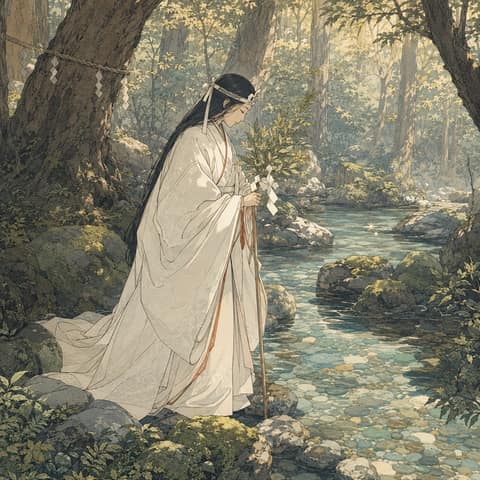
Yamatohime appears as the mitsueshiro who guided Amaterasu Omikami to Ise. A mitsueshiro is not a vessel that controls the divine, but a being that serves the divine will and receives its destination in the human world. Her journey is not an escape far from the Yamato court. It is a tour to search for where the great goddess should be enshrined, to read the physiognomy of the land, to cross through provinces, and to find the center where the deity can settle in peace. In the official history of the Jingu Administration, Yamatohime left Yamato, passed through Iga, Omi, and Mino, and entered Ise Province. Ise, the endpoint of her journey, is not a mere destination. It was chosen as a land capable of quietly receiving the divine authority of Amaterasu Omikami, where clear water descends from the mountains to form the Isuzu River flowing to the sea, where the ocean opens to Tokoyo, and where the forests envelop the shrine. The expression "the upper reaches of the Isuzu River" found in the history of the Naiku perfectly illustrates Yamatohime's power. She is not a hero who calls back the light, but a deity who searches for a place where the light can remain without becoming muddied. Therefore, Yamatohime's spiritual power resides in "selection" and "order." Dividing the sacred realm from the secular world, maintaining purification and abstinence, and ensuring the rules of offerings and festival days are not disrupted. The Jingu Administration explains that after creating Kotai Jingu, Yamatohime established the systems of rituals and purification, building the foundation of the shrine. There is a different kind of tension here from the sudden bizarre occurrences often found in yokai tales. Unseen things become unruly if not welcomed correctly. Sacred things exhaust people if placed in the wrong location. Yamatohime knows that boundary and measures the distance between the divine and humans. Her presence manifests not as a loud oracle, but as a stillness that makes one stop at a fork in the road. The sound of water suddenly becoming clear, the wind changing at the entrance of a forest, words becoming sparse before an old shrine ground. To those who do not misread such small signs, Yamatohime indicates the next step. Conversely, to those who rush to conclusions, who try to paint over sacred sites with their own desires, or who disregard purification as a troublesome formality, the road will feel long, as if wandering in circles. Her protection is not in speed, but in correct anchoring. When understanding Yamatohime, it is best not to separate the three roles: the priestess who hears oracles, the traveling imperial princess, and the institutionalizer who creates the shrine system. The enumeration of her historical touring sites shows that she is not a deity of a single point, but a being who sanctifies the road itself. A road can be a symbol of being lost, but for Yamatohime, it is a process of discernment. The lands she passed through were not failed places. They were necessary memories to confirm the conditions for welcoming the deity one by one, heading toward the conclusion called Ise. Therefore, her story is better suited to the repetition of stopping, purifying, and walking again, rather than flashy moments of victory. For those who pray, Yamatohime is less a "deity who grants wishes" and more a "deity who teaches where wishes should be placed." When one wishes to rebuild the foundations of work, home, relationships, or study, she does not bring sudden change, but guides people toward preparing the environment, restoring order, and washing away unnecessary impurities. Before asking what to seek before the deity, she makes you question with what state of mind and body you stand before the deity. That strictness is also Yamatohime's gentleness. The Yamatohime-gu in Kusube-cho, Ise City, rests quietly in the forest of Mount Kurata, midway along the Miyuki Road connecting the Naiku and Geku. Although established as a Betsugu (auxiliary shrine) in the Taisho era as a new shrine, the deity enshrined there touches the oldest layers of the Ise faith. This overlapping of old and new befits Yamatohime's figure. She is not a legend closed in the past, but a memory that exists to continuously renew the places where deities are enshrined. The deity who established the shrine at the end of her journey still quietly asks in today's noisy world, "Where should the heart be calmed?" The time spent listening closely to that question itself becomes a pilgrimage to Yamatohime.