Kagutsuchi (Hinokagutsuchi-no-kami) is the personification of fire, a fierce deity whose very birth brings about death and rebirth. In the "Kojiki," Izanami dies after her genitals are burned giving birth to the fire god Kagutsuchi, and the enraged Izanagi slashes Kagutsuchi to pieces. From the blood and body parts of the slain god, even more deities are born[1]. Fire is essential for life, but in the context of childbirth, it is dangerous enough to lead the mother goddess to her death. This duality makes Kagutsuchi not just a god of fire, but a turning point in mythology.
The "Nihon Shoki" also contains variant traditions regarding the birth of the fire god and the death of Izanami. Throughout the Kiki mythology, fire is treated as a force that connects the end of creation with the beginning of Yomi (the underworld)[2]. Following Kagutsuchi, the story progresses to the visit to the underworld, ritual purification (misogi), and the birth of the Three Precious Children. In other words, the fire god is an entity that temporarily destroys the order of the world's creation, triggering a chain of death, defilement, purification, and the birth of the sun goddess. In the yokai guide, while treated as a divine spirit, he has strong connections to deities of calamity, fire prevention beliefs, and mountain worship.
In later beliefs, Kagutsuchi is worshipped under names like Homusubi-no-kami as a god of fire prevention and protection against fires. The Atago belief centered at Mt. Atago in Kyoto and the Akiha belief represented by Akihasan Hongu Akiha Shrine are major pillars of folk religion where people fear fire yet pray to it for protection[3][4]. It is not a contradiction that the god who creates fire also becomes the god who quells it. Entrusting uncontrollable power to the deity of that very power is the depth of Japanese fire worship.
Compared to related fire anomalies, Kagutsuchi operates on an entirely different scale. While Kitsunebi (foxfire) and Shiranui are mysterious lights seen by human eyes, Kagutsuchi is a fire that alters the structure of the mythological world. He is not a ghost story about seeing fire, but the catalyst through which the land of the dead, ritual purification, and the birth of the sun goddess continuously unfold. Therein lies his high rank as a divine spirit.
Folklore & Legends
The myth of Kagutsuchi can be read as the most dramatic bodily myth in the "Kojiki." After giving birth to many lands and deities, Izanami gives birth to the fire god, is burned, falls ill, and dies. Because deities are also born from her vomit, feces, urine, and blood, death and defilement are not merely ends, but raw materials for generating new deities[1]. Fire destroys the mother's body, but from that destruction, a chain of deities related to metal, mountains, thunder, and water is unleashed.
The scene where Izanagi slays Kagutsuchi is both violence and creation. Deities are born from the blood on the sword, the blood dripping from its tip, and the severed body parts[1]. Here, fire is severed as an uncontrollable disaster, yet it continues to generate gods even after being cut down. Multiple images surrounding fire—conflagrations, blacksmithing, volcanic eruptions, lightning, and sparks from swords—are condensed here.
The variants in the "Nihon Shoki" recount the birth of the fire god and Izanami's death with different narrative orders and deity names, showing that the Kiki mythology is not a single fixed doctrine but possesses multiple layers of tradition[2]. The fire god's name also fluctuates between Kagutsuchi and Homusubi, which developed into the names of enshrined deities in later shrines. This fluctuation in names should not be seen as confusion, but as the result of the natural force of fire taking on diverse functions.
From the Middle Ages and early modern period onward, fire prevention beliefs became tied to earnest prayers for safety in urban life. In towns crowded with wooden houses, fire was the greatest disaster that could spawn massive conflagrations, even as it was a blessing for heating and cooking. In Atago and Akiha beliefs, the fire god was an object of fear, and simultaneously a guardian deity incorporated into daily life through fire protection talismans and confraternities (ko)[3][4].
When placing Kagutsuchi in a yokai and deity database, it is crucial not to simplify him as a mere fire character. He is not a hero who manipulates flames, but a mythological rift that connects childbirth, death, slaying, blood, the proliferation of gods, and prayers for fire prevention. Because of this, he can broadly connect with Izanami, Izanagi, Atagoyama Tarobo, Kasha, and groups of fire anomalies. Showing both the terror and the blessings of fire gives the entire page depth.
The spread of fire protection talismans and confraternities brought Kagutsuchi's myth down to everyday life. Before the hearths of merchant houses, in mountain asceticism, in cities fearing fires, and in the prayers of artisans working with fire, the fire god became not an abstract myth but an entity that dictated the safety of life. As long as fire cannot be completely eliminated, humans have no choice but to have the fire god quell the fire. This paradox has long supported fire prevention beliefs.
This version of Kagutsuchi bears fire not as a "convenient attribute" but as an "event that changes the world." In the "Kojiki," the scene where Izanami dies giving birth to the fire god instantly pivots the bright story of national creation to the tale of Yomi (the underworld)[1]. Fire is the result of birth, yet it takes the mother goddess away. Here lies the fundamental duality between the fire that sustains life and the fire that burns houses and bodies.
The scene of Kagutsuchi being slain is the epitome of creation arising from destruction. When Izanagi's sword severs the fire god, other deities are born from the blood and body parts[1]. The myth does not end by extinguishing the fire. Even when cut, the power of fire branches off into blood, swords, mountains, and lightning. Kagutsuchi is not a self-contained deity, but a generating device for subsequent gods.
Layering the variant traditions of the "Nihon Shoki" reveals that Kagutsuchi is the totality of fire passed down with fluctuating names and personalities in the Kiki[2]. Names like Kagutsuchi and Homusubi are not mere spelling differences, but indicate multiple perspectives grasping fire as "that which burns," "that which creates," and "that which possesses spiritual power." In YOKAI.JP, explaining this fluctuation adds depth to the page as a divine spirit.
Kagutsuchi, expanding into fire prevention beliefs, reverses from a god of terror to a god of protection. At Atago Shrine and Akihasan Hongu Akiha Shrine, prayers are continuously offered to him as a god of fire and fire prevention[3][4]. Precisely because he is the god with the power to cause fires, he is expected to have the power to quell them. The mindset of not avoiding the cause of disaster but praying at its center is characteristic of Japanese fire protection beliefs.
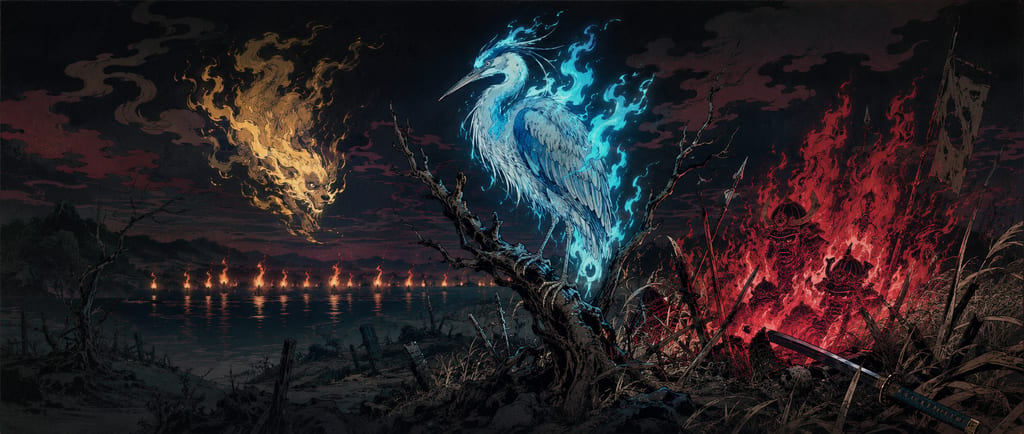
Visually, this version is better suited by layering childbirth, swords, and mountains rather than a simple ball of flame. Red fire, black soot, blood dripping from a sword, fire protection talismans on mountain peaks, the dark entrance to Yomi. When these elements align, Kagutsuchi stands up not as a fantasy fire attribute, but as a dangerous turning point in myth.
In diagnoses or cards, Kagutsuchi symbolizes strong change. When one cannot proceed to the next stage without ending something, when one has no choice but to burn down the old order, he becomes a terrifying but necessary god. However, fire cannot be treated lightly. Kagutsuchi's protection is only directed at those who take responsibility even for the aftermath of the burning.
Reading Kagutsuchi in relation to Izanami, fire appears as a wound left on the mother goddess's body. The birth of fire takes the mother, and her death spawns the story of the underworld. In other words, Kagutsuchi bears not only the blessing of parent-child relations but also the mythological pain that birth hurts someone. There is a weight there beyond a mere god of flames.
Kagutsuchi as a god of fire prevention is also the name for humans to coexist with dangerous forces. Life cannot be sustained without using fire. But if fire is used, disaster can strike at any time. Prayer is not a technique to extinguish fire, but the ethics of living with fire. If this sense of daily life is included in Kagutsuchi's page, ancient mythology and folklore connect beautifully.
In the association network, it expands not only to Izanami and Izanagi but also to fire and mountain anomalies like Atagoyama Tarobo and Kasha. Placing Kagutsuchi allows the stream from the upper reaches of mythology through folk fire protection beliefs to yokai-like images of fire to converge into a single flow.
Character Profile
This section is our own creative profile for storytelling. It is not historical fact or scholarship.
Fierce and inevitable, but does not merely desire destruction. He possesses the primordial heat that generates new gods after burning.
Compatibility
変化を恐れず浄化を求める人とは響き合うが、火を軽く扱う者には最も厳しい災いとして現れる。
Abilities
Spawning fire and changing the worldGenerating gods from destructionReceiving prayers to quell firesConnecting defilement and purificationOpening the myth of swords and bloodSupporting mountain fire prevention beliefs
Weaknesses
Rather than being subdued by water or sealing talismans, he loses control the moment humans underestimate fire. He is difficult to contain within a calm, everyday life.
Habitat
The birth scene of fire in the Age of the Gods, Mt. Atago, Mt. Akiha, hearths, merchant houses with fire protection talismans, memories of blacksmithing and forest fires.
The diagram below is a diagnostic evaluation chart for The Fire God Who Spawns Death and Rebirth. The higher the value of each item, the stronger that characteristic is expressed.