The true identity of Fujin is Shinatsuhiko-no-Kami (Shinatsuhiko, Shinatsuhiko-no-Mikoto), as recorded in the *Kojiki* and the *Nihon Shoki*[1]. The first volume of the *Kojiki* (712) explicitly states in the god-birth section, "Next, they gave birth to the wind god named Shinatsuhiko-no-Kami," while in the *Nihon Shoki* (720), Volume 1, Section 5, the deity appears under multiple names such as Shinatobe-no-Mikoto and Shinatsuhiko-no-Mikoto. The divine name "Shina" (long breath) is an ancient Japanese word representing "breath/wind," and "tsu" (of) + "hiko" (male god) translates to "the male god of long breath," essentially the personification of breath and wind itself.
The core of Fujin worship in the ancient state was Tatsuta Taisha (formerly Tatsuta Fujin-sha)[4]. Located in Heguri District, Yamato Province (now Tatsunominami, Sango-cho, Ikoma-gun, Nara Prefecture), it stands at a location directly hit by the strong downdraft winds (oroshi) blowing from the Ikoma Mountains into the Yamato Basin. The *Nihon Shoki* already mentions worshiping the "Fujin of Tatsuta" in the year 675 AD (Emperor Tenmu's 4th year). During the Ritsuryo period, the "Tatsuta Fujin Festival" was held by imperial decree every April (praying for favorable winds before the Niiname harvest festival) and July (before the typhoon season) as one of the Jingikan's Four Seasons Festivals. It was officially registered in the *Engishiki* (927) deity register as the Tatsuta Shrine Four Pillars (with Amenomihashira-no-Mikoto and Kuninomihashira-no-Mikoto as primary deities) and was highly regarded in state rituals as the wind god of bountiful harvests. From the Middle Ages, Fujin worship was succeeded by Kazemiya (Kazahinomi-no-miya) at Ise Jingu, Suwa Taisha (which enshrines Takeminakata but also holds Fujin aspects), Echizen Tsurugi Shrine, and Sada Shrine in Izumo.
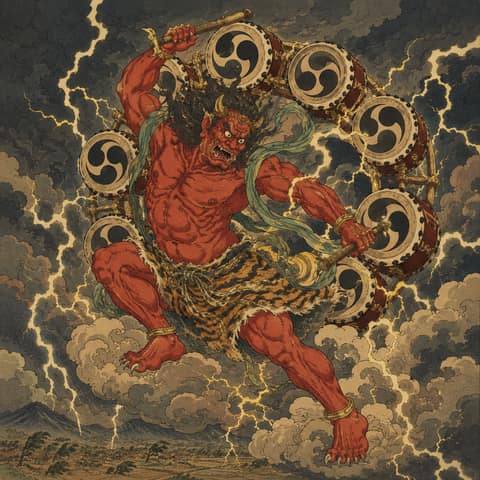
Iconographically, Tawaraya Sotatsu's "Fujin and Raijin Folding Screens" (circa 1620s, formerly at Kennin-ji in Kyoto, designated a National Treasure in 1952, currently deposited at the Kyoto National Museum)[2] is the definitive work. On the two-panel, double-screen golden background, the Wind God on the right (a green demon wearing only a tiger-skin loincloth, carrying a wide-open wind bag on his shoulders) and the Thunder God on the left (a white demon carrying a circle of drums) face off, creating tension in the empty space between them. This composition is considered the pinnacle of the early Edo Rimpa school. Later, painters like Ogata Korin (1700s) and Sakai Hoitsu (1800s) left behind faithful copies of Sotatsu's original "Fujin and Raijin Folding Screens" (Korin's at the Tokyo National Museum, Hoitsu's at the Idemitsu Museum of Arts), which irreversibly cemented the standard imagery for Fujin in Japan.
The wind bag held by Fujin traces its origins to the iconography of the Hellenistic Boreas (god of the North Wind)[3]. In ancient Greece, Boreas was depicted holding a wind bag open over his shoulders. Following Alexander the Great's eastern campaigns, this image was adopted into the Buddhist art of Gandhara in Central Asia, and it traveled along the Silk Road through China (as seen in the Fujin statues at the Mogao Caves in Dunhuang) and Korea, finally reaching Japan. Vāyu (Fujin) in Sanskrit belongs to the same lineage and is deified as "Futen" within the Twelve Devas of Esoteric Buddhism. Sotatsu's rendering of the wind bag represents the unique Japanese culmination crystallized at the very end of this long transmission.
In folk religion, Fujin clearly displays ambivalent divine traits. The aspect of a calamitous deity (Akufujin) who summons typhoons, autumn gales, and storms coexists with the aspect of a benevolent deity (Zenfujin) who presides over the favorable winds sweeping across the fields during the wheat and rice harvests. Rituals embodied a dual structure of both pacifying and praying to these two sides. During the Edo period, the "sending away the god of colds" (when a cold circulated, a straw doll fashioned as Fujin, holding a straw hat and a lantern, was driven out to the village edge or a riverbank to the sound of gongs and drums)[5] was widely practiced across the Tohoku, northern Kanto, and Hokushin'etsu regions, revealing his aspect as a god of pestilence personifying influenza. This is also important as the prehistory of modern public health awareness. In modern literature, Kenji Miyazawa's *Matasaburo of the Wind* (1934) adapted the legend of the "Wind Saburo" (wind-god boy tales passed down near Morioka and the Sanriku coast) in the Tohoku region, making the lineage of wind-child worship known nationwide. Post-war, the contrasting pairing of "Fujin and Raijin" became entrenched in games, anime, and manga (e.g., the Wind Fiend in Square's *Final Fantasy* series, themes in Studio Ghibli's *The Wind Rises*, various wind god summons), carrying the iconographic lineage that began with the National Treasure "Fujin and Raijin Folding Screens" into contemporary subculture.
Character Profile
This section is our own creative profile for storytelling. It is not historical fact or scholarship.
Yokai Type - Kami
Category - Deities & Divine Spirits
Rarity - Legendary
Personality - Silent yet majestic, possessing a disposition that summons both calamities and blessings.
Compatibility - Highly compatible with those who pray for safe travels and voyages, those who wish for bountiful wheat and rice harvests, and those who perform rituals to ward off epidemics like influenza.
Abilities - Summoning storms with the wind bagBountiful harvests through favorable windsWarding off epidemics (sending away the cold god)Performing with Raijin (twin-god dance of storms and harvests)
Weaknesses - Handling the wind bag disrespectfully brings retaliation through gales and typhoons. It is said that his power weakens if worshipped separately from Raijin.
Habitat - Tatsuta Taisha, Ise Jingu Kazemiya, Kennin-ji, Suwa Taisha, and wind-protection/wind-prayer shrines nationwide.