China (Tang / Cathay)ちゅうごく
43 yokai rooted in China (Tang / Cathay). Explore the legends tied to this land.

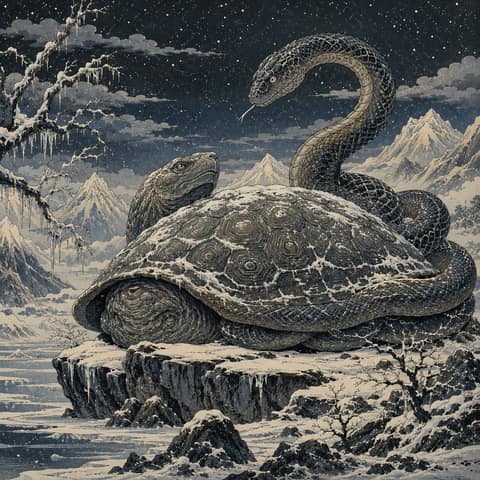
神格 Genbu (Black Tortoise)
Genbu
Genbu, the Black Tortoise, Guardian of the North
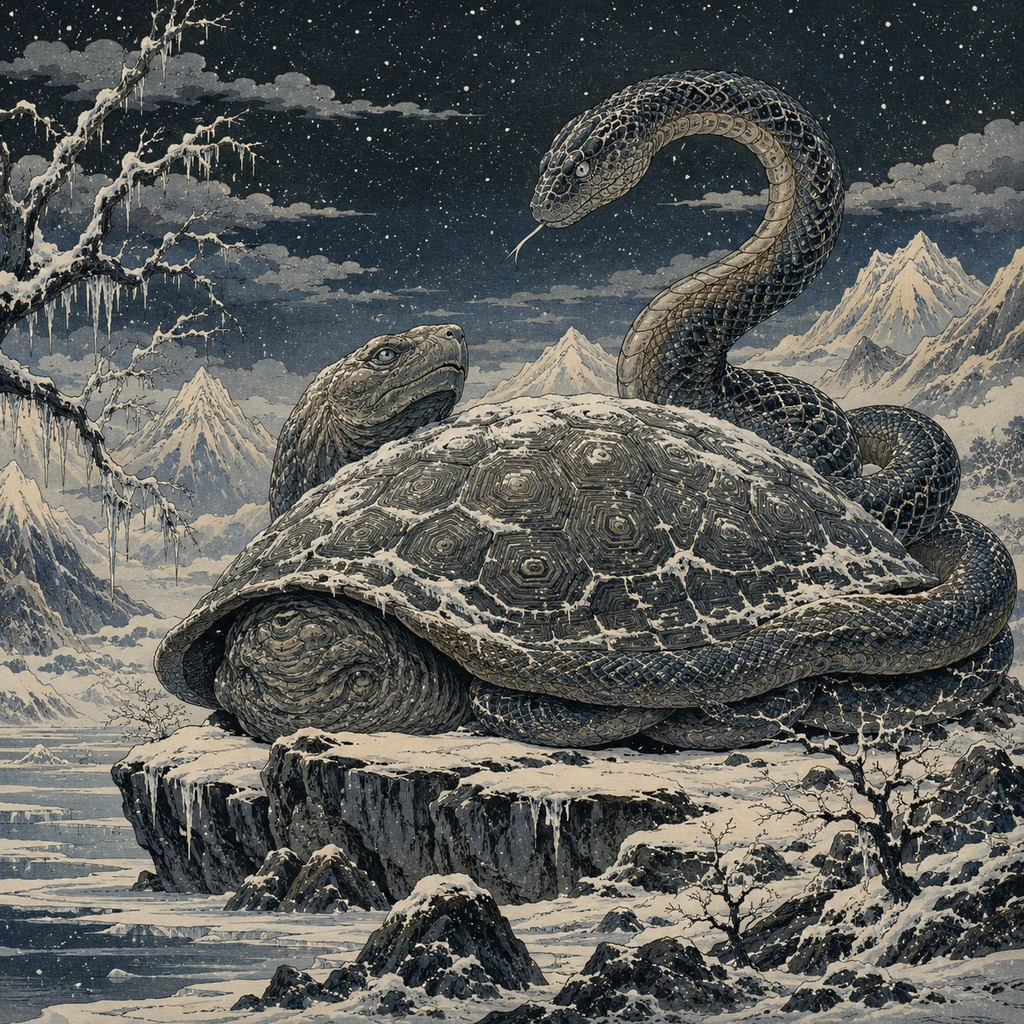
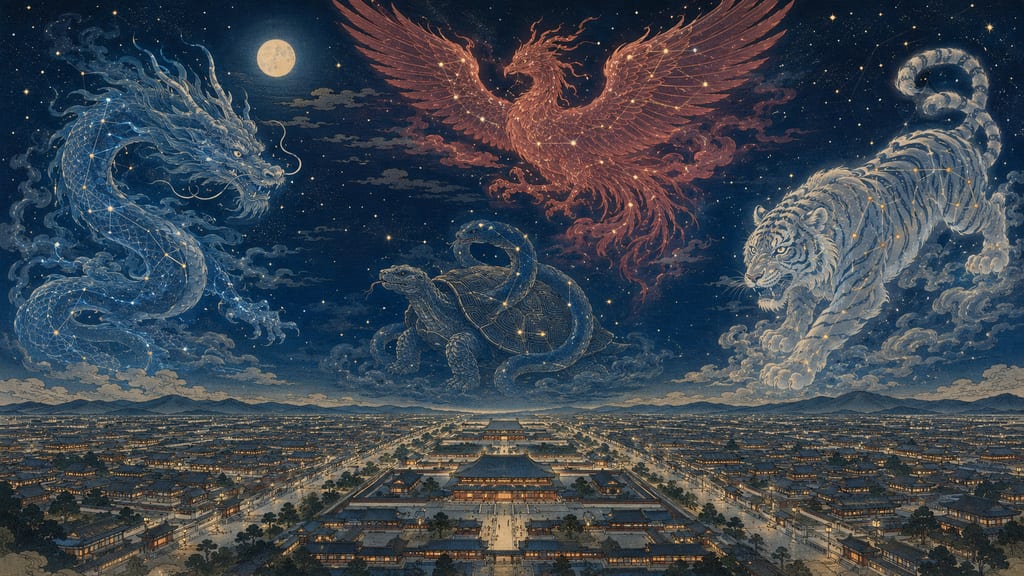
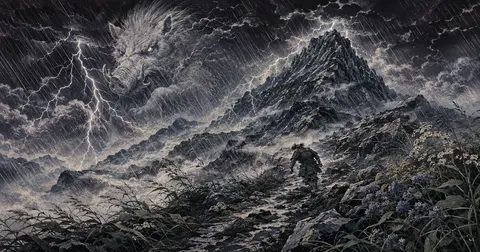
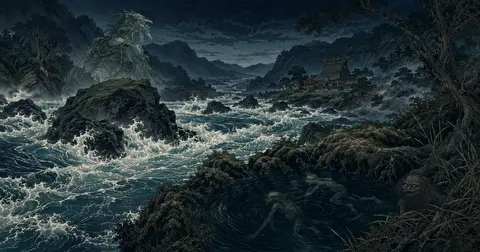
Animal TransformationsChina (guardian of the north among the Four Symbols; received in Japan during the Ritsuryō period)Genbu is the numinous beast of the north, Water, and winter, bearing the most singular form among the Four Symbols—the entwined form of tortoise and snake. This edition traces the meaning of that iconography and the notion of "land matching the Four Symbols" in Japan. Its origin is in the stars of heaven. The chain of the seven northern mansions (Dipper, Ox, Girl, Emptiness, Rooftop, Encampment, Wall) likened to a tortoise wrapped by a snake is Genbu. The Huainanzi's "Treatise on the Patterns of Heaven" makes the emperor of the north Zhuanxu and its beast Genbu, assigning it to Water, winter, and the dark (black). The dark is the color of the Water phase, figuring the northern winter sky into which all things withdraw. Two meanings overlay the tortoise-and-snake form. The first is the original sense—the figure of the stars of the seven northern mansions. The second is the symbol expounded by the Later Han Cantong qi, which sees the entwined form of tortoise (longevity) and snake (procreation) as the harmony of yin and yang, female and male. The latter is an interpretation overlaid on the original sense, and the two must not be confused. Genbu, too, was anthropomorphized in Daoism into "Xuantian Shangdi (Zhenwu Dadi)," but this is a development of a separate lineage from the directional-guardian Four Symbols of Japan. In Japan, Genbu was spoken of most concretely within the geomantic reading of "land matching the Four Symbols"—terrain backed by a mountain to the rear is held to be the auspicious position of Genbu. Yet the identification that "Heian-kyō is land matching the Four Symbols (the north, Genbu = Mount Funaoka, etc.)" is not a certainty from the time of the capital's founding, but a later interpretation organized and settled into doctrine around the 1970s, with even the identified sites differing among researchers. What is certain reaches only as far as the existence of the geomantic notion of "land matching the Four Symbols" in the Heian period. The Four Symbols' banners of the Shoku Nihongi are the literary first appearance, and the iconography keeps the tortoise-and-snake-intertwined form in the Genbu on the northern wall of the Kitora Tomb.

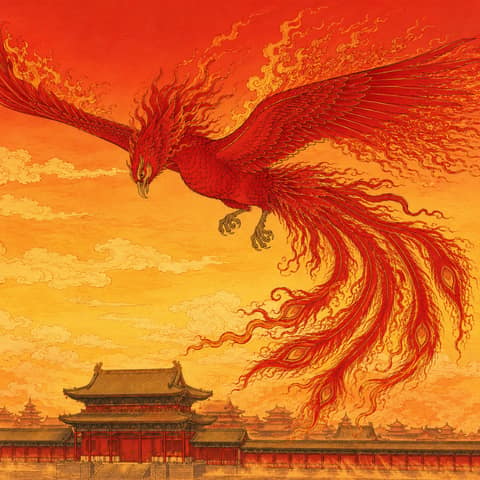
神格 Suzaku (Vermilion Bird)
Suzaku
Suzaku, the Vermilion Bird, Guardian of the South
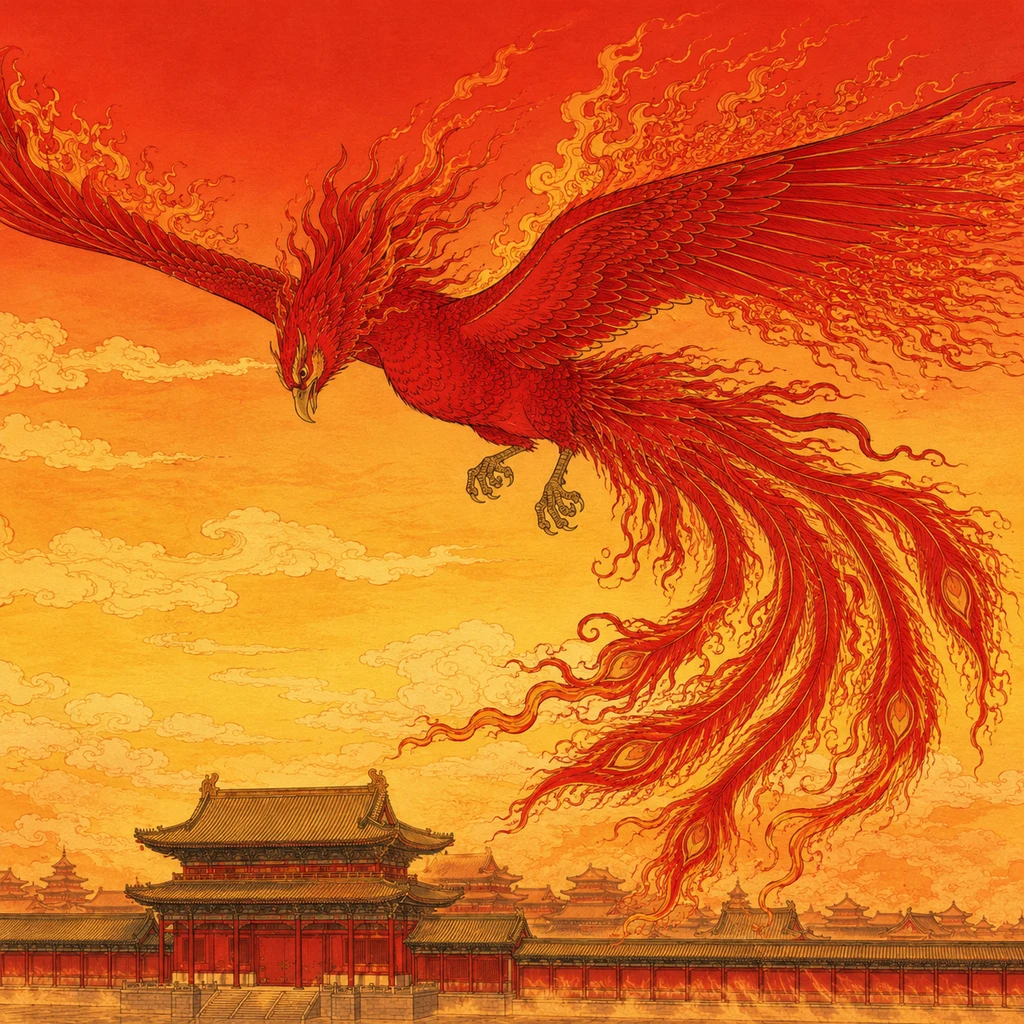
Animal TransformationsChina (guardian of the south among the Four Symbols; its name survives in Heian-kyō's Suzaku Avenue and Suzaku Gate)The key to reading Suzaku lies in its directional symbolism as "the fire bird of the south" and in its subtle distinction from the phoenix. Its origin is in the stars of heaven. Chinese astronomy likened the chain of the seven southern mansions (Well, Ghost, Willow, Star, Extended Net, Wings, Chariot) to a bird form, and made this the Vermilion Bird. The Huainanzi's "Treatise on the Patterns of Heaven" makes the emperor of the south the Flame Emperor and its beast the Vermilion Bird, assigning it to Fire, summer, and the color vermilion. The "Vermilion Bird in front, Black Tortoise behind" of the Book of Rites' "Qu Li" and the southern-palace Vermilion Bird of the Records of the Grand Historian' "Treatise on the Celestial Offices" stand in the same system. The vermilion of Suzaku is the color of the Fire phase, figuring the blazing southern sky of summer. The relationship between Suzaku and the phoenix requires care. Because their images and auspicious connotations closely resemble each other the two tend to be identified, but Suzaku belongs to the Four Symbols (of astronomical, directional origin) and the phoenix to the Four Auspicious Beasts (the numinous beasts alongside the qilin, the numinous tortoise, and the responding dragon)—they are numinous birds of originally different categories. Rather than declaring "Suzaku = phoenix," it is more accurate to grasp that they have been spoken of as overlapping because of their close resemblance. In Japan, the notion of south = Suzaku was carved into the capital. The Suzaku Avenue and Suzaku Gate of Heian-kyō are its traces. As for surviving iconography, there were the Four Symbols murals of the Takamatsuzuka Tomb, but the Suzaku of the southern wall was lost to grave-robbing, and four-direction completeness is limited to the Kitora Tomb. The fire bird of the south, so easily lost, still spreads its wings in the stone chamber of Asuka.

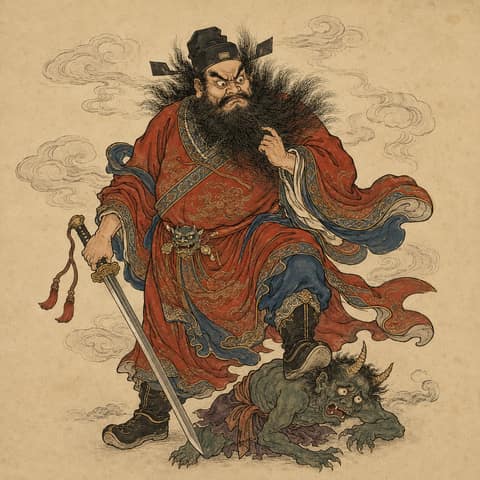
神格 Zhong Kui (Shōki)
SHOH-kee
Traditional Iconography Shoki, Warding Demon-Queller
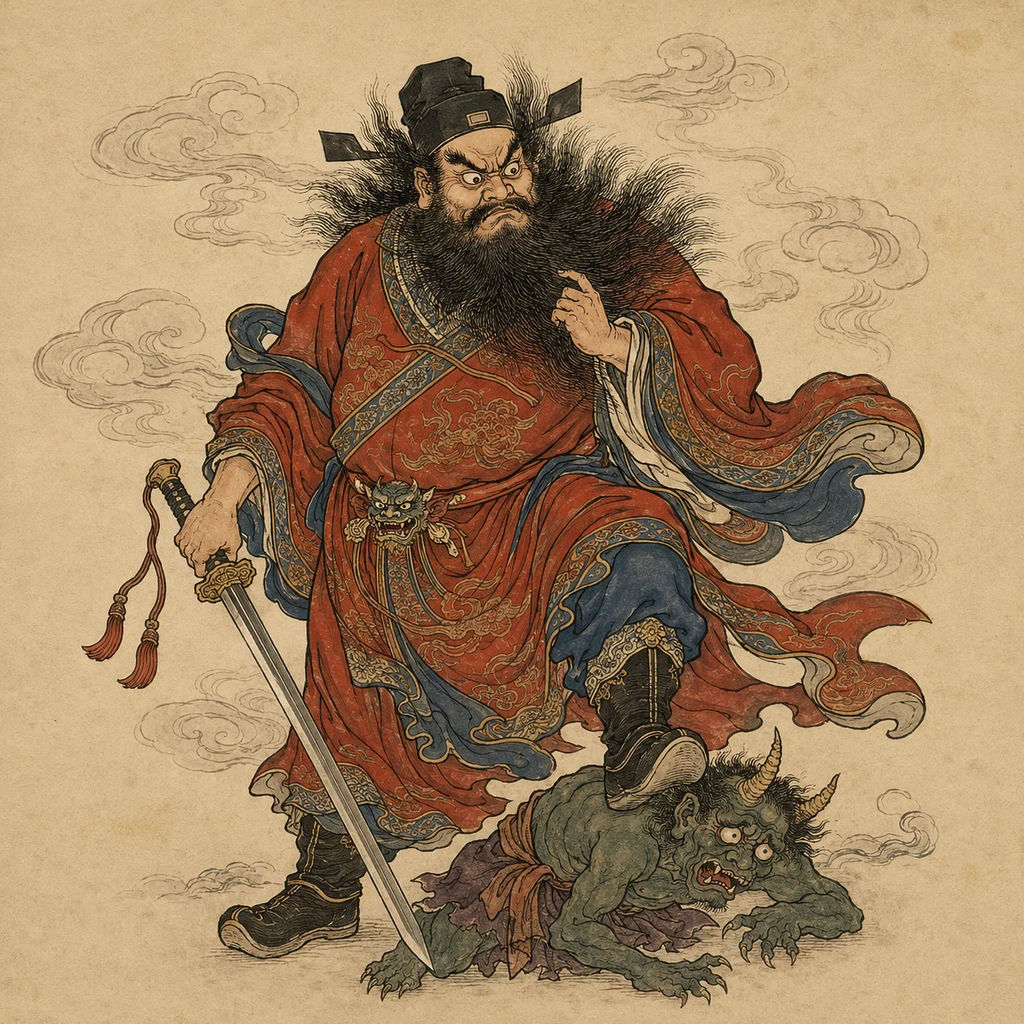
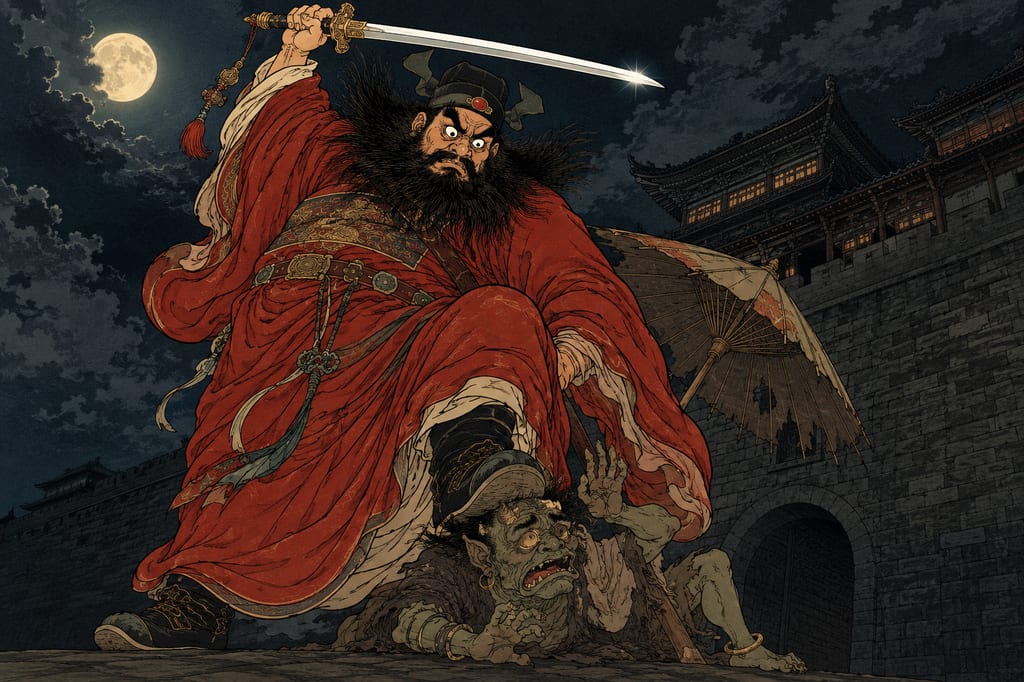
Deities & Divine SpiritsChinese origin; spread throughout JapanShoki, a demon-quelling deity spread across East Asia from Tang dynasty lore, took root in Japan as a talismanic power against calamity and smallpox. He is depicted as a bearded martial figure in official robes and cap, glaring with fierce eyes and wielding a sword in one or both hands. He often appears hunting, trampling, or bagging small demons. At New Year and Boys’ Festival he is displayed on hanging scrolls, banners, and screens, and many townhouses placed ceramic Shoki figures on eaves or roof corners. In Japan the earliest examples trace back to late Heian apotropaic paintings; from the Muromachi period the theme became established, and by late Edo he also appeared as May Festival dolls. Images and figures were hung at entrances, gates, or the upper seat of reception rooms to stop plague deities and malign spirits. Although dedicated shrines are limited today, regional folk belief since early modern times continues, and rooftop Shoki statues are still found from Kinki through the Chubu region. His powers are symbolized by the subduing glare and swordplay that drive off evil sprites, functioning as amulets against drug harm and epidemics.

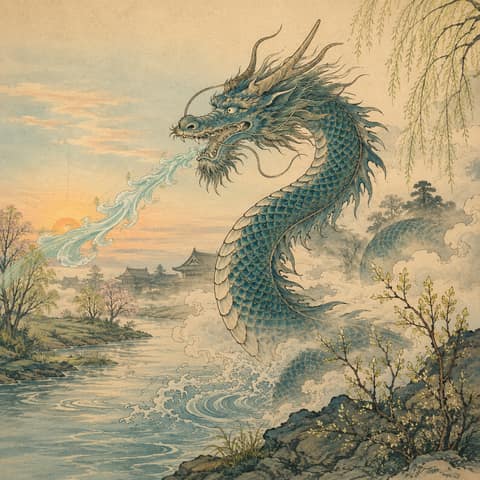
神格 Seiryū (Azure Dragon)
Seiryū
Seiryū, the Azure Dragon, Guardian of the East
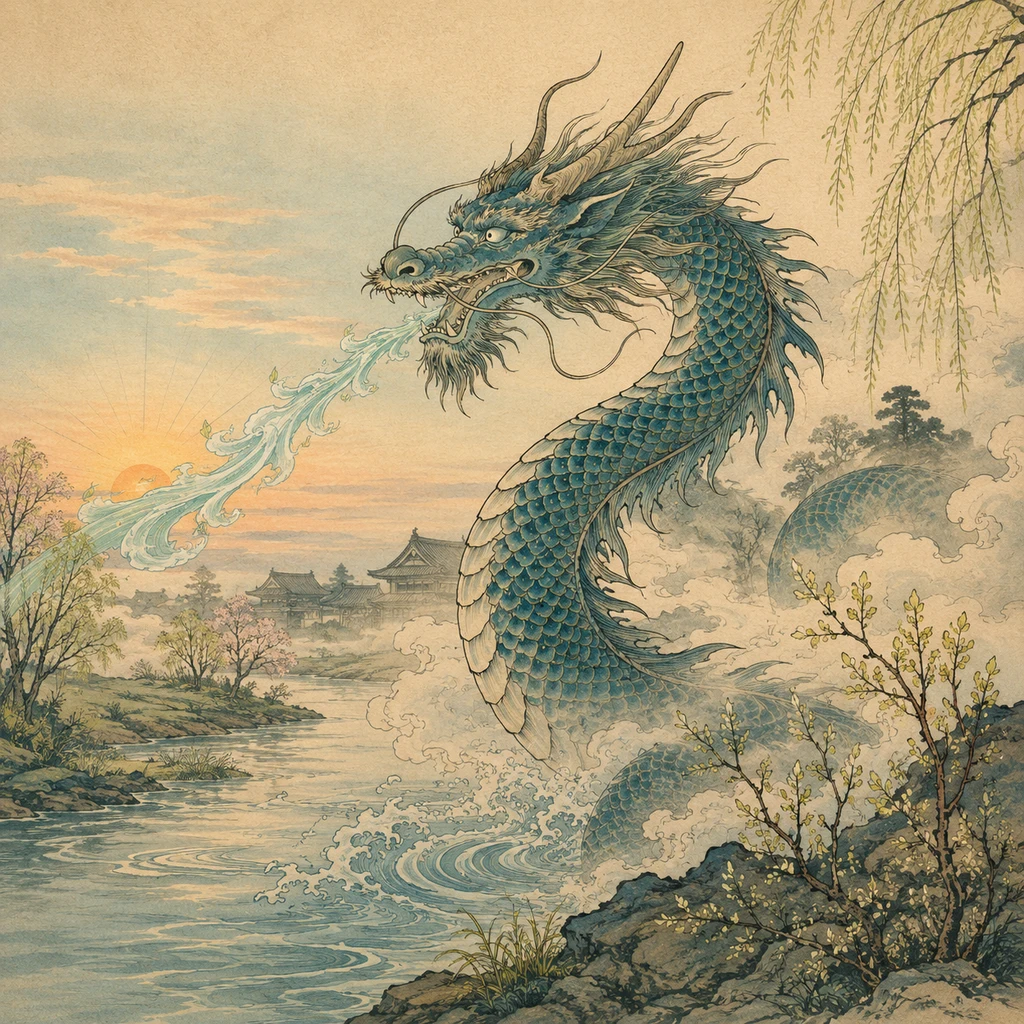
Animal TransformationsChina (the Four Symbols' guardian of the east; depicted in the Kitora Tomb and elsewhere)Seiryū is not a dragon standing alone, but a numinous beast that takes on meaning only within the directional system of the Four Symbols. This edition traces its astronomical origin and its reception in Japan. The origin lies in the heavens. Chinese astronomy distributed the twenty-eight lunar mansions across the four quarters, seven to each, and likened the chain of stars of the seven eastern mansions (Horn, Neck, Root, Room, Heart, Tail, Winnowing Basket) to a single dragon. This is Seiryū. The Huainanzi's "Treatise on the Patterns of Heaven" makes the emperor of the east Taihao and its beast the Azure Dragon, assigning it to the Wood phase and spring, weaving the five directions, five colors, five seasons, and Five Phases into a single cosmology. The "Treatise on the Celestial Offices" of the Records of the Grand Historian likewise makes the eastern palace of heaven the Azure Dragon, binding constellation to numinous beast. The azure of Seiryū is the color of the Wood phase, figuring the rising life-force of spring in the east. Its deep layer is engraved in relics. The lacquer garment chest from the tomb of Marquis Yi of Zeng (c. 433 BCE), the oldest astronomical relic to bear the names of the twenty-eight mansions, depicts the Azure Dragon and White Tiger as a pair. In the Han period, the patterns of the Four Symbols adorned roof tiles, bronze mirrors, and pictorial stones, becoming emblems that warded off evil and summoned fortune. In Japan, the Four Symbols were received as a theory of astronomy, tomb-building, and capital planning. The Four Symbols' banners of the first year of Taihō (701) in the Shoku Nihongi are the certain literary first appearance, and in iconography the Azure Dragon on the eastern wall of the Kitora Tomb in Asuka survives as one wing of a four-direction-complete mural of the Four Symbols. Thus Seiryū was placed between star and terrain, as the guardian beast that governs the east and brings the spring.

神格 Byakko (White Tiger)
Byakko
Byakko, the White Tiger, Guardian of the West
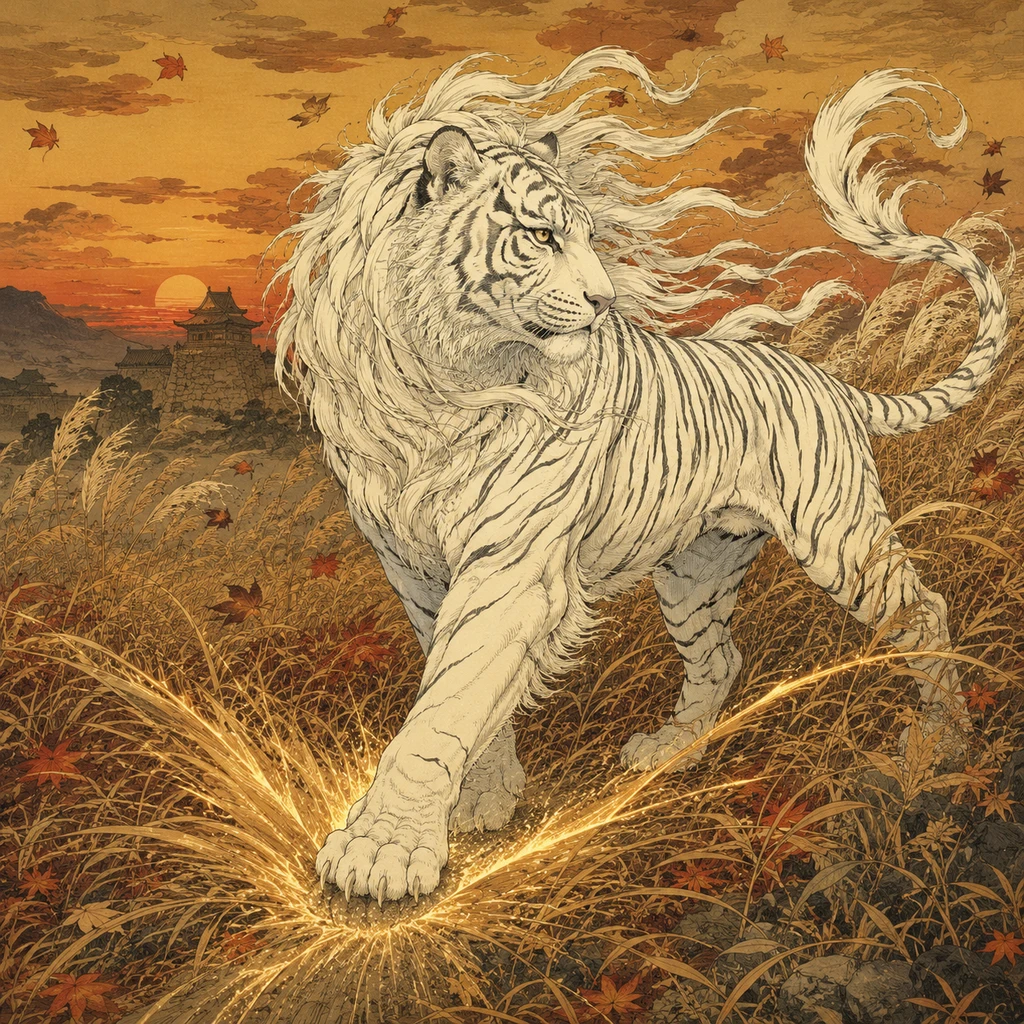
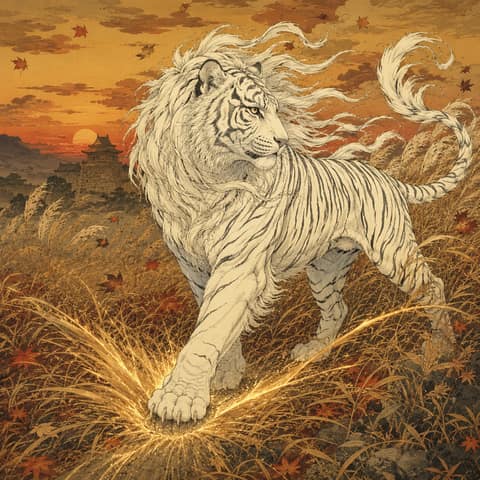
Animal TransformationsChina (guardian of the west among the Four Symbols; depicted in the Kitora Tomb and elsewhere)Byakko is the divine beast of the west, Metal, and autumn, spoken of as forming a pair with the Azure Dragon of the east. This edition traces its astronomical origin and the paired structure with Seiryū. Its origin is in the stars of heaven. The chain of the seven western mansions (Legs, Bond, Stomach, Hairy Head, Net, Turtle Beak, Three Stars) likened to the form of a tiger is Byakko. The Huainanzi's "Treatise on the Patterns of Heaven" makes the emperor of the west Shaohao and its beast the White Tiger, assigning it to Metal, autumn, and white. The western palace of heaven in the Records of the Grand Historian' "Treatise on the Celestial Offices" stands in the same system. The form of a fierce white-furred tiger figures the white of the Metal phase, corresponding to the western sky of autumn, which bears the air of ripening and harvest, and of withering severity. The pairing of Byakko and Seiryū is old. That the early Warring States lacquer garment chest from the tomb of Marquis Yi of Zeng (c. 433 BCE) draws the azure dragon and the white tiger to left and right alongside the names of the twenty-eight mansions shows that the composition of the Four Symbols, setting east (Seiryū) and west (Byakko) face to face, was already established twenty-four centuries ago. In Japan, Byakko was received as a marker of directional protection and of wards. In the Four Symbols' banners of the first year of Taihō (701) in the Shoku Nihongi, Byakko was set to the west (right). Though native tales are scarce, within the geomantic reading of land matching the Four Symbols it was made the guard of the west, and in iconography the White Tiger facing the Azure Dragon still remains on the western wall of the Kitora Tomb. The dragon of the east and the tiger of the west—this symmetry is the very skeleton of the system of the Four Symbols.

神格 Hakutaku (White Marsh)
hah-koo-TAH-koo
Iconographic Tradition Conformant
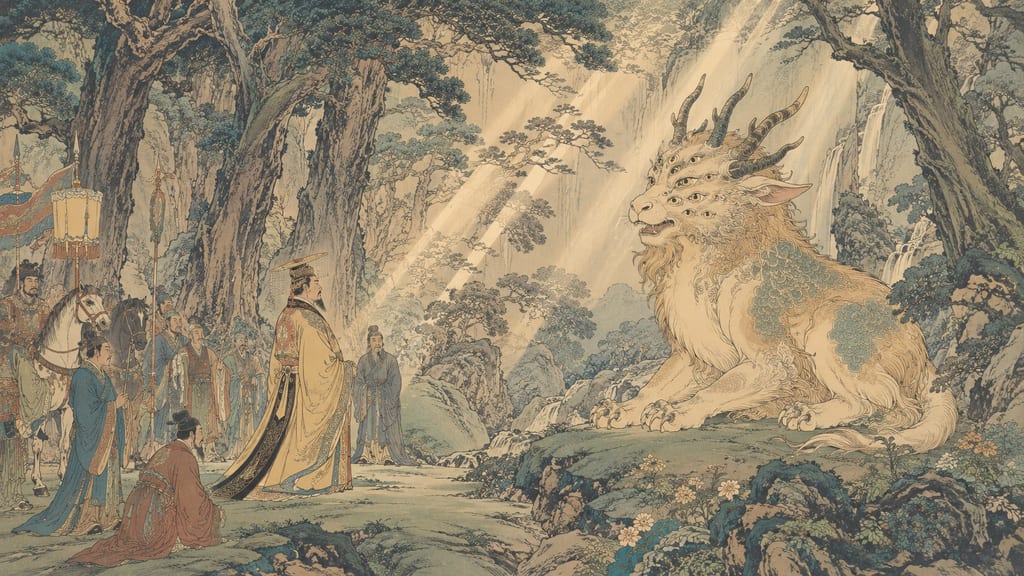
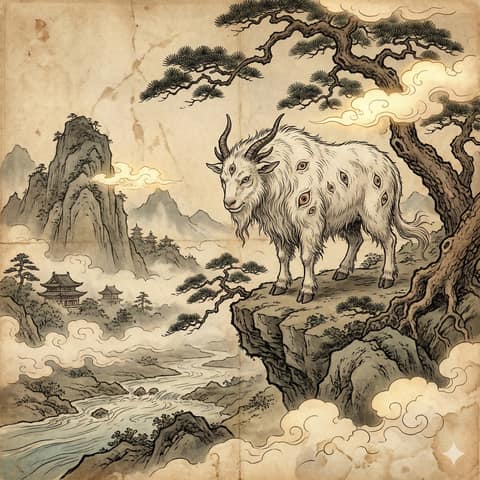
Deities & Divine SpiritsIntroduced from China (widely circulated across Japan as apotropaic images)The image of the Hakutaku varies across eras and texts. In the Sancai Tuhui and the Wakan Sansai Zue it appears as a white lion-like auspicious beast symbolizing lucid and orderly governance. Edo painter Toriyama Sekien employed multi-eyed motifs, adding an eye on the brow to heighten its power to perceive calamities, though older depictions sometimes show only two eyes. Prints of the Hakutaku served as apotropaic images posted on doors or carried as charms, invoked for protection during travel and epidemics. The design also appeared on imperial procession flags and on temple and shrine door panels as talismanic emblems of authority and sanctity, examples of which can be seen at the shrines and temples of Nikkō in Japan. The tradition is sometimes read as a personification of ethics and disaster lore, venerated as a being that classifies anomalies and teaches countermeasures.

伝説 Otsuyu
おつゆ
Otsuyu of the Peony Lantern
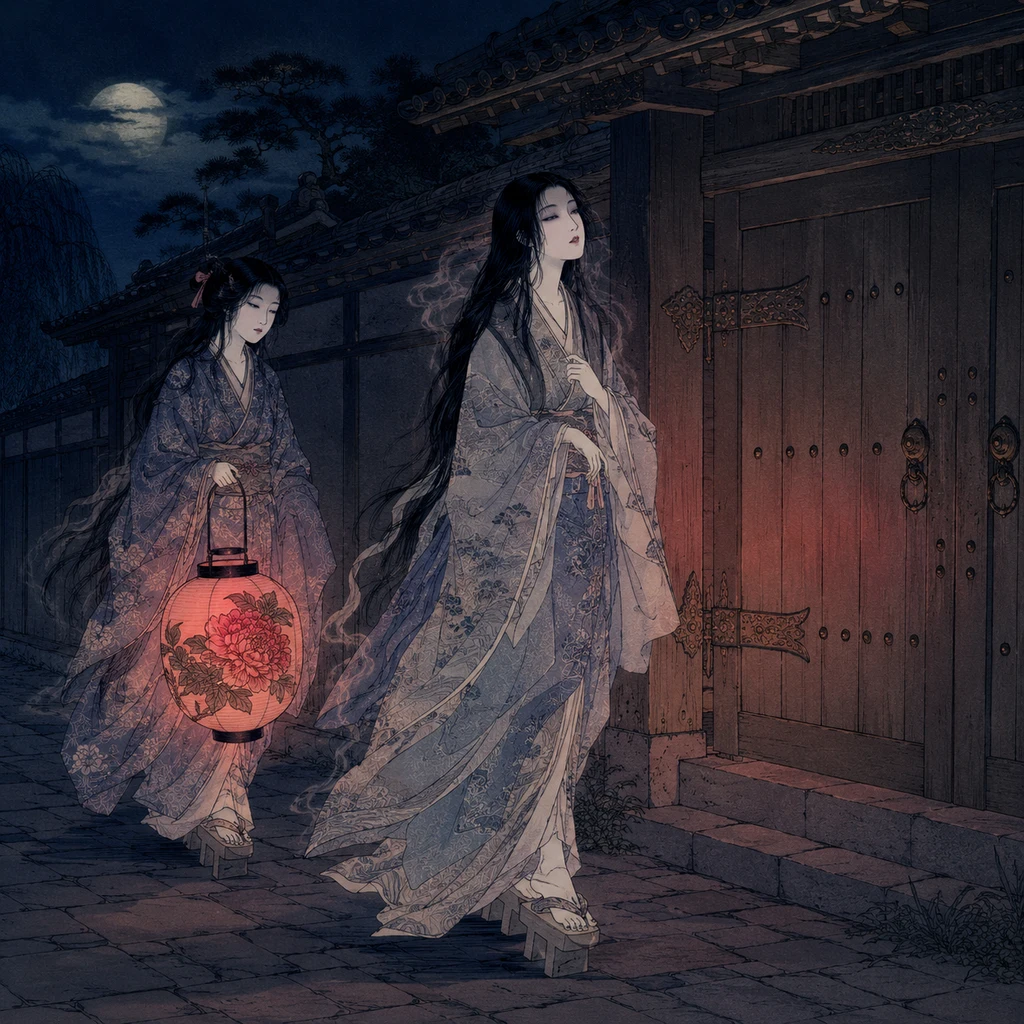
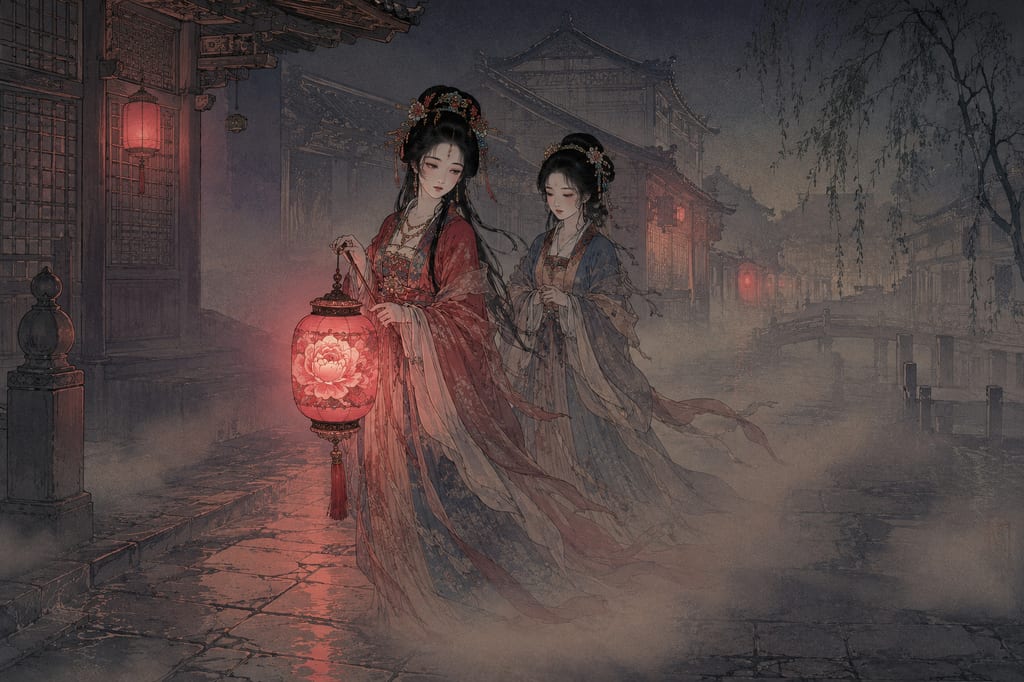
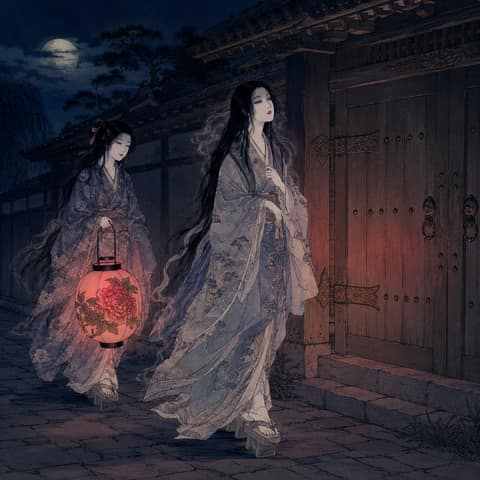
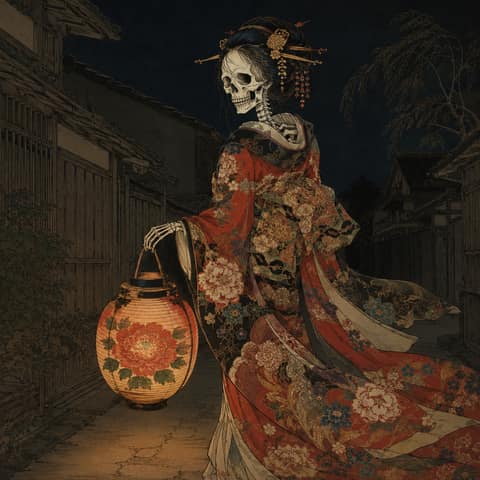
Spirit / GhostOriginally from 'The Tale of the Peony Lantern' in the Chinese text 'Jiandeng Xinhua'; later adapted by Asai Ryoi and San'yutei EnchoOtsuyu of the Peony Lantern is a ghost who embodies 'love continuing after death' rather than sheer terror. Raised as the daughter of a hatamoto, she fell in love at first sight with the ronin Hagiwara Shinzaburo, whom she visited under the guidance of the doctor Yamamoto Shijo. However, due to family circumstances, they were unable to meet again, and it is said she died of lovesickness while yearning for him. Yet, her attachment could not be erased by death. Starting on the night of her first Obon (festival of the dead), accompanied by her maid Oyone, she begins visiting Shinzaburo every night, holding a lantern painted with peonies and making her clogs ring out with a 'clippity-clop' sound. Believing she is alive, Shinzaburo meets her repeatedly, but his neighbor Tomozo sees through their true nature—they are actually buried dead spirits. Terrified, Shinzaburo places talismans of Kaion Nyorai on every door and wears a solid gold statue of Kaion Nyorai on his person to set up a ward. Blocked by the talismans, Otsuyu cannot enter the house and stands outside the gate every night, calling Shinzaburo's name reproachfully and sorrowfully. The tragedy of the story is sealed here by the intervention of human greed. To fulfill Otsuyu's desire, the ghosts bribe the married couple Tomozo and Omine with one hundred ryo. Tomozo replaces the Kaion Nyorai statue with a fake clay one and strips away the protective talismans. Losing his wards, Shinzaburo finally lets Otsuyu inside. The next morning, he is found as a white skeleton, embraced around the neck by a skull, his face contorted in terror. Otsuyu's essence is not a curse or grudge, but her unwavering devotion, persistently seeking her beloved even after death without reward. The sheer purity of this devotion has elevated her to one of the foremost ghosts in early modern Japanese ghost stories. Through the three layers of the Chinese original 'The Tale of the Peony Lantern', Ryoi's adaptation *Otogiboko*, and Encho's rakugo, Otsuyu's image gradually crystallized into a ghost of tragic romance that brings Japanese audiences to tears.

伝説 Nine-Tailed Fox
Kyubi no Kitsune
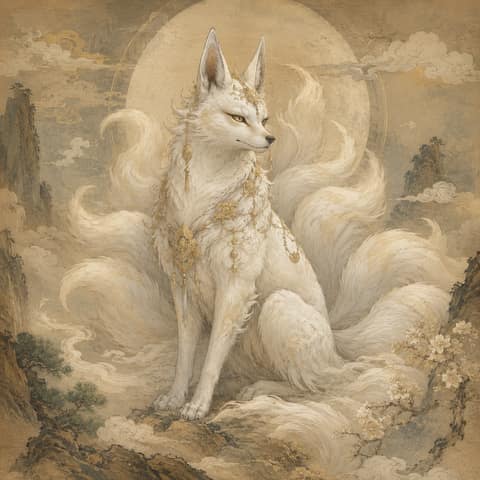
White-Faced, Golden-Furred Nine-Tailed Fox
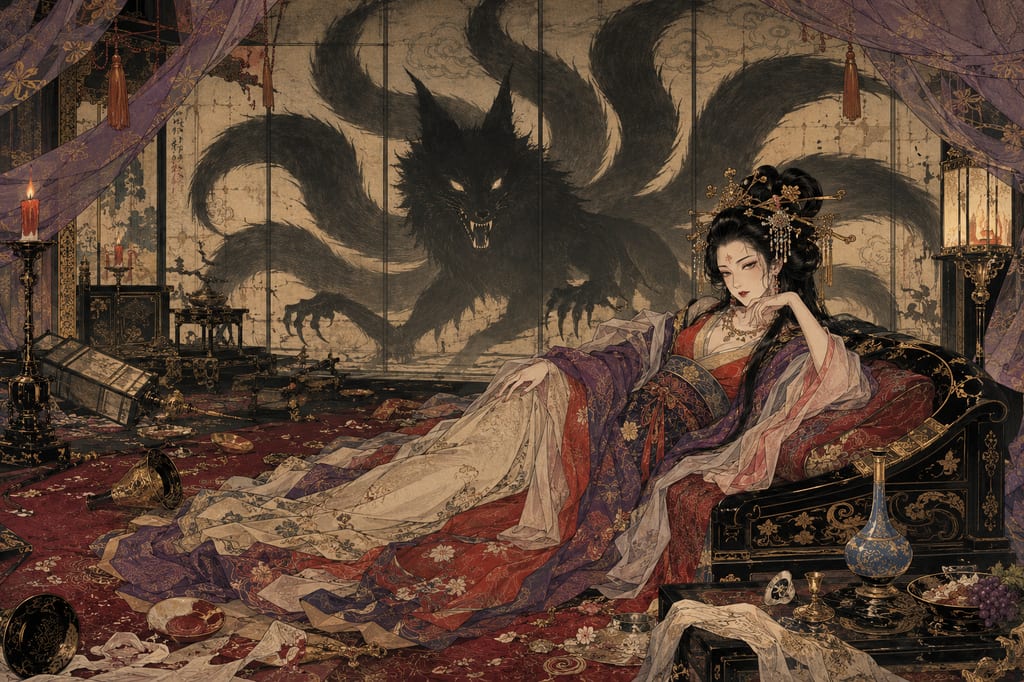
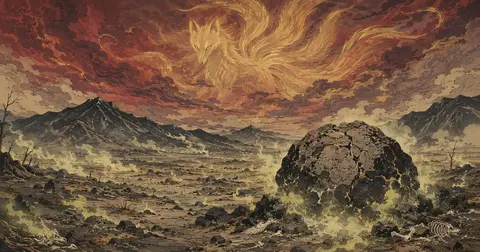
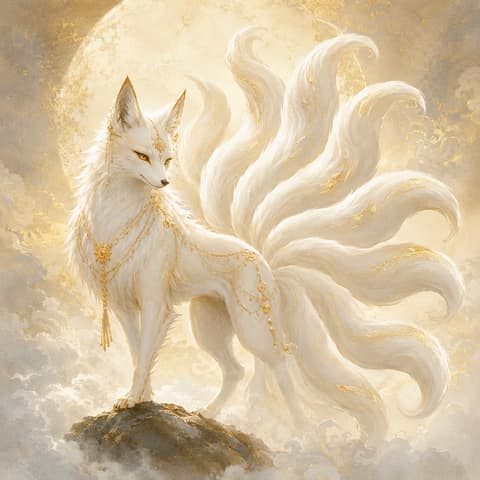
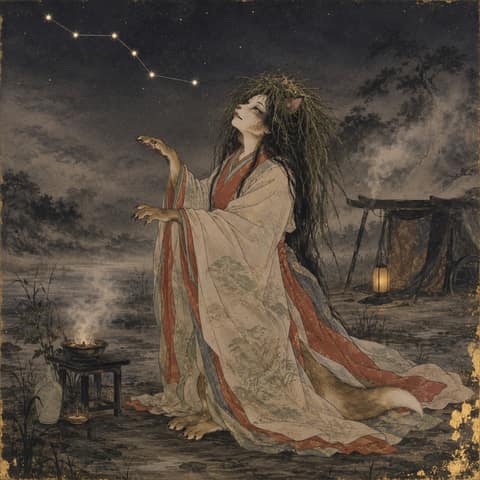
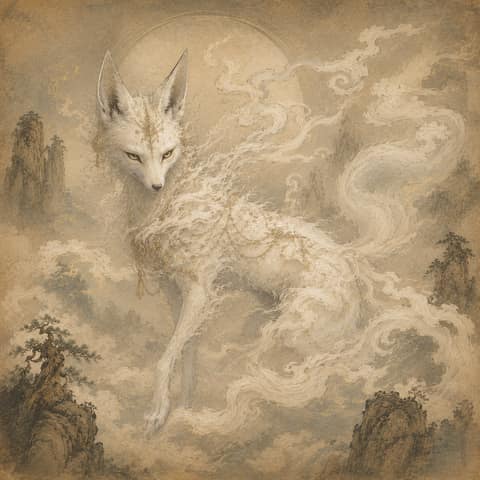
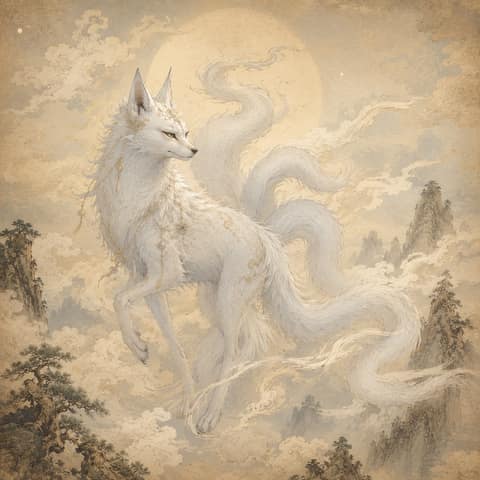
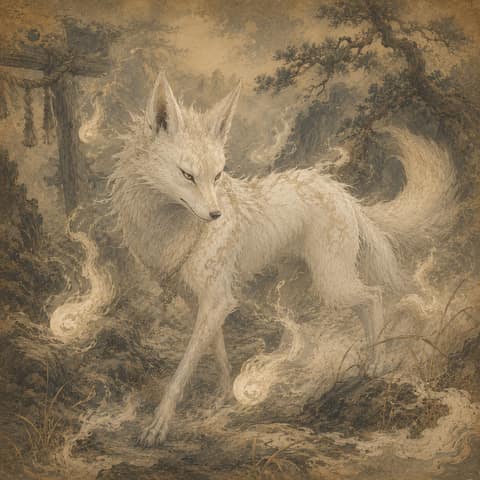
Animal shapeshifterQingqiu in China (the Shan Hai Jing nine-tailed fox) / Kyoto and Nasu (Tamamo-no-Mae and Sesshoseki traditions) / fox worship across JapanThe "white-faced, golden-furred nine-tailed fox" is exactly what the name says: a fox-spirit with a white face, golden hair, and nine tails. Today it is almost automatically understood as Tamamo-no-Mae's true form, but that image did not appear fully formed. It grew from several lines that merged over time: the nine-tailed fox of Chinese classics, the tale of Daji becoming a nine-tailed fox, the Japanese Tamamo-no-Mae legend, and the Sesshoseki tradition of Nasu. The older nine-tailed fox was not necessarily evil. The Shan Hai Jing makes the Qingqiu fox a man-eating beast, yet the nine-tailed fox was also treated in ancient China as an auspicious creature, and Japan received the idea that the nine-tailed fox could be a sacred beast. Nine tails, in other words, did not originally mark simple wickedness. They marked the extremity of otherworldly power. That power might bless kingship or destroy it; the uneasiness lies in that doubleness. Nor was Tamamo-no-Mae always the white-faced, golden-furred nine-tailed fox. Shinmei-kyo records her name, and Tamamo no Soshi gives the story of a beauty serving Retired Emperor Toba who is exposed as a fox. But in the older form the fox has two tails. Terashima Shuichi's account stresses that almost four centuries of rewriting stand between that tale and the tight identification of Tamamo with the Nine-Tailed Fox. Without that gap, the history of the legend's remaking disappears. The decisive change was the joining of Daji's fox to Tamamo. The story that Daji, beloved of King Zhou of the Shang, became a nine-tailed fox was amplified through Chinese commentaries and fiction and reached Japan early. In the late Edo period, Japanese yomihon connected Daji, the Indian Kayo-fujin, and Tamamo-no-Mae as previous bodies and incarnations of one fox. Ehon Sangoku Yofuden was especially important: it made a single fox-spirit bewitch rulers in India, China, and Japan, and fixed Tamamo-no-Mae as the Japanese manifestation of the white-faced, golden-furred nine-tailed fox. The Sesshoseki gave the fox a story after death. In the noh play Sesshoseki, the stone is not merely poisonous rock but the dwelling place of a fox-spirit still bound by obsession. A monk breaks and pacifies the stone through ritual power, changing fox-slaying into an act of salvation. Nasu Town's official tradition likewise says that the stone is the transformed fox that flew from India and China, joining the legend to the sulfurous landscape Basho described in Oku no Hosomichi. Tamamo-no-Mae does not end when she is exposed at court. She remains in Nasu as stone. Painting and performance made this doubleness visible. After the 1751 puppet play Tamamo-no-Mae Asahi no Tamoto, Tamamo appeared repeatedly in joruri and kabuki as a role that was both peerless beauty and fox-spirit. In Utagawa Kuniyoshi's Abe Yasuchika Praying over Tamamo-no-Mae, nine beams of light open behind the beauty, placing courtly grace and vulpine truth in the same image. Mirrors, reflected water, halos that become tails: all are devices for showing that Tamamo is a being who can be seen through. The terror of the white-faced, golden-furred fox lies not in teeth or claws, but in the fact that she first appears as beauty and intellect. She knows Buddhist texts, Chinese classics, waka, and court music; she answers questions without hesitation and earns trust and affection. She does not invade from outside. She is invited into the center. For that reason, force alone cannot expose her. Divination, prayer, mirrors, water, and the stories that keep retelling her are what bring the hidden fox into sight. At the same time, she is not an entirely foreign enemy. She arises from the same fox imagination as Inari's white fox, the hierarchies of tenko and kuko, the tenderness of fox-wife stories, and the fear of fox possession. As Tamamo-no-Mae she may tilt royal power; as the Sesshoseki she leaves poison in the land. Yet people pacify her, enshrine her, paint her, perform her, and keep her in memory. The white-faced, golden-furred nine-tailed fox is not evil that has been erased. It is evil that remains speakable after defeat.

伝説 Juroujin
じゅろうじん
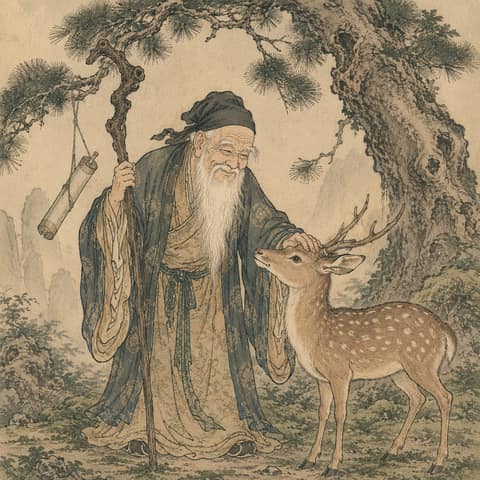
Juroujin, the Pure Sage of Longevity Accompanied by a Black Stag
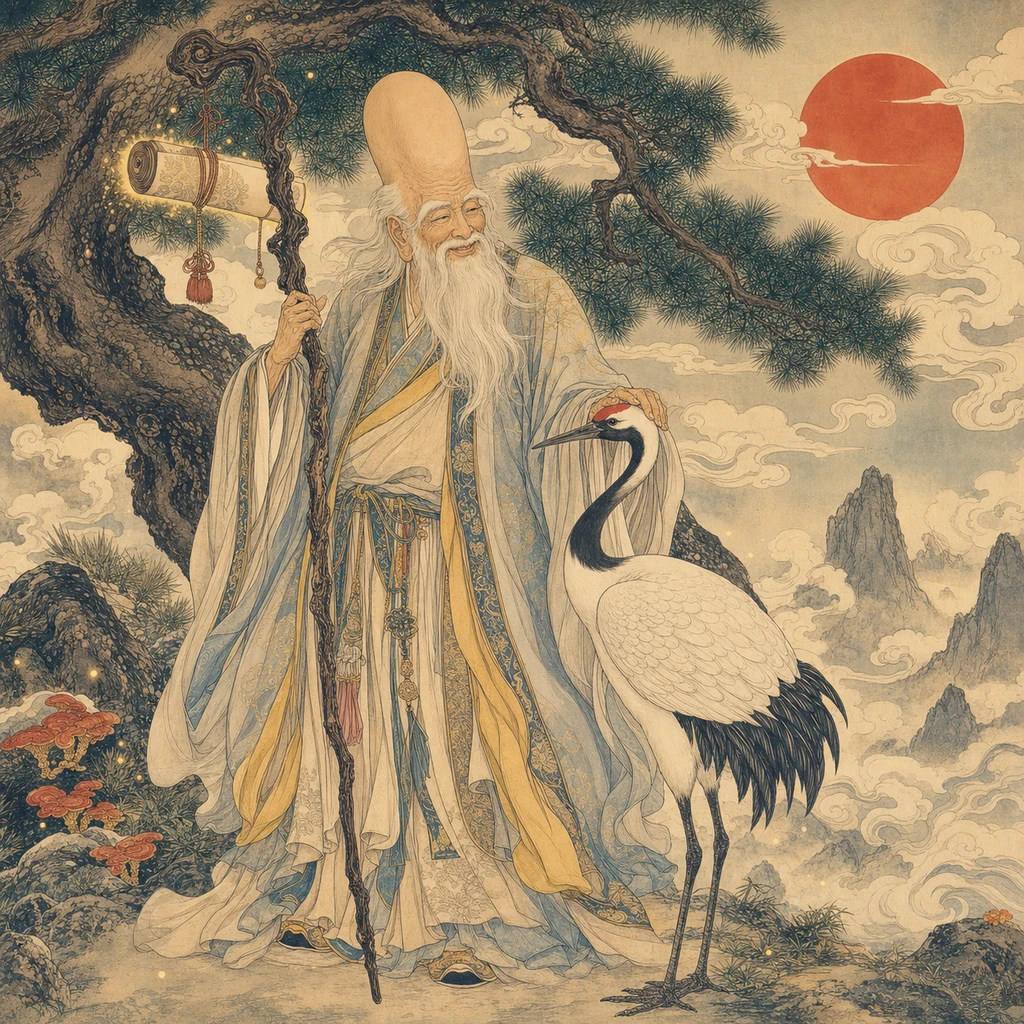
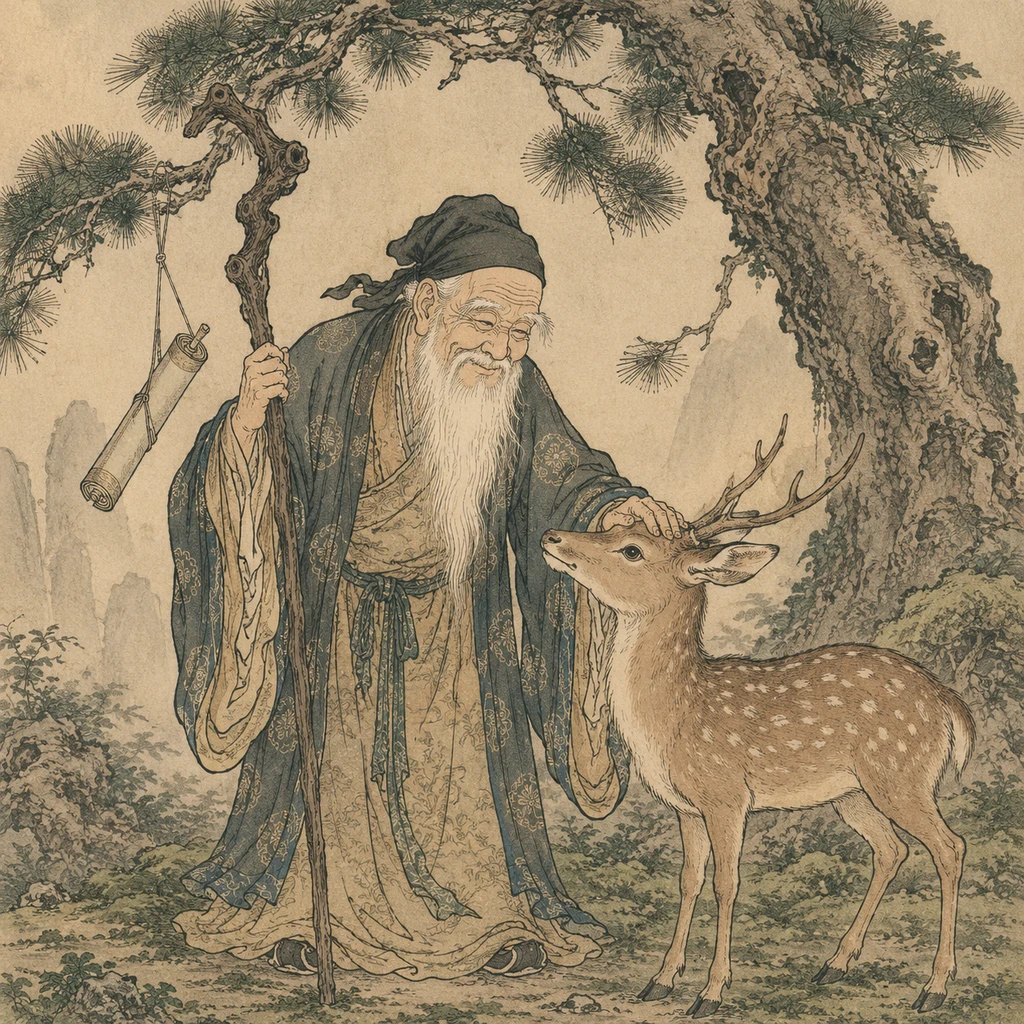
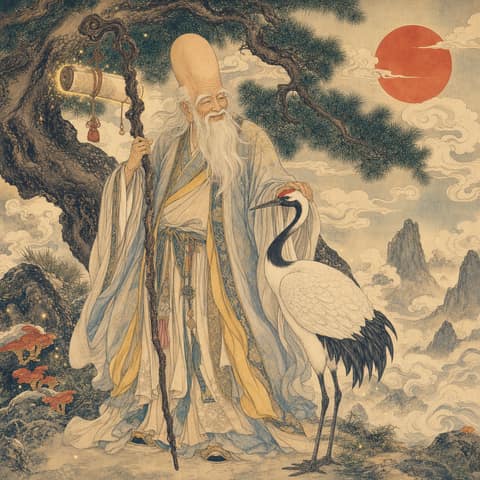
Divine Spirit / DeityChina (Daoist avatar of the South Pole Old Man Star) / Introduced during the Muromachi period / Pilgrimage sites of the Seven Lucky Gods in Kanto and Kinki (Zen, Obaku, and Tendai sect temples)Juroujin's true form is the South Pole Old Man Star (Canopus). This is the alpha star of the constellation Carina—the second brightest star in the entire night sky after Sirius. Because it only appears low in the southern sky of the Northern Hemisphere, ancient Chinese lore passed down the saying, "The year it can be seen is a year of universal peace; the land where it can be seen is a land of longevity." Already registered as an astronomical deity in the 'Treatise on Astrology' of the *Records of the Grand Historian* and the 'Treatise on Astronomy' of the *Book of Jin*, it forms the core of Longevity Star worship in Chinese folk belief. Daoism personified this star as the Longevity Star or Longevity Sage, arranging auspicious items alongside him: a black stag said to live 1,500 years, the Peaches of Immortality of the Queen Mother of the West (which extend life by a thousand years with a single bite), and a gourd containing the elixir of immortality. Iconographically, he is depicted as a short old man with a long head and a long beard, tying a sutra scroll to the head of his staff. A "short body and long head" is a physical omen of longevity in Chinese physiognomy, a formative principle entirely identical to that of his counterpart, Fukurokuju. This is the reason the two have long been considered the same deity under different names. His arrival in Japan occurred in the late Muromachi period (15th century), routed through monks traveling to Song and Ming China and the importation of Daoist and Buddhist paintings by Zen monasteries. The prototype of the current Seven Lucky Gods was formed during the Higashiyama culture period when Zen monks and painters (such as Noami, Soami, and Sesshu) bundled the localized Ebisu, Daikokuten, Bishamonten, and Benzaiten with the imported deities Hotei, Fukurokuju, and Juroujin into the "Seven Gods of Fortune and Virtue." The overlap with Fukurokuju had been an old issue since before the Song dynasty. In Japan, this was resolved by dividing their roles: "Fukurokuju = a secular deity synthesizing happiness, wealth, and longevity," and "Juroujin = an ascetic longevity deity purified to the single virtue of longevity." During the Edo period, a significant number of variant Seven Lucky Gods groupings circulated that removed Juroujin to avoid duplication, replacing him with the sake-loving beast Shojo, Kisshoten, or Fukusuke. Juroujin was loved by the common people for his appearance as an unpretentious, sake-loving sage, appearing frequently in the treasure ship pictures of Kyoden Santo (*Kottoshu*, 1813), Hokusai Katsushika, Kuniyoshi Utagawa, and Yoshitoshi Tsukioka. In the Seven Lucky Gods pilgrimages across Edo and Tokyo, his sites were often small halls belonging to Zen, Obaku, and Tendai sects, gathering prayers for longevity and health, especially from the elderly and the sick. In folk tradition, he also holds an important position as a main constituent deity of the "First Dream Treasure Ship" (established in the mid-Edo period), where placing a treasure ship picture containing Juroujin under one's pillow early on New Year's Day is said to grant an auspicious dream.

伝説 Daikokuten
Daikokuten
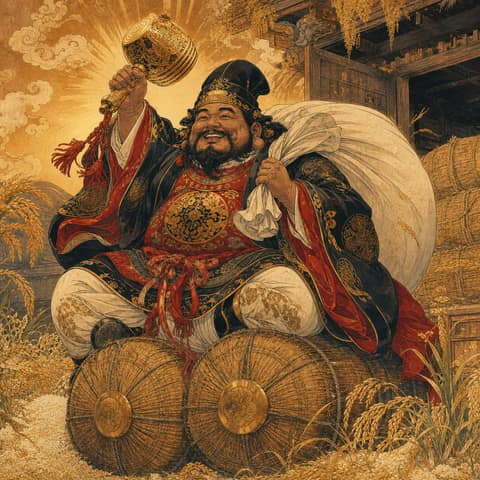
Daikokuten, Fortune God of Two Thousand Years of Transformation
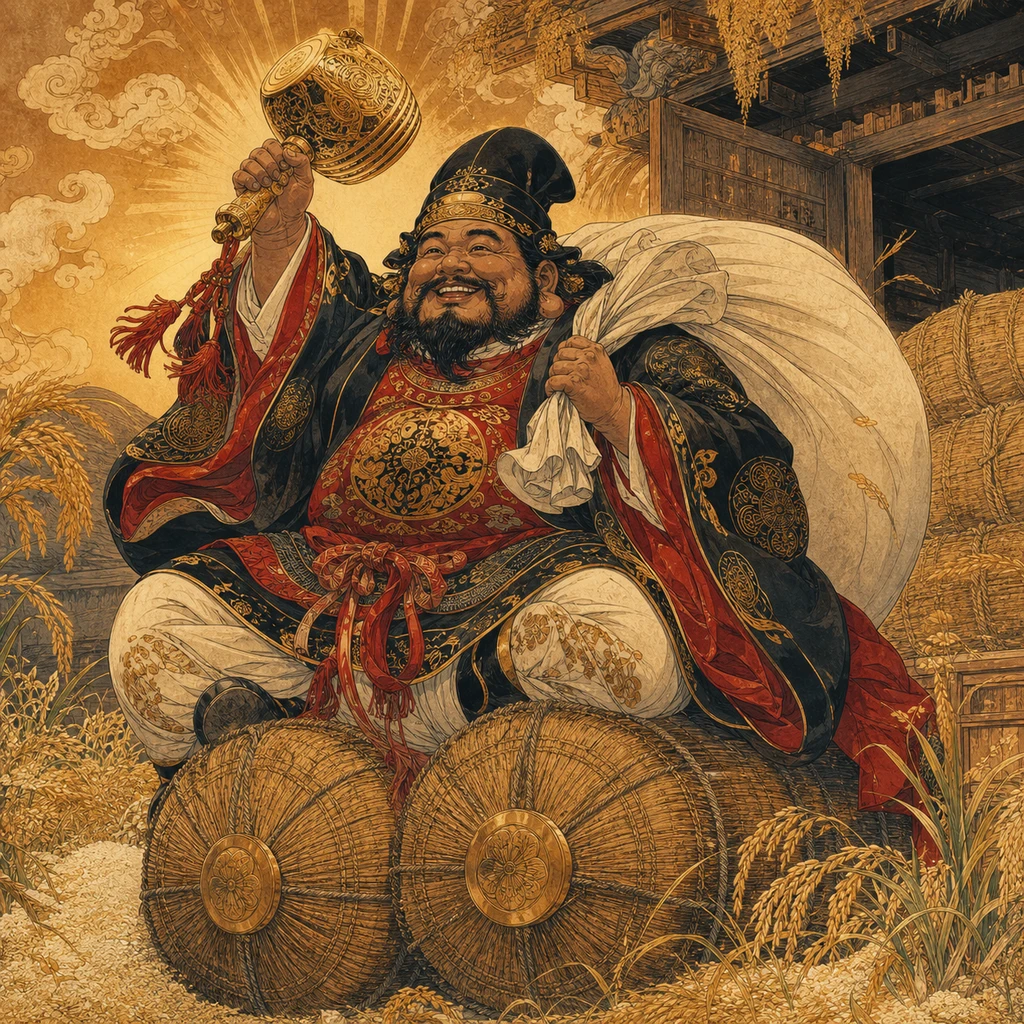
Deity / divine spiritAncient India, as Mahakala / Hieizan Enryakuji in Otsu, Shiga / Izumo Taisha as a center of syncretism with OkuninushiFrom Mahakala to Daikokuten: two thousand years of cultural transformation. The basic profile introduced Daikokuten's main attributes; the deeper story is the long transformation from ancient Indian Mahakala to modern Japanese Daikokuten. Mahakala is the wrathful, nocturnal, destructive aspect of Shiva, and in ancient Indian society he was associated with war, cemeteries, blackness, and fear. Once received into Buddhism, he became a Dharma guardian and moved through Central Asia, China, Korea, and Japan, taking on new meanings in each cultural sphere. In Japan especially, syncretism with Okuninushi, inclusion among the Seven Lucky Gods, and transformation into a wealth deity created a form so new that it almost amounts to rebirth. Daikokuten is a model case of how a foreign deity can be remade inside Japanese religion. Sanmen Daikokuten: Hieizan and Saicho's religious design. The Sanmen Daikokuten enshrined by Saicho at Hieizan Enryakuji, combining Daikokuten, Bishamonten, and Benzaiten into one three-faced deity, is one of the distinctive creations of Japanese Buddhist history. All three deities come from Indian Buddhist guardian traditions, but Saicho's placement of the combined figure as guardian of the temple kitchen and economy connected Buddhist ideals of compassion and protection with the practical realities of food, training, and institutional survival. Sanmen Daikokuten later spread through Hieizan, Tendai, Shingon, Zen, and related lineages, becoming an important symbol of Japanese Buddhism's ability to integrate practice and material support. The logic of syncretism through the sound daikoku. The merging of Daikokuten, the Indian-derived Buddhist deity, and Okuninushi, the Japanese Shinto deity, through their shared reading daikoku is a classic example of medieval Japanese religious syncretism through sound. The written forms, doctrines, and origins were unrelated, but the identical reading of "great black" and "great land" was enough to make them overlap. The new deity was not a simple addition of two figures; it gained new life in popular practice. The case reveals a flexible logic in Japanese religion, where sound, image, folk association, and practical benefit can matter more than strict doctrinal consistency. The civilizational meaning of the Seven Lucky Gods. The Seven Lucky Gods cult, shaped from the Muromachi and Azuchi-Momoyama periods into the Edo period, gathers Daikokuten, Ebisu, Bishamonten, Benzaiten, Fukurokuju, Jurojin, and Hotei around the shared wish for fortune, wealth, and prosperity. Its origins are deliberately mixed: Ebisu is native Japanese, Daikokuten, Bishamonten, and Benzaiten come from Indian religious worlds, and Fukurokuju, Jurojin, and Hotei come from Chinese Daoist, Buddhist, and popular traditions. Edo commoners did not demand a neat theory. They wanted luck, and that pragmatic wish created one of Japan's most inclusive religious combinations. Rice bales, mallet, and sack: medieval Japanese symbolism of fortune. Daikokuten's three main attributes, rice bales, the uchide no kozuchi mallet, and the great sack, compress medieval Japanese ideas of wealth. Rice bales symbolize harvest, food, land, and tax revenue in an agrarian society, entering Daikokuten through Okuninushi's agricultural layer. The mallet appears in classical tales such as the Konjaku Monogatari Shu and Uji Shui Monogatari as a magical tool that produces what one desires, a symbol of inexhaustible resources. The sack combines elements of Mahakala's treasure bag, Hotei's cloth sack, and Japan's seven-treasures imagery, holding gold, silver, lapis lazuli, tridacna shell, agate, pearl, and coral. These objects hold Indian, Chinese, and Japanese symbolism in a single image. Edo treasure-ship prints and collective wishes for prosperity. Treasure-ship prints became popular in the Edo period, showing the Seven Lucky Gods riding a ship of riches. Placing such a picture under the pillow on the second night of the New Year was believed to bring a lucky first dream. These images circulated widely as New Year charms for townspeople and merchants, and Daikokuten was often drawn near the center because he best embodied wealth, harvest, and thriving business. Through treasure-ship prints, Edo publishing, ukiyo-e, popular religion, and commercial culture converged. Even today, the motif survives in New Year decorations, greeting cards, and shop talismans. Daikokuten in the twenty-first century: a fortune god in a global age. Daikokuten remains a familiar god of wealth, business, and harvests. His image is used in New Year Seven Lucky Gods pilgrimages, first shrine visits, prayers for business success, and new-shop celebrations; merchants, restaurants, companies, and private homes still place him on altars. Even in an age of globalization, economic anxiety, and individualization, the desire for fortune, wealth, and prosperity remains universal. Daikokuten gathers that desire into one deity through a two-thousand-year chain linking ancient Indian Mahakala, medieval Sanmen Daikokuten, Edo Seven Lucky Gods worship, and the modern Japanese fortune god. He is one of the clearest symbols of cultural transformation in Japanese religion.
伝説 Tenko
Tenko
Tenko, the Celestial Fox in Communion with Heaven
Animal transformation (dōbutsu henge)China and Japan (the highest rank of fox spirits)This version explores why the Tenko is spoken of as “a yōkai yet near to a god,” and where it truly stands. Of the four grades of fox, only the lowest — the Yako — appears before people in a body of flesh to bewitch them. The higher its rank, the more a fox becomes a formless, spiritual presence, and at the summit, the Tenko, it is described less by any shape than by its very workings: seeing for a thousand leagues, communing with the will of heaven. As Yanagita Kunio and Nakamura Teiri have laid out, the Tenko is the utmost extreme of the senko, the spirit fox that has lived a thousand years and accumulated virtue. In neither deceiving people nor leading them astray, but watching over them from above, the Tenko stands at the opposite pole from the Yako. It was this transcendence that drew the Tenko up into religious faith. Just as Dakiniten is attended by a white fox and Izuna Gongen rides one in the guise of a karasu-tengu, the highest fox is enshrined as a familiar of the gods and buddhas, or as a deity in its own right. The power to which warlords prayed for victory, and to which villagers pressed their palms in hope of fire prevention and good fortune, was in the end the power of this fox in communion with heaven. One thing to be wary of is confusing Tenko with tengu. Because an old usage read “shooting star” as amatsu-kitsune, the two have long been mistaken for one another , yet the Tenko is, properly, a fox that has raised its spiritual rank to the utmost limit — a being of a wholly different lineage from the mountain-ascetic tengu.

伝説 Hotei
ほてい
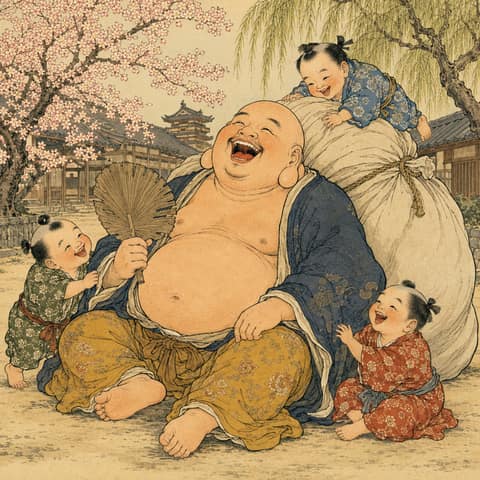
Incarnation of Maitreya, the Laughing Monk, Hotei
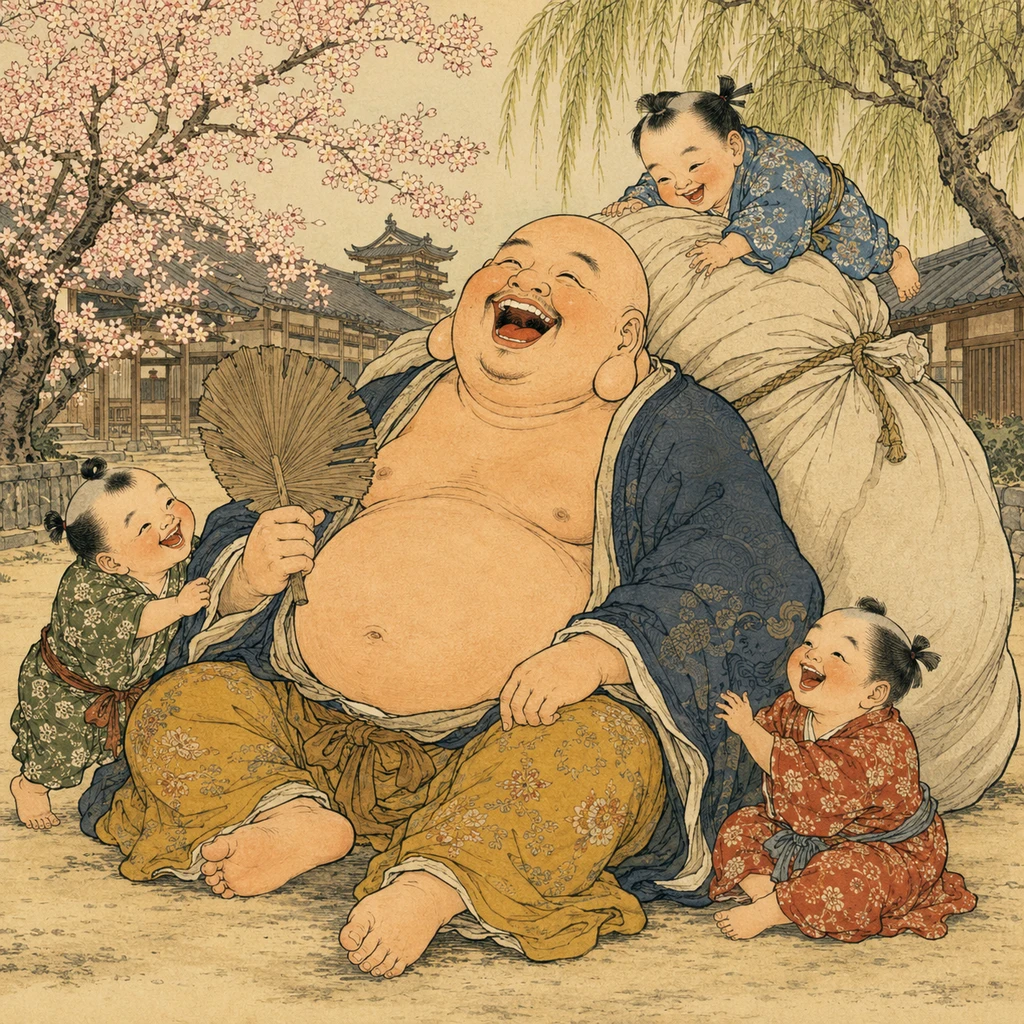
Divine Spirit / DeityYuelin Temple, Fenghua County, Mingzhou (now Fenghua District, Ningbo, Zhejiang, China) / Introduced via Zen Buddhism in the Kamakura period / Shrines and temples of the Seven Lucky Gods pilgrimage in Kanto and KinkiThe origin of Hotei is the historical Zen monk Qici (died 917) of the late Tang and Five Dynasties period. Fascicle 27 of the *Jingde Record of the Transmission of the Lamp* (1004) compiled by Daoyuan of the Northern Song provides an independent biography of him, which serves as the fundamental source of the Hotei lore. He is also recorded in fascicle 21 (Section on Miracles) of the *Song Biographies of Eminent Monks* (988) compiled by Zanning, which notes his origin as Fenghua County, Mingzhou (now Fenghua District, Ningbo City, Zhejiang Province), but reports his secular surname and birth year as unknown. His physical appearance was described as short and stout with a bulging belly and deep wrinkles on his forehead. He always roamed the streets carrying a cloth sack (a monk's alms bag or large knapsack), remained warm even when lying in the snow, stored whatever food he begged for in his sack, and was skilled in divination and prophecy. It is said that in the third month of the second year of Zhenming of the Later Liang dynasty (916), he sat on a rock at Yuelin Temple in Fenghua and passed away after reciting the verse: "Maitreya, the true Maitreya, present in billions of forms, continually manifesting to the people of the time, yet the people of the time do not recognize him." Based on this deathbed verse, he became revered as an incarnation of Bodhisattva Maitreya. In subsequent Chinese Buddhism (especially Zen), the image of Hotei as Maitreya became firmly established, giving rise to the custom of enshrining a large-bellied seated Maitreya statue (Maitreya in the form of Hotei) at the main gates and Heavenly King Halls of temples. From the Song dynasty onwards, he was overwhelmingly favored as a subject of ink painting in China, heavily depicted by monk-painters of the Yuan dynasty (such as Yintuoluo and Meng Yujian) and Zen artists. His introduction to Japan accompanied the arrival of Zen Buddhism during the Kamakura period. Monks who traveled to Song and Yuan China brought back Zen paintings (by artists like Muqi and Yintuoluo), and Japanese monk-painters of the late Kamakura and Nanboku-cho periods (such as Mokuan, Ryozen, and Mokudo Shoei) emulated these to establish a lineage of Hotei imagery unique to Japan. By the late Muromachi period, when the Zen monks and artists of the Higashiyama culture (such as Noami, Soami, and Sesshu) formalized the Seven Lucky Gods motif, they incorporated Hotei alongside the previously imported Fukurokuju and Jurojin, combining them with the already localized Ebisu, Daikokuten, Bishamonten, and Benzaiten to form the "Seven Deities of Fortune and Virtue." Entering the Edo period, he became deeply entrenched among the common people as a member of the Seven Lucky Gods Treasure Ship prints and New Year's first-dream pictures, frequently appearing in the woodblock prints of Katsushika Hokusai, Utagawa Kuniyoshi, and Tsukioka Yoshitoshi. His iconographic features—the bulging belly, large sack, and hearty laugh—symbolize in Chinese tradition that "obesity = broad tolerance and a well-rounded personality" and "large sack = the virtue of endlessly giving what is needed despite owning nothing." He represents a unique archetype of "Zen non-attachment as a blessing," distinct from the Daoist deities of longevity (Fukurokuju, Jurojin), martial deities (Bishamonten), and indigenous gods (Ebisu, Daikokuten). In the various Seven Lucky Gods pilgrimages of Edo/Tokyo (such as Yanaka, Asakusa, Nihonbashi, and the Sumida River), the pilgrimage sites are often Zen, Obaku, and Soto sect temples, which have drawn profound devotion from commoners praying for fertility, business prosperity, marital harmony, and good fortune through laughter. Furthermore, Yuelin Temple still exists today in the Fenghua District, and is honored as the "Ancestral Court of Maitreya," being the site of Hotei's birth and passing.

伝説 Fujin
ふうじん
Green Demon with a Wind Bag - Fujin
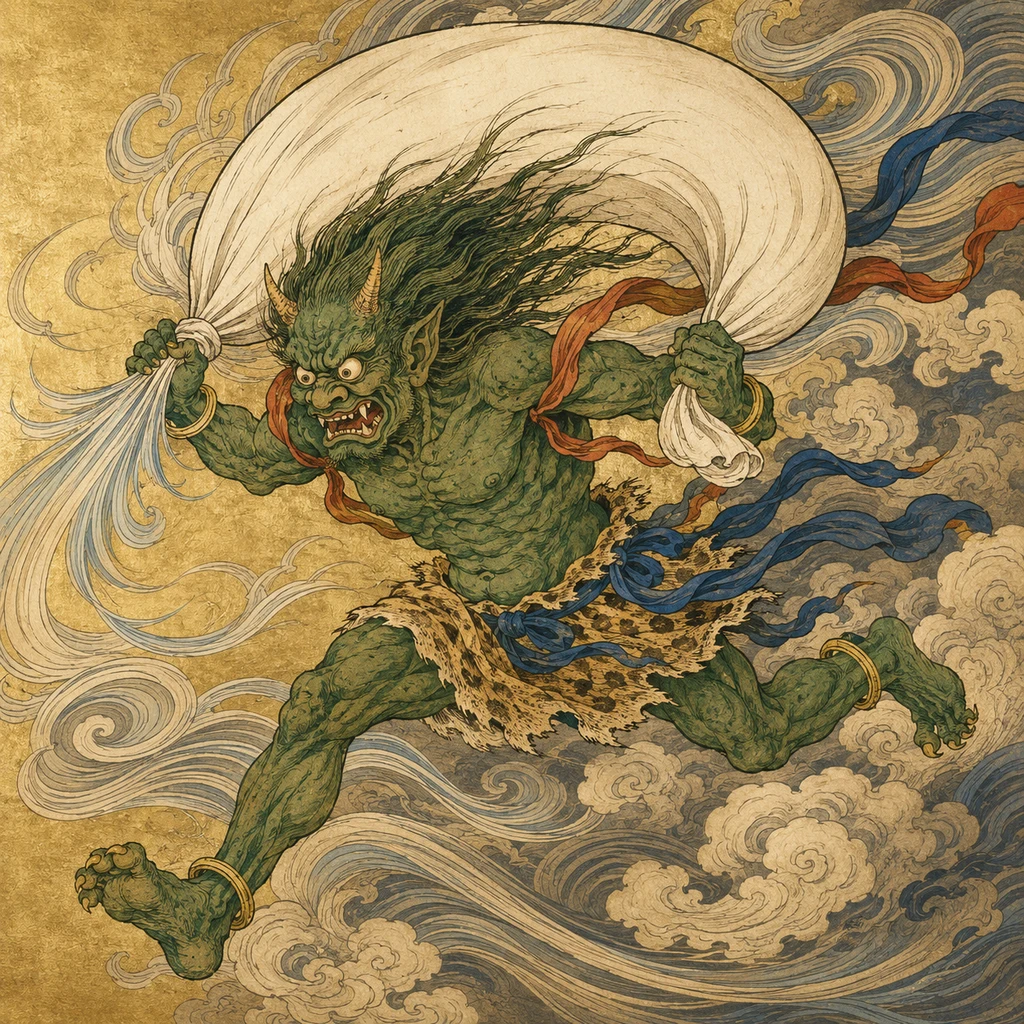
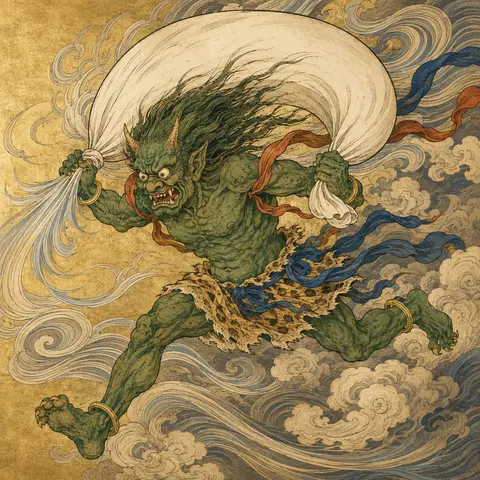
Divine Spirits / DeitiesTatsuta Taisha (currently Sango-cho, Ikoma-gun, Nara Prefecture, the main shrine of the ancient Fujin Festival) / Kazemiya (currently Ise City, Mie Prefecture, a Betsugu of the Inner Shrine of Ise Jingu) / Kennin-ji (currently Higashiyama-ku, Kyoto City, Kyoto Prefecture, houses Tawaraya Sotatsu's "Fujin and Raijin Folding Screens")The true identity of Fujin is Shinatsuhiko-no-Kami (Shinatsuhiko, Shinatsuhiko-no-Mikoto), as recorded in the *Kojiki* and the *Nihon Shoki*. The first volume of the *Kojiki* (712) explicitly states in the god-birth section, "Next, they gave birth to the wind god named Shinatsuhiko-no-Kami," while in the *Nihon Shoki* (720), Volume 1, Section 5, the deity appears under multiple names such as Shinatobe-no-Mikoto and Shinatsuhiko-no-Mikoto. The divine name "Shina" (long breath) is an ancient Japanese word representing "breath/wind," and "tsu" (of) + "hiko" (male god) translates to "the male god of long breath," essentially the personification of breath and wind itself. The core of Fujin worship in the ancient state was Tatsuta Taisha (formerly Tatsuta Fujin-sha). Located in Heguri District, Yamato Province (now Tatsunominami, Sango-cho, Ikoma-gun, Nara Prefecture), it stands at a location directly hit by the strong downdraft winds (oroshi) blowing from the Ikoma Mountains into the Yamato Basin. The *Nihon Shoki* already mentions worshiping the "Fujin of Tatsuta" in the year 675 AD (Emperor Tenmu's 4th year). During the Ritsuryo period, the "Tatsuta Fujin Festival" was held by imperial decree every April (praying for favorable winds before the Niiname harvest festival) and July (before the typhoon season) as one of the Jingikan's Four Seasons Festivals. It was officially registered in the *Engishiki* (927) deity register as the Tatsuta Shrine Four Pillars (with Amenomihashira-no-Mikoto and Kuninomihashira-no-Mikoto as primary deities) and was highly regarded in state rituals as the wind god of bountiful harvests. From the Middle Ages, Fujin worship was succeeded by Kazemiya (Kazahinomi-no-miya) at Ise Jingu, Suwa Taisha (which enshrines Takeminakata but also holds Fujin aspects), Echizen Tsurugi Shrine, and Sada Shrine in Izumo. Iconographically, Tawaraya Sotatsu's "Fujin and Raijin Folding Screens" (circa 1620s, formerly at Kennin-ji in Kyoto, designated a National Treasure in 1952, currently deposited at the Kyoto National Museum) is the definitive work. On the two-panel, double-screen golden background, the Wind God on the right (a green demon wearing only a tiger-skin loincloth, carrying a wide-open wind bag on his shoulders) and the Thunder God on the left (a white demon carrying a circle of drums) face off, creating tension in the empty space between them. This composition is considered the pinnacle of the early Edo Rimpa school. Later, painters like Ogata Korin (1700s) and Sakai Hoitsu (1800s) left behind faithful copies of Sotatsu's original "Fujin and Raijin Folding Screens" (Korin's at the Tokyo National Museum, Hoitsu's at the Idemitsu Museum of Arts), which irreversibly cemented the standard imagery for Fujin in Japan. The wind bag held by Fujin traces its origins to the iconography of the Hellenistic Boreas (god of the North Wind). In ancient Greece, Boreas was depicted holding a wind bag open over his shoulders. Following Alexander the Great's eastern campaigns, this image was adopted into the Buddhist art of Gandhara in Central Asia, and it traveled along the Silk Road through China (as seen in the Fujin statues at the Mogao Caves in Dunhuang) and Korea, finally reaching Japan. Vāyu (Fujin) in Sanskrit belongs to the same lineage and is deified as "Futen" within the Twelve Devas of Esoteric Buddhism. Sotatsu's rendering of the wind bag represents the unique Japanese culmination crystallized at the very end of this long transmission. In folk religion, Fujin clearly displays ambivalent divine traits. The aspect of a calamitous deity (Akufujin) who summons typhoons, autumn gales, and storms coexists with the aspect of a benevolent deity (Zenfujin) who presides over the favorable winds sweeping across the fields during the wheat and rice harvests. Rituals embodied a dual structure of both pacifying and praying to these two sides. During the Edo period, the "sending away the god of colds" (when a cold circulated, a straw doll fashioned as Fujin, holding a straw hat and a lantern, was driven out to the village edge or a riverbank to the sound of gongs and drums) was widely practiced across the Tohoku, northern Kanto, and Hokushin'etsu regions, revealing his aspect as a god of pestilence personifying influenza. This is also important as the prehistory of modern public health awareness. In modern literature, Kenji Miyazawa's *Matasaburo of the Wind* (1934) adapted the legend of the "Wind Saburo" (wind-god boy tales passed down near Morioka and the Sanriku coast) in the Tohoku region, making the lineage of wind-child worship known nationwide. Post-war, the contrasting pairing of "Fujin and Raijin" became entrenched in games, anime, and manga (e.g., the Wind Fiend in Square's *Final Fantasy* series, themes in Studio Ghibli's *The Wind Rises*, various wind god summons), carrying the iconographic lineage that began with the National Treasure "Fujin and Raijin Folding Screens" into contemporary subculture.

伝説 Fukurokuju
ふくろくじゅ
Three-Stars-in-One Long-Headed Deity, Fukurokuju
Divine Spirit / DeityChina (Daoist Three Star Belief) / Introduced in the Muromachi Period / Shichifukujin Pilgrimage Sites in Kanto & Kinki (Zen & Obaku Sect Temples)Fukurokuju is the anthropomorphic deity that integrates the three Daoist stars of China (the Gods of Fortune, Wealth, and Longevity) into a single body. Among the three, the Star of Longevity (the Old Man of the South Pole = Canopus) is an ancient astronomical deity recorded in the astronomical chapters of the "Records of the Grand Historian" and the "Book of Jin," and a year in which it could be seen was said to augur world peace. The Star of Fortune was associated with Jupiter, and the Star of Wealth with the Wenchang star of the Big Dipper. Although each initially had its own independent following, the "Sanxingtu" (Three Stars Image), depicting them together, was established in the Song dynasty and popularized as New Year decorations for the masses throughout the Ming and Qing dynasties. The singular deity Fukurokuju is the anthropomorphized amalgamation of these three stars. Multiple origin tales coexist, including the theory that he is the incarnation of the Song Daoist Tiannanxing, and the theory that he is the incarnation of the Old Man of the South Pole himself. His iconography depicts him as short in stature with an unusually elongated head, bearing a long white beard, attaching a scroll to the head of his staff, and accompanied by a crane or turtle. This is the epitome of Daoist iconography: the "short body and long head" are physical auspices of long life, the scroll signifies the mastery of the Dao, and the crane and turtle represent auspicious beasts of longevity. Introduced to Japan in the late Muromachi period (15th century) likely through Zen monks' travels to China and imported Daoist-Buddhist paintings, the Zen and painter-monk circles of the Higashiyama culture period reorganized him into the "Seven Gods of Fortune and Virtue." By combining the already indigenized Ebisu, Daikokuten, Bishamonten, and Benzaiten with the fellow imported deities Hotei and Jurojin, they grouped them as the seven fortune deities styled after the Seven Sages of the Bamboo Grove—the prototype of the current Seven Lucky Gods. Fukurokuju's inherent dilemma lies in the problem of being the same entity under a different name as Jurojin; since both are incarnations of the Old Man of the South Pole, theories considering them the same deity have existed since ancient times. Although early modern popular encyclopedias like Kaibara Ekken's "Yamato Koto Hajime" list them as distinct entities, irregular Seven Lucky Gods variations replacing Jurojin with Kisshoten, Fukusuke, or Inari also circulated in Edo period Takarabune paintings. Because Fukurokuju simultaneously presides over three virtues (descendants, wealth, and longevity), he was favored for family celebrations by merchants and samurai. For longevity prayers by the clergy, however, Jurojin was often chosen. Their division of roles loosely converged in the late early-modern period as "the comprehensive fortune deity of the secular world (Fukurokuju)" and "the ascetic deity of longevity (Jurojin)."

名妖 Rain Woman
AH-meh-ON-nah
Rain-Summoning Female Spirit
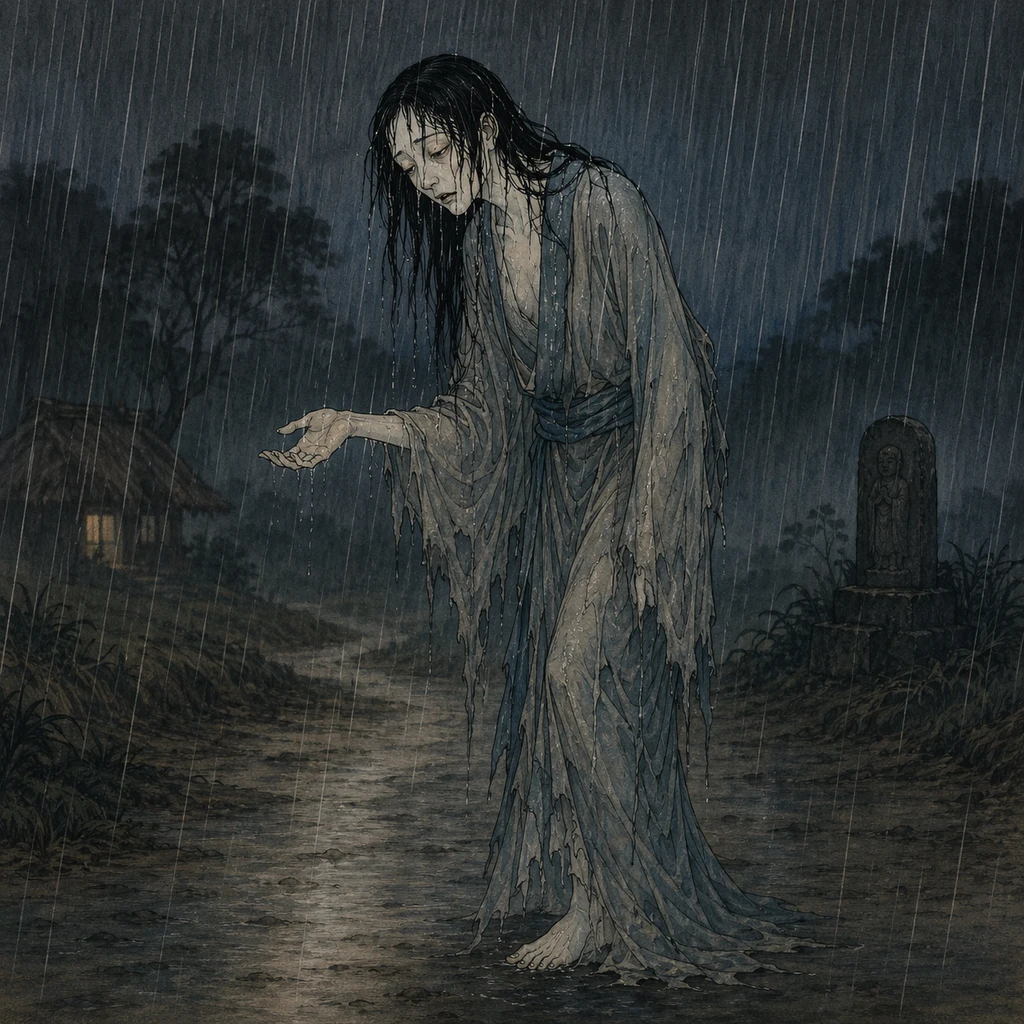
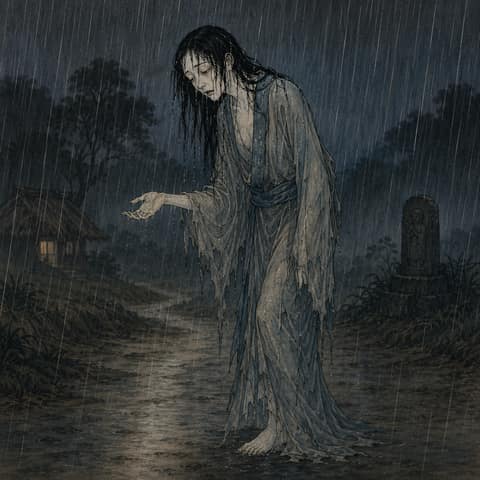
Weather & Calamity SpiritsVarious regions of Japan (notably Shinshū/Nagano and the Kantō area)In historical sources, Ame-onna first appears in Toriyama Sekien’s illustrations, though his entry leans on an allegory from Chu, leaving the standalone monster image faint. In oral traditions nationwide two types stand out. One is a female apparition on rainy nights that targets children (such as Shinshu’s “Ame-onba”), with motifs like approaching crying children on night roads and carrying a sack. The other is a numinous being that summons rain in drought, tied to rain-invoking rites and shrine prayers, venerated as a symbol of blessed showers. Rather than contradicting each other, these reflect a folk reading of rain’s dual gifts and perils. From early modern times, a nickname meaning “one who brings rain” also stuck to individuals, but that is a social label, not a yokai image. Sources vary widely by region, and many tales leave names and citations unspecified.

名妖 Shokuin (Zhu Yin)
SHOH-koo-een
Book-Borne, Picture Scroll Edition
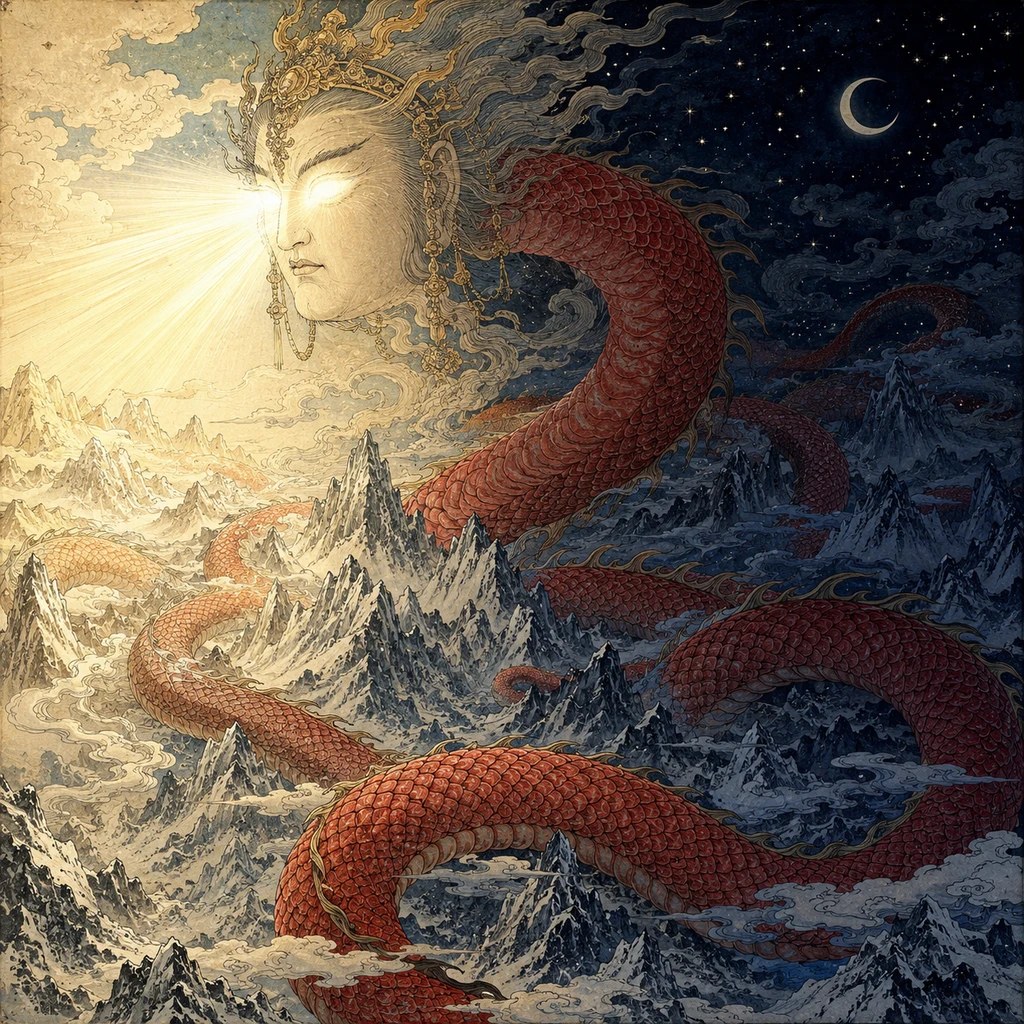
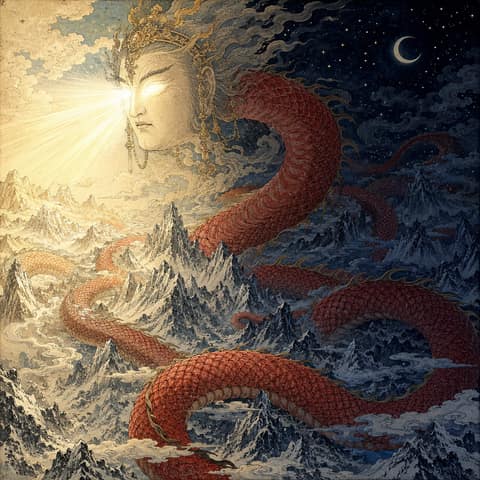
Deities & Divine SpiritsUncertain; derived from the Classic of Mountains and Seas (Shan Hai Jing), transmitted to Japan through textsIn Japan it is understood as a foreign divinity-spiritoriginating in the Classic of Mountains and Seas and related encyclopedic interests. Imagery follows the key points of a human face upon an immense red serpent body, whose opening and closing eyes divide day from night and whose breathing brings seasonal winds and heat or cold. Confusion with the Torch Dragon appears in early modern commentaries, yet most introductions cautiously note textual loci and descriptive differences, and signs of domestic worship are scarce. Consequently, local rites, taboos, and oral lore are meager, with reception centered on reading, sketching, and use as an art motif. It is often cited as an example of incorporating a foreign divinity into yokai catalogues and is positioned as a personification of time and the seasons.

名妖 Suiko (Water Tiger)
sui-ko
The Scaled Suiko, Child-Sized
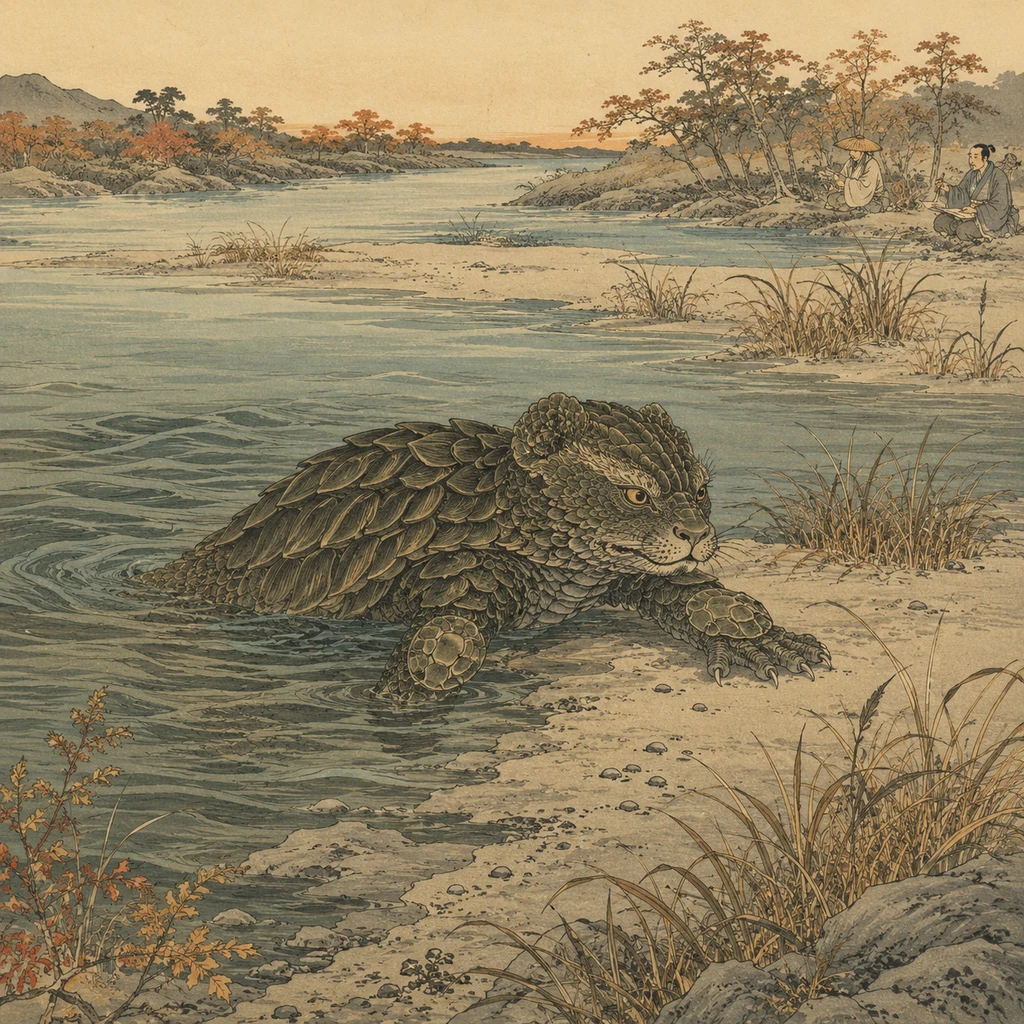
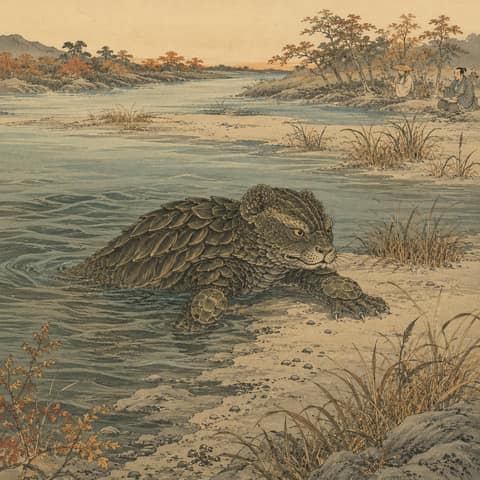
Water SpiritsHubei, China (introduced to Japan through Edo-period texts)This version digs into what sets the suiko apart: it is not a creature of oral legend but one shaped within the pages of books. Where the kappa was born from the fears of riverside life and took on countless forms and names from region to region, the image of the suiko travelled almost entirely through citations in Chinese materia medica and gazetteers. That is why its defining features stay remarkably consistent — a body the size of a small child, hard scales, the habit of baring its carapace on the autumn sand, and the trick of showing only its knees above the water. Japanese scholars cited these Chinese accounts while puzzling over how to square them with the kappa right in front of them. The *Wakan Sansai Zue* placed the two side by side and cautiously judged them "alike yet not the same," while the *Suiko Kōryaku* tried to file reports of water creatures from across the land under the heading "suiko." Toriyama Sekien's illustration in the *Gazu Hyakki Yagyō* is likewise a picture drawn from this continental learning. There are articles touting ways to capture it or its medicinal uses, but interpretations differ from book to book, and the truth remains unclear. The suiko, in the end, is a second face of the water spirit — the trace left by an early-modern attempt to reinterpret the familiar kappa through the lens of Chinese scholarship.

名妖 Hōsōshi (Exorcist of the Great Exorcism)
HOH-soh-shee
Hōsōshi of the Courtly Tsuina Rite
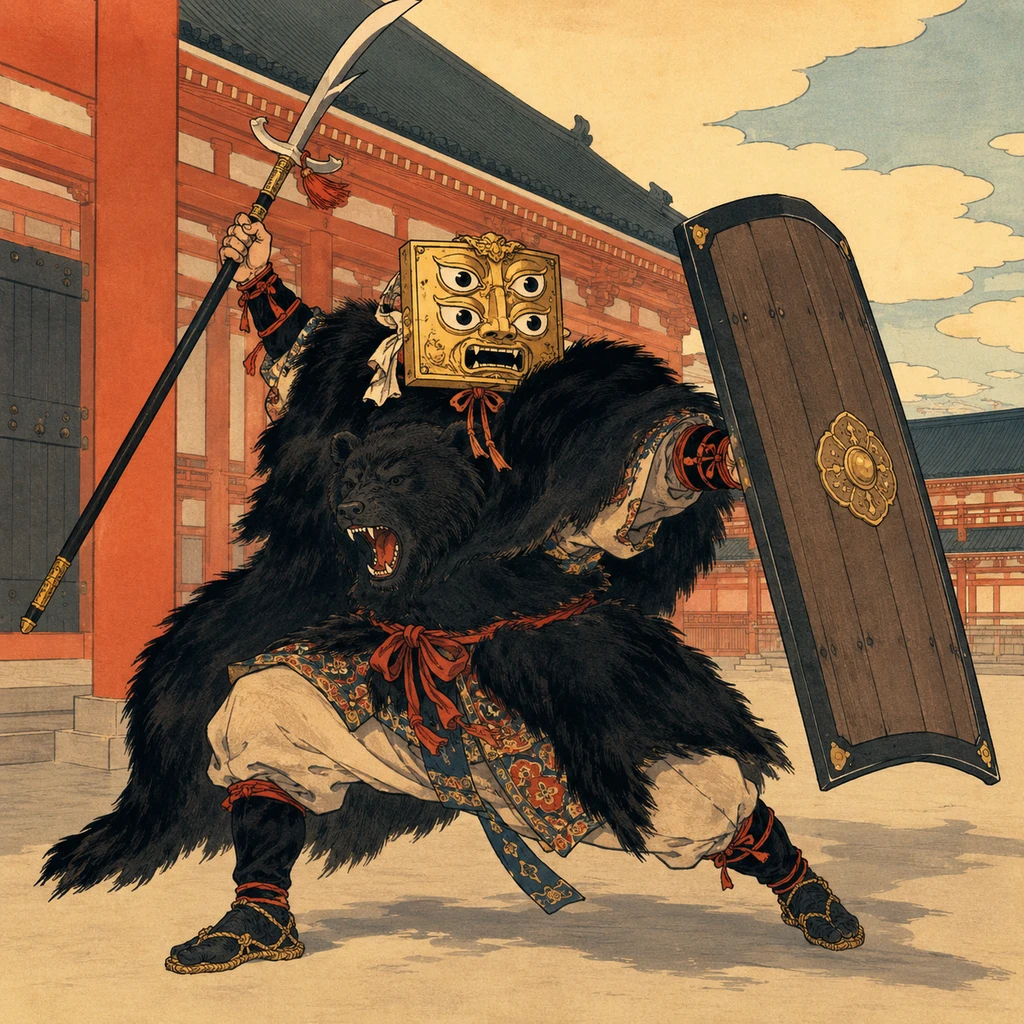
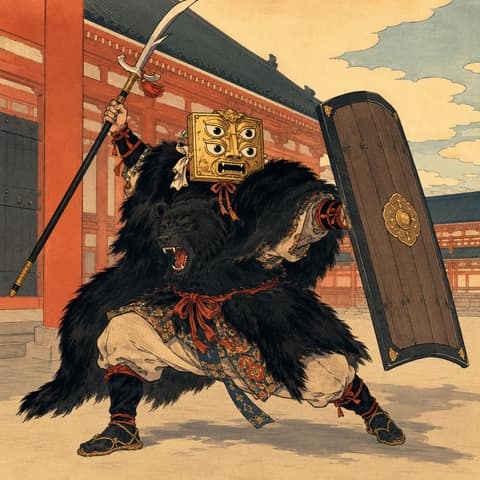
神霊・神格Imperial court (continental ritual imported to Japan)In the imperial court’s Great Tsuina exorcism, this figure confronts and drives out pestilential oni. Wearing a four-eyed square mask, bear hide, and armed with a halberd and great shield, he leads pages and tsuina attendants to circuit the four directions of the palace. The rite follows set forms—onmyoji invocations, drum cues, and expulsion beyond the gates—and later influenced demon-chasing observances at temples and shrines. By the late Heian period, shifts in the term tsuina saw him at times enact a visible “oni role.” Though attire, implements, and routes changed with ceremonial norms, the core purpose remained the banishment of epidemics and ill fortune.

名妖 Mirage (Shinkirō)
shin-kee-ROH
Mirage Pavilions Breathed by the Shink (Sekien lineage image)
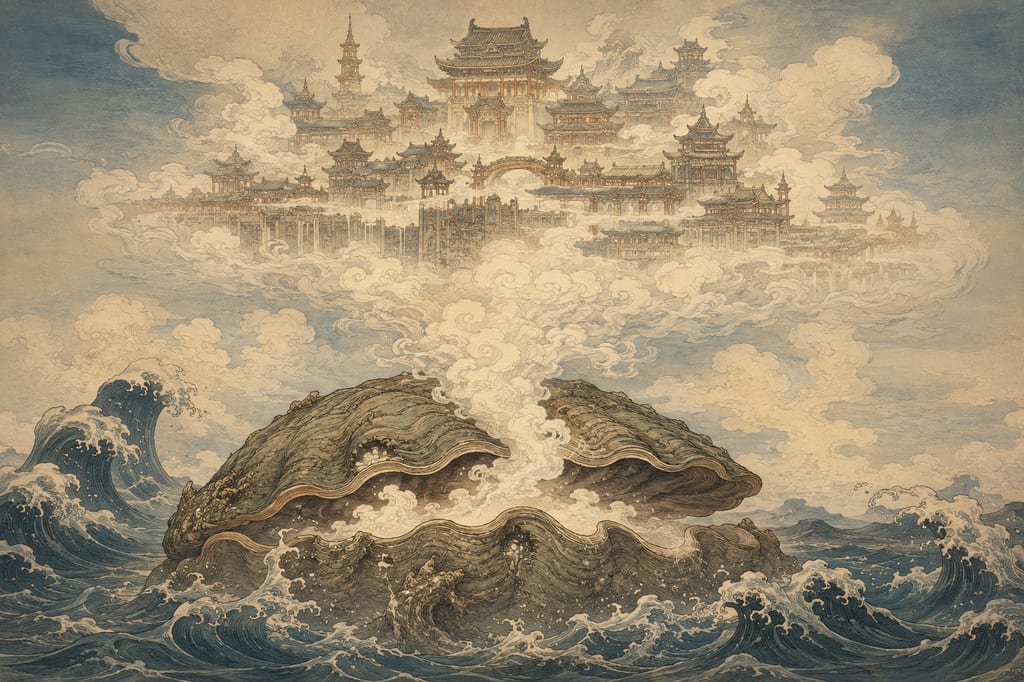
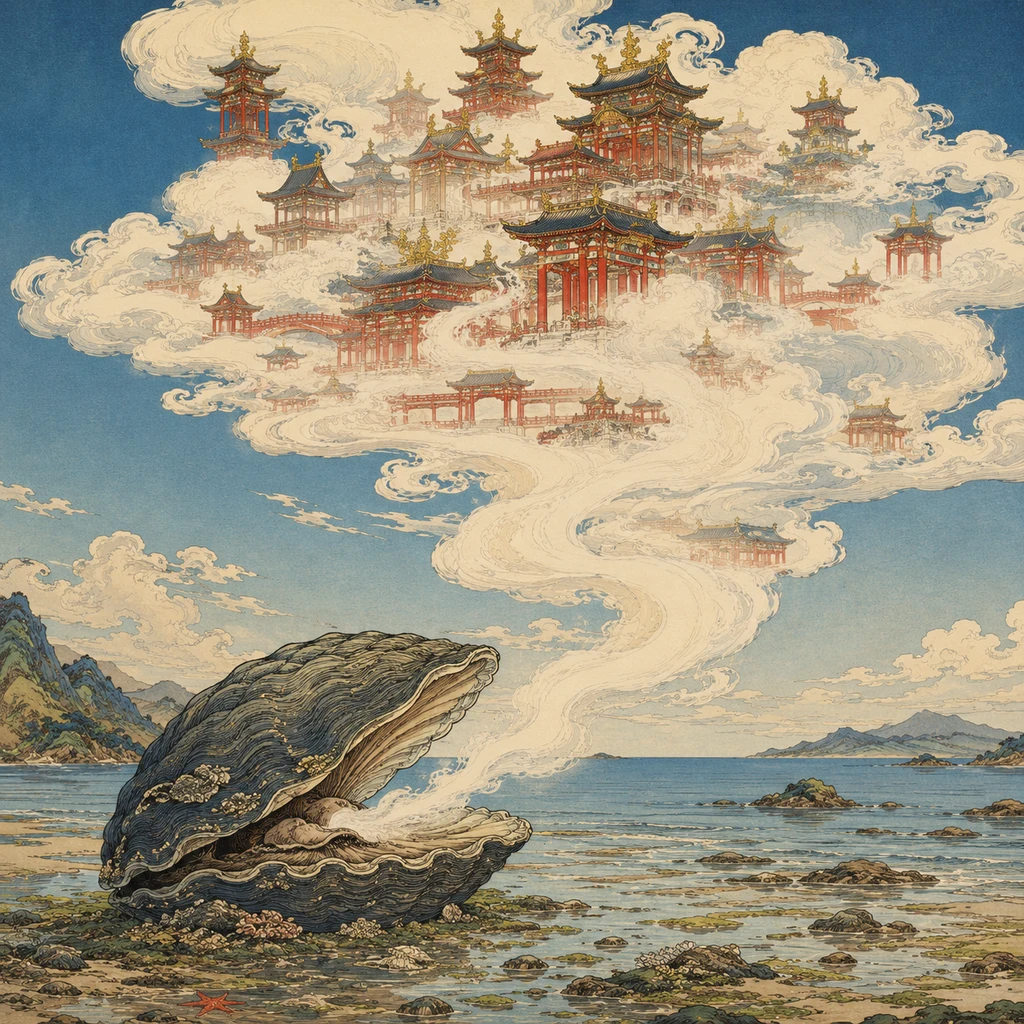
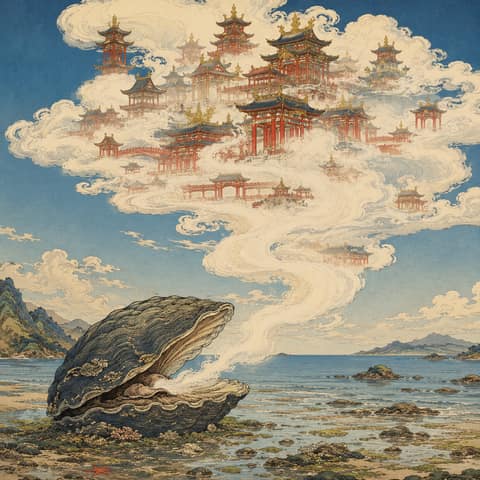
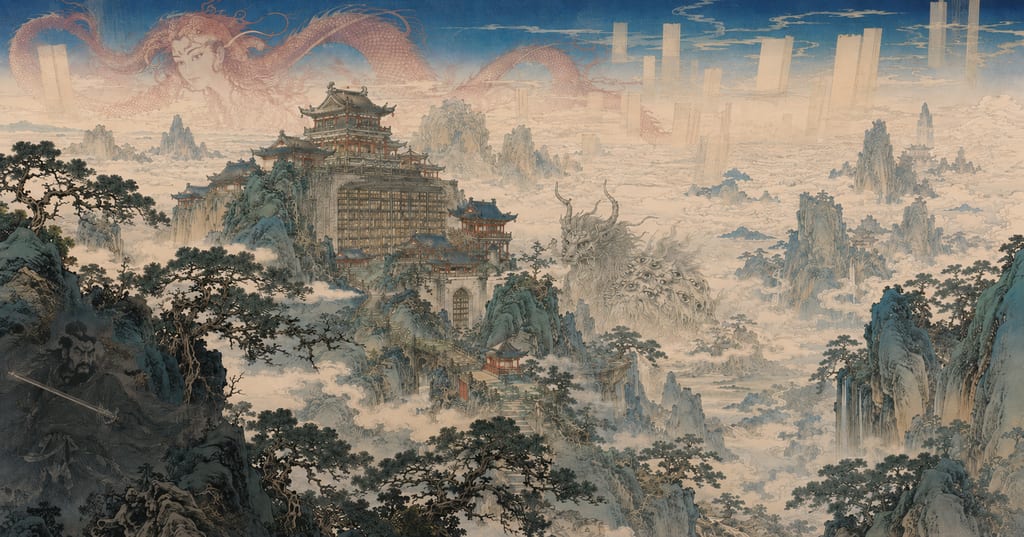
Natural Phenomena SpiritsCoastal regions across JapanIn the lineage attributed to Toriyama Sekien’s Konjaku Hyakki Shūi, the shink—an enormous clam—exhales a vapor at the shore, which fills the sky and forms images of towers and palace gates. The imagery depicts inverted or elongated castles and gatehouses drifting above the sea, sometimes shown alongside the shink itself or a dragon. In the late Edo period the motif was repeated in surimono and ukiyo-e and became a popular topic among spectators. The tradition is not fixed to a single locale, with sightings told from coasts and tidal flats such as Etchū. As a yokai it lacks a stable body, appearing and vanishing to beguile onlookers while causing little harm.

名妖 Batsu (Hiderigami)
BAHT-soo (hee-DEH-ree-gah-mee)
Bibliographic Transmission Batsu (Hiderigami) of the Wakan Zukai Lineage
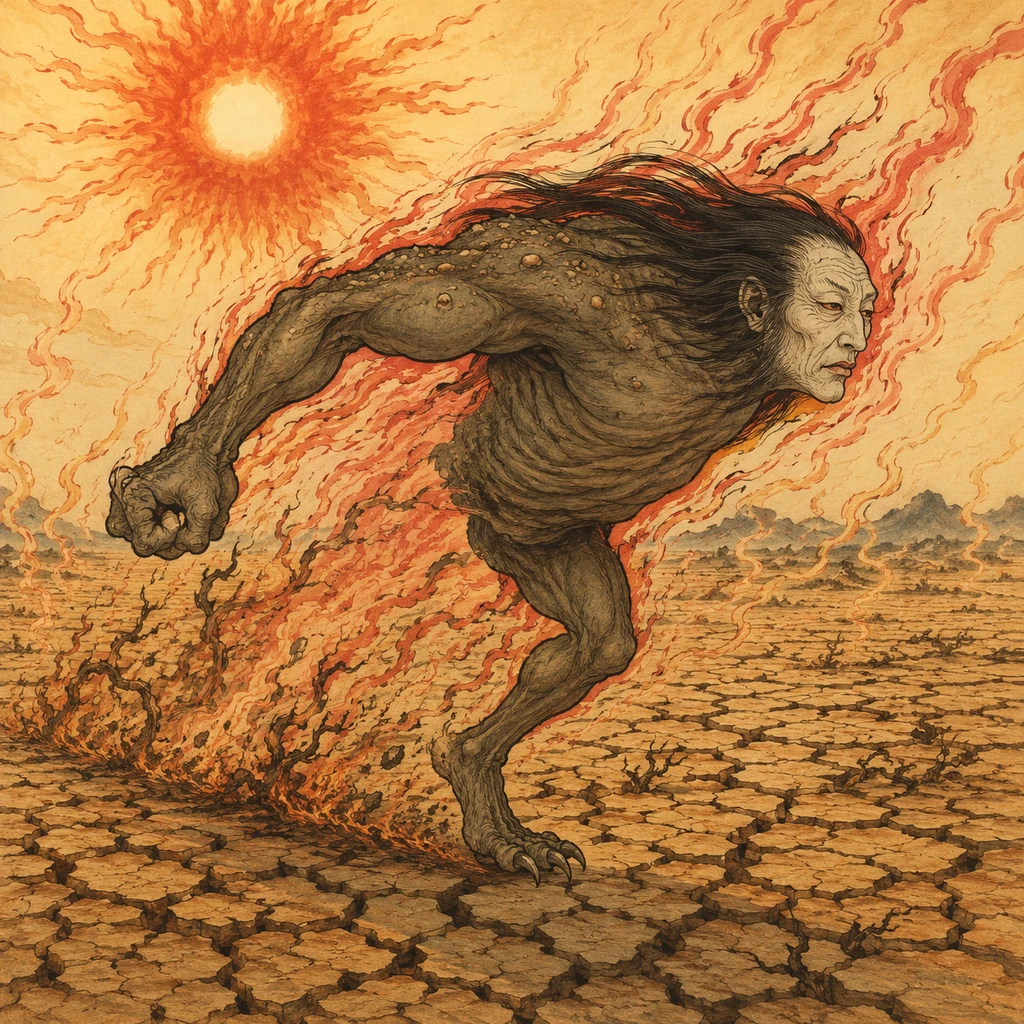
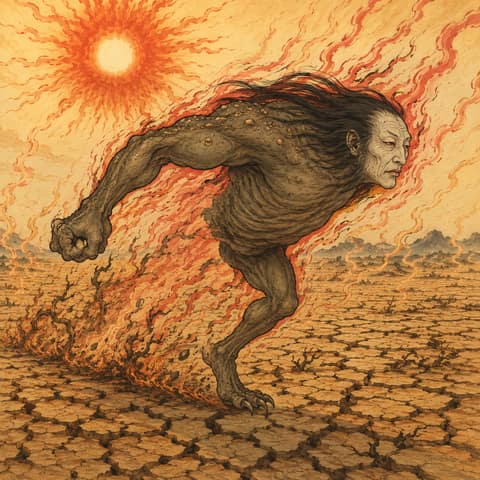
Deities & Divine SpiritsChinese tradition (transmitted to Japan through texts)In Japan, images of the batsu (Hiderigami) were received mainly through later Chinese writings and bibliographic transmission. The Wakan Sansai Zue cites Sancai Tuhui, Bencao Gangmu, and Shenyijing, explaining that the batsu, called the “drought god,” has a human face and beastly body with a single hand and a single foot, runs like the wind, and wherever it dwells no rain will fall. Toriyama Sekien’s Konjaku Gazu Zoku Hyakki visualizes this composite form and notes the alias “Hanmu.” Rather than native Japanese yokai lore, these accounts reflect learned reception of Chinese views on calamities and calendrical omens, treating the batsu as an ideational symbol of drought more than an eyewitnessed apparition. Its form is not fixed, with a goddess aspect (Bo) and a beast-shaped aspect coexisting, though Japanese sources tend to emphasize the latter. Religious responses align with general drought countermeasures such as rain prayers and water-deity rites, and clear cases of direct worship of the batsu itself are not well attested. As a calamity deity, its approach was thought to wither plants and exhaust human spirits.

名妖 Mōryō
MOH-ryoh
Mōryō (Classical Depiction)
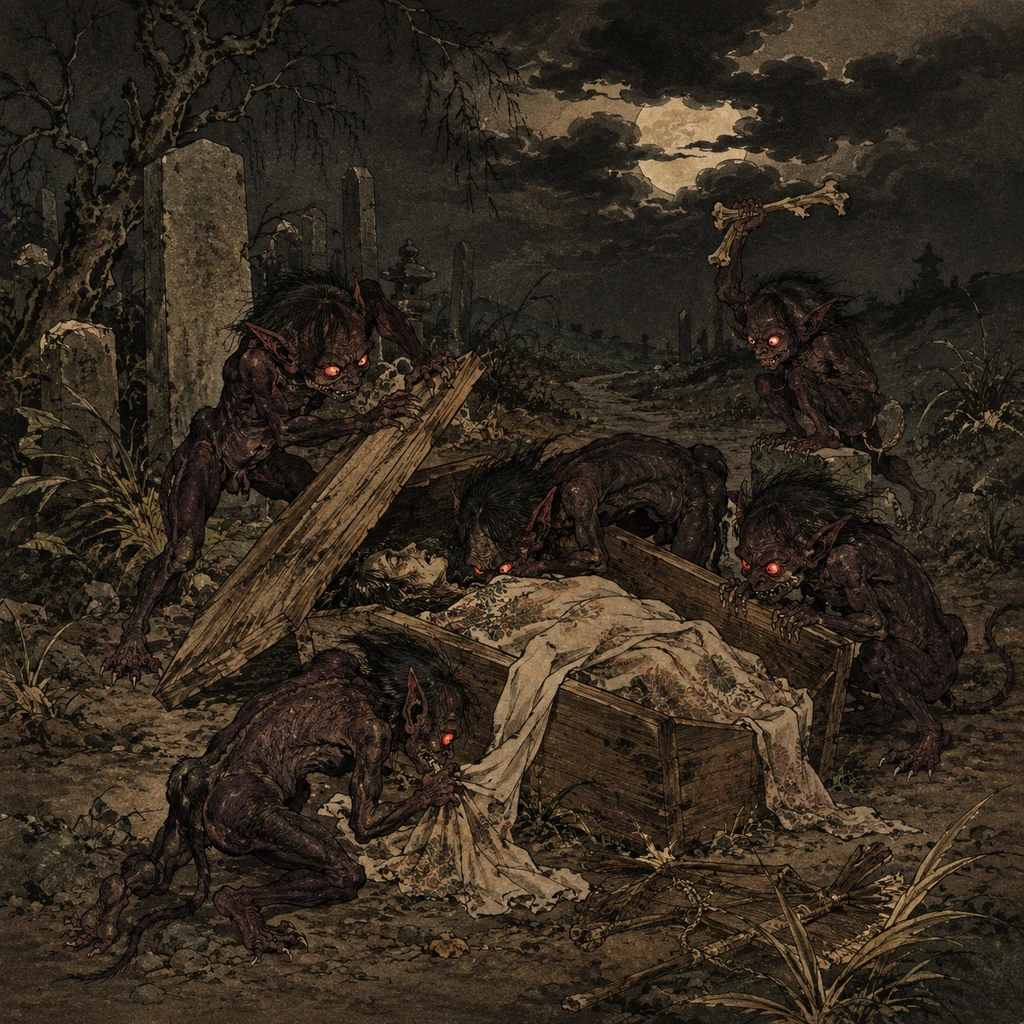
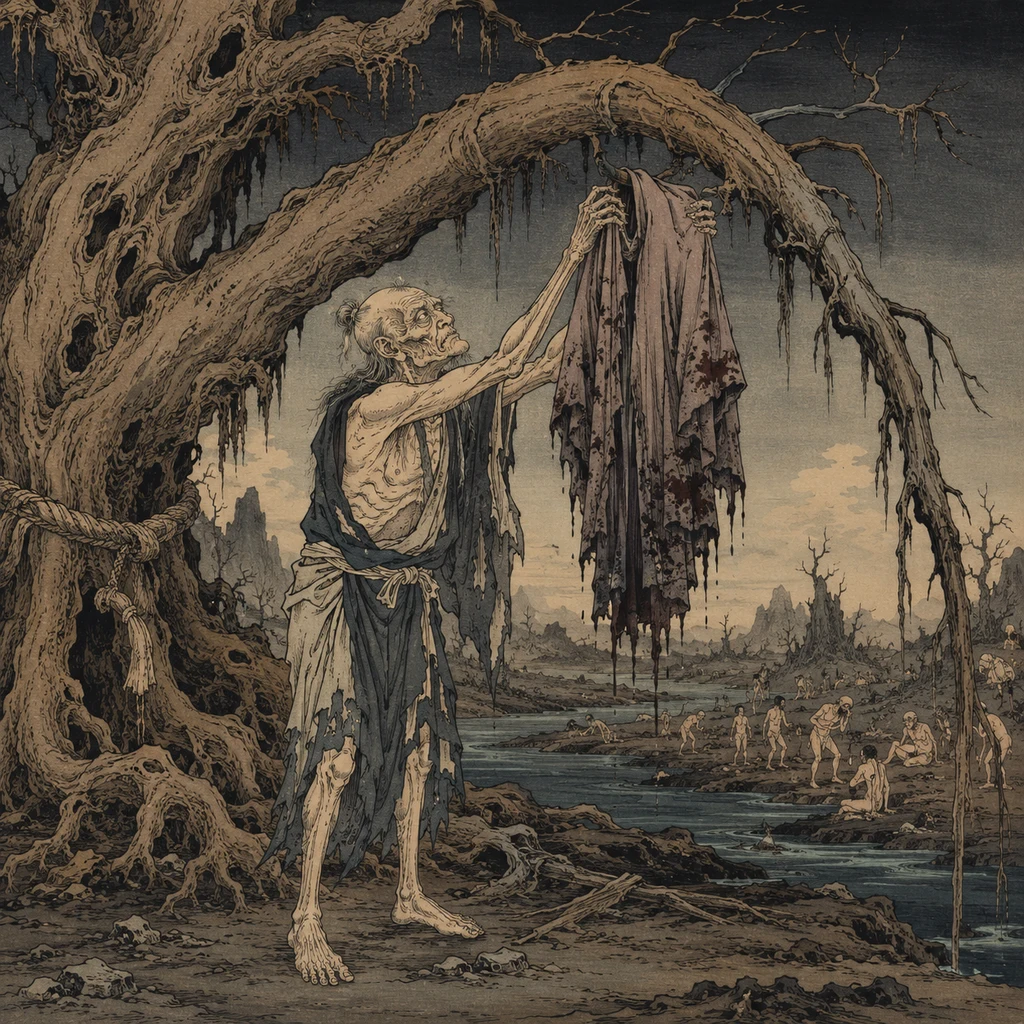
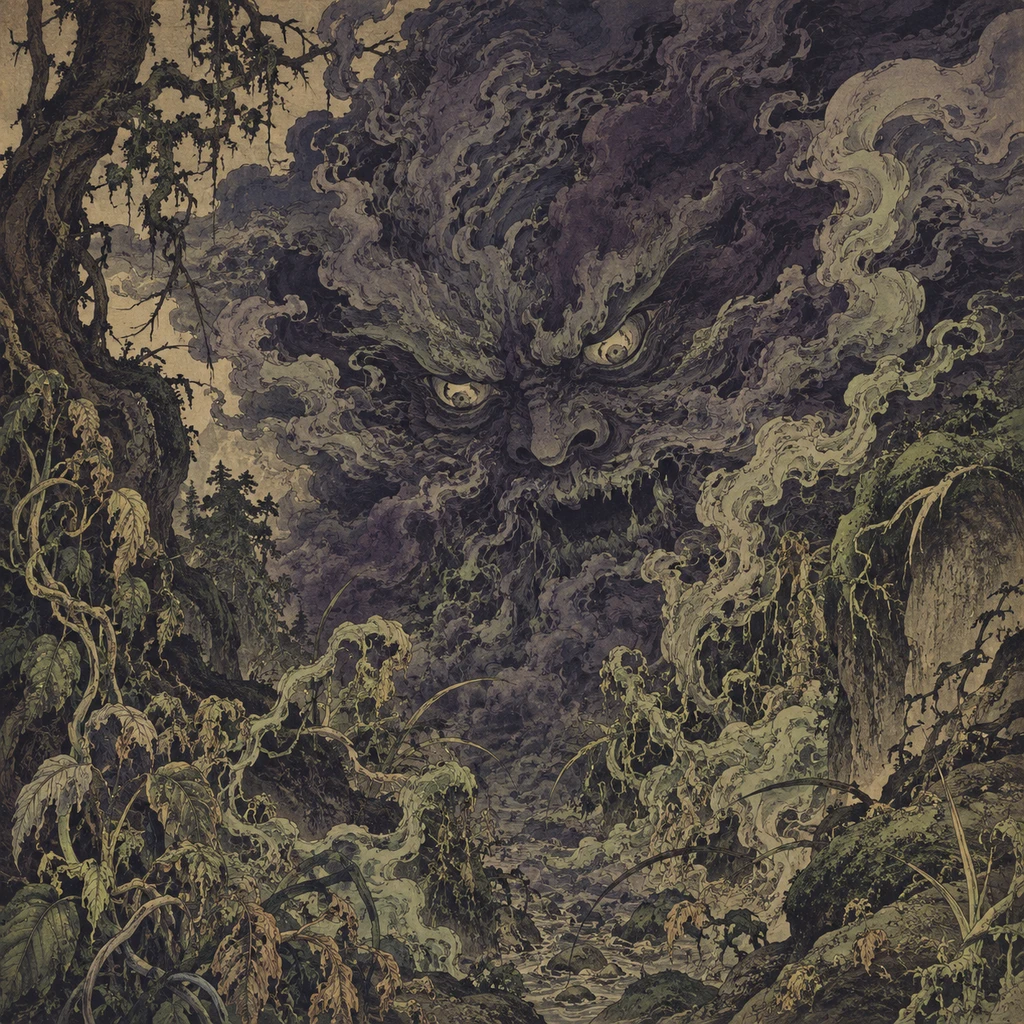
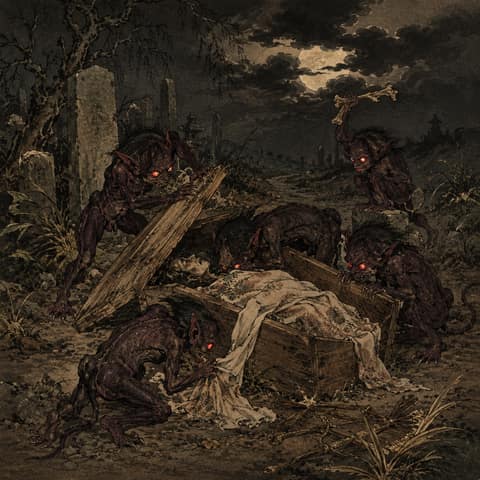
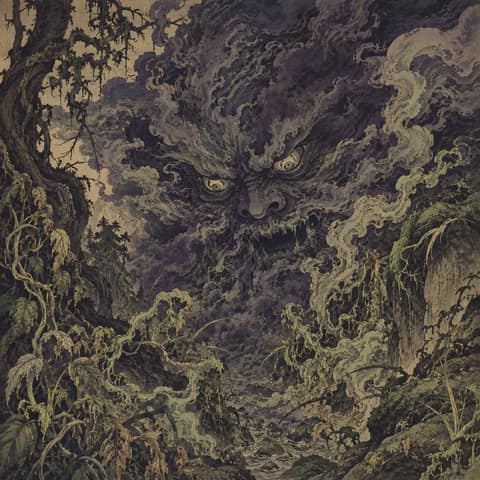
Aquatic SpiritsUncertain (concept from ancient China, adopted in Japan)A generalized classical image of the mōryō based on historical sources. The term was used for uncanny phenomena tied to watersides, graveyards, ancient trees, and great stones, and is understood to be linked with disasters that defile corpses and the spread of death impurity. Its form is not fixed—some accounts call it childlike, others say it manifests only as a vapor or miasma. In Japan, the word came to denote corpse-stealing spirits and served to justify funerary taboos and rites of purification.
稀少 Bake no Kawagoromo
ba-ke no ka-wa-go-ro-mo
The Dipper-Worshipping Fox of Transformation — Bake no Kawagoromo
Animal ShapeshiftersUnknown (a fox-transformation figure recorded in Sekien’s Hyakki Tsurezure Bukuro)This version reads the Bake no Kawagoromo through a single point — the fox that transforms by worshipping the Dipper — and follows the rite of its making and the layers of wit folded into the picture. The passage in the Nuogaoji of the Youyang Zazu, the other source, speaks of more than a skull and the Dipper. There the wild fox is called the “purple fox,” and it is said that “when it strikes its tail at night, fire comes forth.” This stroke of fire from a fox’s tail runs continuous with the foxfire so familiar in Japan; behind the Bake no Kawagoromo, too, stands a fox that should by rights be eerie — kindling fire at its tail in the dark, a skull upon its head. When Sekien exchanged that skull for algae, the dread of the bones faded, and in its place came the comedy and pathos of a creature crowned with weed from the water’s floor. That the picture of transformation leans toward the droll rather than the uncanny is the effect of this single substitution. The word “kawagoromo” itself carries the literary turn Sekien favored. Speak of a kawagoromo, and the most famous in the classics is the “fire-rat’s robe” of the Tale of the Bamboo Cutter — that treasure which burns when set to flame and, if counterfeit, betrays the fraud. It and this fox, whose disguise is about to peel, answer one another twice over through the words “kawagoromo” and “bake no kawa.” There is no written proof that Sekien meant to invoke the allusion, but given how thoroughly his picture-books tread upon classical puns, it is hard to take for mere chance. The placement of the image, too, shows the author’s intent. In the first volume it sits between the “Kutsutsura” and the “Kinu-danuki.” Flanked on both sides by transforming beasts, this run forms a small province set within a book of tool-spirits, given over to the transformations of animals. A fox could crowd in among the spirits of old utensils only because “kawagoromo” could be read as a garment, a thing; and by closing with “mused within a dream,” Sekien made this forced pairing follow, naturally enough, the logic of dreams. Its powers and its failings, too, are all rooted in this one picture. The rite of transformation requires prayer toward the Dipper and a vessel borne on the head (a skull, or algae); should the vessel fall, the change does not take. Dressed though it is as a beautiful woman, it cannot quite clear away the beast in its tail, its paws, its attendants — and that “about to peel” is this fox’s appointed weakness. The lowly wild fox, striving three thousand years to reach the figure of a beautiful woman, bears in itself all the longing and all the shortfall of that road.
稀少 Onmoraki
ohn-moh-RAH-kee
Onmoraki
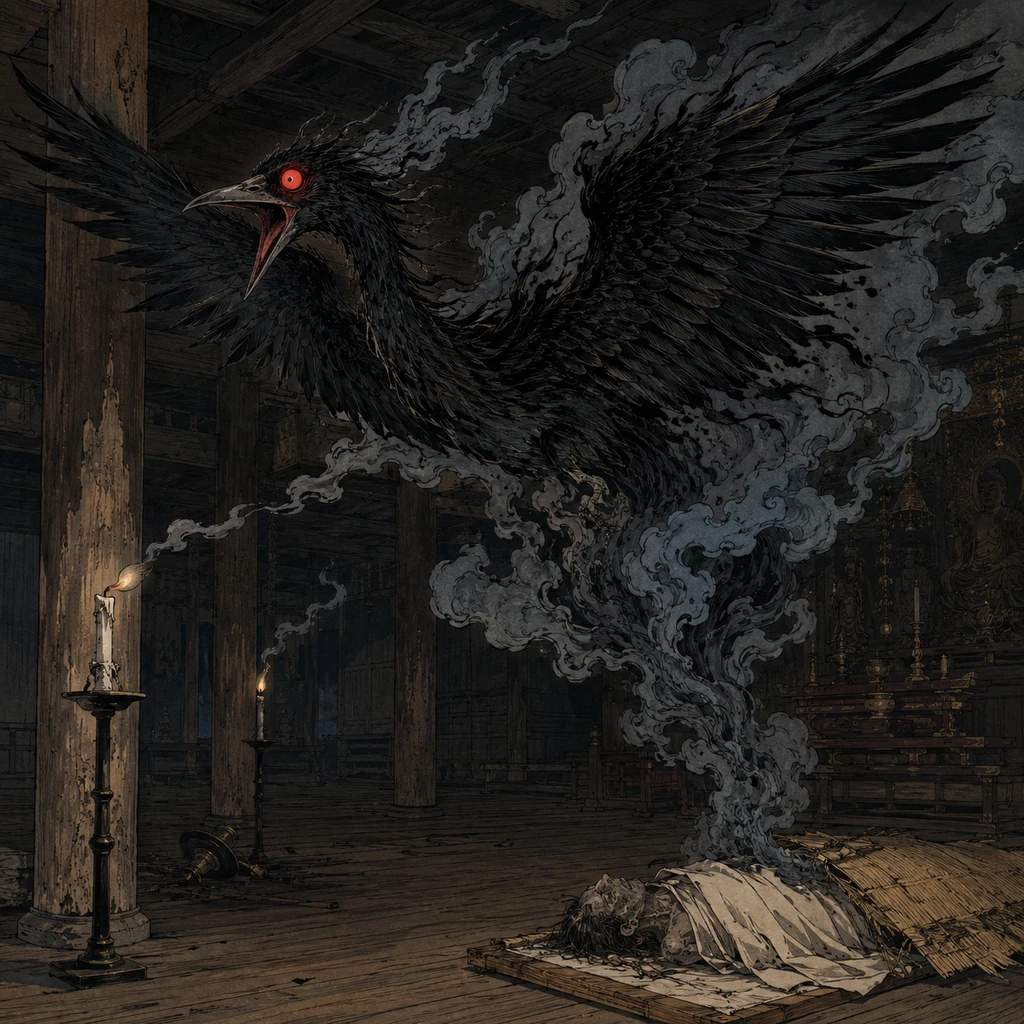
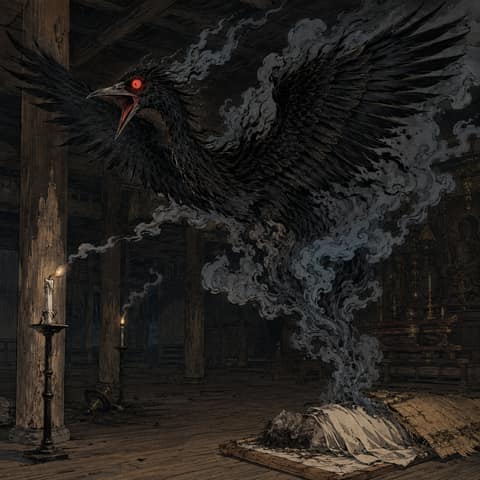
Animal ShapeshiftersJapan (tradition derived from Chinese sources)Following Toriyama Sekien’s Konjaku Gazu Zoku Hyakki, it bears a crane-like black body, eyes that gleam like lamplight, and a cry that trembles through its wings. Said to arise from the qi of a fresh corpse, it appears when sutra recitations or memorial services are neglected at temples. Framed by Chinese lore adapted in Japan and retold in Edo-period strange tales, it manifests less from rancor than from circumstances such as unfinished rites or temporarily laid-out bodies, serving as a cautionary apparition upholding temple norms. Sightings are momentary, vanish when approached, and leave scant trace. Its very form is an alarm, understood as a sign of improper or incomplete memorial observances.

稀少 Golden Crow
KEEN-oo (Kin-ū)
Golden Crow
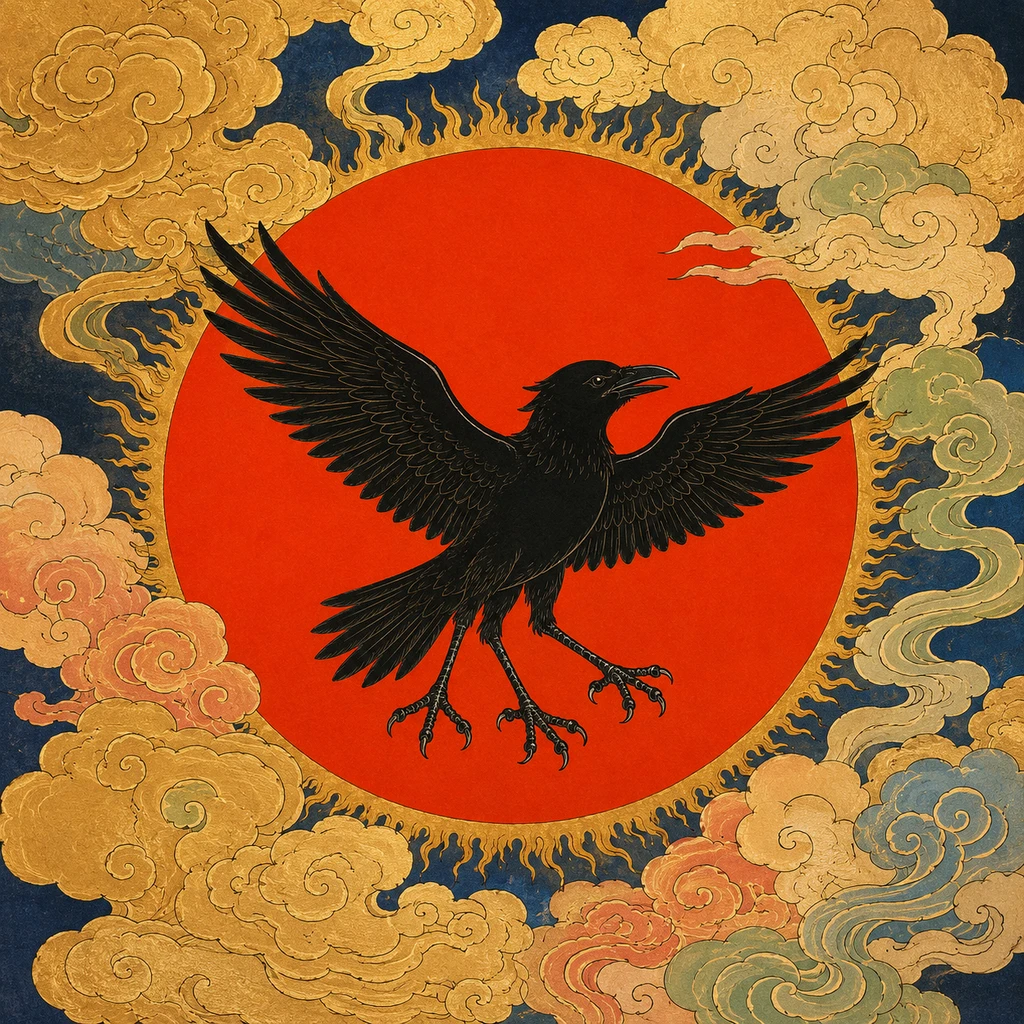
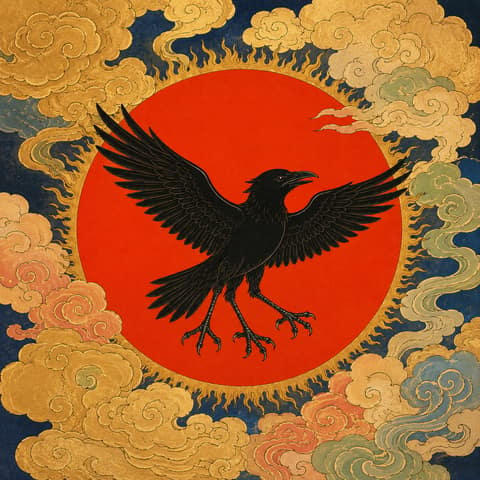
Animal ShapeshiftersChinese origin; transmitted to JapanRooted in ancient China, this iconographic Golden Crow took hold in Japan from the medieval period through religious art and Onmyōdō interpretations. It rarely appears in concrete怪談 and functions chiefly as a symbol. Its three legs are read as the yang number three, marking the sun’s course, authority, and auspice. In Japanese examples, a black crow is placed upon the solar disk held by the Sun Deva, with vermilion and gold backgrounds. Early modern texts sometimes liken it to solar sunspots, but its original nature is mythic and ritual. It recurs on imperial ceremonial garments, temple and shrine banners, and paintings, and in folk events crows may be used with archery targets or sun emblems. Later explanations sometimes confuse it with Yatagarasu, but their origins and roles are distinct.

稀少 Bone Woman
HOH-neh-ON-nah
Bone Woman (after Sekien Toriyama)
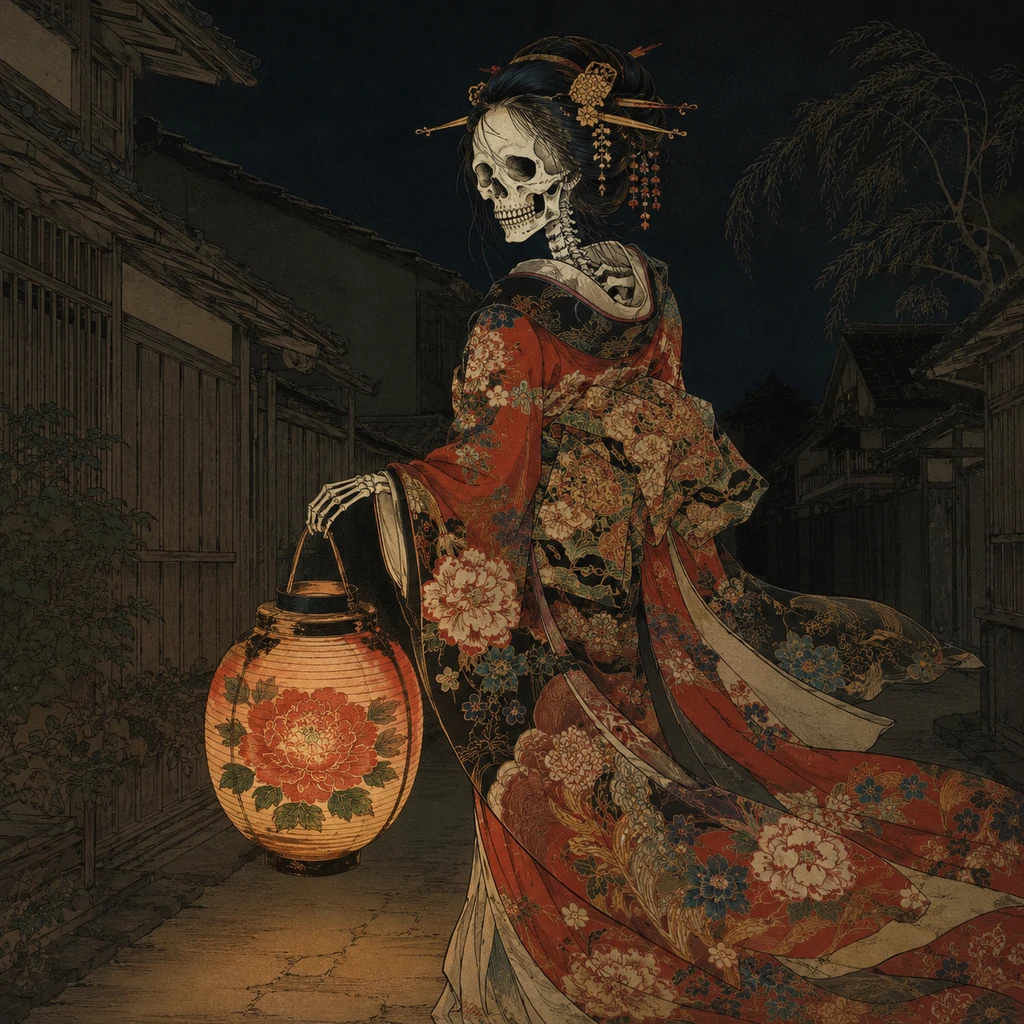
Half-Human BeingsEdo period (print tradition)This version is based on the Bone Woman image in Toriyama Sekien’s Konjaku Gazu Zoku Hyakki. She is a skeletal woman who carries a peony-patterned lantern and visits the home of her beloved in the late night. The source is the ghost tale “Peony Lantern” in Asai Ryōi’s Otogi-bōko. Sekien visualized its core motifs—the inversion of a lovely face and a skeletal body, and the link between lamplight and erotic affection. Rooted in Edo-period notions of vengeful fixation and shifting appearances common to yomihon and kaidan, the figure is an iconographic type rather than a legend tied to specific locales or persons: not a land deity or beast, but a visualization of a passion-bound revenant. Peonies, lanterns, and night roads are its key nodes. While later lore speaks broadly of walking skeletons, this image stresses appearances born of yearning and nocturnal trysts.
稀少 Mountain Sprite (Sansei)
SAHN-say
Traditional Account (Wakan Sansai Zue and Sekien Lineage)
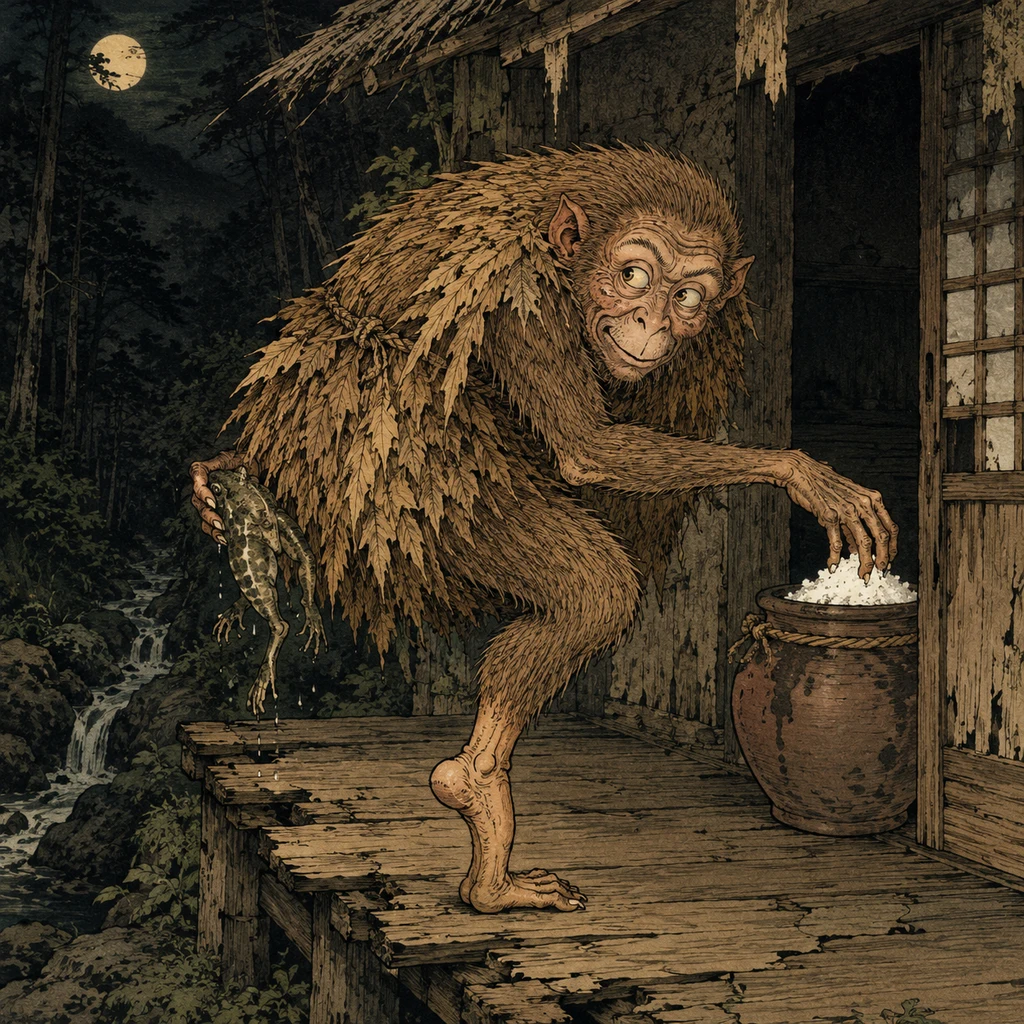
Mountain & Wilderness SpiritsChina – around Anguo County, Hebei ProvinceThis version draws on Chinese materials cited in the Edo-period encyclopedic Wakan Sansai Zue and on Toriyama Sekien’s pictorial interpretation. The mountain spirit lurks in the hills, watching mountain huts where salt is set out for cooking or work and edging closer to them. Sources differ on size, some saying about one shaku while others claim three to four shaku. Its hallmark is a single leg with a heel set backward, making its tracks hard to read. It favors small wetland creatures like crabs and frogs and appears along stream gullies. It is said to bring lustful harm at night, but will retreat if the drought deity’s name “Batsu” (Hatsu/Boatsu, the Chinese demoness Ba) is spoken, a type of name-utterance apotropaic. Those who harm or consort with it suffer illness or fires, functioning as a cautionary taboo against contact. In Japan, Sekien labeled it “Yamaki” (mountain demon) and depicted it peering into a hut with a crab in hand, providing visual cues; local oral lore is scant, and treatment remains largely bibliographic. Modern reinterpretation is restrained, keeping to the contours of old records.
稀少 Jami (Evil Miasma Spirit)
JAH-mee
Iconographic Interpretation Version
Half-Human BeingsChinaThis version organizes the image of the Jami as an example of Sekien aligning a Chinese-origin demonic concept within Japan’s yokai system. Its original sense is “pernicious enchantment,” classed among chimi, a noxious presence born from the gloom of mountains and wastelands that harms body and mind. Its form is not fixed in classical texts, and images function more as visualizations of an idea. The effects fall between illness and invisible curse—fever, hallucination, frenzy—sometimes triggered by contact with resentment or defilement. Countermeasures include bans, talismans, and wards; traditions speak of drawing a prison on the ground to summon and seal, binding it by asking its name, or transferring it into a vessel. In Japan it rarely became an object of distinct cult, often treated as a generic term alongside more-ryo. In folk terms it is distinguished from miasma, mononoke, and tsukumogami, a high-abstraction yokai appearing where the chill of wild places intersects with human grudge.

稀少 Human-Faced Tree
neen-MEN-joo
Illustrated Compendium Tradition—Sekien Design Edition
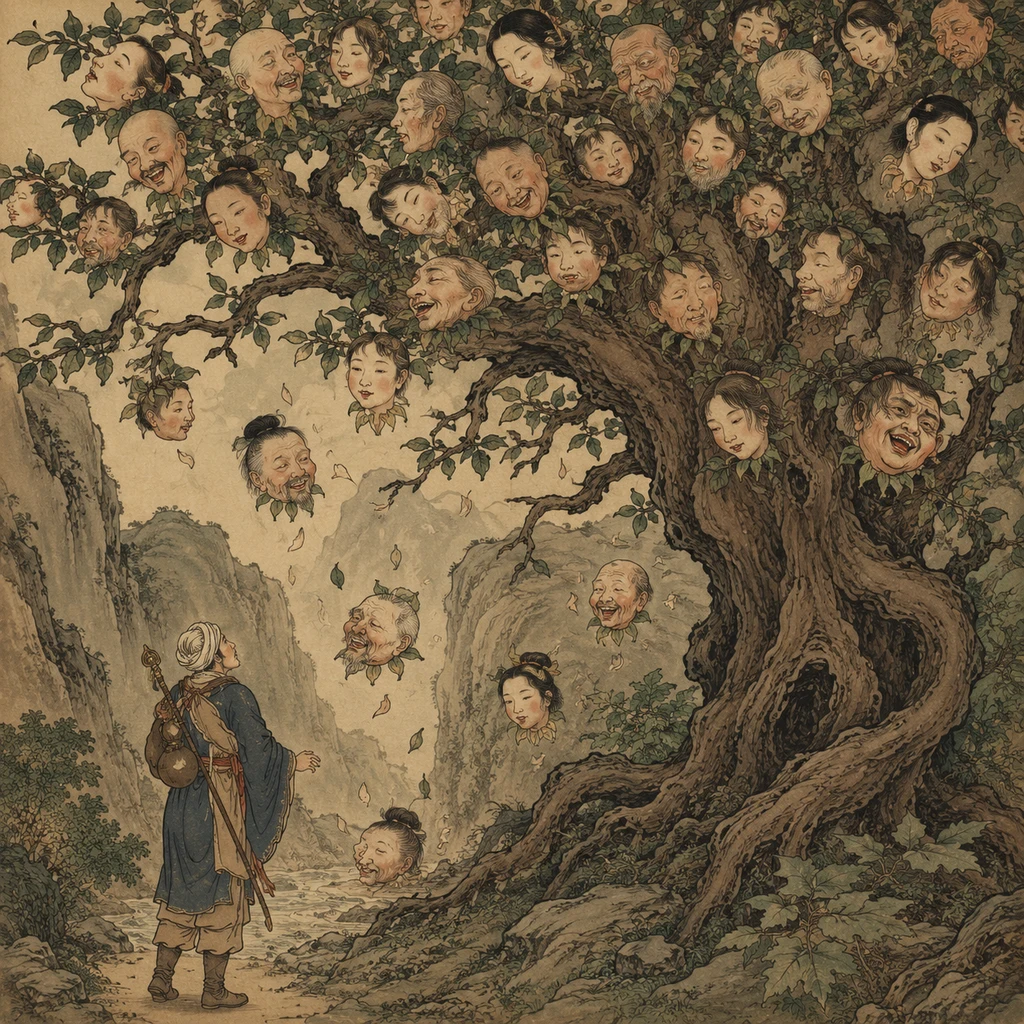
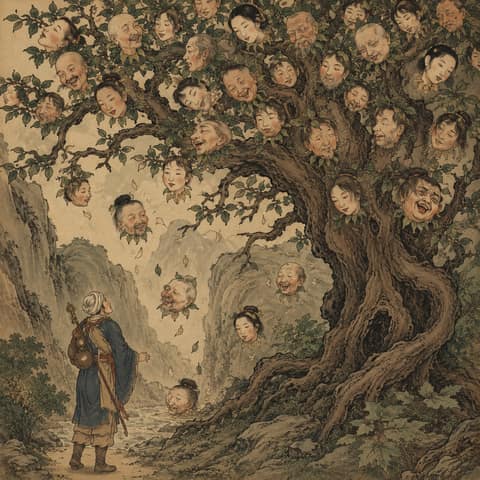
Natural Phenomena SpiritsUnknown; said in sources to grow in the distant land of Dashi ("Great Food" country) to the southwestBased on Edo-period natural history notes and shaped by Toriyama Sekien’s pictorial intent. It is a tree that grows thick in mountain valleys and bears blossoms at the tips of its branches that resemble human faces. The flowers do not understand human speech, but are said to smile at calls or sounds. When laughter overlaps, the petals lose strength and eventually wither and fall. In Japan it was received as a tale of foreign curiosities, lacking specific local toponyms or anecdotes. The faces vary from old to young, often depicted grinning with teeth as they sway in the wind. Its true nature is unclear—treated either as a plant spirit or a rare anomalous tree—and it was recorded more as a curiosity than a source of fear.

稀少 Ashinaga Tenaga (Long-Legs and Long-Arms)
ah-shee-NAH-gah teh-NAH-gah
Wakan Zu-e Lineage: Long-Leg and Long-Arm Pair
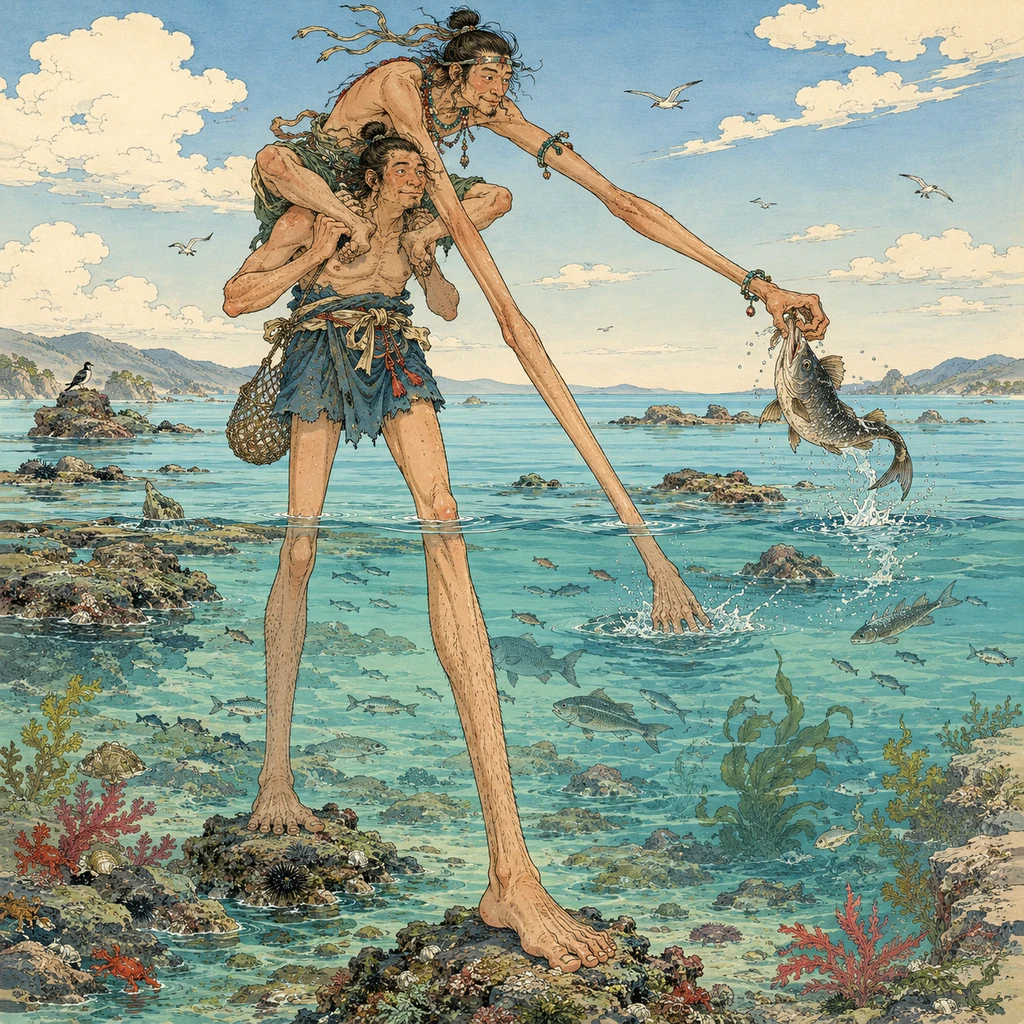
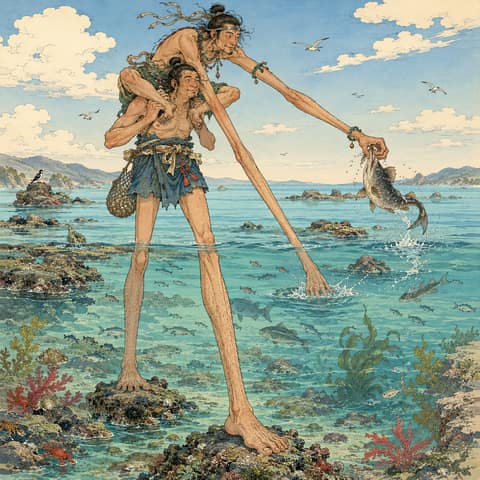
Half-Human BeingsUncertain (ancient foreign lands as reported in early geography)Grounded in the accounts of Sancai Tuhui and the Wakan Sansaizue, this depiction centers on the paired action of the Long-Leg (Ashinaga) and Long-Arm (Tenaga). The Long-Leg wades far into shallow seas, straddling reefs between waves to provide stable footing, while the Long-Arm extends his reach beneath the surface to gather fish and shellfish and to handle nets and baskets. They are recorded as foreign peoples, unattached to specific locales or clans. Dimensions are often given as legs three jo and arms two jo, though sources vary and no single physique is fixed. In Japan they appear in palace screen paintings, caricatures, and kusazoshi, where a set piece of the two cooperating against rough seas became standard. Religiously, they are sometimes placed in Dragon Palace tales as orderly retainers of the sea deity. As folklore, they symbolize otherworldly labor and the extension of reach across distance, and were consumed as images for maritime safety and plentiful catches. Reports of a solitary “Long-Leg” appearing as a weather portent are a separate tradition borrowing the name and should be distinguished from this paired form with Long-Arm.

稀少 Tōdaiki (Human Candelabrum)
toh-dai-kee
Setuwa Iconography Edition, after Sekien Toriyama
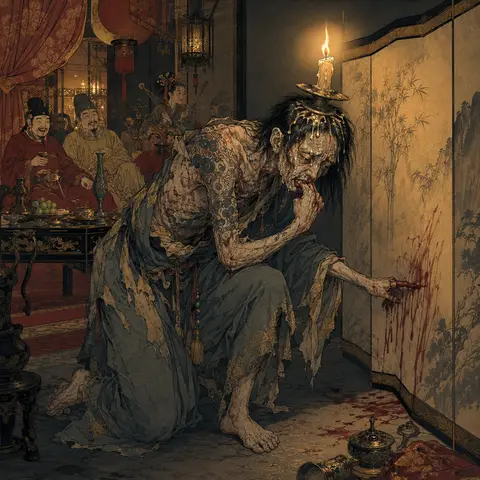
Ghosts & SpiritsUnknown (said to be in Tang China in the tales)An edition based on visual readings of Toriyama Sekien’s Konjaku Hyakki Shūi and related images. Depicted as a human figure in Tang-style robes with a candle set upon a tray or stand on the head. Said to have had the voice destroyed by drugs and the body tattooed, composing poems in tears or fingertip blood in place of speech. Its true nature is not a monster per se but the tragic end of a person enslaved in a foreign land, giving it a strongly narrative character of human ethics and suffering, even while included in yokai catalogs. Details vary by source, yet the figure consistently stands in the night holding a light. Accounts of salvation or death are inconsistent and left unspecified.

稀少 Banana-Plant Spirit
bah-SHOW-noh-SAY
Tradition-Faithful, Sekien Illustrated Edition
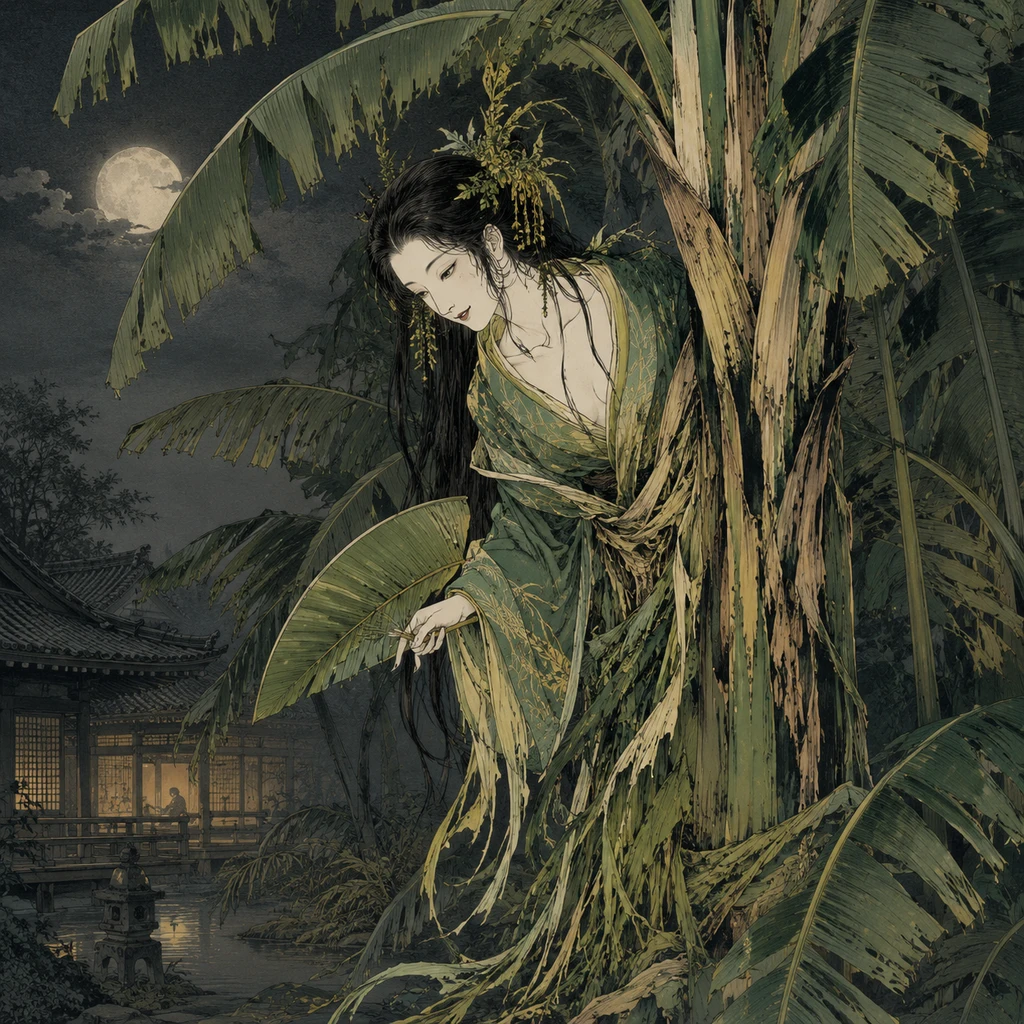
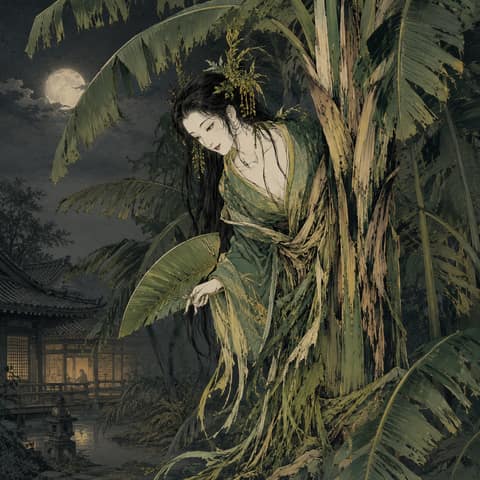
Natural Phenomena SpiritsAcross Japan (notably Ryukyu and Shinshu traditions)A整理 based on the plant-spirit of banana (bashō) as pictured in Toriyama Sekien’s Konjaku Hyakki Shūi. The broad leaves rustle and cast uncanny shadows in wind and rain, thought to summon the strange, with the belief that an aged clump comes to harbor a spirit. It takes the form of a beautiful woman to unsettle both clergy and laity, posing the riddle of whether grasses and trees can attain Buddhahood, and vanishes depending on one’s response. Tales include encounters in Ryukyuan banana groves, an apotropaic rule that those who carry blades are spared, and Shinano stories where striking it leaves the bashō stalk wounded by morning. It is not consistently harmful, more often serving as a warning through shock and confusion. Typical settings are temple gardens, banana plots, and manor yards.
稀少 Shojo
しょうじょう
Wine-loving Red-haired Beast, Noh Master of Dance, Shojo
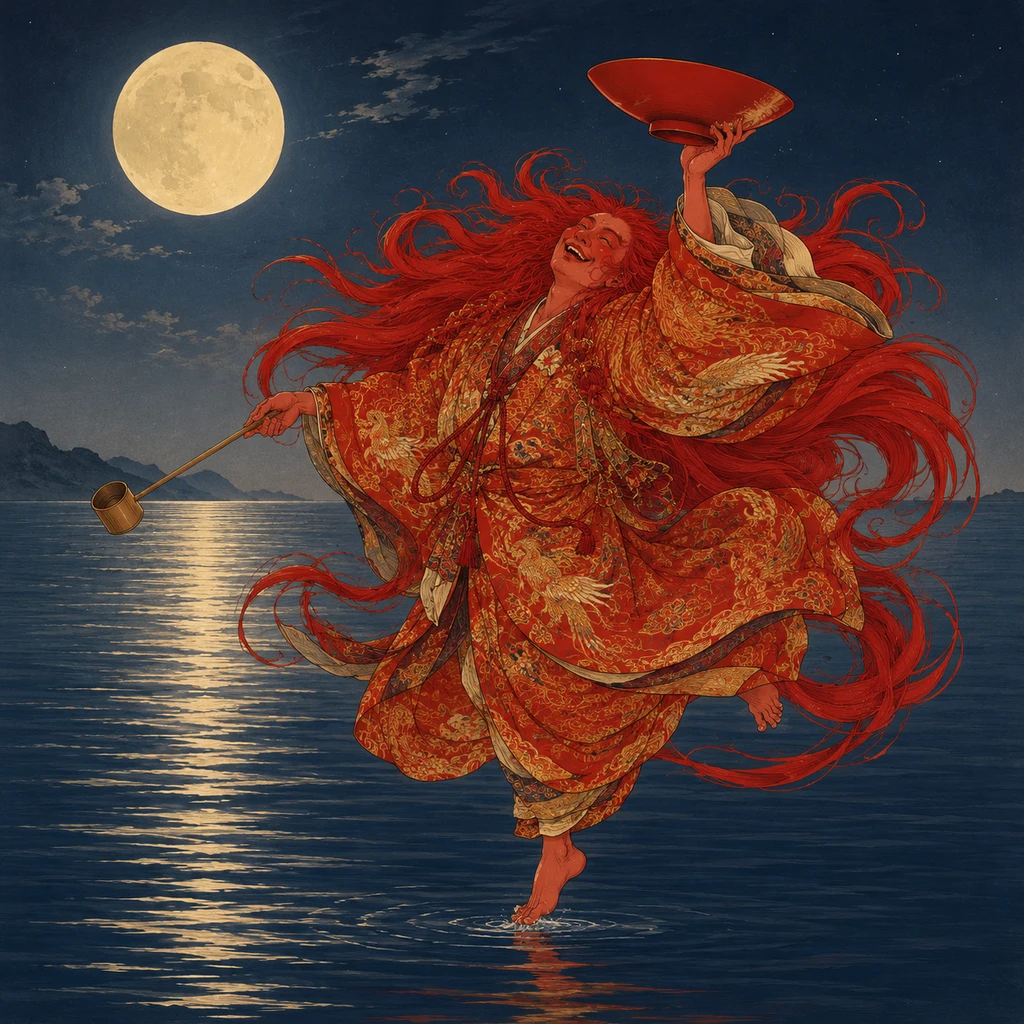
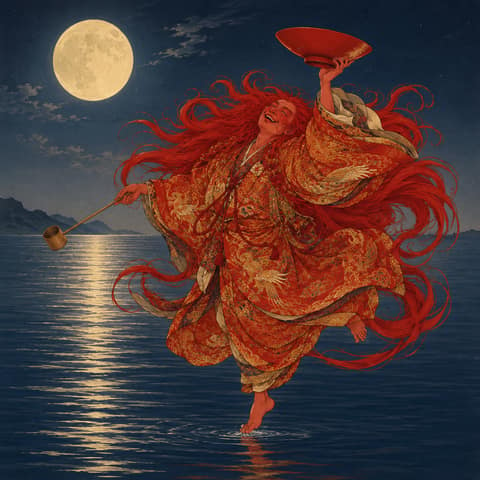
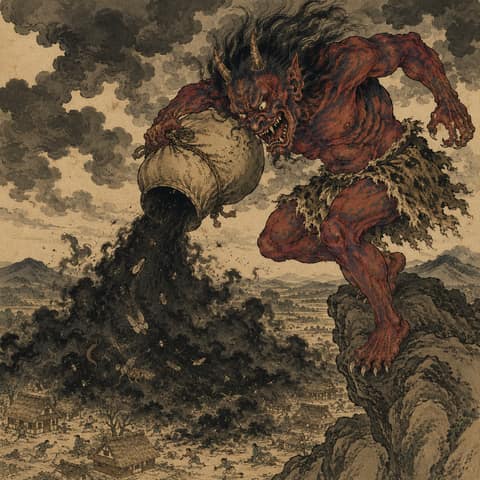
Animal YokaiChinese Classics (Classic of Mountains and Seas, Book of Rites, Chuci, Huainanzi, Commentary on the Water Classic - legendary beast) / Introduced to Japan (Wakan Sansai Zue 1712, Noh play Shojo Muromachi period) / Nagoya, Arimatsu, Tokai City (Shojo giant doll festival, first appearance 1779)The origins of the Shojo lie in two lineages of lore from Chinese classics. ① The "Speaking Beast" Lineage — In the "Quli" section of the "Book of Rites", it is stated: "The parrot can speak, but it still belongs to the birds; the shojo can speak, but it still belongs to the beasts" (a moralistic quote meaning that even if it understands human speech, it does not transcend the realm of beasts). The "Erya" describes it as "small and fond of howling," while the "Classic of Mountains and Seas" states: "On Mount Zhaoyao, there is a beast whose shape resembles a macaque with white ears; it crouches to walk and runs like a human. Its name is xingxing (=shojo), and eating it makes one a good runner." ② The "Beast Fond of Wine and Blood" Lineage — The "Commentary on the Water Classic" notes that the shojo of Pingdao County in Jiaozhi "looks like a yellow dog or a badger, has a human face with regular features, is good at talking with people, and its voice is as beautiful as a fine woman's." The "Lüshi Chunqiu" considers "the lips of the shojo" a great delicacy, while Li Shizhen's "Bencao Gangmu" (1596) details it as a creature from Jiaozhi (modern-day northern Vietnam) with a human face, beast's body, yellow hair, and a fondness for wine. The modern associations with the orangutan or palm civet are later identifications; academically, the classical shojo is best understood not as a real animal but as a composite image of a legendary sacred beast. Its introduction to Japan occurred before the Middle Ages via Chinese texts and Buddhist scriptures. The "Wamyō Ruijushō" (10th century) introduced it as a "speaking beast" citing the "Erya", and it appeared indirectly in the "Konjaku Monogatarishu". Terajima Ryoan's "Wakan Sansai Zue" (1712) was groundbreaking — it explicitly pointed out that "yellow hair is correct, and the 'red hair' theory circulating in Japan is mistaken." Nevertheless, the image of "red hair" became entrenched in Japan due to the influence of Noh theater, a divergence that forms an interesting point of debate in art history and folklore. The uniquely Japanese image of red hair flowed backward from Noh costumes and became fixed. The Noh play "Shojo" (established in the Muromachi period, author unknown) is a current repertoire piece for all five schools, and is one of the most beloved plays, serving as a fifth-group play and kiri-Noh. Set at the Xunyang River in Tang China, it tells the story of Kofu, a filial son who sells wine in the village of Yangzi, and succeeds after a dream revelation. A red-faced customer who frequents Kofu's shop daily introduces himself as the "Shojo who lives in the sea." Waiting at the Xunyang River on a moonlit night, the Shojo appears, drinks wine, performs a dance, and bestows an "inexhaustible wine jar" — a celebratory theme of rewarding filial piety. The play fuses sources like the "Tang Guo Shi Bu", the "Chuci" (The Fisherman), and Li Bai's poem about the Xunyang River. The costume features a red wig, red Karaori robe, scarlet divided skirts, and a dedicated Shojo mask (painted red, with a smiling mouth and eyes). Its highlight is the "chu-no-mai" dance, or the special performance (kogaki) "midare" — a highly advanced technique where the performer glides over the water with erratic, flowing steps. In the Edo period, because Jurojin and Fukurokuju of the Seven Lucky Gods were identical, a variant Seven Lucky Gods circulated where Jurojin was replaced by the Shojo. Kita Sadakichi's "Study of the Gods of Fortune" (1920) cites primary sources like the "Genroku Gorui Setsuyo", making it academically robust. This variant form also appears in treasure ship paintings by Hokusai, Kuniyoshi, and Yoshitoshi. A "Shojo" giant doll festival has been passed down since the mid-Edo period in Arimatsu and Tokai City in Nagoya. Spreading along the old Tokaido highway, it already appeared in the "Narumi Festival Picture" of 1779. Giant red Shojo dolls chase children, and being tapped by one is believed to ward off summer diseases and epidemics. There are also local legends across the country, such as oral traditions of small Shojo appearing at sea in Toyama, or a ship-ghost variant demanding "give me a barrel" in Yamaguchi. "Shojohi" (Shojo scarlet) is a deep crimson color originating from the red costumes of the Noh play "Shojo". Though popularly called the "color of Shojo's blood," the actual dye was cochineal/kermes, and the "Shojo's blood" is merely a myth. Scarlet woolen cloth imported via the Nanban trade in the late Muromachi to early Edo periods was highly prized by Sengoku warlords for their surcoats. During the Edo period, it was such a rare luxury that the shogunate would confiscate it from merchants, making it a symbol of martial prowess and authority. In modern times, it appeared in Hayao Miyazaki's "Princess Mononoke" (1997) as the "sages of the forest," trying to replant trees to restore the forest but unable to keep up with humans, begging San to "let us eat humans, we want human strength". The red image of the Shojo is also inherited in biological names like the fruit fly (Drosophila, named for its attraction to alcohol), the Shojo dragonfly, and the Shojo-bakama flower.

珍しい Akki (Malevolent Oni)
AHK-kee
Akki (Traditional Image)
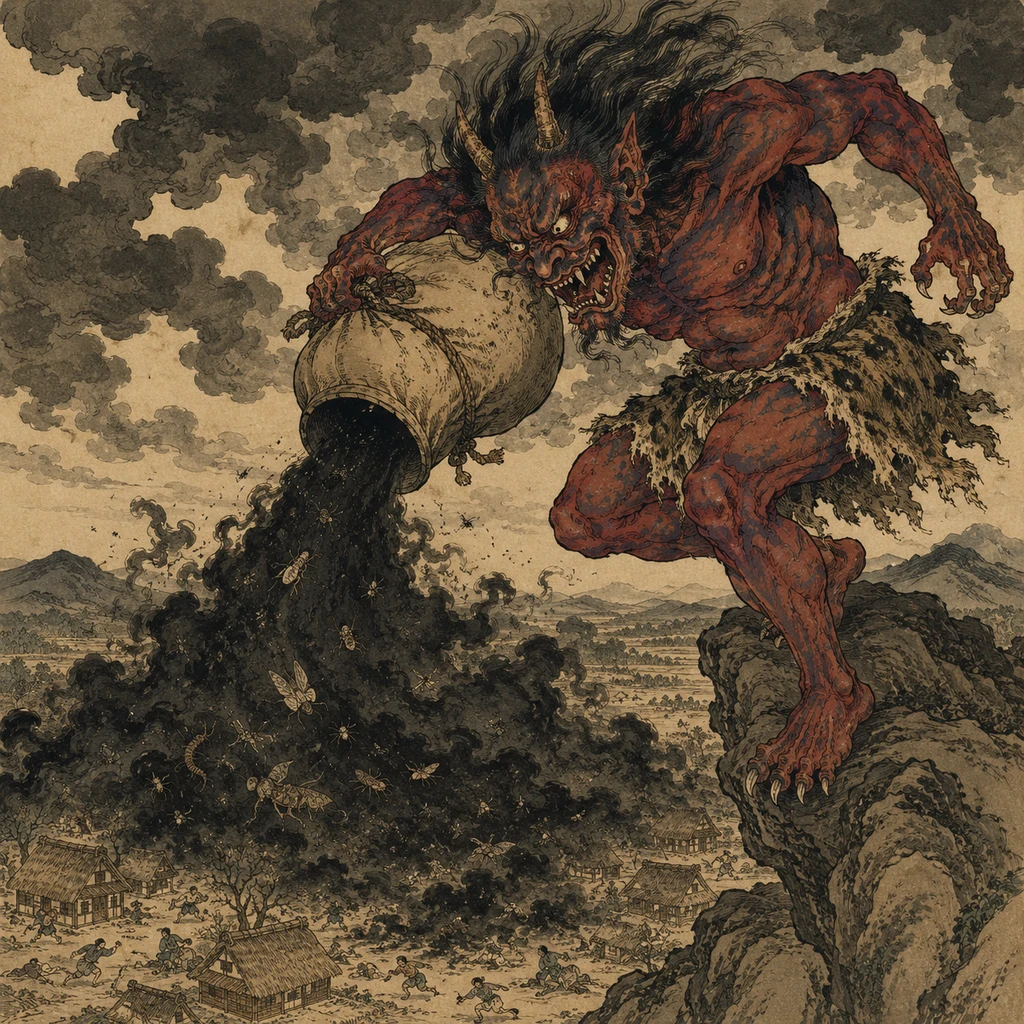
General ClassificationsAcross JapanThe traditional image of the akki is a collective notion of “oni” that personify external calamities such as epidemics and natural disasters, spoken of not as individuals but as targets to be subdued. After Buddhism took root, they were systematized as beings set against benevolent deities, often depicted as groveling demon figures trampled by the Four Heavenly Kings or Wisdom Kings to display divine might. Among commoners, practices like Setsubun bean-throwing and displaying foul-smelling or thorny materials expressed a shared intent to guard boundaries and repel misfortune at the threshold of the home. In texts they overlap with terms like akuma and jaki, and over time could also signify inner demons of desire and agitation, yet in daily practice they were treated chiefly as personifications of external threats.

珍しい Echo-Worm
OHH-seh-ee-choo (ohh-OH-seh-ee-choo)
Edo Essays and Anecdotes Edition
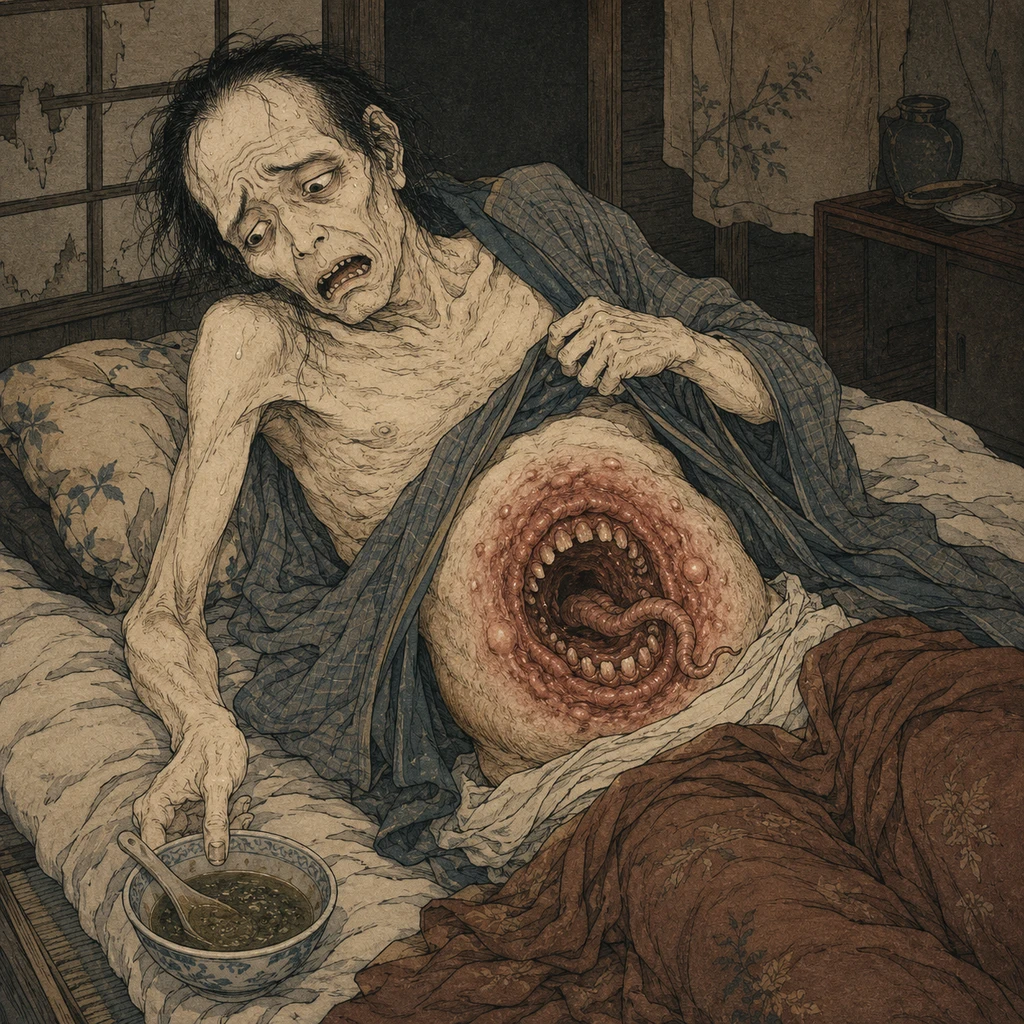
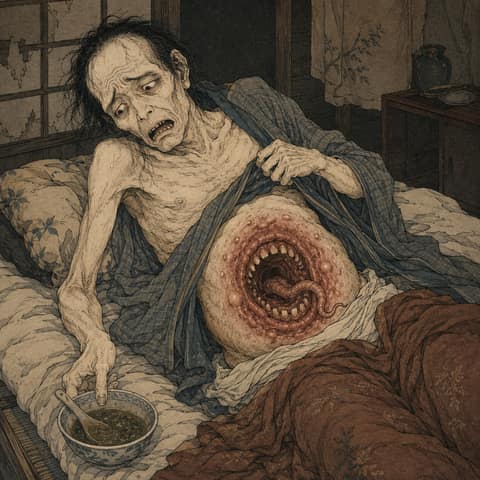
Half-Human BeingsIntroduced from China; recorded across JapanA portrait of the Echo-Answering Worm from Edo-period essays and tales. Marked by high fever and a sore like a mouth on the abdomen, its voice echoes the host’s words and at times spews curses. It craves food and drink, and refusal is said to raise the fever. Cures attempted include prayers and decoctions, especially a method of selecting and combining drugs it dislikes, then administering them so the creature weakens and later exits the body. Some accounts describe a lizard-like form with horns, though appearances vary widely. Chinese lore of the echoing parasite merged with Japan’s notion of the human-faced sore, emphasizing a mouth opening in the belly. Attempts to exhibit the illness for profit were recorded, though families often refused for shame. Its origins span materia medica and storytelling, long understood as a disorder set at the boundary of medicine and the uncanny.

珍しい Kiko (Air Fox)
ki-ko
The Kiko — Mid-Ranking Fox Become a Breath of “Ki”
Animal ShapeshiftersThroughout Japan (third rank in the fox hierarchy)This version digs into the role the Kiko plays among the four fox ranks: that of a boundary. The fox hierarchy is not merely an order of strength but a single ladder by which the beast draws step by step closer to spirit and to god. The rung on which the Kiko stands is the very seam dividing “the flesh-bodied Yako” from “the form-shedding Kūko and Tenko”. Where the Yako is known for visible mischief — leading travelers astray, taking on a guise to fool them — the Kiko, having already slipped free of its shell, turns its workings further inward: possessing a person, troubling the heart. The view that the fox in tales of possession is no ordinary Yako but a Kiko of deeper attainment is rooted right here. There is one more thing visible in the Kiko: incompleteness. Where the Kūko holds twice its power and goes on to become the Tenko and depart the human world, the Kiko cannot yet cut its ties to people. Swaying between the instinct of the beast and the detachment of a god, deceiving and possessing by turns, it is in a sense a fox still only halfway through its training. If the higher foxes are beings that watch quietly over the world, the Kiko is the one that, nearest of all to humankind, still struggles on.

珍しい Kūko (Sky Fox)
kū-ko
The Kūko — High Fox Just Below the Tenko
Animal ShapeshiftersThroughout Japan (a high-ranking fox, just below the Tenko)This version looks a little more closely at what kind of being the Kūko actually is. In the Edo-period ranking of foxes, only the lowest, the Yako, was thought to possess a visible body of flesh; from the Kiko upward, foxes were believed to become formless spiritual beings. Because the Kūko ranks just below the Tenko, its shape as an ordinary beast has lost almost all meaning, and it manifests instead as a presence or an influence. By its very nature it differs from the Yako, which stands before people’s eyes to deceive them. A high-ranking fox is closer to one that protects and guides than to one that harms. Overlapping with the lineage of white foxes regarded as messengers of Inari, the Kūko and Tenko were revered in the world of belief as wise foxes that serve the gods. The reason the Kūko so rarely causes any concrete incident is not weakness but that it has long since outgrown the stage of meddling with people out of vanity. Even so, because it wields immense supernatural power, it was thought that to slight it might invite calamity. Gentle toward those who revere it, showing a glimpse of its power only before the arrogant, the Kūko has been spoken of as a mature fox that knows exactly the right distance to keep from human beings.

珍しい Resurrection Incense
hahn-GOHN-koh
Canon-Conforming Incense Apparition
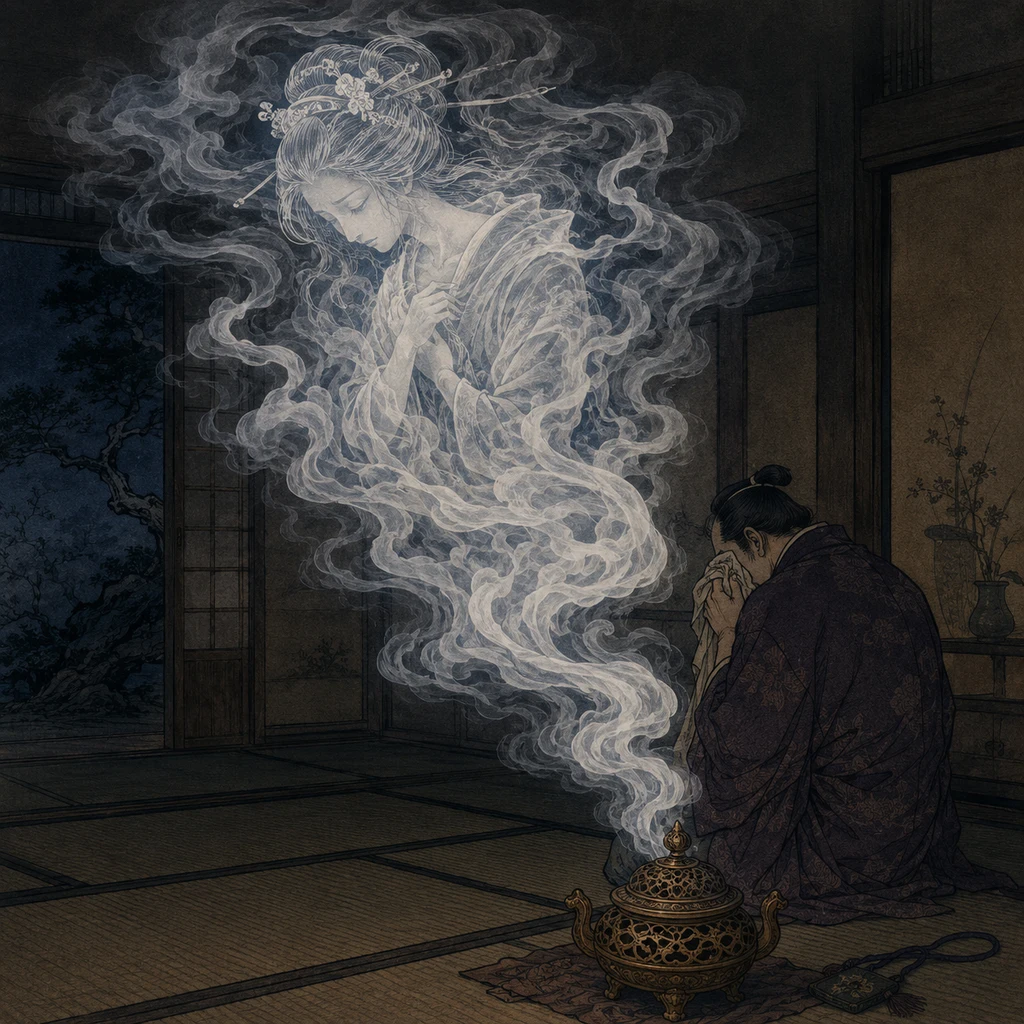
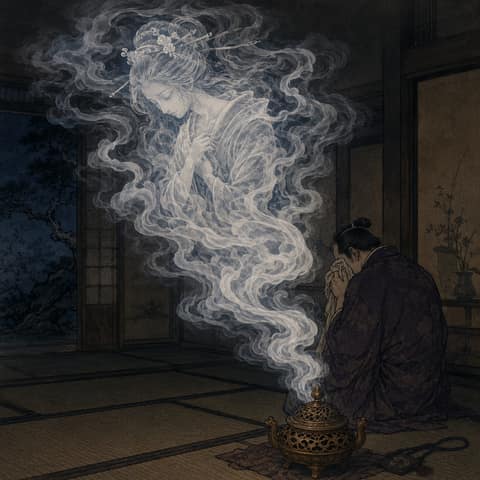
Household SpiritsUnknownRather than a physical substance, the reviving incense is told in narrative tradition as a medium for reunion with the dead. The Chinese motif of seeing a figure within smoke was adopted into early modern Japanese literature and theater, where the handling of censers, incense wood, and ash is rendered with ritual care. In yokai picture compendia it sometimes appears as a type of tool-born apparition, with set-piece depictions of a visage forming in the incense smoke. It is often interpreted not as recalling a spirit itself, but only as manifesting a semblance or shadow. Medicinal virtues are mentioned as apocrypha in materia medica, yet Edo-period notes record skepticism and file it among curious tales. In Kamigata and Edo rakugo, a tryst lasts only until the incense or stick burns out, making the quantity and duration of incense a key stage device.

珍しい Houki (Fengxi)
FOO-kee
Houki, the Foreign Beast of Sanglin
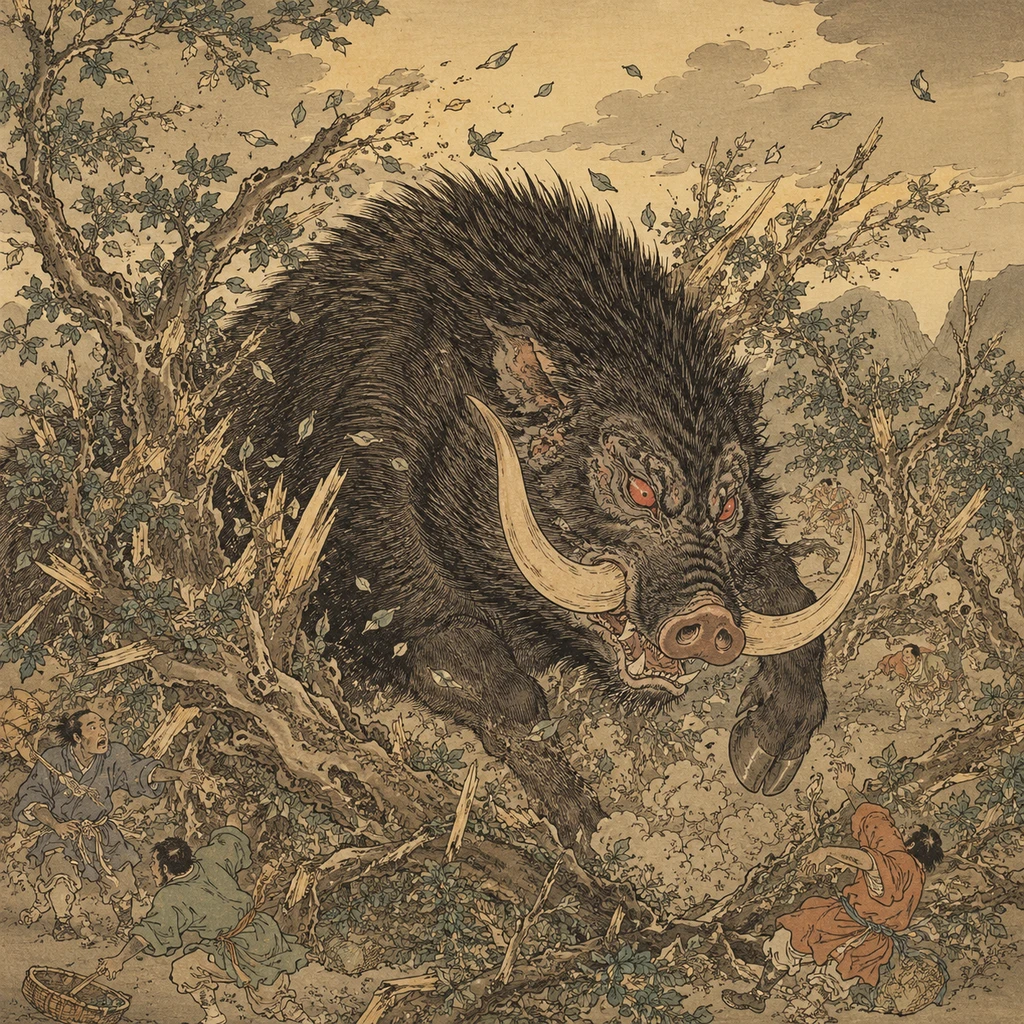
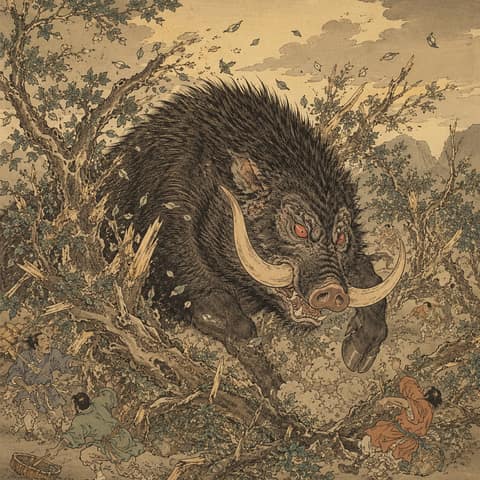
Animal ShapeshifterA foreign beast originating from the Chinese "Classic of Mountains and Seas" (Shanhaijing). Mentioned only by name in Edo-period tales of foreign lands, without tying into Japanese geographical folklore.This is an interpretation of the "foreign beast of Sanglin," imported from Chinese classics and long dormant within natural histories. In this version, Houki is not a human-sized anomaly like Japanese yokai that "frighten people on dark roads" or "settle in homes to bring wealth," but is positioned as a "mythological-scale raging god (symbol of natural disasters)" that brings destruction on a national scale. Its thick, hard skin repels all physical attacks; its charges can flatten forests into plains; and it summons torrential rains when immersed in water. In ancient China, the uncontrollable fury of nature itself (such as floods and beast plagues) manifested in the form of a "gigantic boar." The legend of its extermination by Hou Yi functions as a mythological device narrating the victory of civilization—humanity's hero subjugating overwhelming natural violence through "culture (archery)" and bringing it completely under human control by "eating it (making it an offering)." In Japan, such continental-scale monsters were difficult to localize and were merely filed away as "bizarre foreign beasts." However, when modern entertainment unearthed its attributes of being "hard, gigantic, and possessing near-invincible charging power" to reinterpret it as a motif for the ultimate enemy character, the "despair and awe toward overwhelming violence" held by ancient Chinese toward Houki was inadvertently shared as genuine terror by modern people. It is a highly dramatic case in the history of yokai reception, where a monster with a severed lineage reclaimed its original intimidation through the power of pop culture.

珍しい Fūri (Wind Tanuki)
FOO-ree
Bibliographic-Transmission Composite (Edo Natural History Lineage)
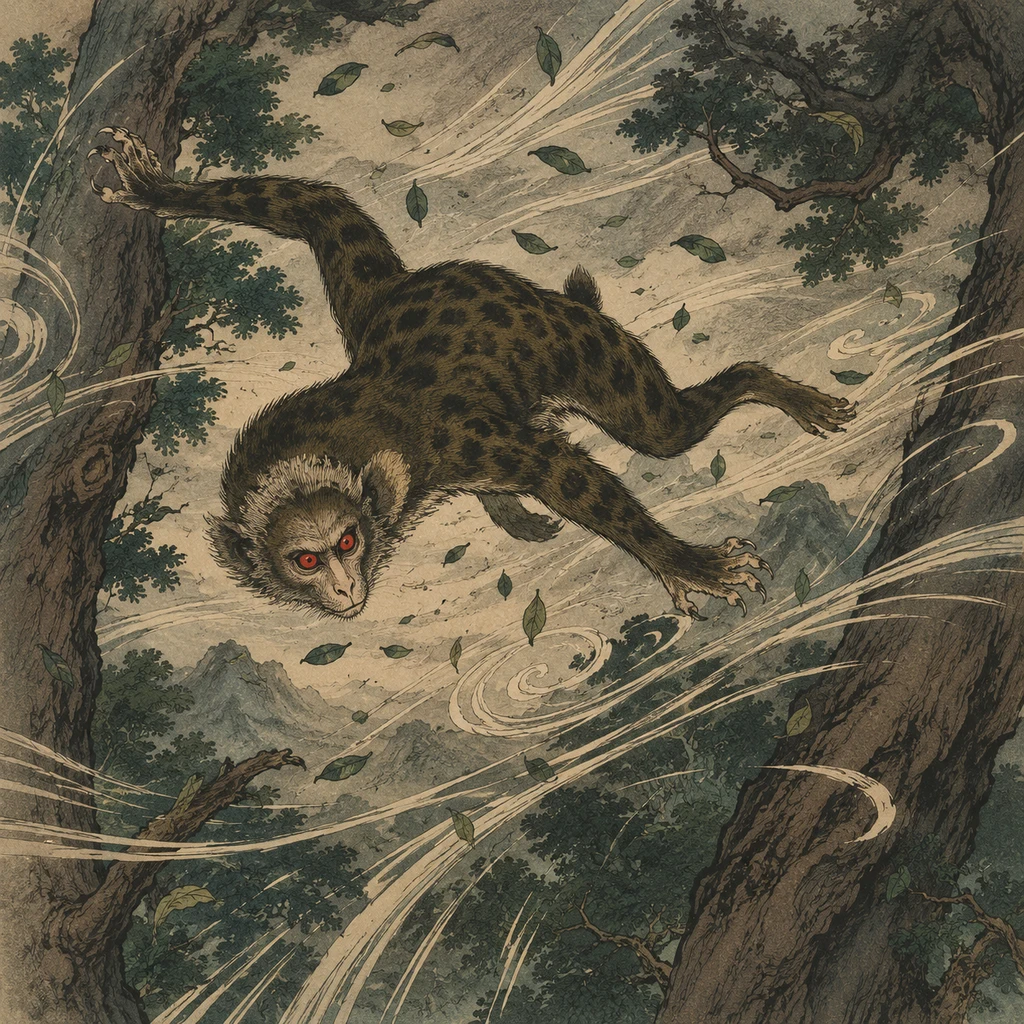
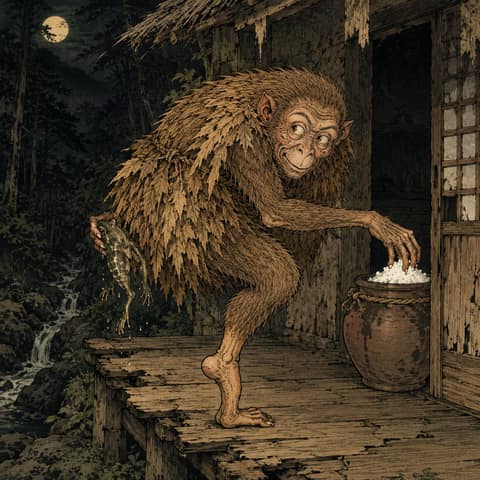
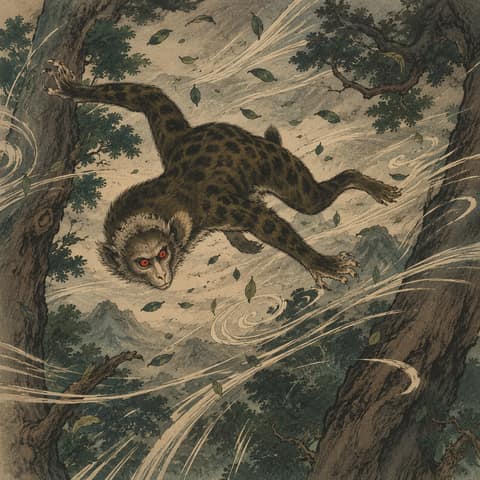
動物変化Imported from China (accounts found across Japan)A synthesis based on Chinese natural-history accounts transmitted in the Edo period, organized against Japanese essays and illustrated compendia. Said to be the size of a small monkey or a marten or tanuki, with a short tail, red eyes, and a dark coat mottled with spots. It appears with the wind to startle people and livestock or leave sudden grazing wounds, without the heavy harm stressed for demons. Its existence wavered in Japan: Wakan Sansai Zue argued it was unborn, Mimi-nashi Hoichi’s Miminashi? (Mimibukuro) recorded rare encounters, and Kō Wahonzō compared the creature 狤𤟎 to the kamaitachi. Thus, though the name is foreign, early modern scholars’ efforts at comparison and identification converged on the idea of a wind-borne beastly apparition, an unseen thing that inflicts slashing grazes. Details of ecology and form vary by text, likely arising from layered readings of local animals—marten, tanuki, monkey, otter—and wind-related mishaps.

珍しい Yako (Field Fox)
ya-ko
The Yako — Low Fox of the Kyushu Packs
Animal ShapeshiftersNorthern Kyushu, Izumi, and elsewhere (a low-ranking fox spirit)This version turns to how the Yako was spoken of in the Buddhist world, and in Zen in particular. Zen has the term yako-zen, "wild-fox Zen." It is a word of admonition for a half-finished state in which one has not truly attained enlightenment yet believes oneself enlightened. Its source is the famous tale "Hyakujō and the Wild Fox," recorded in the Song-dynasty Zen collection of dialogues, the Mumonkan. An old man came to listen each time the Tang Zen master Baizhang Huaihai (Hyakujō Ekai) preached. One day the old man revealed his story. Long ago, when he had been abbot of this very temple, he was asked whether one who has attained enlightenment still falls subject to cause and effect (karmic retribution), and he answered, "He does not fall (into cause and effect)." For that single mistaken word he had been cast into the body of a wild fox through five hundred rebirths. The old man begged Hyakujō for the correct answer. When Hyakujō rephrased it as "He does not obscure cause and effect," the old man was freed of his delusion on the spot, shed the wild-fox body, and attained buddhahood. Here the wild fox becomes a symbol of admonition—the form into which one who has fallen into half-baked enlightenment is transformed. Quite apart from the village field fox that deceives people, the Yako has lived on at length within the language of Zen as well, as "where shallow cleverness ends up."

珍しい Penghou
POONG-hoh
Edo-Period Scholarly Edition (Bibliographic and Picture Scroll Tradition)
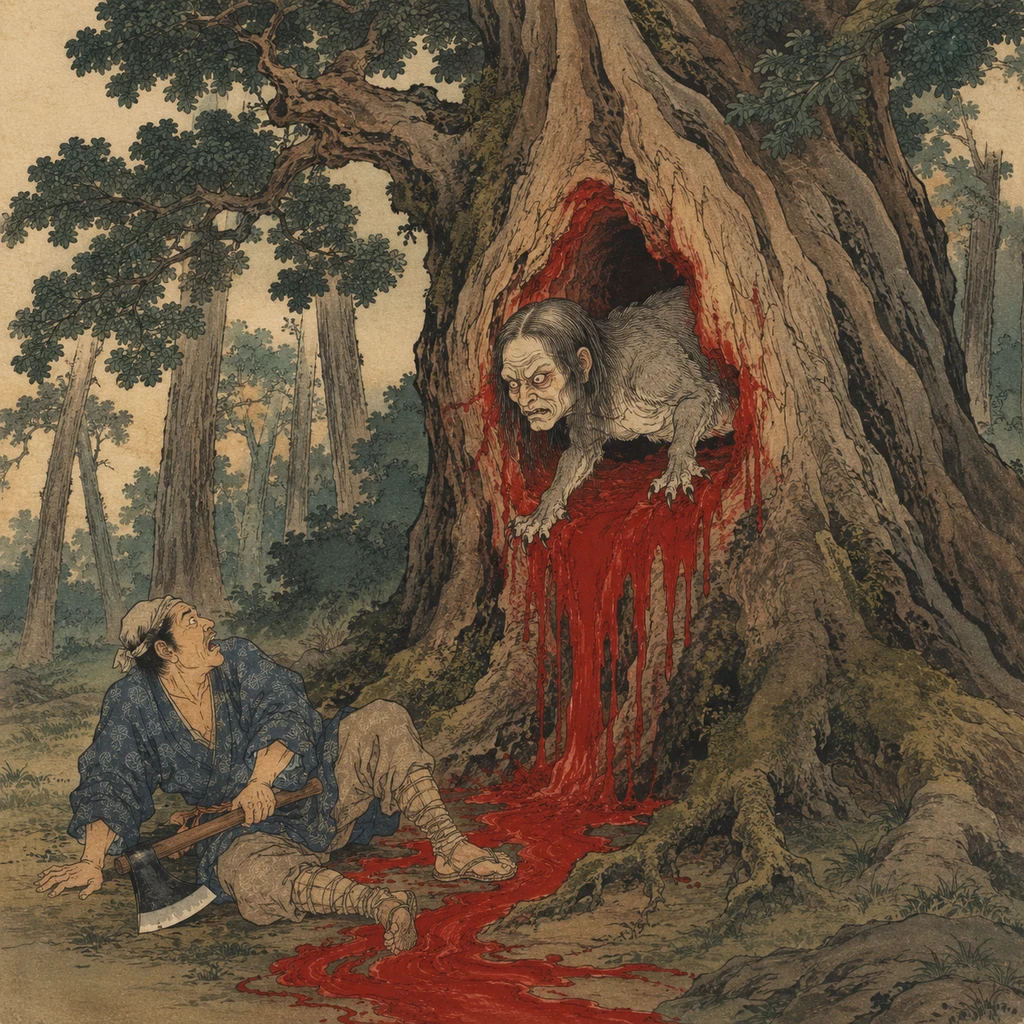
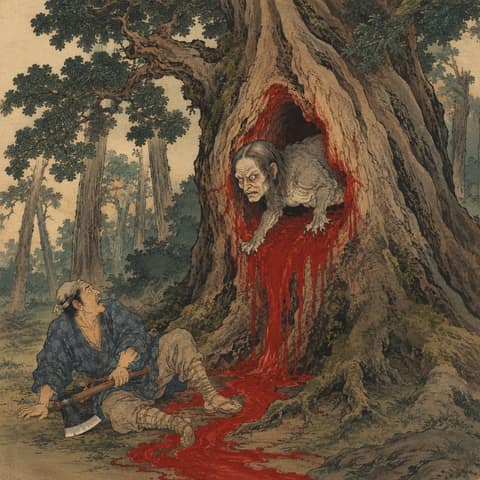
Natural Phenomena SpiritsIntroduced from China (appearing in Japanese bibliographies and picture scrolls as a foreign yokai)An Edo-period rendering of Penghou, organized within the Japanese concept of kodama after scholars and painters absorbed Chinese narratives. It is depicted as a dog with a human face, tied to venerable camphors and other old trees. Echoes in the mountains were taken as the work of tree spirits, and notes on Penghou informed dog-shaped variants within yamabiko imagery. Early modern natural histories cite Chinese texts explicitly, layering foreign entries atop local lore rather than reporting concrete regional怪談, so place-specific tales are scarce. Japanese accounts treat it as a “tree spirit,” equating kimoki with kodama, linking it to taboos on felling and the cult of ancient trees. Details vary across sources, but two elements persist: it appears bleeding from an old tree, and it bears a human-faced canine form. This version eschews embellished fiction to show how Chinese originals were received in Japanese encyclopedias.

珍しい Baku (Dream Eater)
ba-ku
The Baku of the Pillow
Divine SpiritsChinese in origin; nationwide in Japan (Edo-period dream-warding custom)The name “Baku of the Pillow” comes from this beast having been cherished, above all, as a guardian charm at the bedside. Here, rather than the tale of eating dreams, let us turn to the baku drawn upon the pillow itself. A baku pillow is a pillow on whose box-shaped side a picture of the baku or the character for baku was drawn, or on which a baku was worked in maki-e lacquer; rest your head on it to sleep, it was believed, and through the whole night nothing evil would draw near. According to Yano Ken’ichi’s study of the pillow, the baku pillow was no mere ornament but a practical charm, made to guard the most defenseless stretch of time — the hours of sleep. Trace the baku’s form to its roots and two streams run mingled within it. One is the figure transmitted by the Shuowen Jiezi and the commentary on the Erya: a bear-like body mottled black and white that eats even copper, iron, and bamboo. This derives from a real beast of Sichuan in China (most likely the panda). The other is the figure in the text Bai Juyi attached to a screen painting — “trunk of an elephant, eyes of a rhinoceros, tail of an ox, feet of a tiger.” Japanese painters and encyclopedias drew the baku by joining these two. That familiar figure — a black-and-white mottled bear’s body with a long trunk and short legs — is the result of the two becoming one. The baku was drawn on more than pillows and charm-cards. Carvings of the baku are often found on shrine and temple buildings as well. On the kibana that support the roof and on the kaerumata (the gable-shaped member above the beam), baku were carved, charged with keeping fire and calamity at a distance. As the baku at the bedside guards sleep, the baku on the building guards the house. Both arise from the same idea — placing a baku at the threshold where evil would enter — and so it appears on pillow and on building alike. The baku is often mistaken for another spirit-beast, the baize, and here too I would make the difference plain. The baize is a beast said to understand human speech and to know every yokai in the world — originally a thing apart from the baku. The trigger for the confusion lay in the line Bai Juyi added about the baku, that “in common speech this is called the baize.” Because both were alike in being “beasts that drive off evil,” the mix-up occurred in pictures too, and there is even a known case where an image called the “Baku King” was in fact a baize to begin with. The baku and the baize are best kept apart in thought as separate beasts — alike in office, but different in origin. Seen this way, the Baku of the Pillow is neither a monster that steals dreams nor a yokai that attacks people. It is a sentinel, charm-like, set at the “gaps where evil slips in” — the bedside as one sleeps, the doorway of the house. Together with the way the Wakan Sansai Zue spread the baku’s form and its evil-warding power through the world, people drew the baku on pillows, on charms, and on the beams of shrines and temples, setting it to keep watch over bad dreams and calamity without end. What the name “pillow-beast” reflects is this face of the baku as a quiet keeper of watch.

一般 Kenne-o
kenne-o
The Weighing Demon of the Eryoju Tree
霊・亡霊中国偽経『十王経』の三途の川の老爺、奪衣婆と対、渡来仏教Kenne-o as the Underworld's Back-End Engineer. The base description noted that Kenne-o is Datsue-ba's counterpart, but here we dissect his "systemic singularity." While Datsue-ba handles the violent "front-end" task of directly interacting with the dead to strip their clothes, Kenne-o manages the "back-end" data processing: receiving the clothes and hanging them on the Eryoju tree to weigh the sins. The resulting measurement—how deeply the branch bends—is sent directly to King Shoko (or King Enma) as the foundational data for the deceased's trial. He does not even converse with the dead, specializing entirely in the role of a "ruthless measuring instrument" that mechanically calculates karma. An Inversion of Gender and Faith in the Japanese Underworld. Typically, in pairings of gods or demons, the male deity assumes the leading role while the female deity is subordinate. However, with the two demons of the Sanzu River, this dynamic is completely inverted. It was the old hag Datsue-ba whose name became known, feared, and ultimately prayed to by the commoners as a "cough-curing deity." The old man Kenne-o, meanwhile, faded entirely from the historical center stage. This occurred because Japanese folk religion exhibits a strong affinity for "motherhood" and the "shamanic power of old women," and because the visceral, direct action of "stripping clothes" was far more sensational in inciting the masses' fear. The Modern Rediscovery of Kenne-o. Even in modern subcultures such as yokai media, horror fiction, and video games, Datsue-ba often appears as a boss character or a memorable NPC, whereas Kenne-o's presence is minimal to nonexistent. Recently, however, alongside the re-evaluation of Buddhist art and hell scrolls, the iconographic significance of the "old man working silently beneath the Eryoju tree" is garnering renewed attention. Without him, the uniquely elaborate Japanese mechanism of "weighing sins by the weight of stripped clothes" simply collapses. To allow the overwhelmingly present Datsue-ba to exist, Kenne-o serves as an absolutely essential "demon as a stage prop."