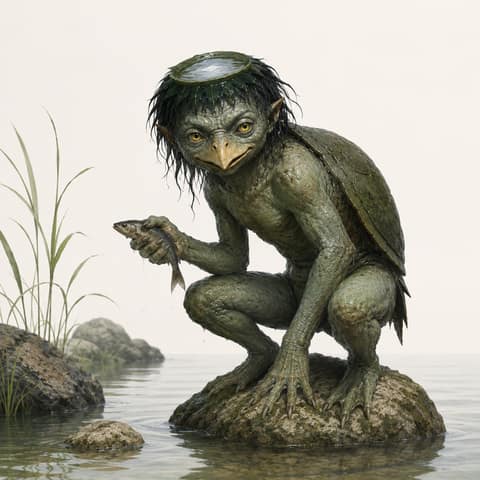
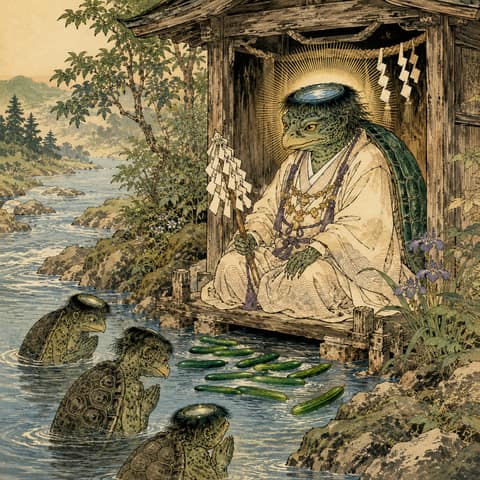
The suiko is a water-dwelling creature first recorded in Chinese materia medica. Roughly the size of a small child, it was said to be clad in hard scales and to bask with its carapace exposed on the sand in autumn. Writers gave it a tiger-like head, distinctive knees, and sharp claws. The Ming-dynasty *Honzō Kōmoku* (Compendium of Materia Medica)[1] did much to spread its image, though the account itself reaches back to an older gazetteer, the *Xiangmian Ji*. The lore travelled to Japan through books during the Edo period, where it was often conflated with the kappa. Scholars, however, insisted that the two were "alike yet not the same" — strikingly similar, but distinct beasts — and recorded them separately.
Folklore & Legends
The Chinese gazetteer *Xiangmian Ji* describes the suiko as a beast that lived in the deep pools where rivers meet near Zhonglu County, lifting only its kneecaps above the surface. The Ming-dynasty *Honzō Kōmoku*[1] later quoted this passage and carried it to a wide audience.
In Japan, Kaibara Ekken's *Yamato Honzō* and Terajima Ryōan's *Wakan Sansai Zue*[2] presented the suiko as something apart from the kappa, and Toriyama Sekien drew a suiko in his *Gazu Hyakki Yagyō*[3] that drew on the Chinese image. In the late Edo period, Koga Dōan gathered reports of water creatures from across the country under the single name "suiko" in his *Suiko Kōryaku*[4]. The Japanese suiko, in other words, has a different pedigree from the kappa born of riverside oral tradition: it grew up as bookish knowledge imported from China. Accounts of how to catch it and of its supposed medicinal virtues vary so widely from one text to the next that little can be said for certain.
This version digs into what sets the suiko apart: it is not a creature of oral legend but one shaped within the pages of books. Where the kappa was born from the fears of riverside life and took on countless forms and names from region to region, the image of the suiko travelled almost entirely through citations in Chinese materia medica and gazetteers. That is why its defining features stay remarkably consistent — a body the size of a small child, hard scales, the habit of baring its carapace on the autumn sand, and the trick of showing only its knees above the water.
Japanese scholars cited these Chinese accounts while puzzling over how to square them with the kappa right in front of them. The *Wakan Sansai Zue*[2] placed the two side by side and cautiously judged them "alike yet not the same," while the *Suiko Kōryaku*[4] tried to file reports of water creatures from across the land under the heading "suiko." Toriyama Sekien's illustration in the *Gazu Hyakki Yagyō*[3] is likewise a picture drawn from this continental learning. There are articles touting ways to capture it or its medicinal uses, but interpretations differ from book to book, and the truth remains unclear. The suiko, in the end, is a second face of the water spirit — the trace left by an early-modern attempt to reinterpret the familiar kappa through the lens of Chinese scholarship.
Character Profile
This section is our own creative profile for storytelling. It is not historical fact or scholarship.
Lurks in deep river pools, showing only its knees or carapace and rarely revealing its whole body. As fierce as the kappa it resembles, yet its true form stays half-hidden within old books.
Compatibility
People who love classical texts, natural history, and careful scholarship
Abilities
Lurks underwater, revealing only part of its bodyDefends itself with hard scalesAmbushes from the water's edgeBares its carapace on the sand in autumn
Weaknesses
Said to grow sluggish when kept above water too long
no reliable account fixes the look of its whole body
The diagram below is a diagnostic evaluation chart for The Scaled Suiko, Child-Sized. The higher the value of each item, the stronger that characteristic is expressed.