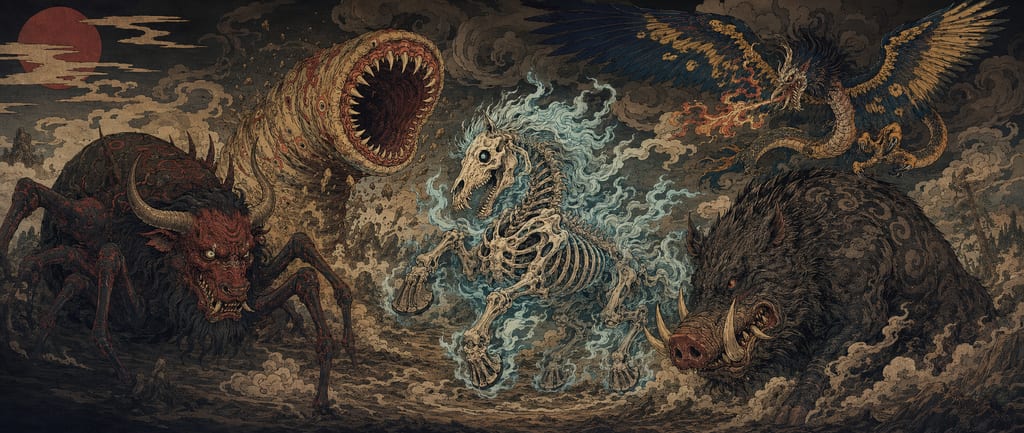
Houki is originally not a Japanese yokai, but a colossal and ferocious wild boar monster (or divine beast) recorded in ancient Chinese mythology and geographical texts such as the *Classic of Mountains and Seas* (Shanhaijing). Pronounced "Fengxi" in Chinese, it became established in Japan through its Sino-Japanese reading "Houki". According to legend, it is an impossibly massive boar completely covered in a hide as hard as armor. It was feared as a living disaster, using its overwhelming power to ravage farmlands and devour people. In Japan, it was introduced to the educated class via "tales of foreign lands" in Edo-period encyclopedias like the *Wakan Sansai Zue*, but it never developed into a folk belief (folk yokai) rooted in local regions. For a long time, it remained merely an "imported monster" confined to the pages of books. However, in modern times, its name has suddenly been thrust into the spotlight through pop culture media such as manga and anime.
Folklore & Legends
In Chinese mythology (such as the *Huainanzi*), which serves as the source text for Houki, this monster settled in a region called "Sanglin" (Mulberry Forest) and committed every imaginable atrocity. Following the orders of the sage king Yao, the legendary master archer Hou Yi was dispatched to subjugate it. A gruesome extermination tale remains, detailing how Hou Yi shot through Houki's legs to capture it alive, then chopped its meat to pieces to offer it as a steamed dish to the emperor. On the other hand, it possessed a duality that deified the fury of nature: it was said that rain would invariably fall whenever Houki entered a river or body of water, and thus it was worshipped as an object of rainmaking (a rain god or water god) during droughts.
In Japan, it was never included in the framework of "Japanese yokai" drawn by Toriyama Sekien and others, but was strictly treated as a piece of "Chinese classical education." However, entering the 2020s, in the globally popular manga *ONE PIECE* (by Eiichiro Oda), the gigantic boar form transformed into by one of the "Five Elders" (Topman Warcury), the highest authorities in the world, was explicitly named "Houki". Consequently, the name "Houki" has become well-known not only to the general Japanese public but to readers worldwide. It stands as an extremely rare example of a "mythological beast resurrected in the modern era," seeing its fame skyrocket after an interval of several millennia.
This is an interpretation of the "foreign beast of Sanglin," imported from Chinese classics and long dormant within natural histories. In this version, Houki is not a human-sized anomaly like Japanese yokai that "frighten people on dark roads" or "settle in homes to bring wealth," but is positioned as a "mythological-scale raging god (symbol of natural disasters)" that brings destruction on a national scale.
Its thick, hard skin repels all physical attacks; its charges can flatten forests into plains; and it summons torrential rains when immersed in water. In ancient China, the uncontrollable fury of nature itself (such as floods and beast plagues) manifested in the form of a "gigantic boar." The legend of its extermination by Hou Yi functions as a mythological device narrating the victory of civilization—humanity's hero subjugating overwhelming natural violence through "culture (archery)" and bringing it completely under human control by "eating it (making it an offering)."
In Japan, such continental-scale monsters were difficult to localize and were merely filed away as "bizarre foreign beasts." However, when modern entertainment unearthed its attributes of being "hard, gigantic, and possessing near-invincible charging power" to reinterpret it as a motif for the ultimate enemy character, the "despair and awe toward overwhelming violence" held by ancient Chinese toward Houki was inadvertently shared as genuine terror by modern people. It is a highly dramatic case in the history of yokai reception, where a monster with a severed lineage reclaimed its original intimidation through the power of pop culture.
Character Profile
This section is our own creative profile for storytelling. It is not historical fact or scholarship.
Those who desire absolute power, or those who love overwhelming violence
Abilities
Absolute defense from a thick, hard skinInvincible charging power capable of altering terrainWater god power to summon torrential rain by entering water
Weaknesses
Ambush by mythological-tier archery (such as joints in the legs), being captured alive and cooked by a hero
Habitat
The mythological foreign land of Sanglin, Unknown
Interested in this type of yokai?
Discover the yokai most similar to your personality with our yokai diagnosis
The diagram below is a diagnostic evaluation chart for Houki, the Foreign Beast of Sanglin. The higher the value of each item, the stronger that characteristic is expressed.
Meet your guardian yokai at the shrine
Draw an omikuji fortune and discover the yokai watching over you today.