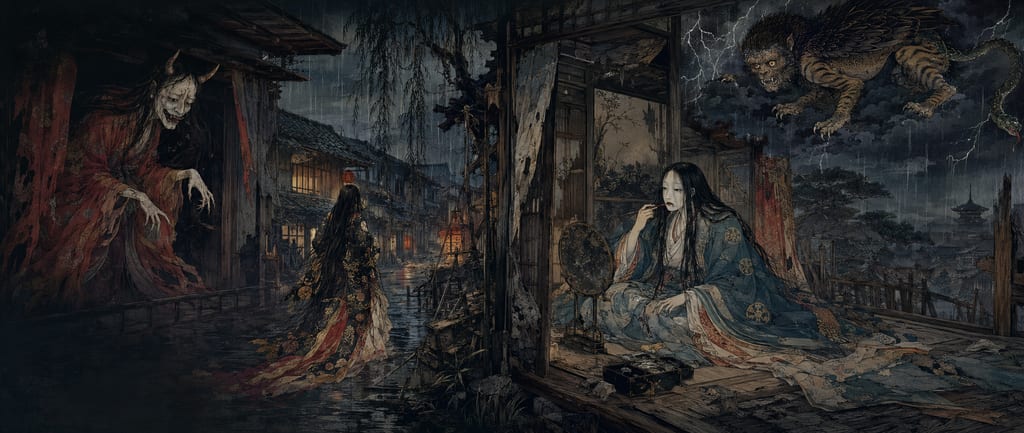
Mōryō is a collective term for malevolent beings that dwell in mountains, rivers, plants, stones, and graveyards, often linked to water-born spirits. In Chinese classics it appears as wangliang or wuxiang, sometimes described as childlike figures with red-black skin, red eyes, and long ears. In Japan it was read as the water deity “mizuha” and later paired with chīmi (chimi) as a set. Mōryō are said to crave the livers of the dead and are associated with funerary disturbances and corpse-snatching apparitions.
Folklore & Legends
The Chinese Huainanzi states that wangliang (wuxiang) arise from water, with notes describing a child’s form, red-black complexion, red eyes, and long ears. The Bencao Gangmu says they eat the livers of the deceased and fear tigers and cypress. In Japan, “wuxiang” was interpreted as the native reading mizuha, becoming a general term for water-related monsters. Edo-period essays record incidents where black clouds overshadow a funeral and the corpse vanishes from the coffin—events attributed to mōryō.
A generalized classical image of the mōryō based on historical sources. The term was used for uncanny phenomena tied to watersides, graveyards, ancient trees, and great stones, and is understood to be linked with disasters that defile corpses and the spread of death impurity. Its form is not fixed—some accounts call it childlike, others say it manifests only as a vapor or miasma. In Japan, the word came to denote corpse-stealing spirits and served to justify funerary taboos and rites of purification.
Character Profile
This section is our own creative profile for storytelling. It is not historical fact or scholarship.
The diagram below is a diagnostic evaluation chart for Mōryō (Classical Depiction). The higher the value of each item, the stronger that characteristic is expressed.