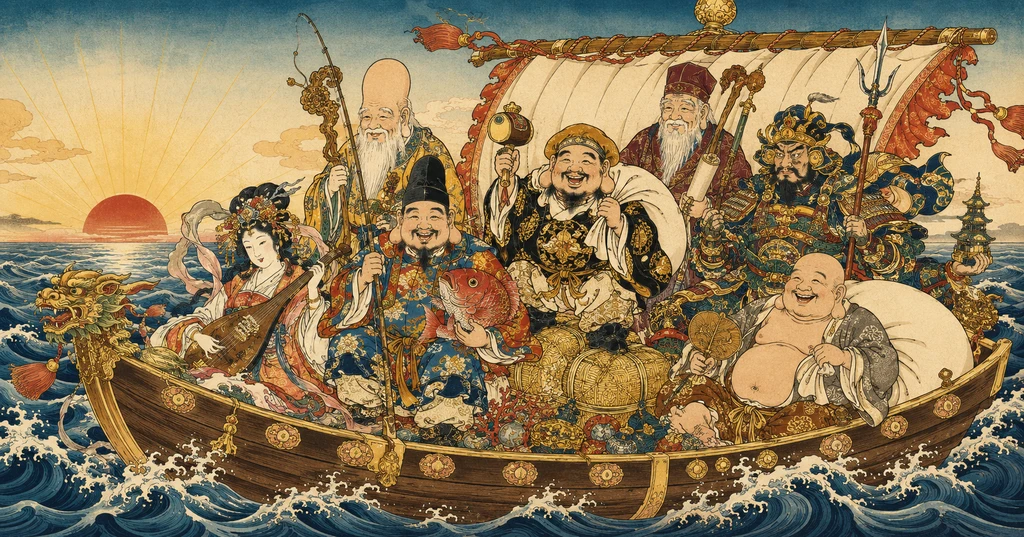
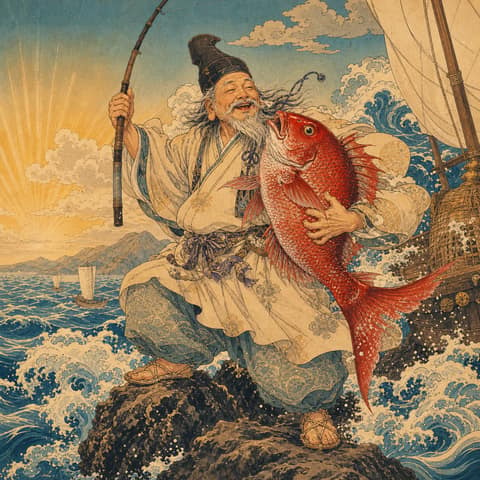
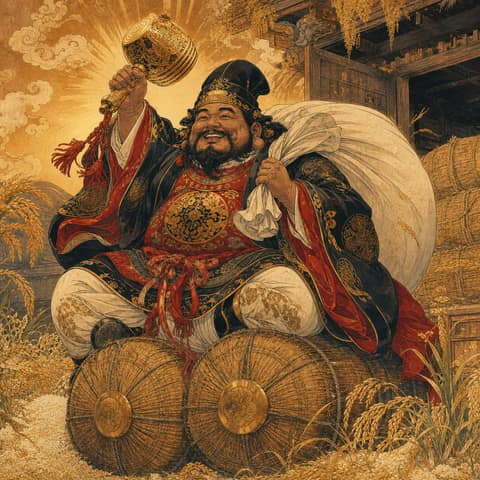
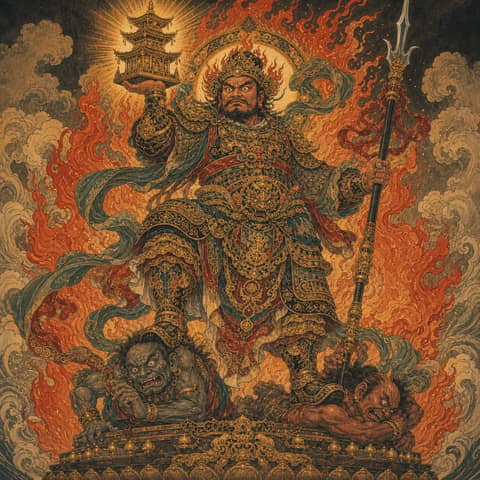
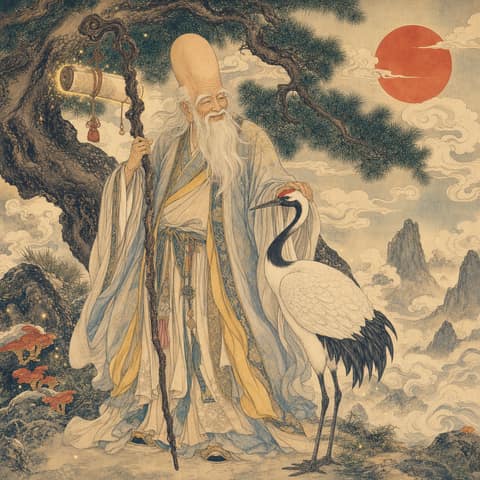
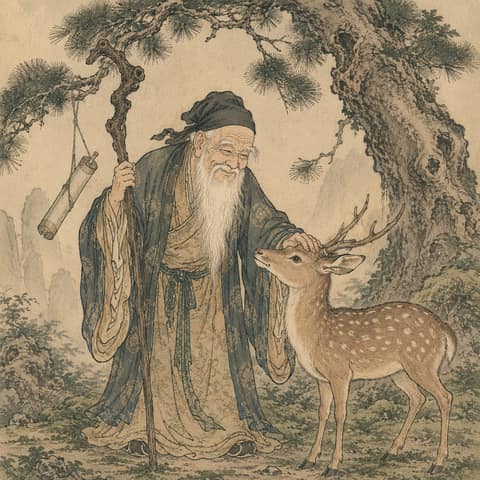
A Daoist deity of longevity manifesting as the avatar of the South Pole Old Man Star (Canopus)[1]. He is depicted as a short old man with a strangely elongated head, sporting a long white beard. He ties a sutra scroll to the top of his staff, is accompanied by a black stag (Genroku)[2] said to live for 1,500 years, and carries peaches and a gourd containing an elixir of immortality. Although he shares the same origin as Fukurokuju (both being personifications of the South Pole Old Man Star)[3], Juroujin was distinguished in Japan as an ascetic longevity deity singularly focused on the virtue of "life" (ju). His integration into the Seven Lucky Gods during the Higashiyama culture period[4] of the late Muromachi era paralleled that of Fukurokuju. Loved for his rustic, unpretentious appearance as an old sage fond of sake, he became an indispensable presence in Edo-period depictions of the Seven Lucky Gods' treasure ship and their associated pilgrimages.
Folklore & Legends
The original archetype of Juroujin is the South Pole Old Man Star (Canopus)[1]. Because Canopus, the alpha star of the constellation Carina, rarely appears in the low southern skies of the Northern Hemisphere, ancient Chinese lore held that "the year it is seen brings universal peace, and the land where it is seen is a land of longevity." It was already recorded as an astronomical deity in the 'Treatise on Astrology' of the *Records of the Grand Historian* and the 'Treatise on Astronomy' of the *Book of Jin*. Daoism personified this star as the Longevity Star or Longevity Sage, pairing him with auspicious beasts and items such as a black stag[2] said to live for 1,500 years, the Peaches of Immortality of the Queen Mother of the West, and a gourd concealing an elixir of life. This belief was introduced to Japan during the late Muromachi period (15th century) through monks who had traveled to Song and Ming dynasty China and via Zen monasteries. He was welcomed as the deity governing "life" (ju) alongside Fukurokuju, who is an avatar of the exact same star. Initially, they were strongly regarded as the same entity under different names, but Zen and artist monks assigned them distinct roles: "Fukurokuju = a secular deity synthesizing the three virtues of happiness, wealth, and longevity," and "Juroujin = an ascetic deity purely focused on the single virtue of longevity." This led to them being depicted side by side in Seven Lucky Gods artworks during the Higashiyama culture period[4]. By the Edo period, variant groupings of the Seven Lucky Gods circulated that omitted Juroujin and replaced him with the Shojo (a sake-loving mythical beast) or Kisshoten[5], a desperate measure to resolve the overlap between Juroujin and Fukurokuju. Juroujin remained highly popular as an unpretentious, sake-loving old sage, frequently depicted in treasure ship illustrations by artists like Kyoden Santo (*Kottoshu*, 1813), Utamaro Kitagawa, and Hokusai Katsushika. In the Seven Lucky Gods pilgrimages of Edo/Tokyo (such as in Yanaka, Asakusa, and Nihonbashi), his designated shrines were often small halls belonging to Zen, Obaku, or Tendai sects, particularly attracting worshippers praying for longevity and health. In folklore, he was also a core deity in the "First Dream Treasure Ship Picture," where placing a picture of Juroujin under one's pillow early on New Year's Day was believed to bring auspicious dreams.
Juroujin's true form is the South Pole Old Man Star (Canopus)[1]. This is the alpha star of the constellation Carina—the second brightest star in the entire night sky after Sirius. Because it only appears low in the southern sky of the Northern Hemisphere, ancient Chinese lore passed down the saying, "The year it can be seen is a year of universal peace; the land where it can be seen is a land of longevity." Already registered as an astronomical deity in the 'Treatise on Astrology' of the *Records of the Grand Historian* and the 'Treatise on Astronomy' of the *Book of Jin*, it forms the core of Longevity Star worship in Chinese folk belief. Daoism personified this star as the Longevity Star or Longevity Sage, arranging auspicious items alongside him: a black stag[2] said to live 1,500 years, the Peaches of Immortality of the Queen Mother of the West (which extend life by a thousand years with a single bite), and a gourd containing the elixir of immortality. Iconographically, he is depicted as a short old man with a long head and a long beard, tying a sutra scroll to the head of his staff. A "short body and long head" is a physical omen of longevity in Chinese physiognomy, a formative principle entirely identical to that of his counterpart, Fukurokuju[3]. This is the reason the two have long been considered the same deity under different names. His arrival in Japan occurred in the late Muromachi period (15th century), routed through monks traveling to Song and Ming China and the importation of Daoist and Buddhist paintings by Zen monasteries. The prototype of the current Seven Lucky Gods was formed during the Higashiyama culture period[4] when Zen monks and painters (such as Noami, Soami, and Sesshu) bundled the localized Ebisu, Daikokuten, Bishamonten, and Benzaiten with the imported deities Hotei, Fukurokuju, and Juroujin into the "Seven Gods of Fortune and Virtue." The overlap with Fukurokuju had been an old issue since before the Song dynasty. In Japan, this was resolved by dividing their roles: "Fukurokuju = a secular deity synthesizing happiness, wealth, and longevity," and "Juroujin = an ascetic longevity deity purified to the single virtue of longevity." During the Edo period, a significant number of variant Seven Lucky Gods groupings circulated that removed Juroujin to avoid duplication, replacing him with the sake-loving beast Shojo[6], Kisshoten, or Fukusuke. Juroujin was loved by the common people for his appearance as an unpretentious, sake-loving sage, appearing frequently in the treasure ship pictures of Kyoden Santo (*Kottoshu*, 1813), Hokusai Katsushika, Kuniyoshi Utagawa, and Yoshitoshi Tsukioka. In the Seven Lucky Gods pilgrimages across Edo and Tokyo, his sites were often small halls belonging to Zen, Obaku, and Tendai sects, gathering prayers for longevity and health, especially from the elderly and the sick. In folk tradition, he also holds an important position as a main constituent deity of the "First Dream Treasure Ship" (established in the mid-Edo period), where placing a treasure ship picture containing Juroujin under one's pillow early on New Year's Day is said to grant an auspicious dream.
Character Profile
This section is our own creative profile for storytelling. It is not historical fact or scholarship.
Unpretentious, composed, and carrying the air of an old sage fond of sake. He does not scatter flashy blessings but exudes a quiet presence, merely offering to exist alongside one through the long years.
Compatibility
Highly compatible with those praying for health, longevity, and healing from illness, those devoted to ascetic practices, academics, or calligraphy, and those wishing to accept old age peacefully. For those primarily seeking descendants or financial luck, aligning him with his counterpart Fukurokuju can clash energies; therefore, it is traditional to focus solely on his virtue of "longevity."
Abilities
Life Extension (granting the blessing of health and longevity)Healing Illnesses (via the auspicious talismans of the black stag, peach, and gourd)South Pole Old Man Star Resonance (summoning the stellar omen of universal peace)Sutra Recitation (warding off disease demons with the sutra scroll tied to his staff)
Weaknesses
The issue of sharing the exact same origin as Fukurokuju means that worshipping both side-by-side dilutes the purity of his "longevity" virtue. Prayers for happiness (fuku) and wealth (roku) are fundamentally out of his jurisdiction, and being greedy will scatter his efficacy.
Habitat
Small halls of Zen, Obaku, and Tendai sects, illustrations of the Seven Lucky Gods' treasure ship, under pillows on New Year's Day, and pilgrimage sites for the Seven Lucky Gods in the Kanto and Kinki regions.
The diagram below is a diagnostic evaluation chart for Juroujin, the Pure Sage of Longevity Accompanied by a Black Stag. The higher the value of each item, the stronger that characteristic is expressed.