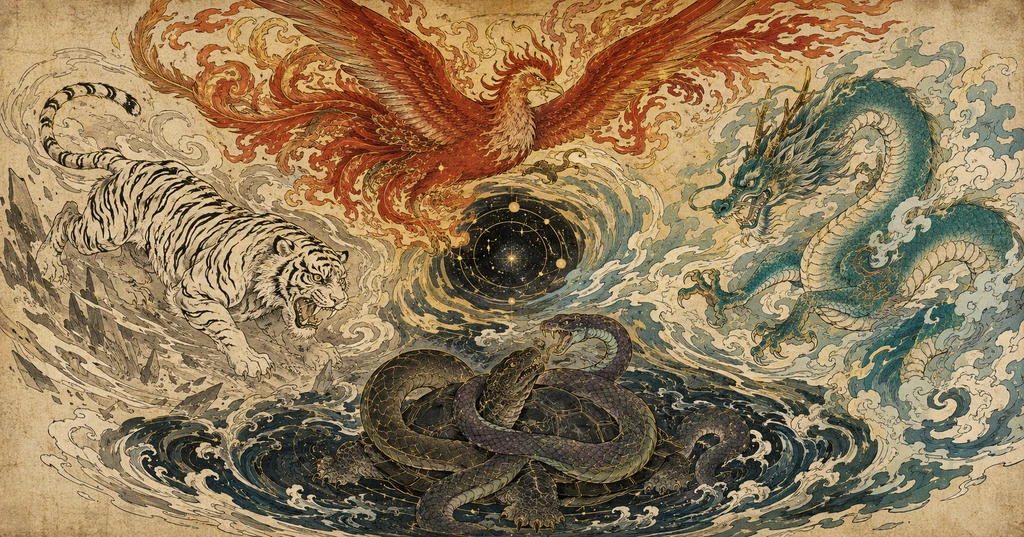
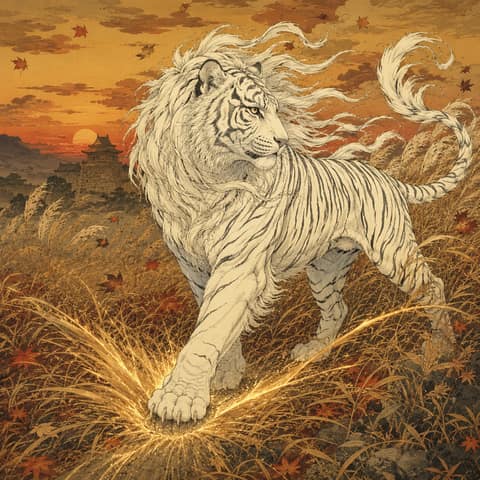
Byakko, the White Tiger, is one of the Four Symbols that guard the west, the divine beast that shapes the seven western lunar mansions of the heavens into the form of a tiger. In the Five Phases it is assigned to Metal, in the five colors to white, and in the seasons to autumn, and it is represented as a fierce white-furred tiger. Arising from Chinese astral and Five Phases thought, the Huainanzi's "Treatise on the Patterns of Heaven"[1] makes the beast of the west the White Tiger. After it was received into ancient Japan, it formed a pair with the Azure Dragon and was depicted as a marker of directional protection and of wards.
Folklore & Legends
Byakko is the divine beast that embodies the direction west, the Metal phase, and autumn. The chain of stars of the seven western mansions (Legs, Bond, Stomach, Hairy Head, Net, Turtle Beak, Three Stars) was likened to a tiger—this is the origin of its iconography. The Huainanzi's "Treatise on the Patterns of Heaven"[1] makes the emperor of the west Shaohao and its beast the White Tiger, assigning it to Metal, autumn, and the color white. The western palace of heaven in the Records of the Grand Historian' "Treatise on the Celestial Offices"[2] stands in the same lineage. The form of a white-furred tiger corresponds to Metal = white.
The antiquity of Byakko appears in the relics. The early Warring States lacquer garment chest from the tomb of Marquis Yi of Zeng[3] (c. 433 BCE) bears, alongside the names of the twenty-eight mansions, an azure dragon and a white tiger drawn as a pair—the composition of the Four Symbols, setting east and west face to face, was already established.
In Japan, Byakko was spoken of as forming a pair with the Azure Dragon and guarding the west of capitals, shrines, and temples. In the New Year's audience rite of the first year of Taihō (701) in the Shoku Nihongi[4], the banner of the White Tiger was raised to the west (right), together with the image of the moon and the Black Tortoise. Few native Japanese tales of Byakko survive, but within the geomantic reading of "land matching the Four Symbols" it was made the marker of the west, and in iconography the White Tiger is painted on the western wall of the Kitora Tomb[5] in Asuka, facing the Azure Dragon on the eastern wall.
Yokai Cards2
Byakko (White Tiger) across multiple art-style decks
Byakko is the divine beast of the west, Metal, and autumn, spoken of as forming a pair with the Azure Dragon of the east. This edition traces its astronomical origin and the paired structure with Seiryū.
Its origin is in the stars of heaven. The chain of the seven western mansions (Legs, Bond, Stomach, Hairy Head, Net, Turtle Beak, Three Stars) likened to the form of a tiger is Byakko. The Huainanzi's "Treatise on the Patterns of Heaven"[1] makes the emperor of the west Shaohao and its beast the White Tiger, assigning it to Metal, autumn, and white. The western palace of heaven in the Records of the Grand Historian' "Treatise on the Celestial Offices"[2] stands in the same system. The form of a fierce white-furred tiger figures the white of the Metal phase, corresponding to the western sky of autumn, which bears the air of ripening and harvest, and of withering severity.
The pairing of Byakko and Seiryū is old. That the early Warring States lacquer garment chest from the tomb of Marquis Yi of Zeng[3] (c. 433 BCE) draws the azure dragon and the white tiger to left and right alongside the names of the twenty-eight mansions shows that the composition of the Four Symbols, setting east (Seiryū) and west (Byakko) face to face, was already established twenty-four centuries ago.
In Japan, Byakko was received as a marker of directional protection and of wards. In the Four Symbols' banners of the first year of Taihō (701) in the Shoku Nihongi[4], Byakko was set to the west (right). Though native tales are scarce, within the geomantic reading of land matching the Four Symbols it was made the guard of the west, and in iconography the White Tiger facing the Azure Dragon still remains on the western wall of the Kitora Tomb[5]. The dragon of the east and the tiger of the west—this symmetry is the very skeleton of the system of the Four Symbols.
Character Profile
This section is our own creative profile for storytelling. It is not historical fact or scholarship.
Strict and quietly resolute, it does not stir rashly but guards the boundary.
Compatibility
Favorable with those who value order; detests conduct that disturbs boundaries
Abilities
Strengthening the wards of the westGoverning the air of autumn and quelling ill eventsActing as a signpost and direction-warding markerBearing the Metal phase to repel evil and curse
Weaknesses
Its power wanes when the balance of the Four Symbols is broken; it manifests with difficulty in places where boundaries are disturbed
Habitat
Sculptures and wall paintings of temples and shrines, tomb murals, folding screens, mandalas, and pedestal ornaments, the imagined ward-domains of directional ritual
The diagram below is a diagnostic evaluation chart for Byakko, the White Tiger, Guardian of the West. The higher the value of each item, the stronger that characteristic is expressed.