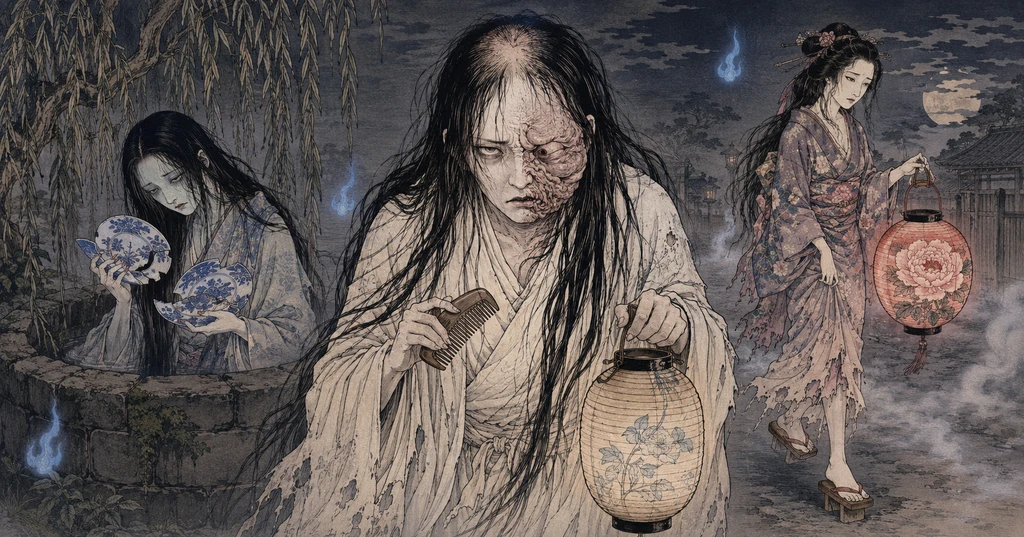
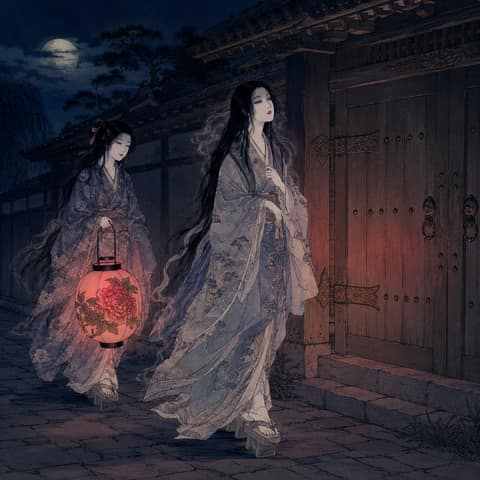
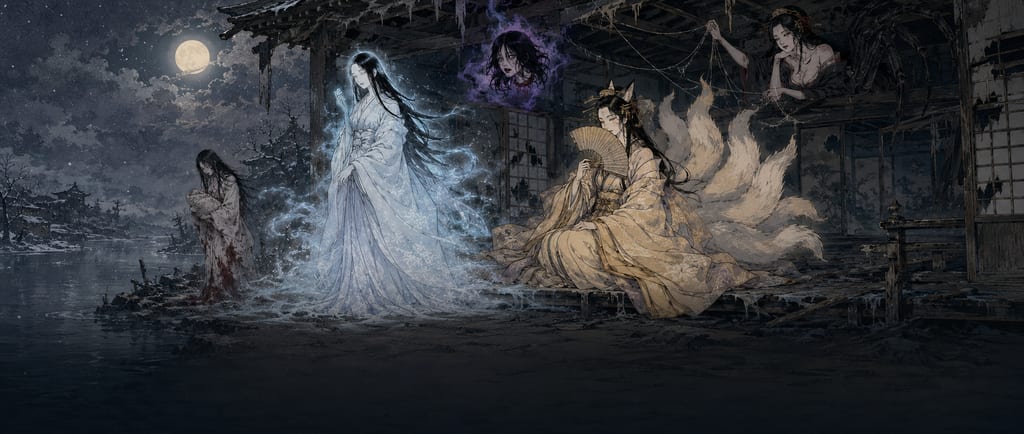
Otsuyu is the legendary female ghost protagonist of the ghost story *Botan Doro* (The Peony Lantern). Said to be the daughter of the hatamoto Iijima Heizaemon, she falls in love at first sight with the ronin Hagiwara Shinzaburo[1], whom she met through the introduction of the physician Yamamoto Shijo[1]. However, unable to meet him again, she is said to have passed away from lovesickness. Unable to let go of her feelings even in death, she visits Shinzaburo every night accompanied by her maid Oyone, carrying a peony lantern[1], her wooden clogs echoing with a 'clippity-clop' (karan-koron) sound. After discovering her true identity as a spirit, Shinzaburo wards his house with the talismans of Kaion Nyorai[1] and a solid gold Buddha statue. However, his neighbors, the married couple Tomozo and Omine, are bribed by the ghosts to peel off the talismans. Shinzaburo is ultimately cursed to death; he is found reduced to a skeleton, embraced by a skull. Because the story strongly evokes empathy for the dead rather than the living, Otsuyu is remembered not merely as a 'vengeful ghost,' but as a 'ghost who died for love and continues to love.' Alongside Oiwa of *Yotsuya Kaidan* and Okiku of *Sarayashiki*, she is counted among the most iconic female ghosts of early modern Japanese ghost stories.
Folklore & Legends
The tale of Otsuyu derives its folkloric interest precisely from the fact that it was established not through a single legend, but through three distinct layers of literature. The original source is *Jiandeng Xinhua* (New Tales Told by Lamplight), a collection of weird tales written by the Ming dynasty Chinese literati Qu You[2], with its author's preface dated the 11th year of Hongwu (1378). In one of its tales, 'The Tale of the Peony Lantern', a single man from Mingzhou (Ningbo) named Qiaosheng[2] becomes intimately involved with a beautiful woman named Fu Liqing[2], who is accompanied by a maid holding a double-headed peony lantern on the night of the Lantern Festival. However, she was already dead, and the man is eventually found dead in her coffin alongside her corpse. This single tale profoundly influenced the Edo literary world.
The second layer is *Otogiboko* by the kanazoshi author Asai Ryoi[3], published in the 6th year of Kanbun (1666). 'The Peony Lantern (Vowing to a Ghost in Prayer)' included in Volume 3 adapts 'The Tale of the Peony Lantern', replacing the setting and character names with Japanese ones to localize the supernatural elements. This rooted the motif of the peony lantern and the deceased beautiful woman in Japan.
The third layer is the human drama ghost story *Kaidan Botan Doro* by the rakugo storyteller San'yutei Encho[1], active from the end of the Edo period to the Meiji era. Around the age of 25 (during the Bunkyu era, c. 1861–1864), Encho combined *Otogiboko* with ghost stories handed down at a rice merchant's in Fukagawa and true stories heard at a hatamoto family's house in Ushigome. He reconstructed a long epic interweaving the tragic romance of Otsuyu and Shinzaburo with a human drama where the couple Tomozo and Omine are bribed with a hundred ryo to remove the talismans[1] and Kosuke's quest for revenge. In the 17th year of Meiji (1884), the stenographic book *Kaidan Botan Doro* by Wakabayashi Ganzo and Sakai Shozo[1], who had just finished their stenography training, was published. This is considered Japan's first stenographic book and is said to have influenced the Genbun Itchi (unification of spoken and written language) movement. The widely known image of 'Otsuyu' today—the peony lantern and the clippity-clop sound of wooden clogs—originates precisely from this Encho version. In other words, only by distinguishing these three layers of transmission—from the Chinese 'The Tale of the Peony Lantern' to Ryoi's adaptation and finally to Encho's rakugo—can the exact contours of the ghost Otsuyu be seen.
Otsuyu of the Peony Lantern is a ghost who embodies 'love continuing after death' rather than sheer terror. Raised as the daughter of a hatamoto, she fell in love at first sight with the ronin Hagiwara Shinzaburo, whom she visited under the guidance of the doctor Yamamoto Shijo. However, due to family circumstances, they were unable to meet again, and it is said she died of lovesickness while yearning for him[1]. Yet, her attachment could not be erased by death. Starting on the night of her first Obon (festival of the dead), accompanied by her maid Oyone, she begins visiting Shinzaburo every night, holding a lantern painted with peonies and making her clogs ring out with a 'clippity-clop' sound. Believing she is alive, Shinzaburo meets her repeatedly, but his neighbor Tomozo sees through their true nature—they are actually buried dead spirits. Terrified, Shinzaburo places talismans of Kaion Nyorai on every door and wears a solid gold statue of Kaion Nyorai on his person to set up a ward[1]. Blocked by the talismans, Otsuyu cannot enter the house and stands outside the gate every night, calling Shinzaburo's name reproachfully and sorrowfully.
The tragedy of the story is sealed here by the intervention of human greed. To fulfill Otsuyu's desire, the ghosts bribe the married couple Tomozo and Omine with one hundred ryo. Tomozo replaces the Kaion Nyorai statue with a fake clay one and strips away the protective talismans[1]. Losing his wards, Shinzaburo finally lets Otsuyu inside. The next morning, he is found as a white skeleton, embraced around the neck by a skull, his face contorted in terror.
Otsuyu's essence is not a curse or grudge, but her unwavering devotion, persistently seeking her beloved even after death without reward. The sheer purity of this devotion has elevated her to one of the foremost ghosts in early modern Japanese ghost stories. Through the three layers of the Chinese original 'The Tale of the Peony Lantern', Ryoi's adaptation *Otogiboko*, and Encho's rakugo, Otsuyu's image gradually crystallized into a ghost of tragic romance that brings Japanese audiences to tears.
Character Profile
This section is our own creative profile for storytelling. It is not historical fact or scholarship.
In life, she was introverted and single-minded, typical of a sheltered young lady. After agonizing over an unrequited love, she died of illness, unable to let go of her feelings for her beloved even in death. Her essence lies not in a fierce curse, but in her earnest longing and the sorrow of continually calling out his name at his gate.
Compatibility
She has a deep connection with those who tend to bottle up their feelings without voicing them, and those who lose themselves from being too devoted. Otsuyu acts as a mirror reflecting the 'whereabouts of unreached feelings,' quietly consoling the hearts of those burdened by memories of parting or unrequited love.
Abilities
Journeys to the living world every night to appear before her belovedBewitches people while accompanied by a peony lantern and Oyone, her wooden clogs clackingPoses as a living person, meeting her lover without him realizing she is a ghost
Weaknesses
Wards created by the talismans of Kaion Nyorai and a solid gold Buddha statue. When blocked by these, she cannot enter the house and has no choice but to stand still outside the gate.
Habitat
The nighttime streets of Edo, at the gate of her beloved's home. Places where the light of the peony lantern glows.
The diagram below is a diagnostic evaluation chart for Otsuyu of the Peony Lantern. The higher the value of each item, the stronger that characteristic is expressed.