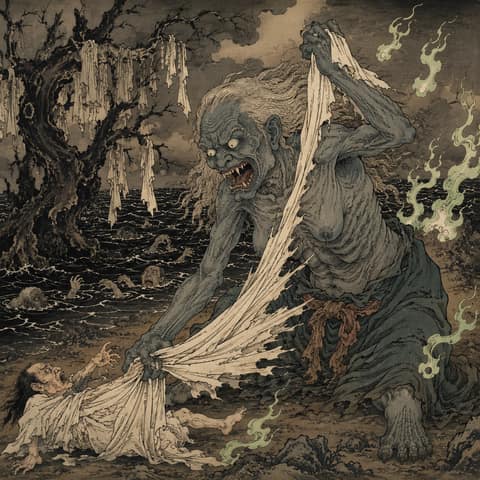
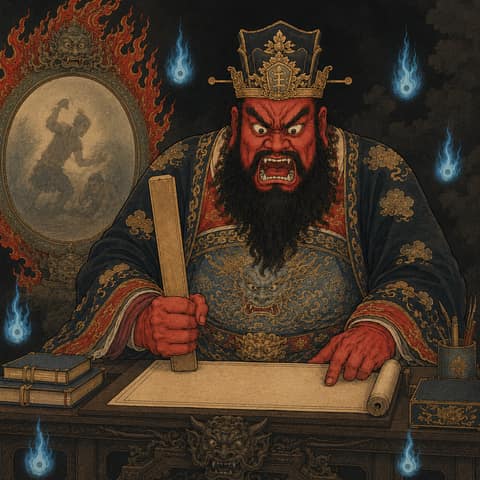
Kenne-o is a demonic old man from the underworld in Japanese Buddhism and folk religion, serving as the counterpart to the hag Datsue-ba on the banks of the Sanzu River. His role is to receive the clothes that Datsue-ba strips from the dead and hang them on the branches of a massive tree called the Eryoju (Clothing-Receiving Tree). The heavier the sins committed in life, the more water the clothes absorb, and the deeper the branch bends, thereby measuring the weight of the deceased's sins. His first appearance is in the *Sutra of Jizo and the Ten Kings*, a Japanese apocryphal sutra compiled at the end of the 12th century. Together with Datsue-ba and the Eryoju tree, he was invented as part of a uniquely Japanese underworld judgment system[1]. While Datsue-ba became wildly popular during the Edo period as the "Cotton Hag" (a deity who cures coughs) and garnered her own independent cult of worship, Kenne-o remained forever hidden in her shadow, almost never becoming the standalone object of folk faith. Consequently, in visual representations like hell scrolls, he carries the distinct aura of a "phantom demon," standing quietly beside Datsue-ba as a silent worker.
The Legend of Flaying the Skin. In certain legends and folktales, Kenne-o displays an incredibly brutal side. If a deceased person arrives at the Sanzu River without the six-mon toll *and* without any clothes to strip, Kenne-o is said to flay their "raw skin" instead, hanging it on the Eryoju tree to weigh their sins. This horrifying anecdote symbolizes the unrelenting severity of Buddhist karmic law: absolutely no excuse, not even the physical lack of clothing, can allow a soul to escape the underworld's judgment.
Asymmetry with Datsue-ba and His Existence as a "Shadow". In the history of medieval and early modern Japanese religion, Kenne-o's most defining characteristic is the staggering disparity in fame between him and his partner, Datsue-ba. While Datsue-ba was enshrined alone in Jizo halls and sparked explosive folk cults as a "cough-curing deity" in the Edo period, instances of Kenne-o statues being carved independently or forming the center of a folk cult are virtually nonexistent. He functioned strictly as a "system component." In visual media such as hell scrolls, he was continually depicted as a mute laborer, silently hanging clothes on branches behind Datsue-ba or at the base of the Eryoju tree.
Kenne-o as the Underworld's Back-End Engineer. The base description noted that Kenne-o is Datsue-ba's counterpart, but here we dissect his "systemic singularity." While Datsue-ba handles the violent "front-end" task of directly interacting with the dead to strip their clothes, Kenne-o manages the "back-end" data processing: receiving the clothes and hanging them on the Eryoju tree to weigh the sins. The resulting measurement—how deeply the branch bends—is sent directly to King Shoko (or King Enma) as the foundational data for the deceased's trial. He does not even converse with the dead, specializing entirely in the role of a "ruthless measuring instrument" that mechanically calculates karma.
An Inversion of Gender and Faith in the Japanese Underworld. Typically, in pairings of gods or demons, the male deity assumes the leading role while the female deity is subordinate. However, with the two demons of the Sanzu River, this dynamic is completely inverted. It was the old hag Datsue-ba whose name became known, feared, and ultimately prayed to by the commoners as a "cough-curing deity." The old man Kenne-o, meanwhile, faded entirely from the historical center stage. This occurred because Japanese folk religion exhibits a strong affinity for "motherhood" and the "shamanic power of old women," and because the visceral, direct action of "stripping clothes" was far more sensational in inciting the masses' fear.
The Modern Rediscovery of Kenne-o. Even in modern subcultures such as yokai media, horror fiction, and video games, Datsue-ba often appears as a boss character or a memorable NPC, whereas Kenne-o's presence is minimal to nonexistent. Recently, however, alongside the re-evaluation of Buddhist art and hell scrolls, the iconographic significance of the "old man working silently beneath the Eryoju tree" is garnering renewed attention. Without him, the uniquely elaborate Japanese mechanism of "weighing sins by the weight of stripped clothes" simply collapses. To allow the overwhelmingly present Datsue-ba to exist, Kenne-o serves as an absolutely essential "demon as a stage prop."
Character Profile
This section is our own creative profile for storytelling. It is not historical fact or scholarship.
A cold, pragmatic official who silently weighs the sins of past lives without a shred of emotion. He exhibits none of Datsue-ba's fiery temperament or compromises with folk faith; he simply operates as a cog in the underworld machine.
Compatibility
A terrifying figure to those who arrive at the Sanzu River without the six-mon toll, and to grave sinners. To the dead who already fear Datsue-ba, Kenne-o's silent presence waiting in the background induces an even deeper layer of despair.
Abilities
Receives the clothes stripped by Datsue-baHangs clothes on the Eryoju tree to measure sins by the bend of the branchesFlays the skin of the dead who arrive with no clothesProvides the foundational data for the Ten Kings' judgments
Weaknesses
The six-mon toll (the river crossing fee), good deeds accumulated in life (which lighten the clothes), and the salvation of Amida Buddha. If one bypasses Datsue-ba, they never interact with him.
Habitat
The banks of the Sanzu River beneath the Eryoju tree. The narrative spaces of Ten Kings picture explanations (etoki) and hell scrolls.
The diagram below is a diagnostic evaluation chart for The Weighing Demon of the Eryoju Tree. The higher the value of each item, the stronger that characteristic is expressed.