Etymology and Vedic Origins. The name "Enma" derives from the Sanskrit "Yama," transliterated into kanji such as 閻魔 or 閻羅[3]. In Vedic India (late 2nd millennium BCE), Yama appeared as the "first mortal who chose death and opened the path to the underworld." In the *Rigveda*, there are hymns dedicated to Yama, depicting him as the ruler of "svarga" (the other world), where ancestral spirits reside. Initially, he was a gentle deity guarding the dead, but his aspects of judgment and punishment were gradually emphasized. He was paired with his twin sister Yami. After being incorporated into Buddhism, the concept traveled to China during the Later Han dynasty, merging with Daoist views of the underworld (such as the Mount Tai Lord). It flowed into Japan during the Nara period via esoteric scriptures and hell scrolls, eventually popularizing as the Ten Kings belief system between the late Heian and Kamakura periods.
The Ten Kings Belief and Apocryphal Sutras. The foundational texts for the Ten Kings system are two Chinese apocryphal sutras[1]: The *Yoxiu Shiwang Shengqi Jing* (compiled in Chengdu during the late Tang dynasty, 9th–10th century) and the *Sutra of Jizo and the Ten Kings* (compiled in Japan around the late 12th–early 13th century). The latter added uniquely Japanese elements like the Johari Mirror. In this system, the deceased undergoes ten trials on specific days (every seven days up to the 49th day, then the 100th day, the first anniversary, and the third anniversary).
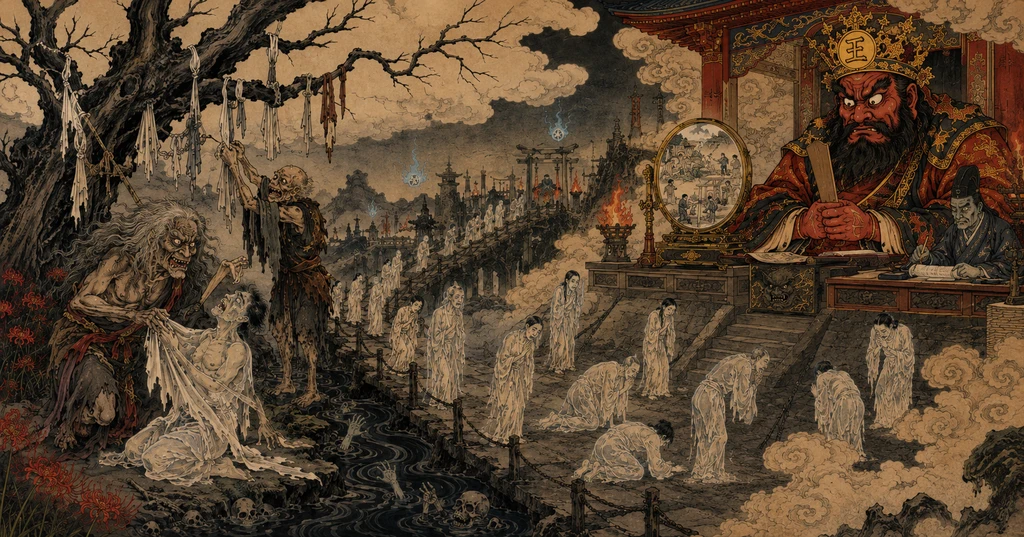
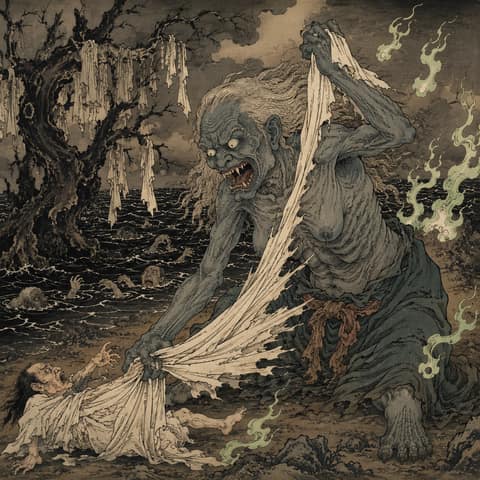
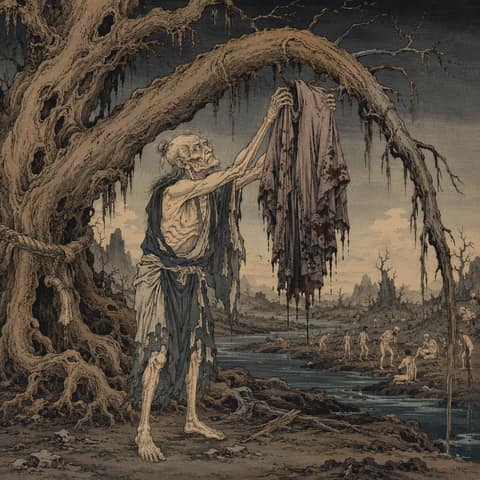
The Core of the Underworld Judiciary. The sequence of the Ten Kings places Enma as the fifth judge, presiding on the 35th day (Go-shichi-nichi)[4]. This is the centerpiece of the entire judicial process. Here, the good and evil deeds of one's life are meticulously audited. Sins are finalized through the records kept by the Kushojin (twin spirits born with every human), read aloud by Shimei, transcribed by Shiroku, and visually confirmed via the Johari Mirror. The initial weighing of sins—where Datsue-ba strips the deceased's clothes at the Sanzu River—functions as the preliminary data sent to King Enma for this main trial.
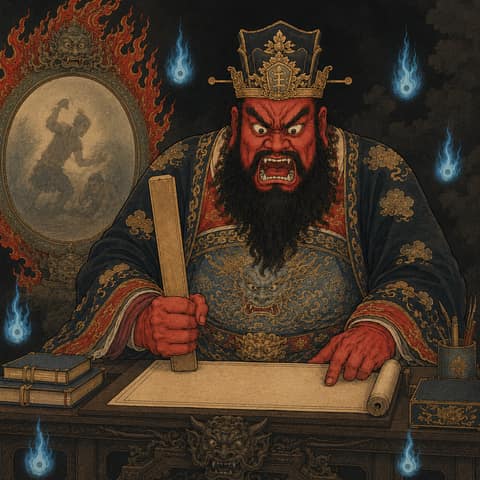
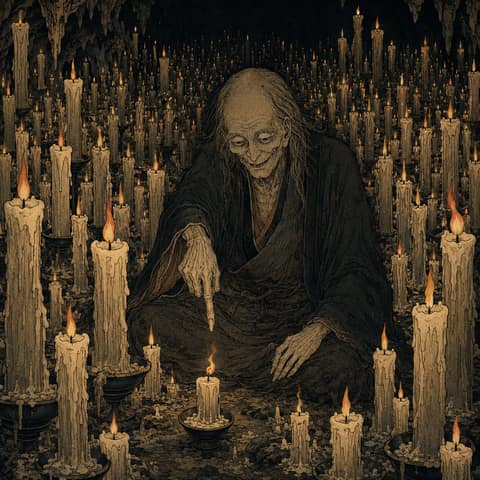
Enma's Holidays and Iconography. The 16th days of the 1st and 7th lunar months are "Enma Saijitsu," days when the lid of hell's cauldron is opened, and even King Enma rests from his duties of torture[8]. These days coincided with "Yabuiri," when apprentices and servants were given leave to visit their family homes, prompting Edo commoners to combine their holidays with visits to Enma halls. Iconographically, Enma is depicted in the attire of a Chinese official, wearing a crown and Daoist robes, holding a scepter. His face is the epitome of wrath: bristling eyebrows, glaring eyes, an open roaring mouth, and a red complexion. Surrounded by his scribes and the Johari Mirror, his image has transcended purely Buddhist frameworks to function as a national moral compass, warning children that "lies will cost you your tongue."
The Evolution of Enma from Vedic Deity to Buddhist Judge. The base description traced Enma's origins back to the Vedic deity Yama. In this deep dive, we explore how this "First Mortal" evolved into the ultimate judge of the underworld. In early Indian mythology, Yama was not a punisher; he was simply the first human to die, who then became a benevolent ruler of the ancestral realm, guiding subsequent souls to a peaceful afterlife. However, as Buddhist cosmology developed and synthesized with Hindu and later Chinese Daoist concepts, the afterlife became highly structured and bureaucratic. By the time Enma reached China, he was dressed in the robes of a Tang Dynasty magistrate, complete with bureaucratic ledgers and court officials. This transformation from a mythological pioneer of death into a strict, terrifying judge perfectly mirrors the institutionalization of religion and the growing need for a moral deterrence system in medieval societies.
The Johari Mirror: The Ultimate Surveillance Technology. The most striking aspect of King Enma's courtroom is the *Johari no Kagami* (Pure Crystal Mirror). This artifact functions exactly like a modern video playback device. It is said that when a sinner stands before Enma and attempts to lie or hide their past deeds, the Johari Mirror projects a crystal-clear, incontrovertible replay of their entire life. In an era long before photography or film, the concept of a magical mirror that perfectly records and plays back human action was an astonishingly advanced piece of conceptual "technology." It served as a terrifying psychological deterrent: the idea that the universe maintains an objective, visual record of every sin, rendering all excuses and lies useless before the final judge.
The Theology of Honji-Suijaku: Enma as Jizo. One of the most profound theological developments in Japanese Buddhism is the equating of King Enma with Jizo Bodhisattva (Ksitigarbha). Through the *honji-suijaku* (original ground and local traces) theory, Japanese monks postulated that the terrifying, wrathful Enma was merely a strategic manifestation (suijaku) of the infinitely compassionate Jizo (honji). Why would a compassionate savior appear as a wrathful judge? The theological answer is *hoben* (skillful means): some souls are so steeped in ignorance and sin that gentle preaching cannot reach them. For these obstinate sinners, the Bodhisattva must don the terrifying mask of Enma, using fear and judgment to forcibly steer them away from the cycle of suffering. This dual-aspect theology brilliantly reconciles the harsh reality of karmic punishment with the Mahayana ideal of universal salvation.
Ono no Takamura: The Bureaucrat Who Commuted to Hell. The folklore surrounding Enma is inextricably linked to the legendary Heian-era courtier Ono no Takamura (802–853). A renowned scholar, poet, and official, Takamura was said to live a double life: by day, he served the Emperor in Kyoto; by night, he climbed down a specific well at Rokudo Chinno-ji temple to serve as Enma's assistant in the underworld. This legend highlights a fascinating aspect of the Japanese underworld: it was viewed not as an impenetrable, chaotic abyss, but as a rigid bureaucracy mirroring the imperial court, where a skilled earthly official could seamlessly transition into an underworld magistrate. Takamura's dual citizenship between the realms of the living and the dead underscores the porous nature of boundaries in medieval Japanese cosmology.
The Cultural Impact of "Pulling Out Tongues". "If you lie, Lord Enma will pull out your tongue." This phrase is arguably the most successful moral meme in Japanese history. Even today, practically every Japanese child is told this by their parents when caught in a lie. The visceral image of having one's tongue extracted with giant iron pincers bypasses complex theological arguments about karma, delivering an immediate, terrifying consequence for dishonesty. It demonstrates how Enma was abstracted from his complex position as the fifth judge of the Ten Kings and distilled into a universally understood cultural icon of ultimate, inescapable accountability.
Character Profile
This section is our own creative profile for storytelling. It is not historical fact or scholarship.
A wrathful, uncompromising judge who embodies absolute justice and truth, yet harbors the infinite compassion of Jizo Bodhisattva beneath his terrifying exterior.
Compatibility
Strict and terrifying to liars and unrepentant sinners, but deeply respected by those who understand that his harsh judgments are a necessary step toward eventual salvation.
Abilities
Presides as the fifth judge of the Ten Kings on the 35th day after deathUses the Johari Mirror to play back a deceased's past actionsMaintains perfect karmic records via his scribes Shimei and ShirokuCoordinates with Datsue-ba for preliminary data from the Sanzu RiverManifests the 'Dual-Aspect' of compassion and judgment as an incarnation of JizoSuspends hell's tortures during Enma Saijitsu (the 16th of January and July)
Weaknesses
Because he is an "absolute judge of wrath," prayers for mercy are often more effectively directed to his true form, Jizo Bodhisattva. In esoteric Buddhism, Fudo Myo-o fulfills a similar role of "forceful salvation."
Habitat
The Enma庁 (Enma's Court) in the underworld; Rokudo Chinno-ji (Kyoto); Enno-ji (Kamakura); the Three Great Enma Temples of Edo; and countless Enma and Jizo halls across Japan.
The diagram below is a diagnostic evaluation chart for The Fifth Judge of the Underworld. The higher the value of each item, the stronger that characteristic is expressed.