Tenjiku (India)てんじく
3 yokai rooted in Tenjiku (India). Explore the legends tied to this land.

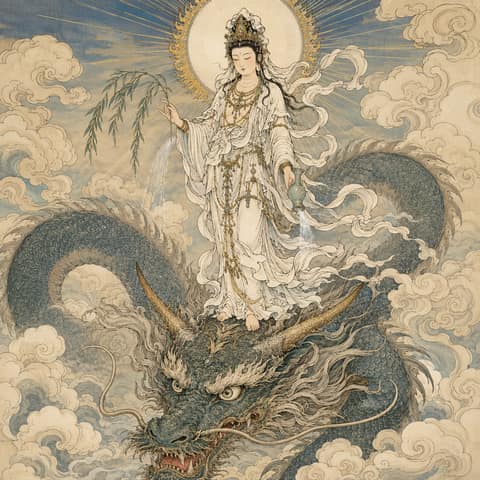
神格 Kannon
kannon
Bodhisattva of 33 Forms and Infinite Compassion
神霊・神格大乗仏教の菩薩、浄土は南インド補陀落、渡来仏Ultimate Metamorphosis and Empathy. The greatest characteristic of Kannon Bodhisattva lies in having no fixed form, possessing the ability of "Fumon Jigen" to infinitely transform into the most suitable form (a Buddha, a god, a human, or even a non-human entity) to save the other person. This is not mere magic; it is the manifestation of an "ultimate empathic ability (compassion)," standing at the exact same eye level as the suffering other and sharing their pain as one's own. Kannon has served as the emotional pillar for the Japanese people for over a millennium precisely because Kannon does not reign as an absolute, transcendent dictator, but descends into the mud-stained living spaces of humans to weep alongside them. Attendant to Amida Nyorai and Care at the Moment of Death. Kannon Bodhisattva is not only worshipped independently but also plays a crucial role as an attendant (assistant) to Amida Nyorai, the Lord of the Western Paradise (Pure Land). When a person reaches the end of their life, it is Kannon's duty to appear riding on a cloud alongside Amida Nyorai (Raigo) to welcome the deceased, placing their soul on a lotus pedestal to guide them to paradise. Kannon was not only a savior from all the hardships of the present world but also the "ultimate deity of terminal care" who alleviated the fear of death and guaranteed the soul's destination. The "Hidden Christians" and Maria Kannon. The vast tolerance of Kannon worship (the flexibility to take any form) proved its worth even in the harshest phases of history. Under the ban on Christianity during the Edo period, oppressed "Kakure Kirishitan" (Hidden Christians) secretly continued their worship by venerating statues of the "Jibo Kannon" (Koyasu Kannon, holding a child) as the Virgin Mary. By embracing even the god of a foreign religion as a variation of its own form and receiving the prayers of persecuted people, the "Maria Kannon" demonstrates the absolute zenith of Kannon worship's function as an asylum (sanctuary).

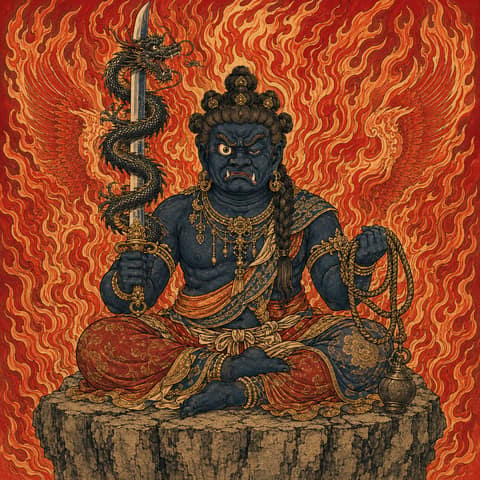
神格 Fudo Myo-o
fudo-myoo
The Wrathful Avatar of Dainichi Nyorai
神霊・神格インド密教 Acalanatha 由来、空海が請来した渡来尊The Theology of "Strict yet Gentle" Duality. The greatest iconographic and doctrinal feature of Fudo Myo-o is the intense contrast between his terrifying appearance and the profound compassion he harbors within. A Wisdom King (Myo-o) is a Buddha who deliberately transforms into a fearsome figure to persuade and instruct; Fudo Myo-o is thus another face of Dainichi Nyorai, the universe's ultimate truth. His wrath is not born of hatred toward evil, but rather an expression of the "extreme limit of compassion" to save wandering souls at any cost. This duality is the primary reason he gathered such broad worship across all classes, from strictly disciplinarian monks to anonymous commoners praying for daily peace. A Hybrid of Worldly Benefits and Memorial Services. Originally, in Esoteric doctrine, Fudo Myo-o was a spiritual pillar meant to lead practitioners to enlightenment. However, as he fused with Japanese indigenous beliefs, he assumed extremely pragmatic roles. From dispelling diseases to preventing fires, and even ensuring modern traffic safety, he acts as a "breakwater" against every threat in daily life. Simultaneously, in the Thirteen Buddhas belief system, he is deeply involved in memorial services for the dead, acting as the guiding deity for the first seventh-day mourning period. Thus, he transformed into an omnipotent guardian deity relied upon throughout the entire process from life to death. Fudo Myo-o and His Retainers. Fudo Myo-o is often depicted in a triad accompanied by Kongara Doji and Seitaka Doji, or surrounded by numerous retainers such as the Eight Great Youths (Hachidai Doji) or the Thirty-Six Youths. This illustrates how Fudo Myo-o's immense power was subdivided to build a system capable of meticulously addressing the diverse wishes of all people. The visual contrast of placing innocent, childlike attendants beside a terrifying central deity is also one of the unique aesthetic and religious expressions achieved by Japanese Buddhist art.

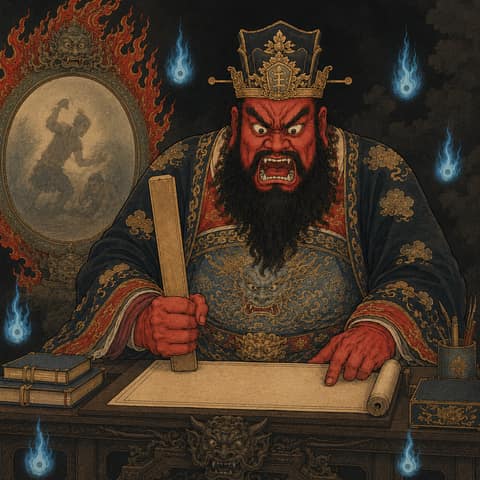
神格 Enma Daio
Enma-o
The Fifth Judge of the Underworld
神霊・神格インド神話のヤマが仏教化した渡来神格、在地発祥地なしThe Evolution of Enma from Vedic Deity to Buddhist Judge. The base description traced Enma's origins back to the Vedic deity Yama. In this deep dive, we explore how this "First Mortal" evolved into the ultimate judge of the underworld. In early Indian mythology, Yama was not a punisher; he was simply the first human to die, who then became a benevolent ruler of the ancestral realm, guiding subsequent souls to a peaceful afterlife. However, as Buddhist cosmology developed and synthesized with Hindu and later Chinese Daoist concepts, the afterlife became highly structured and bureaucratic. By the time Enma reached China, he was dressed in the robes of a Tang Dynasty magistrate, complete with bureaucratic ledgers and court officials. This transformation from a mythological pioneer of death into a strict, terrifying judge perfectly mirrors the institutionalization of religion and the growing need for a moral deterrence system in medieval societies. The Johari Mirror: The Ultimate Surveillance Technology. The most striking aspect of King Enma's courtroom is the *Johari no Kagami* (Pure Crystal Mirror). This artifact functions exactly like a modern video playback device. It is said that when a sinner stands before Enma and attempts to lie or hide their past deeds, the Johari Mirror projects a crystal-clear, incontrovertible replay of their entire life. In an era long before photography or film, the concept of a magical mirror that perfectly records and plays back human action was an astonishingly advanced piece of conceptual "technology." It served as a terrifying psychological deterrent: the idea that the universe maintains an objective, visual record of every sin, rendering all excuses and lies useless before the final judge. The Theology of Honji-Suijaku: Enma as Jizo. One of the most profound theological developments in Japanese Buddhism is the equating of King Enma with Jizo Bodhisattva (Ksitigarbha). Through the *honji-suijaku* (original ground and local traces) theory, Japanese monks postulated that the terrifying, wrathful Enma was merely a strategic manifestation (suijaku) of the infinitely compassionate Jizo (honji). Why would a compassionate savior appear as a wrathful judge? The theological answer is *hoben* (skillful means): some souls are so steeped in ignorance and sin that gentle preaching cannot reach them. For these obstinate sinners, the Bodhisattva must don the terrifying mask of Enma, using fear and judgment to forcibly steer them away from the cycle of suffering. This dual-aspect theology brilliantly reconciles the harsh reality of karmic punishment with the Mahayana ideal of universal salvation. Ono no Takamura: The Bureaucrat Who Commuted to Hell. The folklore surrounding Enma is inextricably linked to the legendary Heian-era courtier Ono no Takamura (802–853). A renowned scholar, poet, and official, Takamura was said to live a double life: by day, he served the Emperor in Kyoto; by night, he climbed down a specific well at Rokudo Chinno-ji temple to serve as Enma's assistant in the underworld. This legend highlights a fascinating aspect of the Japanese underworld: it was viewed not as an impenetrable, chaotic abyss, but as a rigid bureaucracy mirroring the imperial court, where a skilled earthly official could seamlessly transition into an underworld magistrate. Takamura's dual citizenship between the realms of the living and the dead underscores the porous nature of boundaries in medieval Japanese cosmology. The Cultural Impact of "Pulling Out Tongues". "If you lie, Lord Enma will pull out your tongue." This phrase is arguably the most successful moral meme in Japanese history. Even today, practically every Japanese child is told this by their parents when caught in a lie. The visceral image of having one's tongue extracted with giant iron pincers bypasses complex theological arguments about karma, delivering an immediate, terrifying consequence for dishonesty. It demonstrates how Enma was abstracted from his complex position as the fifth judge of the Ten Kings and distilled into a universally understood cultural icon of ultimate, inescapable accountability.