Her Place in Religious History as an Apocryphal Figure. The base description mentioned that the *Sutra of Jizo and the Ten Kings* marks Datsue-ba's first appearance; here, we delve into her status as an "apocryphal" figure. Though apocryphal sutras (gikyo) were not officially canonized in the Buddhist Tripitaka, they were mass-produced at the crossroads of folk religion, esoteric Buddhism, and Pure Land ideology. While the *Sutra of Jizo and the Ten Kings* was based on a Chinese Tang Dynasty text, it underwent meticulous Japanese localization by introducing Datsue-ba, Kenne-o, and the Eryoju tree[1]. Apocryphal texts should not be dismissed merely as "fake sutras"; today, they are re-evaluated as vital religious resources that absorbed the masses' thirst for a comprehensible afterlife and salvation, significantly propelling the development of medieval Japanese Buddhism.
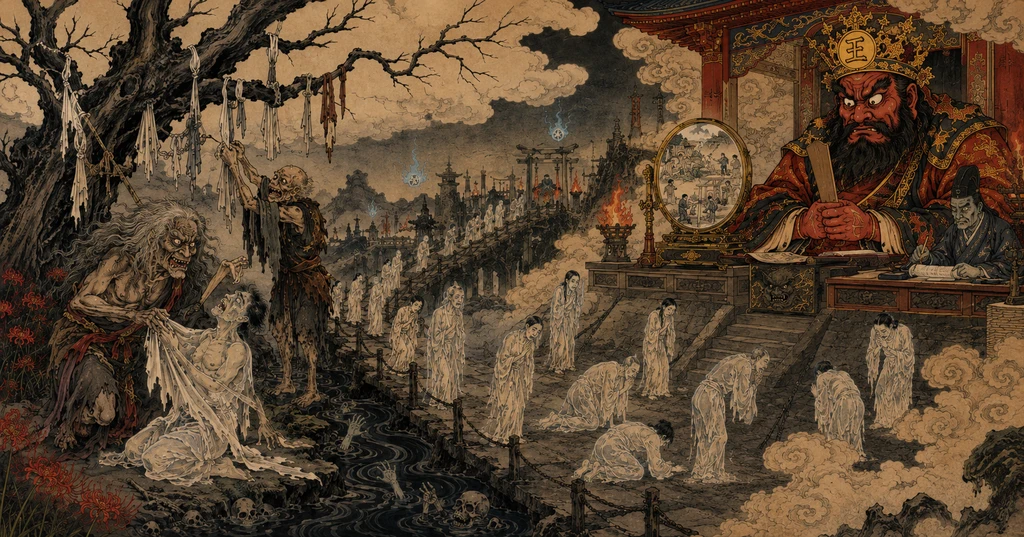
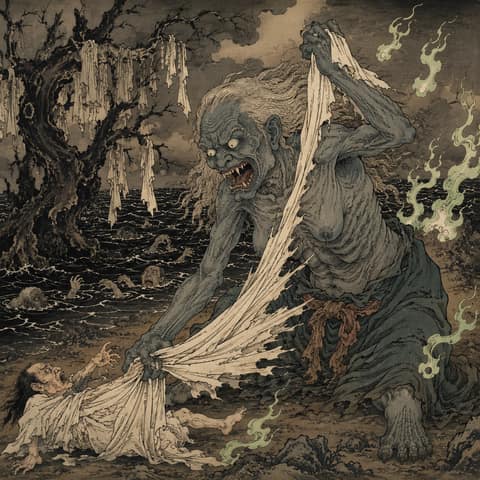
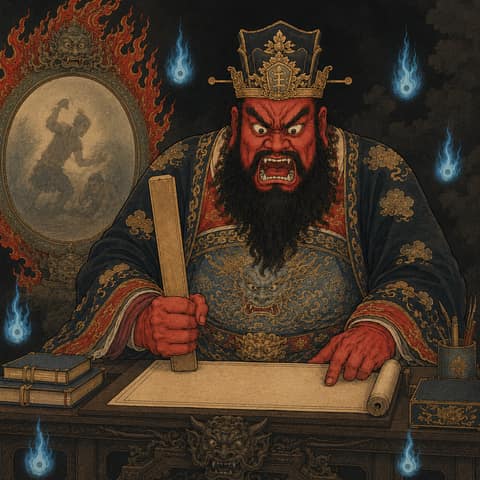
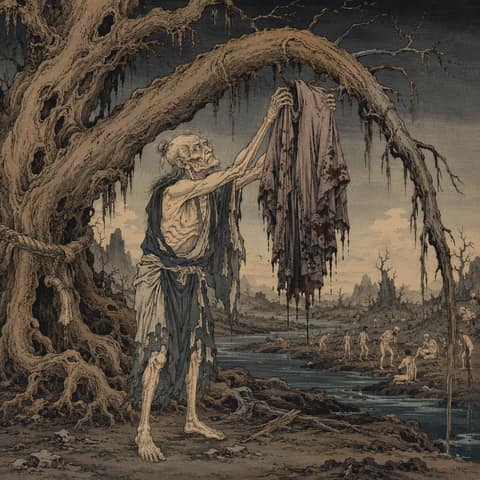
The Technology of Visualizing Underworld Judgment. The entire apparatus—Datsue-ba, Kenne-o, the Eryoju tree, the six-mon toll, the Sanzu River—is a brilliant epistemological design by ancient Buddhism to materialize and translate the abstract concept of "karma." The three-stage translation—stripping the clothes → hanging them on a tree → weighing the sin by how much the branch bends—converted "invisible karma" into "the visible bending of a tree branch." This became an indispensable visual asset for medieval Buddhist monks when conducting *etoki* (picture explaining) with narrative scrolls. Preachers from the Pure Land, Ji, and Zen sects would point to these scrolls, explaining the mechanics of judgment to the common people. This historical practice forms the very core of Japan's collective view of life and death.
A Comparison of East Asian River-Crossing Underworld Views. The structure of the Sanzu River and Datsue-ba is positioned as a variant of the East Asian "river-crossing" underworld motif. Stories of the dead crossing a river exist in China and Korea, but the Japanese trinity of Datsue-ba, Kenne-o, and the Eryoju tree exhibits extraordinary originality. It is fascinating to compare this with the River Styx and the ferryman Charon in Greek mythology, serving as material to explore the anthropological universality of river-crossing underworlds. The imagination that "the dead must cross a river" shares a common matrix in human societies built around large river basins, yet each culture carved out its own unique, localized judgment machinery.
The Hayarigami Phenomenon at Shoju-in: A Social History of Urban Buddhism. The massive popularity of the Datsue-ba statue at Shoju-in (Naito Shinjuku) from 1849 through the Meiji era[2] is a crucial case study for understanding the social history of urban Buddhism in the Edo period. Edo was a world-class metropolis with over a million residents; infectious diseases like tuberculosis and cholera were rampant, meaning the urban poor lived side-by-side with the fear of sudden death. The rumor that Datsue-ba possessed the miraculous power to "stop coughs" exploded as a folk remedy for respiratory illnesses, drawing endless lines of worshippers to her wooden statue. At the end of the Edo period, Datsue-ba was not the only figure to become a *hayarigami* (fad deity); O-Take Dainichi Nyorai and Mimeguri Shrine also experienced similar booms, serving as key phenomena for deciphering the collective psychology of the masses during times of political and social turmoil.
The "Cotton Hag" and the Symbolism of Cloth. The Datsue-ba statue at Shoju-in was dubbed the "Cotton Hag" because worshippers draped cotton over her head and shoulders. This presents a fascinating inversion of the symbolism of cloth for a hag whose very name means "clothes-stripper." Datsue-ba is fundamentally a monster that *takes* clothes, yet the masses reversed this by *offering* her cotton (new cloth) in exchange for curing their coughs and ensuring good health. The binary opposition of "stripping clothes" versus "offering clothes" was masterfully reconciled in folk religion. If illness is something that "strips away health," then the folk logic dictates: "I offer you clothes, so please take my illness away." The statue brilliantly completed a flexible religious metamorphosis from a strict underworld judge in Buddhist scripture to a benevolent scapegoat deity in local folklore.
Late Edo Woodblock Prints and Publishing Culture. Throughout the Kaei, Ansei, Man'en, and Bunkyu eras of the late Edo period, the Datsue-ba of Shoju-in was heavily depicted in nishiki-e (color woodblock prints)[2]. Edo's publishing culture swiftly commercialized the fad deity, building an industrial structure that tightly linked plebeian faith with consumer culture. The Datsue-ba prints functioned simultaneously as religious souvenirs, proof of pilgrimage, and media for spreading information, driving the gears of Edo's urban economy. At the intersection of Buddhist philosophy, folk religion, urban consumerism, and the publishing industry, Datsue-ba transcended the realm of a mere "underworld hag" to become a master key for decoding the collective mindset of Edo society.
Datsue-ba's Rebirth in Modernity. In post-war yokai literature, horror, anime, and games, Datsue-ba has been repeatedly reshaped. The apocalyptic panics, pandemic fears, and confusion regarding life and death in the 21st century share a structural resonance with the anxieties of medieval and early modern people. The visceral imagery of Datsue-ba "stripping clothes to measure sins" retains a formidable evocative power. Resurrected in the modern weird fiction of authors like Natsuhiko Kyogoku, Baku Yumemakura, and Fuyumi Ono, as well as in subcultures like the game *Okami* and the *Touhou Project*, Datsue-ba continues to serve as a vital nexus connecting the religious imagination of the past with the pop culture of modern Japan.
Character Profile
This section is our own creative profile for storytelling. It is not historical fact or scholarship.
Yokai Type - Traditional Yokai
Category - Ghosts & Spirits
Rarity - Legendary
Personality - A dual-natured existence: a ruthless hag who strips the clothes of the dead, but also a compassionate folk deity who cures coughs and acts as a scapegoat for illness.
Compatibility - Deeply connected to those who bring their six-mon toll, those whose clothes are lightened by good deeds, and the sick who offer cotton. Extremely strict against heavy sinners and the destitute dead.
Abilities - Strips the clothes of the dead arriving at the Sanzu RiverCollaborates with Kenne-o to weigh the sins of the deceased's past lifeGuards the boundary of the underworldCures coughs and respiratory diseases (Edo period folk belief)Syncretized in local folklore as the 'Shozuka no Baba'Serves as the connective tissue between Sai no Kawara, the six-mon toll, and the Six Realms of Reincarnation
Weaknesses - The six-mon toll (river crossing fee), good deeds accumulated in life, the chanting of the Nembutsu, and the salvation of Jizo Bodhisattva. Pure Land sects preached that faith in Amida's vow bypasses her entirely.
Habitat - The banks of the Sanzu River beneath the Eryoju tree; Shoju-in (Shinjuku) and Soen-ji; Jizo halls and Sai no Kawara monuments across Japan; medieval underworld paintings and modern horror media.