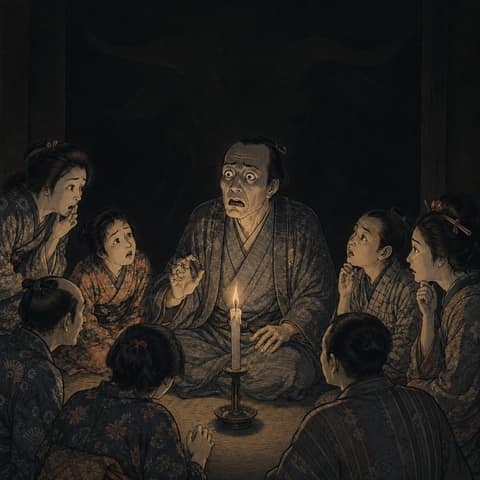
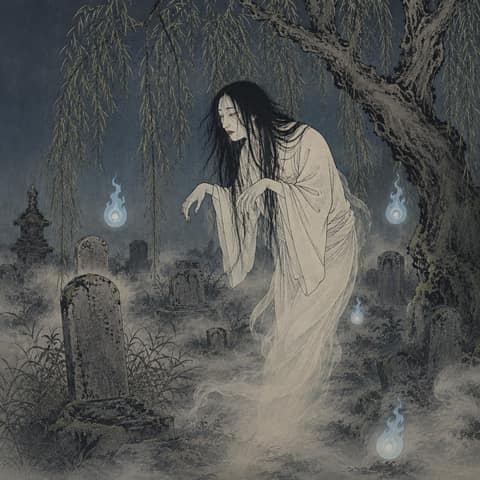
This shinigami is not a monster that attacks with a scythe or as a skeleton, but a storytelling device that turns lifespan into something "visible." In the rakugo play "Shinigami," the most unforgettable scene is where countless candles burn. Human lives line up as individual fires; there are long fires, short fires, and fires about to go out. Because abstract lifespan is converted into the light and dark right before one's eyes, the listener accepts death not through logic, but visually[1].
The core of this version lies in the fact that the shinigami tests human judgment rather than killing humans. The man is taught a technique by the shinigami, learning that if the shinigami is at the patient's feet, they can be saved. The ability itself seems like a gift, but it also means bearing the responsibility of "one who can see." The shinigami does not give many orders; it only hands over rules. It is always the human who breaks them, and the way they break them oozes with attachment to greed, fear, emotion, and fame.
The shinigami in rakugo is also a being that converted an imported folktale into Japanese humor. While possessing a skeleton similar to the Grimm tale "Godfather Death," Encho's oral performances push the doctor's rise to success, the slice-of-life feel of the nagaya, and the comical struggle for money to the forefront[3]. Therefore, the shinigami borrows Western allegorical imagery while wearing the breath of Edo-Tokyo's popular entertainment. The duality of it being both scary and funny, of being cornered by the shortness of lifespan while laughing, supports the Japanization of this anomaly.
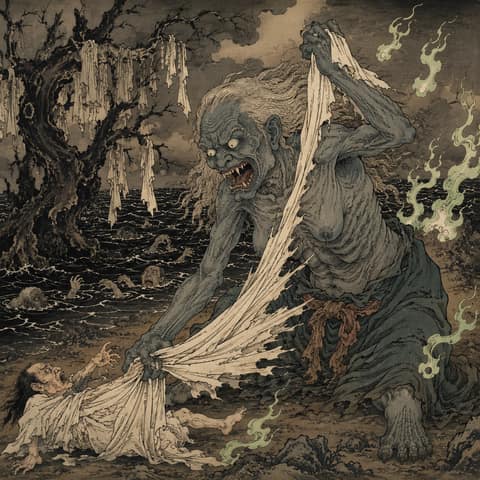
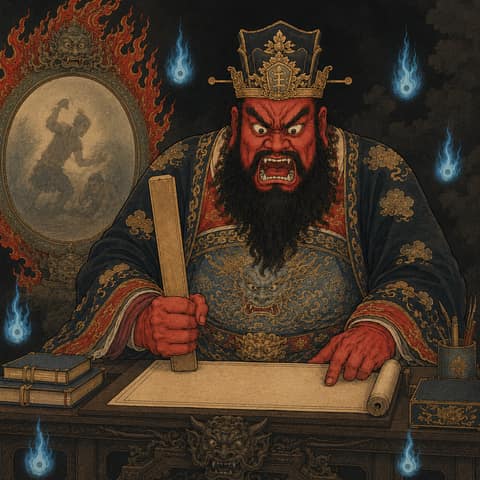
Compared to the kings of the underworld, this shinigami is a mediator, not an administrator. King Enma judges sins after death, and Datsueba strips clothes from the dead, whereas the shinigami enters a person's room while they are still alive[2]. It is because it is before death that negotiations occur, and because negotiations occur, a story is born. Standing in a more ambiguous and precarious place before the system of the afterlife begins is what opened the shinigami up to urban legends and modern creations.
The terror of this version lies in the fact that the shinigami does not seem to act solely out of malice. It looks like it is helping the man, and it also looks like it has been luring him to ruin from the start. The ambiguity of being readable both ways distances the shinigami from a simple villain. It is natural for humans to wish to avoid death, but the moment that wish turns toward another's life or a loophole in the rules, the shinigami transforms from a quiet guide into a mirror of judgment.
If handling this shinigami on a modern page, it is best not to confine it solely to the image of black robes. The lighting of a hospital room, the remaining amount of fire, a shadow standing at the pillow, an invisible promise, the boundary between medicine and superstition—the essence of the shinigami lies in the combination of these "signs forecasting death." In cards or diagnoses, positioning it as a presence that reflects both the heart that fears the end and the heart that wants to know the end will bring out the depth of this anomaly.
When turning the shinigami into a page, one should avoid simply placing a Western-style skeleton and calling it a day. The Japanese "Shinigami" was established by the overlapping of rakugo, adapted folktales, Buddhist views of the underworld, and modern medical anxiety. Therefore, the structure of the transaction surrounding death is more important than its appearance. The fire is short, the position of the sickbed is bad, breaking the rules comes with a price. The combination of such conditions calls the shinigami.
This personality is also the reason why the shinigami is repeatedly remade in modern creations. Because it is not fixed to a single classical picture, it can be a young man in black robes, an old man in white, a kind guide, or a cold contractor. Yet at its core remains the human desire to escape death, and the moment that desire inevitably hits a wall. In YOKAI.JP, keeping this mutability while placing the rakugo candle as the central axis is the strongest approach.
Character Profile
This section is our own creative profile for storytelling. It is not historical fact or scholarship.
Yokai Type - Traditional Yokai
Category - Ghosts & Spirits
Rarity - Legendary
Personality - Quiet and somewhat cynical. Rather than blaming human desires, it pretends to grant their wishes, only to reveal that there is no escape.
Compatibility - 死や運命を正面から見つめる人とは深い対話になるが、短絡的な利益を求める相手には冷たい罠として働く。
Abilities - Showing the fire of lifespanAnnouncing the approach of deathReading the presence of a sickbedTesting desire through contractsGuiding to the border of the underworldHiding death within laughter
Weaknesses - Cannot explain its power to an opponent who completely ignores rules, and acts poorly as a threat to those who do not fear death.
Habitat - Sickbeds, nagaya, during performances at yose (vaudeville theaters), dark places lit by candles, the pillows of those waiting for death.