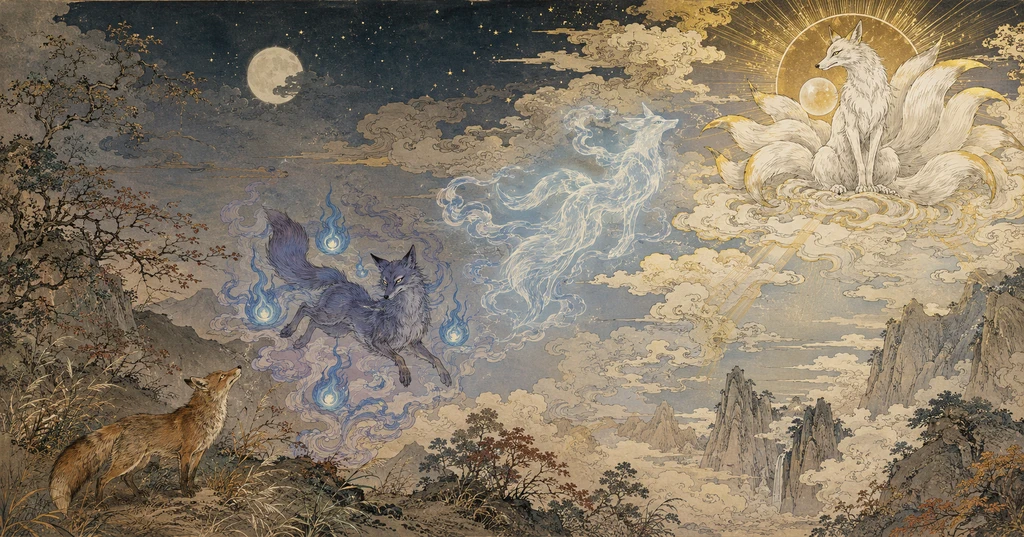
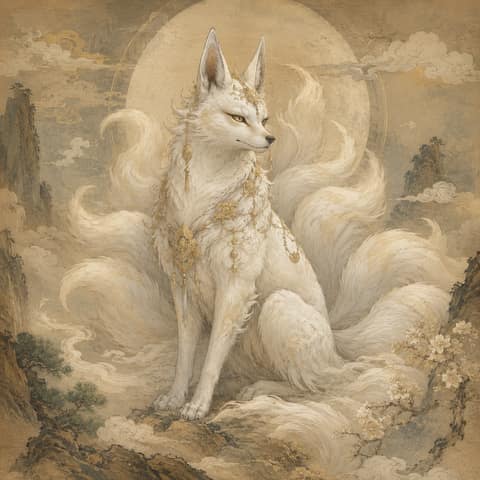
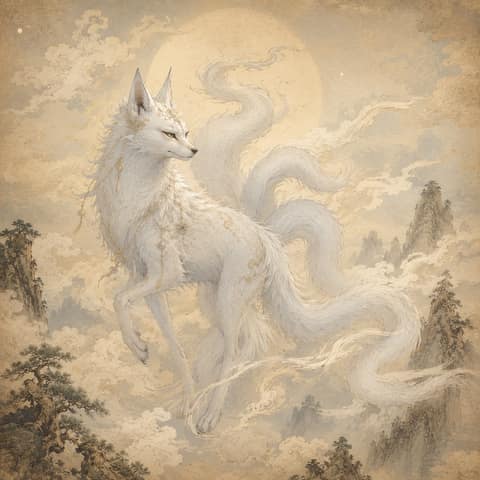
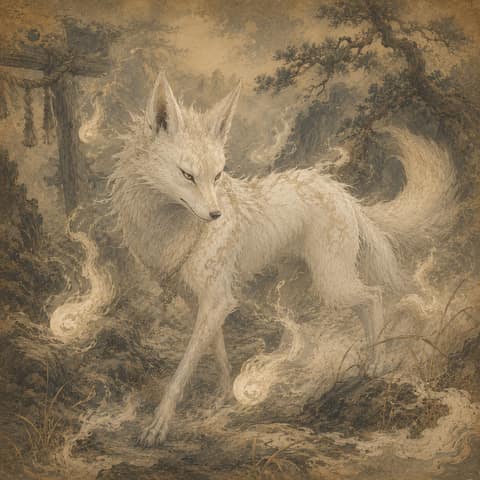
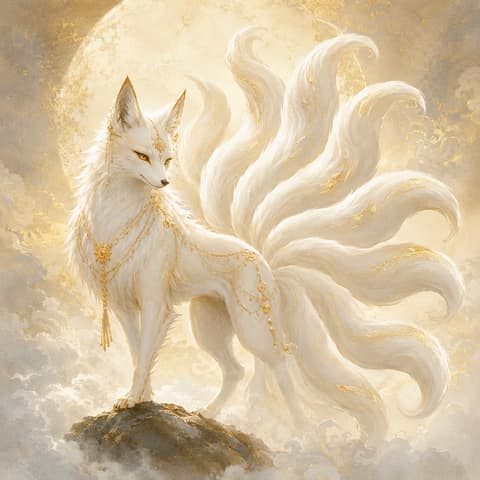
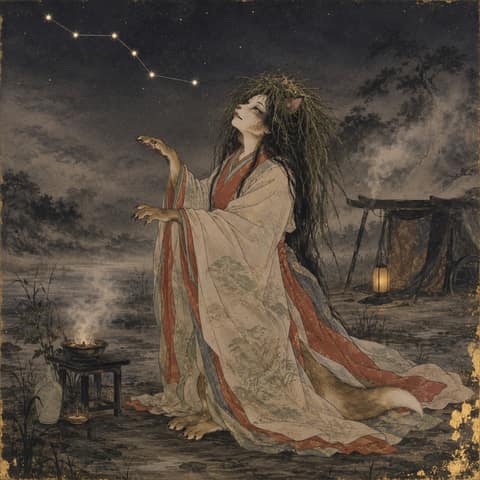
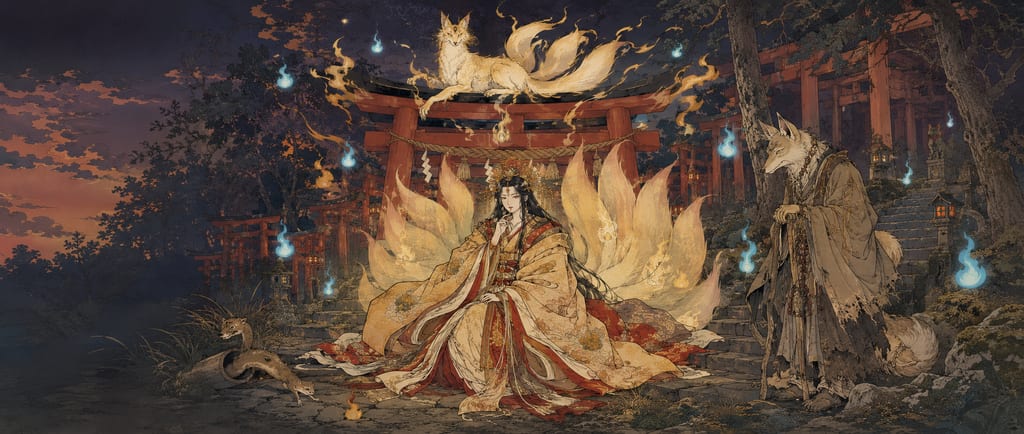
The Tenko, or “celestial fox,” is the highest-ranking of the spirit foxes, the form a fox is said to attain after honing its spiritual power across countless years. Edo-period essays divide foxes into four grades — Tenko, Kūko, Kiko, and Yako [1] — and place the Tenko at the very summit. As an old Chinese treatise on the strange, the *Genchūki*[2], puts it, “when a fox reaches a thousand years it gains passage to heaven and becomes a Tenko.” At that point it is no longer a mere shape-shifting fox but a being all but equal to a god. It is said to see for a thousand leagues, and unlike the Yako or Kiko that bewitch and possess people to work mischief, it does not meddle with humankind lightly.
Folklore & Legends
The idea that a fox grows closer to godhood with age reaches back to China. The *Yūyō Zasso*[3] is said to describe the Tenko as a nine-tailed, golden beast that serves the palaces of the sun and moon and is versed in the principles of yin and yang. This image of a golden, nine-tailed creature later fed into tales of nine-tailed foxes such as Tamamo-no-Mae.
In Japan, this loftiest of foxes dissolved into the world of religious faith. Dakiniten, depicted as a celestial maiden riding a white fox, became bound up with the Inari cult and was also called Shinko-ō Bosatsu. The name “Shinko” (literally “dragon-fox”) is understood to be a deliberate substitute for “Tenko,” chosen to shed the eerie air the latter word carries. Foxes also became the familiars of gods of victory and fire prevention, such as Izuna Gongen[4], depicted as a karasu-tengu bearing a sword and a rope while astride a white fox. It was this same Izuna Gongen that Uesugi Kenshin is said to have mounted on the crest of his helmet. The supreme Tenko, contiguous with Inari’s white foxes and with Dakiniten, gradually became an object of reverence rather than dread.
It should be noted that, because an old usage read “shooting star” as amatsu-kitsune, the Tenko has often been confused with the tengu, the bird-and-beast yōkai [5].
This version explores why the Tenko is spoken of as “a yōkai yet near to a god,” and where it truly stands.
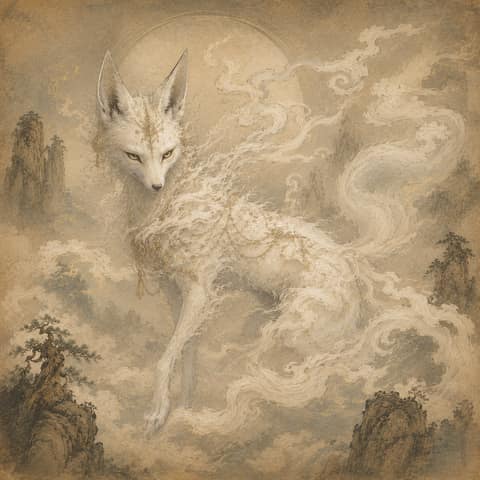
Of the four grades of fox, only the lowest — the Yako — appears before people in a body of flesh to bewitch them. The higher its rank, the more a fox becomes a formless, spiritual presence, and at the summit, the Tenko, it is described less by any shape than by its very workings: seeing for a thousand leagues, communing with the will of heaven. As Yanagita Kunio and Nakamura Teiri [6] have laid out, the Tenko is the utmost extreme of the senko, the spirit fox that has lived a thousand years and accumulated virtue. In neither deceiving people nor leading them astray, but watching over them from above, the Tenko stands at the opposite pole from the Yako.
It was this transcendence that drew the Tenko up into religious faith. Just as Dakiniten is attended by a white fox and Izuna Gongen rides one in the guise of a karasu-tengu, the highest fox is enshrined as a familiar of the gods and buddhas, or as a deity in its own right. The power to which warlords prayed for victory, and to which villagers pressed their palms in hope of fire prevention and good fortune, was in the end the power of this fox in communion with heaven.
One thing to be wary of is confusing Tenko with tengu. Because an old usage read “shooting star” as amatsu-kitsune, the two have long been mistaken for one another [5], yet the Tenko is, properly, a fox that has raised its spiritual rank to the utmost limit — a being of a wholly different lineage from the mountain-ascetic tengu.
Character Profile
This section is our own creative profile for storytelling. It is not historical fact or scholarship.
It does not meddle with people lightly, watching over the world from on high. Endowed with the wisdom to see a thousand leagues and a spiritual rank close to the divine, it grants blessings to those who revere it and shows its power to those who scorn it.
Compatibility
People of deep faith who pair humility with great ambition
Abilities
Sees for a thousand leaguesA near-divine spiritual power in communion with the will of heavenHas no fixed form and manifests as pure workingsBestows fortune and victory in the guise of Inari, Dakiniten, and Izuna Gongen
Weaknesses
The self-restraint never to wield its power idly
Reveals itself only before fervent prayer or true faith
Its true nature is obscured by confusion with the tengu
Habitat
The celestial realm and sacred peaks, Inari shrines, and fox-venerating holy sites such as Mount Izuna and Mount Akiba
The diagram below is a diagnostic evaluation chart for Tenko, the Celestial Fox in Communion with Heaven. The higher the value of each item, the stronger that characteristic is expressed.