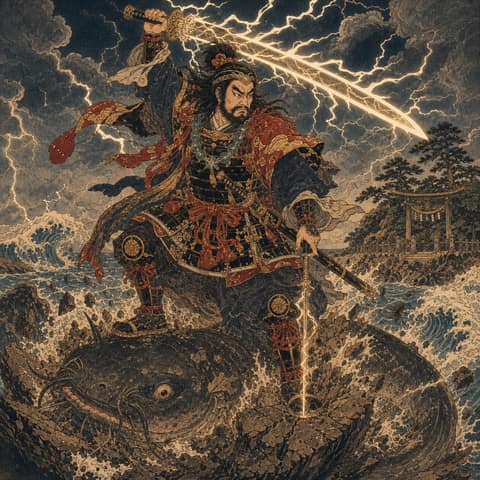
Raijin is the Japanese deity of thunder and lightning, typically depicted as an ogre-like figure carrying a ring of drums on his back, which he strikes to create thunder. He forms a pair with Fujin (the wind god), and in Tawaraya Sotatsu's "Wind God and Thunder God Screens" (circa 1620s, formerly held by Kennin-ji in Kyoto, now a National Treasure)[1], a white-skinned Raijin is depicted on the left side facing the viewer, while a green Fujin is on the right. However, Raijin is generally represented in shades of red; Sotatsu's choice to paint him white to contrast with the gold-leaf background is highly unusual. Rather than a single deity, "Raijin" functions as a categorical name encompassing multiple deities, classically represented by Kamo-wakeikazuchi-no-Okami, the enshrined deity of Kamo-wakeikazuchi Shrine (Kamigamo Shrine)[2]. Meanwhile, during the Heian period, following the Seiryoden lightning strike incident (930)[3], the vengeful spirit of Sugawara no Michizane was conflated with Karai Tenjin (the fire-thunder deity), leading to his enshrinement as the thunder god of the Tenjin faith at Kitano Tenmangu[4]. Takemikazuchi also bears "ikazuchi" (thunder) in his name, but his divine nature is more that of a sword or martial deity, and he is distinguished from Raijin proper.
Folklore & Legends
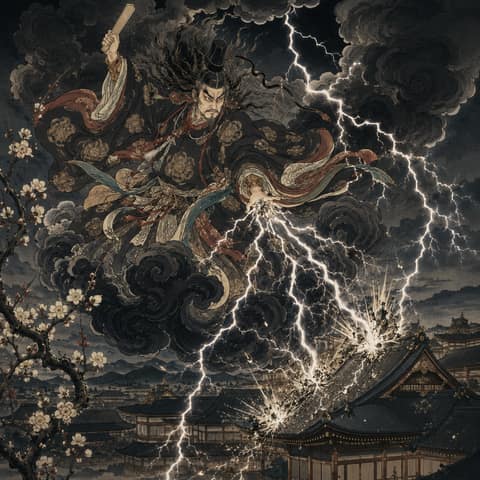
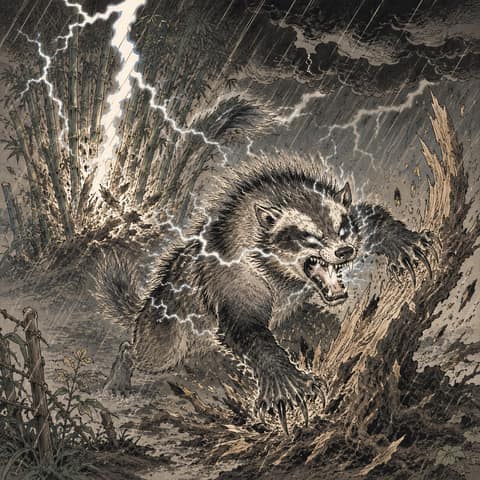
Raijin's earliest appearance can be found in the Yomi (Underworld) myth of the Kojiki. According to the first volume of the "Kojiki" (712)[5], when Izanagi saw Izanami's decaying body in the Underworld, eight thunder deities had emerged upon it—Oikazuchi on her head, Honoikazuchi on her chest, Kuroikazuchi on her abdomen, Sakuikazuchi on her genitals, Wakaikazuchi on her left hand, Tsuchiikazuchi on her right hand, Naruikazuchi on her left foot, and Fusuikazuchi on her right foot (collectively known as the Eight Thunder Gods, or Yakusa-no-ikazuchi-no-kami). A similar account is recorded in the "Nihon Shoki" (720)[6]. The center of classical Raijin worship is Kamo-wakeikazuchi Shrine (Kamigamo Shrine, Kyoto)[2], tracing its origins to the legend of the red-painted arrow (ninuri-no-ya) from the lost writings of the "Yamashiro no Kuni Fudoki"—in which Tamayori-hime was impregnated by a red-painted arrow floating down the Kamo River, giving birth to Wakeikazuchi-no-kami. In the mid-Heian period, the vengeful spirit of Sugawara no Michizane, who died in exile after losing a political struggle, merged with the fire-thunder deity Karai Tenjin following the Seiryoden lightning strike incident of the eighth year of the Encho era (930)[3] (where a lightning strike killed and injured courtiers including Major Counselor Fujiwara no Kiyotsura, shortly after which Emperor Daigo also passed away). He was subsequently enshrined as the Tenjin deity of Kitano Tenmangu (founded in 947)[4]. In the realm of folklore, the first volume of the "Nihon Ryoiki"[7] tells of a farmer who saved a thunder god that had fallen to earth, and was blessed with a heaven-sent child of thunder; this child grew up to be Dojo Hoshi, a monk of extraordinary strength who vanquished the oni of Gango-ji temple. In popular belief, customs such as hiding one's belly button when thunder claps (under the superstition that "Lord Thunder will steal your belly button") and chanting "Kuwabara, kuwabara" as a charm to ward off lightning strikes are widely known. The origins of the latter are contested, split between a Kyoto legend claiming lightning never struck Michizane's estate in Kuwabara, and a Settsu legend about a thunder child locked in a well at Kinsho-ji temple. Additionally, the beast-like yokai known as "Raiju," said to fall to earth alongside lightning strikes, belongs to a separate lineage from Raijin, the ogre-like thunder god.
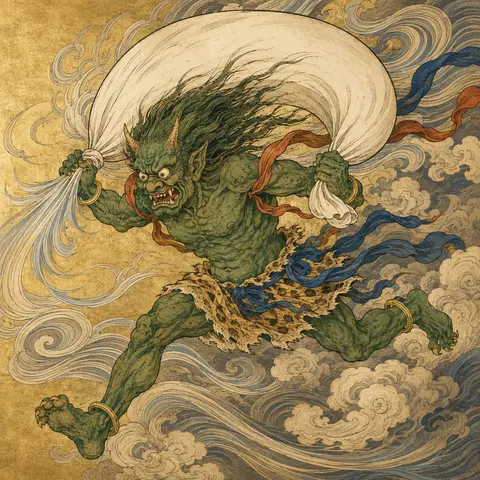
The definitive image of Raijin was established by Tawaraya Sotatsu's "Wind God and Thunder God Screens"[1], a pair of two-panel folding screens with a gold-leaf background. It pits a white Raijin on the left (carrying a ring of connected drums on his back) against a green Fujin on the right (carrying a wind bag). This composition was faithfully reproduced by subsequent Rimpa school painters like Ogata Korin and Sakai Hoitsu, becoming the standard iconography for Fujin and Raijin today. The drums encircling Raijin's back are said to produce thunderclaps when struck; combined with his ogre-like form, tiger-skin loincloth, and sharp claws, this design visualizes the tempestuous forces of the sky. In the history of faith, Raijin can be broadly classified into three lineages. First is the classical thunder god represented by Kamo-wakeikazuchi-no-Okami (Kamigamo Shrine). Second is the Tenjin lineage, which conflates the vengeful spirit of Sugawara no Michizane with Karai Tenjin (Kitano Tenmangu, founded in 947). Third is Takemikazuchi, who bears "thunder" in his name but is essentially a sword and martial deity, and should not be equated with Raijin. In the Kanto region, Raiden worship spread outward from its headquarters at Raiden Shrine in Itakura, Gunma; it enshrines deities like Karai-no-Okami, Oikazuchi-no-Okami, and Wakeikazuchi-no-Okami as targets for prayers against lightning strikes and for bountiful harvests. In an agrarian society, lightning was seen as a harbinger of fertility—striking rice paddies to make the crops bear fruit as "inazuma" (literally "spouse of the rice"). Thus, Raijin has long been revered as a dual-natured entity: a terrifying deity who delivers heavenly punishment, and a benevolent god who brings the blessings of rain and harvest.
Character Profile
This section is our own creative profile for storytelling. It is not historical fact or scholarship.
The diagram below is a diagnostic evaluation chart for Raijin, the Deity Who Strikes Drums to Summon Thunder. The higher the value of each item, the stronger that characteristic is expressed.