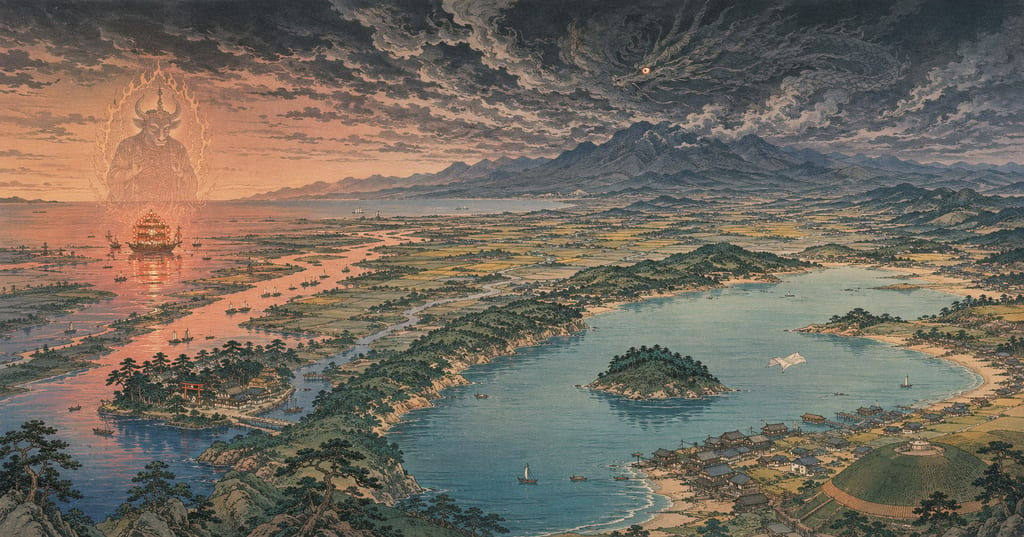
If one were to pierce through the yokai culture of Aichi Prefecture with a single thread, that thread would invariably lead to iron and swords, and to plagues and winds. This region, where the two former provinces of Owari and Mikawa are bundled into a single prefecture, embraces the twin inland seas of Ise Bay and Mikawa Bay. Since ancient times, it has been a nexus where maritime transport, metallurgy, and faith intersect.
The defining symbol is the Kusanagi-no-Tsurugi (Grass-Mowing Sword) enshrined at Atsuta Jingu. According to the *Nihon Shoki*, this sword originates from the Ame-no-Murakumo-no-Tsurugi, which emerged from the tail of the eight-headed serpent Yamata-no-Orochi when it was slain by Susanoo in Izumo[1]. Susanoo, the progenitor of this sword, became conflated during the medieval period with Gozu Tenno, the supreme deity of plague warding, whose head shrine was established at Tsushima Shrine in western Owari. A sword is forged of iron, and the blacksmith god who strikes that iron came to be worshipped on the border of Owari and Ise as a one-eyed wind god, whose gales were feared as the 'Divine Wind of Ichimokuren.' Furthermore, to the south in Mikawa Bay, a small island preserves a rustic monster—rescued from obscurity solely by modern folklore studies—where the most mundane of fabrics, bedding, covers a person and steals their breath.
Susanoo, swords, iron, winds, and plagues ── the supernatural entities of Aichi align along this interconnected cycle. This article traces the topography of 'swords and iron, plagues and winds' that forms the backbone of this region, pivoting on three central figures: the plague god of Tsushima, the one-eyed wind god of Owari, and the cloth monster of the islands in Mikawa Bay.
A Region Bound by Two Inland Seas ── The Topography of Owari and Mikawa
The administrative district of Aichi Prefecture was formed through the abolition of the han system in the Meiji era, combining the former provinces of Owari and Mikawa. Yet, the character of these two lands is a study in contrasts. The western half, Owari, sprawls across an alluvial plain where the Three Kiso Rivers ── the Kiso, Nagara, and Ibi ── flow into Ise Bay. This plain, gathering water from all directions, nurtured early rice cultivation and commercial industry. In the eastern half, Mikawa, mountains press right up to the sea, scattering small islands and fishing villages across the enclosed waters of Mikawa Bay. Within the same prefecture, the metropolitan culture of a massive river delta coexists with the island culture of an intricate coastline.
This topography shaped both faith and the supernatural. In water-abundant western Owari, the constant struggle against the flooding of the Three Kiso Rivers and summer epidemics led to an accumulation of prayers, giving rise to festivals that cast plague gods adrift on the river currents. Memories of blacksmithing, working with iron and fire, stretched to the opposite shores of Ise Bay, crystallizing into a one-eyed god in the mountains surrounding the water. Conversely, on the islands of Mikawa Bay, isolated from the mainland, simple, orally transmitted monsters survived completely detached from the illustrated scroll culture of the outside world. The two inland seas ── Ise Bay and Mikawa Bay ── connected these two provinces through networks of water, transforming the specific anxieties harbored by each land into their own distinct supernatural forms.
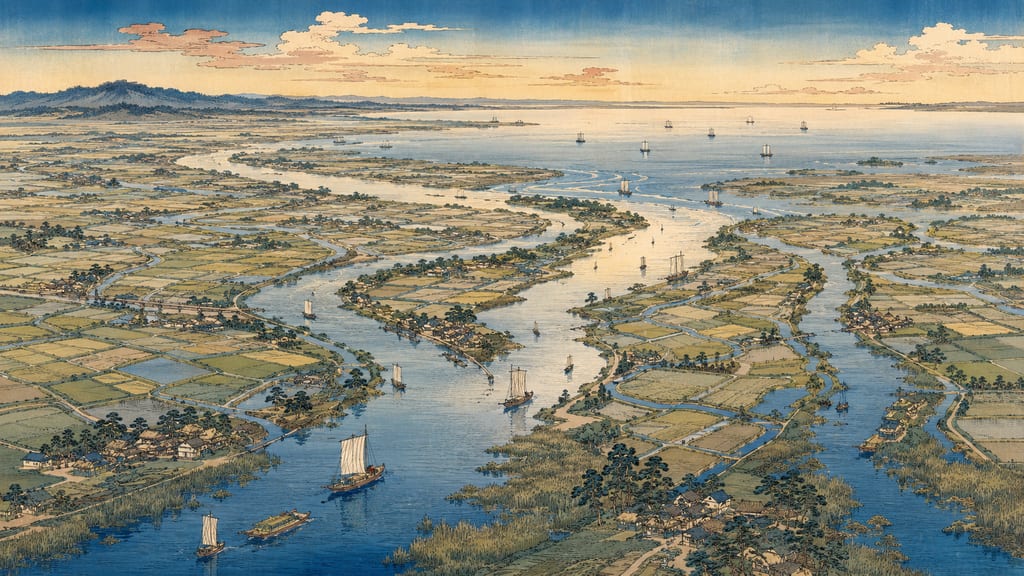
Moving into the early modern period, the center of gravity in Owari shifted to the castle town of Nagoya, built upon the Atsuta Plateau. Nagoya Castle, constructed by Tokugawa Ieyasu in 1610 (Keicho 15) through a nationwide mobilization, involved the 'Kiyosu-goshi' ── the relocation of the entire town from Kiyosu ── concentrating people, goods, and faith all at once. Temples and shrines were arranged in the direction of the castle's demon gate, while the Tokaido road crossed the sea from Miya-juku in Atsuta to Kuwana via the Shichiri-no-Watashi ferry ── meaning the entrance to the Ise route, looking toward Mount Tado and Ichimokuren, lay at the southern tip of Owari. Atsuta enshrining the sword, Tsushima warding off plagues, and Tado summoning the wind. The geography of the supernatural in western Aichi fits almost entirely within the triangle connecting these three points.
Tsushima Tenno ── The Capital of Plague Gods Overseeing Three Thousand Shrines
When discussing the supernatural in Aichi, one cannot bypass Tsushima Shrine, situated in the low, marshy wetlands of western Owari. Here, just before the Three Kiso Rivers empty into Ise Bay, where the waters converge, shrine tradition claims its founding in the first year of Emperor Kinmei (540). It proclaims itself the head shrine of the roughly three thousand Tenno and Tsushima shrines scattered across the nation[2]. If Kyoto's Yasaka Shrine is the axis of Gion faith in western Japan, Tsushima Shrine is the center of Tenno faith centered in the Tokai region, and the two are often mentioned side-by-side as 'Yasaka in the West, Tsushima in the East.'
However, the shrine's traditional founding date and its first appearance in historical records must be distinguished. The earliest confirmed historical mention of Tsushima Shrine is an inscription on the *Dai Hannya Kyo* (Great Perfection of Wisdom Sutra) dating to 1175 (Joan 5); the founding in 540 is a matter of shrine legend[3]. The myth of the deity's arrival across the sea was also organized in later eras. The *Gozu Tenno Koshiki* (Ritual Rules of Gozu Tenno), a text copied in 1540 (Tenbun 9) and preserved by the shrine, records that Gozu Tenno, having crossed over to Japan, arrived in the western provinces from Tsushima during the reign of Emperor Korei, and manifested in Tsushima, Kadoma Manor, Ama District, Owari Province during Emperor Kinmei's reign, deeming it a sacred land corresponding to the four guardian spirits[3]. The narrative structure of the god himself crossing the sea to reach Owari perfectly suits Tsushima, a bustling waterfront port town.
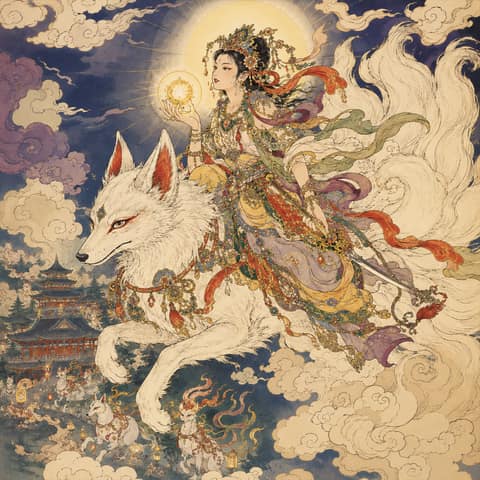
The primary deity enshrined there is a plague god king wholly unique to Japan.
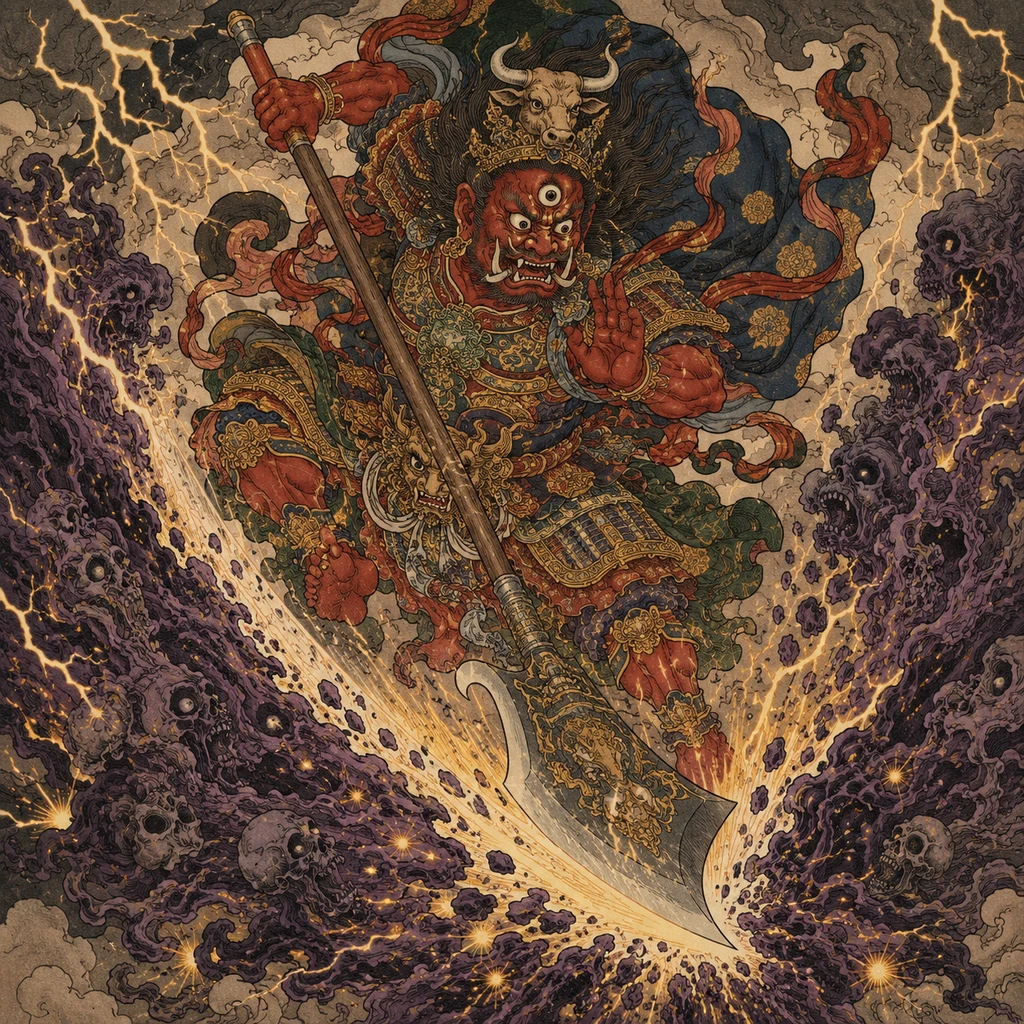
Gozu Tenno
A unique Japanese deity whose existence has not been confirmed overseas in countries like India, China, or Korea. Several theories regarding his origin exist, including being the guardian deity of Jetavana (Gion Shōja in India), originating from the Korean Peninsula (Gozu Mountain / brought by immigrants), or syncretism with Susanoo. From the Middle Ages onward, his identification with Susanoo-no-Mikoto became established. He became the supreme deity in cults warding off epidemics, primarily as the main god in the Somin Shōrai legend from the lost writings of the 'Bingo-no-kuni Fudoki' (where Mutō-no-Kami = Gozu Tenno tests the poor Somin Shōrai brothers and grants them a chinowa [reed ring] to protect against plagues). Centered around Kyoto's Yasaka Shrine (formerly Gion Shrine, founded in 656 by Korean envoy Irishi, with the Gion Goryo-e established in 869), he is widely revered as the main deity of the Gion Festival (one of Japan's three major festivals, originating in 869). Due to the separation of Shinto and Buddhism in the Meiji period (1868), all Gozu Tenno shrines, Tenno shrines, and Gion shrines nationwide were forcibly renamed to feature Susanoo-no-Mikoto as their main deity. However, colloquial names like 'Tenno-san' and 'Gion-san' and folk practices such as warding off plagues and passing through the chinowa continue to this day.
Read moreGozu Tenno is a venerated figure worshipped exclusively in Japan; his existence has not been confirmed in India, China, or Korea[4]. Various theories exist regarding his origins, including a Buddhist derivation identifying him as the guardian deity of the Jetavana monastery, or a theory that he was brought by immigrants via Mount Gozu on the Korean Peninsula, but none are conclusive. Yet, from the medieval period onward, Gozu Tenno became synchronized with Susanoo[5], decisively determining his character. The fierce god who slew Yamata-no-Orochi in Izumo and produced the Kusanagi sword is, precisely because of his ferocity, the god who wards off plagues. The reason Tsushima Shrine later designated Takehaya Susanoo-no-Mikoto as its main deity is rooted in this history of syncretism.
The narrative at the core of the faith remains the same, whether inside or outside Tsushima. It is the legend of Somin Shorai from a lost fragment of the *Bingo-no-Kuni Fudoki* ── a tale in which Muto-no-Kami (Gozu Tenno), seeking lodging on a journey, was hosted not by the wealthy older brother, but with millet rice by the poor Somin Shorai. In return, the god taught him: 'Attach a cogon grass ring (chinowa) to your waist and chant that you are a descendant of Somin Shorai, and you shall escape epidemics'[6]. The following day, the family that refused hospitality was wiped out by a plague, leaving only Somin Shorai's lineage alive. The folk customs of passing through a chinowa ring and affixing a talisman reading 'Gate of the Descendants of Somin Shorai' spread to Tenno shrines nationwide from this single legend. The summer of Tsushima Shrine is likewise pierced through by this prayer to drive away plagues.
Five Ships of Fire on the Tenno River ── The Owari Tsushima Tenno Festival
The faith of Tsushima manifests most dramatically in the Owari Tsushima Tenno Festival, held annually on the fourth Saturday and Sunday of July. With a tradition spanning some six hundred years, surviving records suggest this river festival began around the fifteenth or sixteenth century. In 1980 (Showa 55), the 'Danjiri Boat Event of the Owari Tsushima Tenno Festival' was designated as a Significant Intangible Folk Cultural Asset of Japan, and in 2016 (Heisei 28) it was inscribed as one of 33 'Yama, Hoko, Yatai, float festivals in Japan' on the UNESCO Intangible Cultural Heritage list[7]. Alongside the Kangen-sai of Itsukushima Shrine and the Sumiyoshi Matsuri of Sumiyoshi Taisha, it is counted as one of Japan's three great boat festivals.
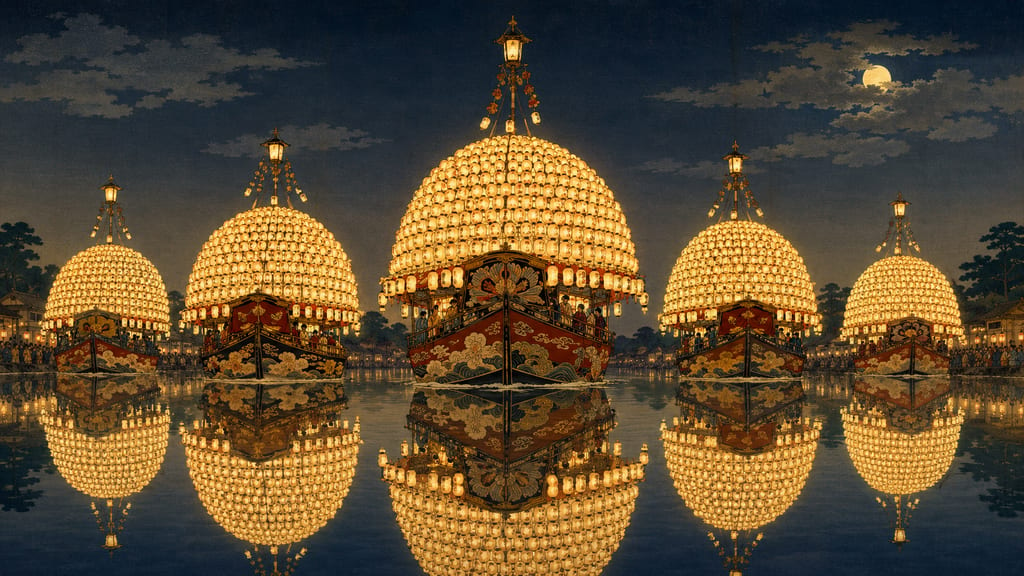
On the eve of the festival, five makiwara-bune (straw-wrapped boats) representing Tsushima's five districts float on the waters of the former Tenno River, illuminated by roughly five hundred lanterns arranged in a hemispherical dome. The countless lights reflecting on the water serve to pacify the rough spirit (aramitama) of Gozu Tenno, who rages in the summer, and to drive away epidemics by sending him down the river. The following morning, during the Asa-matsuri (morning festival), boats carrying Noh dolls row out, and young men wielding halberds simultaneously dive into the river, racing up the opposite bank to the shrine. The origin of the festival ── held as a prayer to safely survive the severe heat, since many infectious diseases broke out in the summer[7] ── rests on the exact same logic as the Kyoto Gion Festival, which originated in response to the great epidemic of the Jogan era.
What reveals the true essence of this festival most clearly is a sacred ritual performed in the dead of night, hidden behind the glamorous boat procession. At Tsushima Shrine, deep in the night after the morning festival, the 'Kamiyoshi-nagashi' (or Miyoshi-nagashi) is performed, sealing human sins and impurities into bundles of reeds and setting them adrift on the river. This sequence of rituals, beginning with the selection of the reed-cutting ground fourteen days prior and ending with the final offering of the reeds seventy-five days later, is a purification rite that transfers plague gods into the reeds to float them away from the land. This is considered the original core of the Tenno Festival[8]. The fire boats of lanterns are the public festival designed to attract the eye, while the Kamiyoshi-nagashi ── transferring impurity to reeds and sending them down the dark river ── is the hidden festival, meant not to be seen but to purify. Whereas the Gion Goryo-e in the capital parades through streets with sixty-six halberd floats, Owari's Tenno Festival floats ships of fire on the surface of a river emptying into the inland sea, entrusting impurities to reeds on the water ── a prime example of topography dictating the shape of faith.
The prosperity of Tsushima was supported from behind by the warlords of the Sengoku period. The Oda clan, originating from the adjacent Shobata Castle, revered Tsushima Shrine as their tutelary deity and expanded their power backed by the economic might of the Tsushima port. The subsequent Toyotomi family also donated shrine territory. The existing Romon gate is said to have been donated by Toyotomi Hideyoshi in 1591 (Tensho 19) and is designated as a National Important Cultural Property[2]. The main hall (Honden), dating to 1605 (Keicho 10), is said to have been donated by Masako, wife of Tokugawa Ieyasu's fourth son, Matsudaira Tadayoshi, and is also an Important Cultural Property[3]. Through the combination of Tsushima port's trade and the faith of the Oda, Toyotomi, and Matsudaira, the Tenno faith of the Tokai region was propagated out to various locales.
However, entering the Meiji period, this deity was severely shaken by the political system. Due to the Kami and Buddhas Separation Order of 1868 (Meiji 1), the title 'Gozu Tenno,' which carried Buddhist connotations, was prohibited. Tenno and Gion shrines nationwide were forcibly renamed to shrines honoring Susanoo-no-Mikoto as their main deity[9]. Just as Kyoto's Gion Kanjin-in became Yasaka Shrine, the Tsushima Gozu Tenno Shrine dropped the name Gozu Tenno and was rebranded as Tsushima Shrine, with Takehaya Susanoo-no-Mikoto as its primary deity. Yet, the mouths of the common people never let go of the affectionate title 'Tenno-san,' and the passing through the chinowa, the talismans, and the festivals continued uninterrupted. During the pandemic from 2020 onward, when people once again reached out for the chinowa rings, the image of the Plague God King, storing over a millennium of memories, quietly surfaced once more.
The Blacksmiths of Owari and the One-Eyed Wind God ── Ichimokuren
A land that gives birth to a sword is also a land that forges swords. Owari, where Atsuta Jingu enshrines the Kusanagi sword as its sacred body, was home to many swordsmiths from the medieval through the early modern periods, steeped in memories of blacksmithing with iron and fire. That memory of forging crystallized into a single, bizarre god on the border of Ise and Owari.
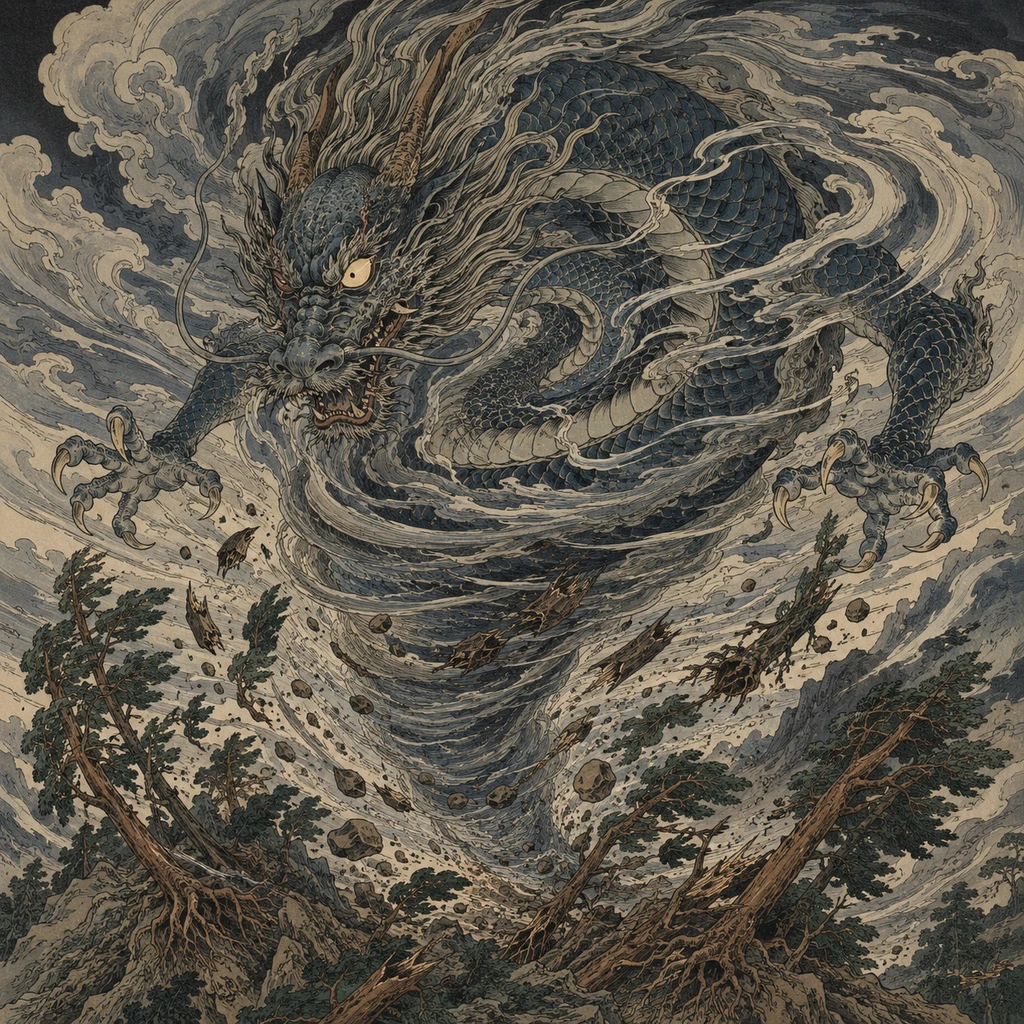
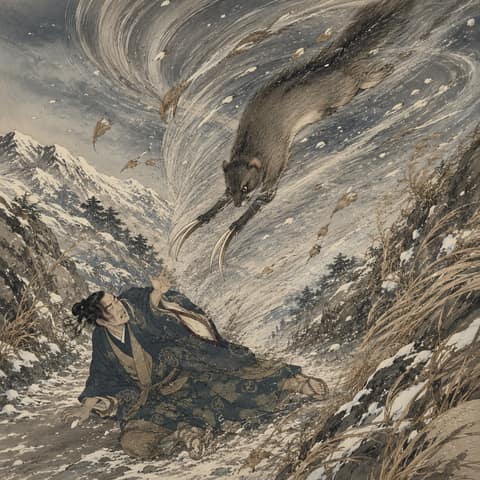
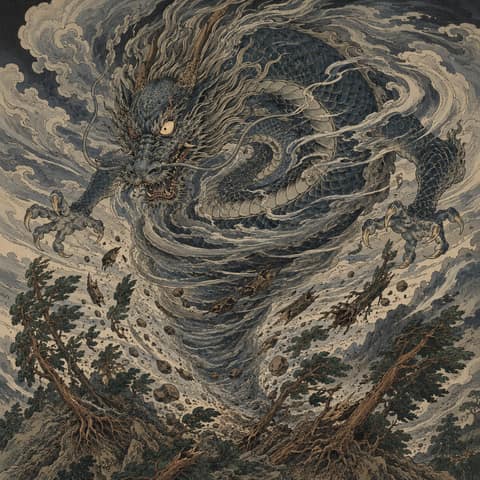
Hitome-ryō
A wind deity enshrined at Hitome-ryō Shrine, the auxiliary sanctuary of Tado Grand Shrine. Traditionally viewed as a one-eyed dragon god, later syncretized with the smithing deity Ame-no-Mahitotsu (Ame-no-Hitotsu-no-Megane). Along the Ise Bay coast, he was revered as a ruler of wind and rain, attracting prayers for safe voyages and rainmaking. The shrine’s hall has no doors so the god may come and go freely to manifest his power. Feared and respected for the ability to unleash violent gales.
Read moreIchimokuren is a one-eyed wind god enshrined at the Ichimokuren Shrine, an auxiliary shrine of Tado Taisha in Kuwana. Though based on the Ise side, his divine power crosses borders. The *Wakan Sansai Zue* (Illustrated Sino-Japanese Encyclopedia of the Three Realms), compiled around 1712 (Shotoku 2) by Terajima Ryoan, notes that sudden gales blowing across Ise, Owari, Mino, and Hida were called the 'Divine Wind of Ichimokuren'[10]. It was said that when the god departed from his shrine on Mount Tado and raged, hurricane-force winds would arise, uprooting trees and toppling rocks, yet blowing through along a single destructive path while leaving the rest untouched. The reason the sanctuary of Ichimokuren Shrine has no doors is reportedly to allow the god to enter and exit freely to exert his divine might. To the farmers of Owari, sudden fierce winds were the pathway of this one-eyed god.
Why one eye? Here, the wind god overlaps with the blacksmith god. The *Kogo Shui* (Gleanings of Ancient Words), compiled by Inbe no Hironari in 807 (Daido 2), records that Ame-no-Mahitotsu-no-Kami made swords, axes, and iron bells during the myth of the heavenly rock cave, identifying this deity as a one-eyed blacksmith god[11]. The origin of this single eye is sought in the action of a blacksmith narrowing one eye to judge the color of the iron in the forge, or in an occupational hazard where working with fire and iron causes the loss of an eye. Ame-no-Mahitotsu-no-Kami is thus linked to Amatsu-mara of the *Kojiki* and even to the prototype of the fire-blowing *hyottoko* mask[12]. In later ages, Ichimokuren syncretized with this Ame-no-Mahitotsu-no-Kami, acquiring a dual nature: a dragon god who summons the wind, and a one-eyed god who strikes iron.
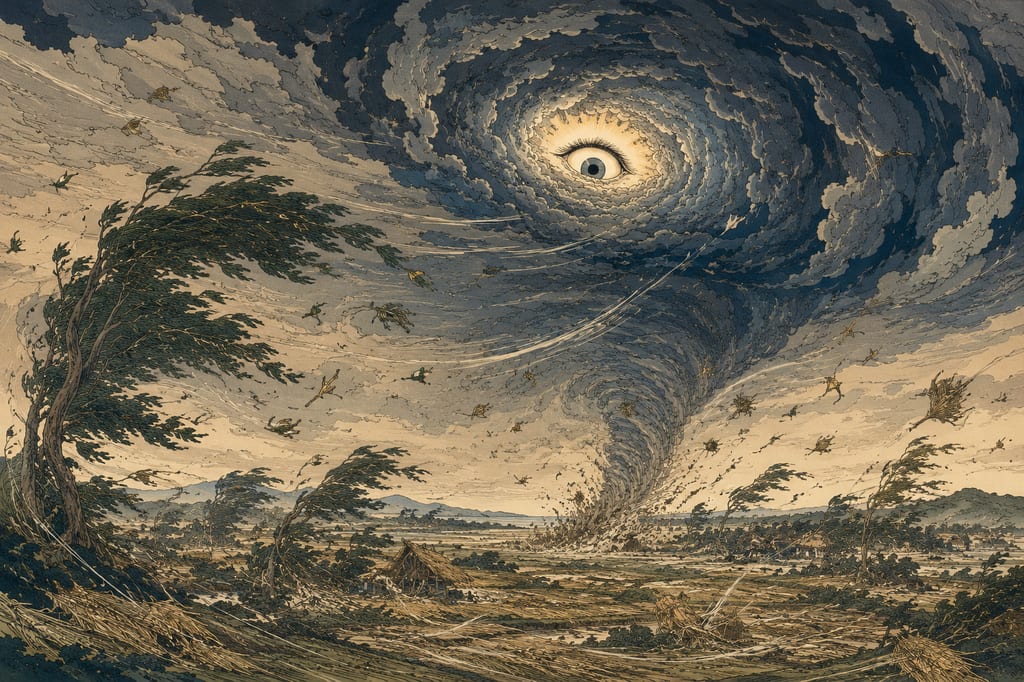
It is no coincidence that in Owari, the province of swords, a one-eyed god who rules the iron of which swords are made and summons storms was feared. The Kusanagi sword of Atsuta, Susanoo, Gozu Tenno, and Ame-no-Mahitotsu-no-Kami are all deities revolving around iron, fire, and untamed power, echoing each other within the topography surrounding Ise Bay. Above all, Atsuta Jingu enshrines the Ame-no-Murakumo-no-Tsurugi that emerged from the tail of Yamata-no-Orochi, renamed 'Kusanagi-no-Tsurugi' (Grass-Mowing Sword) following the tale of Yamato Takeru mowing down burning grass during his eastern expedition[1]. The memory of the sword is thus placed at the core of Owari's genius loci.
The character 'ren' (連) in Ichimokuren is also suggestive. It evokes a linked chain of dragons or serpents, and the god of Tado has long been prayed to as a dragon deity ruling over rain. A god who calls the wind is also a god who calls the rain, and in years of drought, the one-eyed god of storms inverses into an entity that brings blessed showers. Awe and supplication were two sides of the same deity. During the Edo period, sailors on Ise Bay would read the weather by watching the clouds and mist over Mount Tado, praying to Ichimokuren for protection from shipwrecks and for rain. Tado Taisha itself was a crucial wing of the Ise pilgrimage, sung in the refrain: 'If you visit Ise, you must visit Tado; if you do not visit Tado, it is a half-pilgrimage.' For the people of Owari heading to Ise, the one-eyed wind god was a familiar deity holding their journey's weather in his hands. The fires of the forge, the winds on the sea, and the rains for the fields were all bound together in this single, one-eyed god.
The Monster of the Mikawa Bay Islands ── Saku Island's Futon-kabuse
Turning our gaze from the plagues and winds of Owari to the south of the prefecture, we look to Mikawa Bay. In this calm inland sea embraced by the Chita and Atsumi peninsulas float three inhabited islands: Saku Island, Shinojima, and Himakajima. Saku Island is located near the very center of Mikawa Bay, positioned about ten kilometers from West Mikawa, the Chita Peninsula, and the Atsumi Peninsula alike ── a place akin to the navel of the bay[13]. Blessed with rich fishing grounds since antiquity and serving as a linchpin of maritime traffic connecting Ise with the eastern provinces, these islands have maintained a flow of time distinct from the mainland.
Their history runs deep. There are 47 burial mounds on the island centered around late-Kofun period tombs. Gold rings and magatama beads were excavated from the Yamanokamizuka Tumulus discovered in 1966 (Showa 41)[13]. These artifacts testify that it was already a hub of maritime exchange during the Kofun period. In the early modern era, it prospered as a shipping island. Edo-period Saku Island was a vital strategic point on the shipping routes connecting Ise and Shima with the Kanto region. Because the journey took half a day by sea compared to about four days by land, coastal shipping, rather than agriculture, sustained the island's economy[13]. And it is on Saku Island, the largest of these inhabited islands, that a single, rustic monster—picked up only by modern folklore studies—has been passed down.
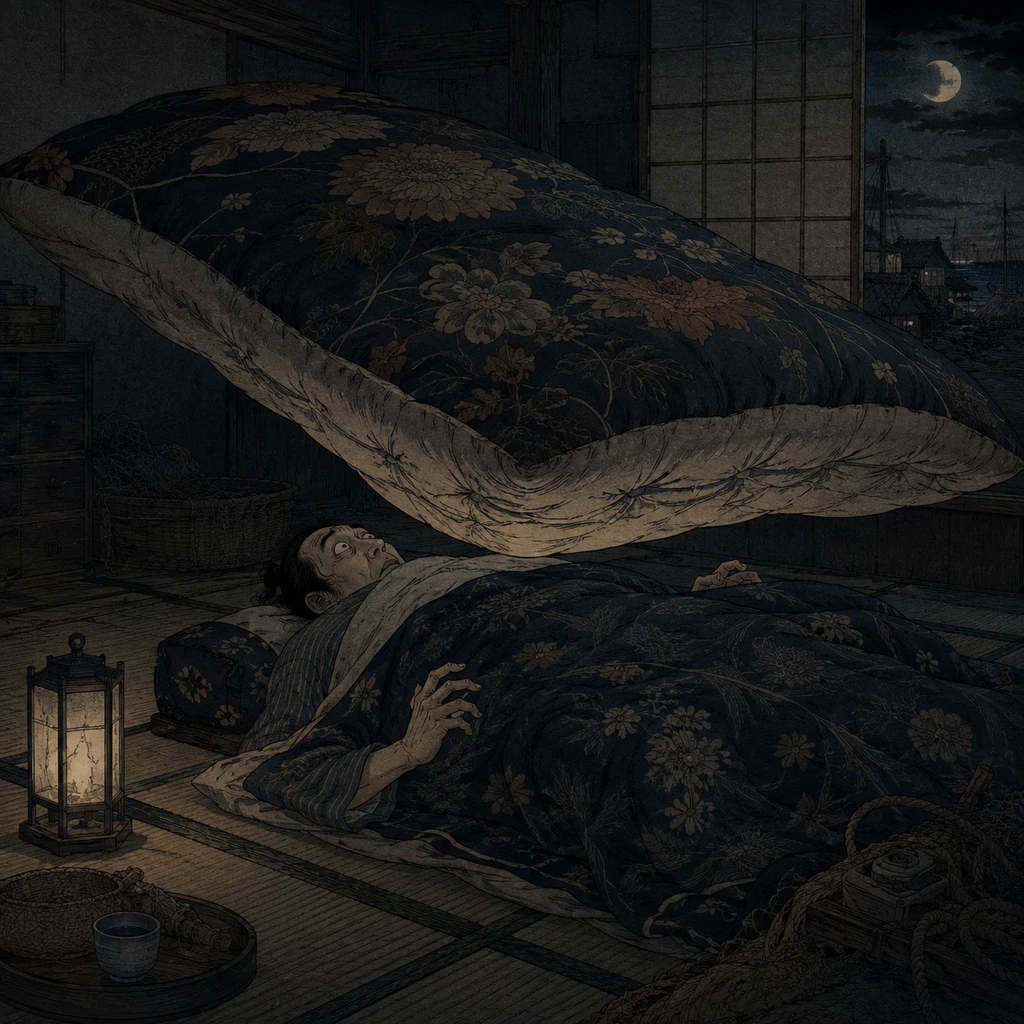
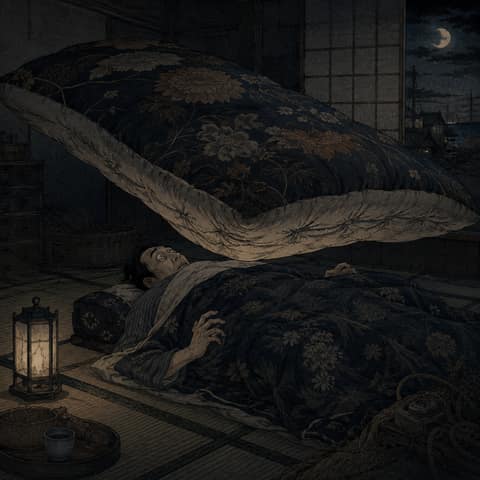
Futon-kabuse
Futon-kabuse is a bedding apparition transmitted on Sakushima in Mikawa Bay, Aichi Prefecture. Without warning, a futon is said to float lightly onto the bed, cover a person, and smother them. Older records do not specify the exact time or place of appearance, nor the details of how to drive it away. Like the Fusuma of Sado and the Ittan-momen of Kagoshima, it survives in a short folklore report only as the basic pattern of bedding or cloth covering a person and causing suffocation. Its primary source is a field note by Segawa Kiyoko (1895-1984), who investigated fishing villages around Mikawa Bay; the record amounts to about a single line included in Yanagita Kunio's edited volume Kaison Seikatsu no Kenkyū (1949). It does not appear in Edo-period picture scrolls or books, nor in early modern local gazetteers. It is a local apparition recovered by modern coastal folklore studies. Originally a plain tradition told in a fishing community, it later gained its place beside Fusuma and Ittan-momen when yokai encyclopedias framed it as one of the "bedding-type" apparitions.
Read moreThe Futon-kabuse is a monster of bedding; without any warning, a futon flies down onto a bed, covers a person, and suffocates them. What is noteworthy is the scantness of its source material. The oldest record of this monster is known solely through the field notes of folklorist Kiyoko Segawa from her research on Saku Island in Mikawa Bay, which were incorporated into *Kaison Seikatsu no Kenkyu* (Studies of Fishing Village Life, Folklore Society of Japan, 1949) edited by Kunio Yanagita. The original text amounts to barely a single line of collected memo: 'It comes down softly, swiftly covers you, and suffocates you'[14]. Neither the time of appearance, methods of repulsion, nor testimonies of eyewitnesses remain in the records. Kiyoko Segawa, recognized by Kunio Yanagita and invited to his study group, became the first female researcher at his Institute of Folklore Studies. It was amidst her nationwide surveys of fishing villages that she jotted down this single line from the island.
Here, facts and embellishments must be clearly separated. When modern yokai encyclopedias or web bestiaries describe it in detail—saying 'a light futon suddenly becomes heavy' or 'it covers you on dark roads at night'—these should be seen as later dramatizations, and we need the perspective to return to the simplicity of the original text. The Futon-kabuse appears neither in Edo-period picture scrolls and illustrated books, nor in early modern topographies. It does not exist in Toriyama Sekien's *Gazu Hyakki Yagyo* or *Konjaku Gazu Zoku Hyakki*. Like the Fusuma of Sado Island in Niigata and the Ittan-momen of Osumi in Kagoshima, this demonstrates that monsters of bedding and cloth do not belong to the lineage of illustrated Edo yokai, but to the domain of regional oral traditions salvaged by modern folklore studies.
When placed alongside its brethren, the differences in form stand out.
The Fusuma is a square wrapping-cloth (furoshiki) shape, the Ittan-momen is a long, narrow bolt of cloth, and the Futon-kabuse is the shape of a futon ── monsters possessing nearly the identical skeletal structure emerged independently on islands and coasts geographically far apart. Ensuke Konno's *Nihon Kaidan-shu Yokai-hen* (Collection of Japanese Ghost Stories: Yokai Edition, 1981) organized these alongside the Nobusuma as 'monsters of the overhead.' We can read this as a folkloric explanatory device: projecting the nocturnal anxieties of a fishing village enclosed by the sea ── sudden feelings of suffocation, sleep paralysis, nightmares ── onto the most familiar of objects, bedding. The fact that the record was only a single line conversely prevented the characterization of this monster, allowing the purity of the modern collection record to reach the present day intact.
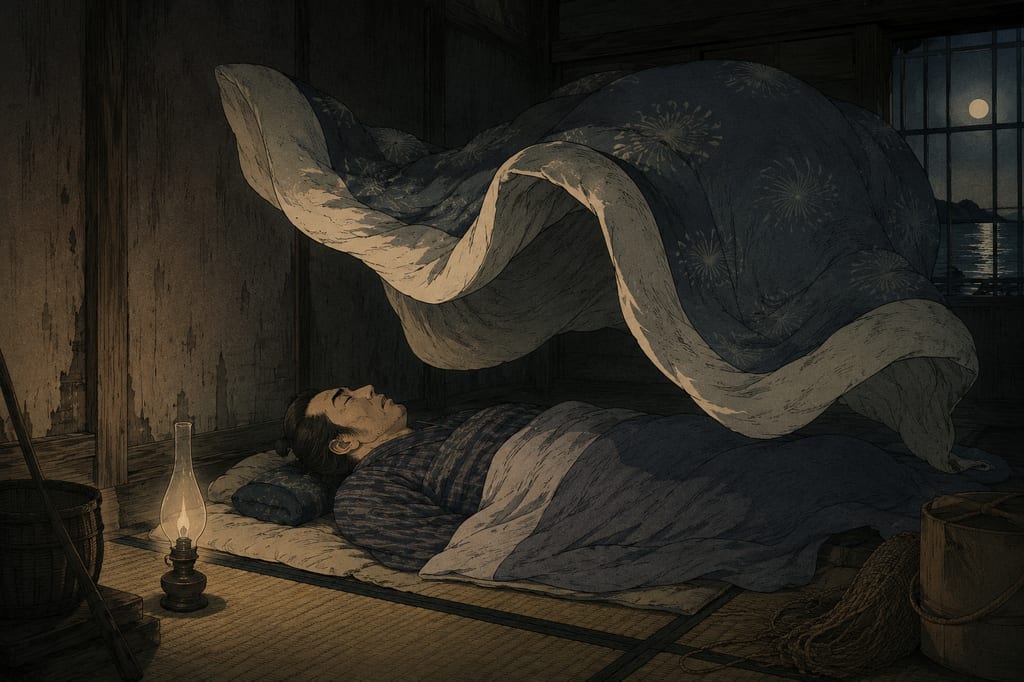
Why was this monster born on an island in Mikawa Bay? The clue lies in the island's lifestyle itself. In the fishing villages of an enclosed inland sea, fishermen returning from the night sea fall asleep exhausted in narrow sleeping quarters. The damp sea breeze, low ceilings, creaking wooden doors ── amidst the textures of such a life, feelings of breathlessness or sleep paralysis just as one falls asleep summon the explanation that 'something has covered me, futon and all.' Rather than an external monster coming from outside, the Futon-kabuse was a materialization of anxiety from within, where the bed, supposedly the safest place, suddenly inverts and attacks. While mainland cities drew yokai with clear outlines like Kappa and Tengu, the island saw a monster in the most mundane of beddings.
The rarity of its records overlaps with the fate of the island. Saku Island's population counted 1,634 in 1947 (Showa 22), but dwindled to 271 by 2010 (Heisei 22) and to 196 by 2020 (Reiwa 2), with the elderly now accounting for about half of the residents[13]. The small fishing village, enclosed by the sea, quietly passes down this monster even now as depopulation advances—a monster that left almost no records other than Segawa's notes. Since the 1990s, island revitalization through modern art has progressed, and to the eyes of visitors, it appears as a tranquil island of art; yet beneath that bedding, a single line of collected memo still breathes.
Conclusion ── Two Inland Seas and a Single Cycle
Aichi's yokai culture was nurtured where the two provinces of Owari and Mikawa, with their differing histories, were connected by the water networks of the two inland seas, Ise Bay and Mikawa Bay. Gozu Tenno of Tsushima is the pinnacle of syncretism where Susanoo, the sword-bearer, transformed into a plague-warding god. The Tenno Festival—which comforts his rough spirit with fires on the water and transfers impurities to reeds to float them away—is proof that topography determines the shape of faith. Ichimokuren of Owari was a deity of fire and wind, uniting the one-eyed blacksmith god who strikes the iron of swords with the dragon god who summons the wind. And the Futon-kabuse of Saku Island in Mikawa Bay, in stark contrast to these mythological deities, is a nameless island monster surviving solely within a single line of a folklore memo.
What pierces through all three is the wisdom of the common people, attempting to tame the threats of nature by translating them into divine figures and supernatural anomalies. Summer plagues become the rough spirit of Gozu Tenno, which can be exorcised if transferred to reeds and floated down the river. Sudden gales become the pathway of Ichimokuren, transforming into objects of awe and prayer if enshrined in a doorless sanctuary. The suffocation of the bed becomes the Futon-kabuse, granted a name by being spoken of. Giving a name and a story to formless anxiety ── this is the essence of the yokai culture fostered by the two inland seas of Aichi.
From the highest ranks of mythology to an anonymous island's bedding ── the supernatural entities of Aichi line up with vast fluctuations across the cycle of swords and iron, plagues and winds. The chinowa of Tsushima Shrine, the storms of Mount Tado, the sleeping quarters of Saku Island. All are places you can still trace if you walk this land today, where the memories of the earth remain, having taken the shapes of the supernatural.