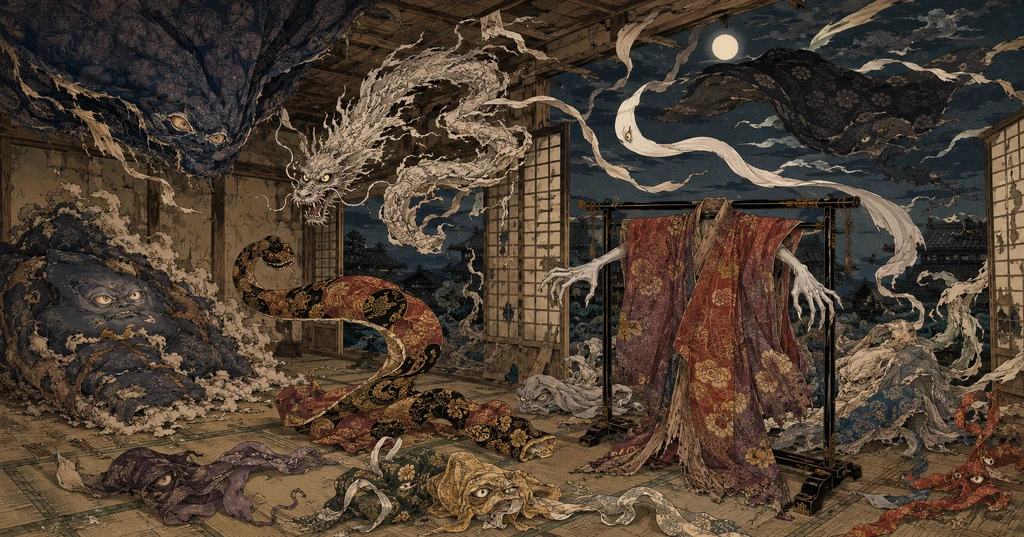
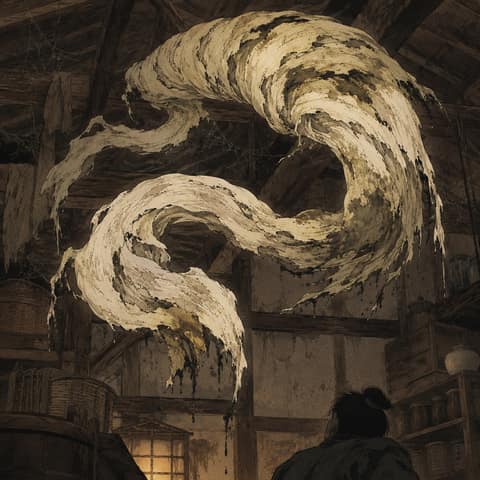
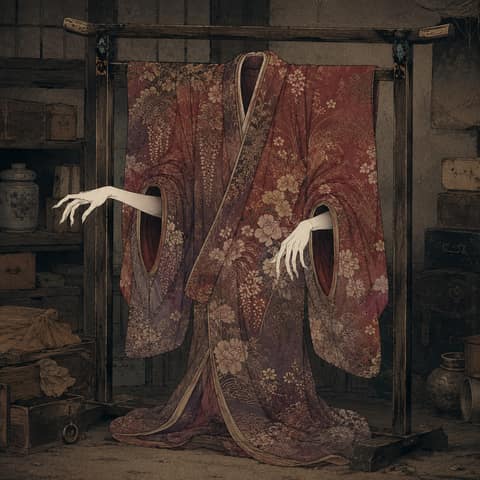
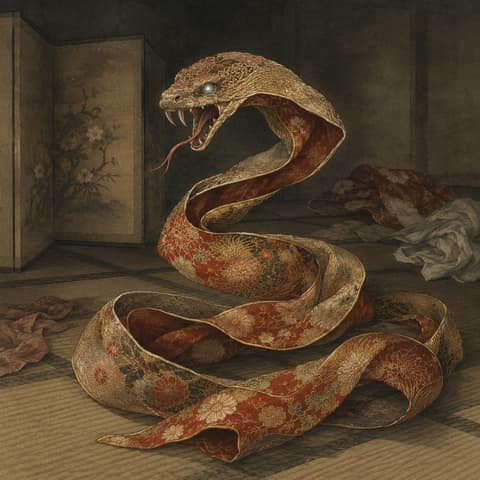
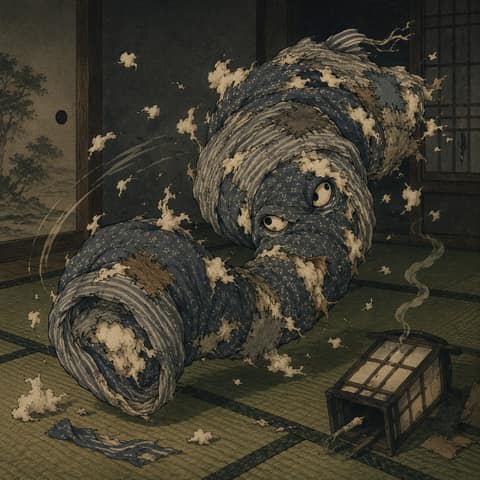
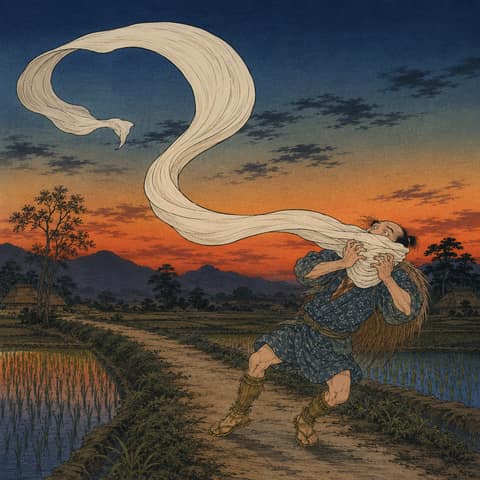
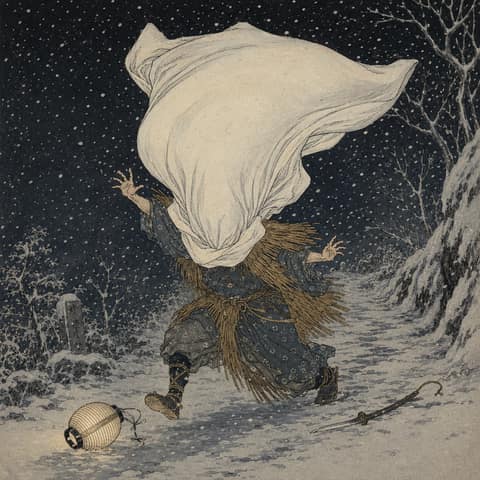
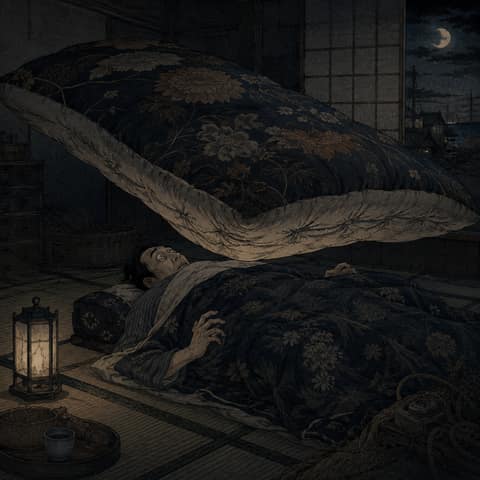
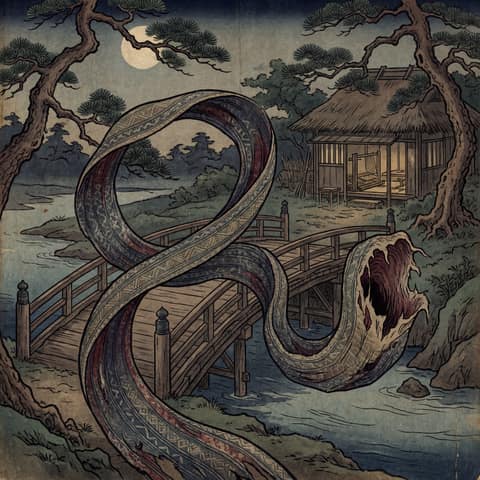
Futon-kabuse is a bedding apparition transmitted on Sakushima in Mikawa Bay, Aichi Prefecture. Without warning, a futon is said to float lightly onto the bed, cover a person, and smother them. Older records do not specify the exact time or place of appearance, nor the details of how to drive it away. Like the Fusuma of Sado and the Ittan-momen of Kagoshima, it survives in a short folklore report only as the basic pattern of bedding or cloth covering a person and causing suffocation. Its primary source is a field note by Segawa Kiyoko (1895-1984), who investigated fishing villages around Mikawa Bay; the record amounts to about a single line included in Yanagita Kunio's edited volume Kaison Seikatsu no Kenkyū (1949)[1]. It does not appear in Edo-period picture scrolls or books, nor in early modern local gazetteers. It is a local apparition recovered by modern coastal folklore studies. Originally a plain tradition told in a fishing community, it later gained its place beside Fusuma and Ittan-momen when yokai encyclopedias framed it as one of the "bedding-type" apparitions.
Folklore & Legends
The only source: Segawa Kiyoko and Kaison Seikatsu no Kenkyū. The old record of Futon-kabuse is known only through the route by which folklorist Segawa Kiyoko's Sakushima field notes from Mikawa Bay were incorporated into Kaison Seikatsu no Kenkyū, edited by Yanagita Kunio (Nihon Minzoku Gakkai, 1949)[1]. The original note is extremely brief, no more than something like "it comes softly, slips over the person, and suffocates them." It leaves no details about time of appearance, methods of defense, or witness testimony. When modern yokai encyclopedias and web guides describe it in detail as a futon that flies onto a sleeping person at night and smothers them, or as a light, fluffy futon that suddenly grows heavy, those descriptions should be read as later embellishment. The right starting point is the plainness of the original note.
Sakushima: an island in Mikawa Bay. Sakushima is the largest inhabited island in the Mikawa Bay islands, with an area of 1.81 square kilometers. It belongs to Isshiki in Nishio, Aichi Prefecture, formerly Isshiki, Hazu District, merged in 2011. The north of the island is gently sloping hill country, while two settlements, East and West, lie along the southern coast. In the Edo period the island was an important point for maritime trade; in the modern period, fishing, including large clams, and farming became the main livelihoods. The population was 1,634 in 1947, but by 2010 it had fallen sharply to 271. This small fishing village enclosed by the sea still preserves a yokai that left no written record apart from Segawa's field note.
A bedding apparition: kinship with Fusuma and Ittan-momen. Futon-kabuse is often placed in the same lineage as the Fusuma of Sado Island in Niigata, a white cloth about the size of a furoshiki, and the Ittan-momen of Ōsumi in Kagoshima, a long strip of white cloth. Konno Ensuke's Nihon Kaidanshū: Yōkai-hen (1981) grouped it together with Nobusuma as an "overhead apparition". If we consider the difference in shape - Fusuma as a wrapping-cloth form, Ittan-momen as a bolt-of-cloth form, and Futon-kabuse as a futon form - we can see that geographically distant islands and coastal areas independently generated traditions with nearly the same core. It may be read as a folk explanation for the night fears of fishing villages: sudden suffocation, sleep paralysis, nightmares, all projected onto the most familiar object of the sleeping room.
Not a Toriyama Sekien-line yokai. Futon-kabuse does not appear at all in Edo-period picture scrolls or illustrated books, nor in Toriyama Sekien's Gazu Hyakki Yagyō, Konjaku Gazu Zoku Hyakki, or related works. This point is the same as with Fusuma. It shows that bedding and cloth apparitions do not belong to the Edo lineage of illustrated yokai, but to the area that modern folklore studies recovered from local oral tradition.
Modern reception: a minor related type. In modern yokai encyclopedias and web guides, Futon-kabuse is often introduced almost as an appendix to Ittan-momen or Fusuma, and it appears extremely rarely in manga or games. The fact that the record is only a single line has actually hindered its development into a character, leaving artists little concrete detail to design from. Yet that very simplicity also makes it a rare example of a yokai that has reached the present while preserving the clean, unembellished quality of a modern folklore field note.
This version focuses on the process of retelling through which modern yokai encyclopedias have shaped this apparition. The primary source preserves only the bare structure: "it comes softly, slips over the person, and suffocates them." Postwar yokai encyclopedias, including lines descending from Mizuki Shigeru's Nihon Yōkai Taizen and illustrated references edited by Kyōgoku Natsuhiko and Tada Katsumi, took that single sentence as a starting point and added details such as "a futon that feels light gradually becomes heavy" or "it falls silently while the person is asleep." These are later embellishments not grounded in the primary record. At the same time, they work well as a way to convey to modern readers the nighttime bodily sensations of a fishing village: the weight of bedding dampened by sea wind, sleep paralysis from exhaustion, and the cold dampness of the tide creeping in from the sea. The fact that it has no counterpart in Toriyama Sekien - a modern coastal-folklore apparition that does not fit inside Edo picture-scroll yokai - has also left later artists and writers room to imagine its form freely. That openness is part of Futon-kabuse's modern character.
Character Profile
This section is our own creative profile for storytelling. It is not historical fact or scholarship.
The diagram below is a diagnostic evaluation chart for Weight Falling on the Bed: Sakushima Futon-kabuse. The higher the value of each item, the stronger that characteristic is expressed.