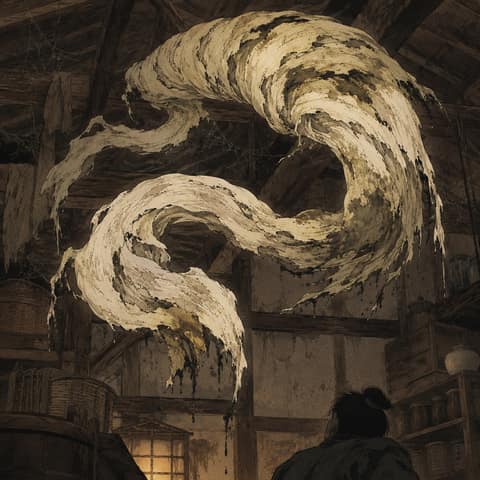
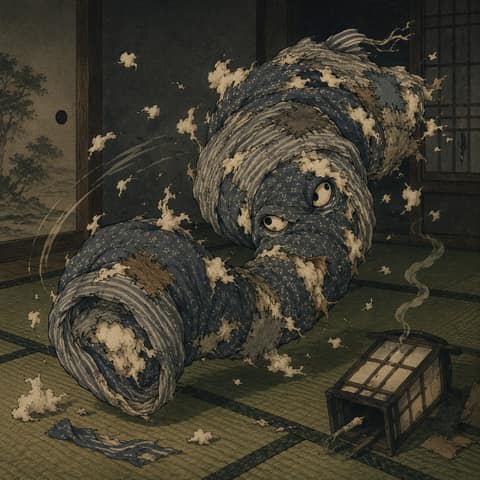
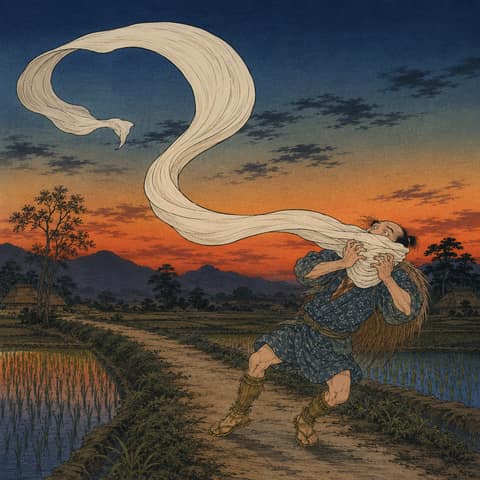
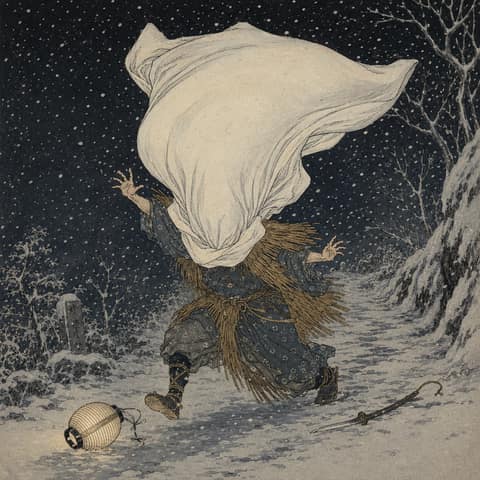
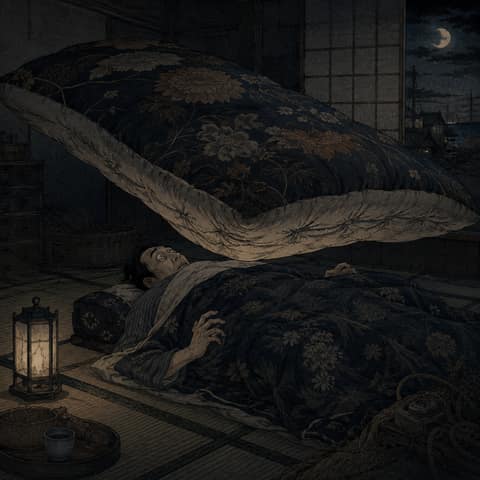
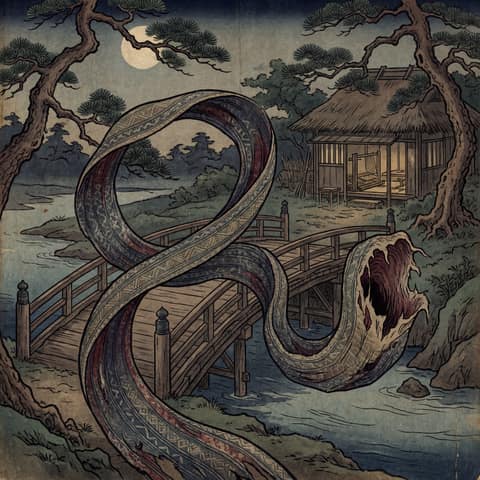
Fusuma is a cloth yokai said to fly through the night. The name comes from fusuma, an old word for bedding or a one-piece night covering found in classics such as The Pillow Book and The Tale of Genji; the yokai's name makes it sound as if that bedding itself had become uncanny. Its best-known home is Sado Island in Niigata Prefecture. There, a white cloth about the size of a wrapping cloth is said to fly without warning onto the head of someone walking alone at night or outside an inn, blocking sight and hearing and sometimes smothering the person to death. In Sado, even a famous Masamune blade cannot cut it; only teeth dyed black with kane, or ohaguro tooth dye[1], can bite through it. The custom that men on Sado also practiced ohaguro until the Meiji period is often connected to dealing with this apparition, but no primary source has been confirmed that directly proves a causal link. A tradition under the same name is also found in Tosa, Kōchi Prefecture. There the cloth is so vast that its edges cannot be seen and it wraps the whole body, while the methods of escape - smoking tobacco or calmly sitting down and waiting - differ sharply from the Sado type. One also often sees claims that Fusuma appears in Toriyama Sekien's Konjaku Gazu Zoku Hyakki, but this is a mistaken tradition: the creature in that book is Nobusuma, a flying-squirrel-like beast apparition, not a bedding-type Fusuma. Fusuma is not an Edo picture-scroll yokai. It should first be understood as a being lifted from local tradition by modern folklore studies through Sōgō Nihon Minzoku Goi (1955)[2] and Yōkai Dangi (1956)[1].
Folklore & Legends
The white cloth of Sado: the ohaguro lineage. In Sado Island tradition, Fusuma flies in from nowhere on night roads or snowy paths and, as soon as it covers a person, blocks their sight and hearing. According to Yanagita Kunio's Yōkai Meii[1] and related folklore writings, even if the victim draws the sword at their waist and tries to cut it, the blade will not pass through. Only teeth blackened with ohaguro can bite through the cloth. In Sado, the custom of men using kane tooth dye survived into the Meiji period, and old interpretations repeatedly describe this as a remnant of measures against Fusuma. The existence of male ohaguro in Sado is certain, but no direct primary source proves that it was practiced in order to defeat yokai. The connection should also be read as a later rationalization.
The giant Fusuma of Tosa: a different form. A being with the same name is also reported in Tosa, Kōchi Prefecture, but its form is very different. The Tosa type is so huge that its edges cannot be seen; when it covers someone, they begin to faint. Yet it is said that blades and tobacco can keep it off, and that if one sits down calmly on the spot, it disappears on its own. The first rule in studying this yokai is not to confuse Sado's white-cloth type with Tosa's giant type simply because they share the same name.
The name Fusuma: its history as an everyday object. Fusuma was originally an old word, used from the Heian period onward, for bedding or a night covering: a large single cloth placed over the body during sleep. It appears frequently as an ordinary noun in The Pillow Book and The Tale of Genji. Yet fusuma could also be a sacred cloth, appearing in ritual garments for the Daijōsai and in wedding customs such as fusuma-ōi, where bride and groom were covered together by a single fusuma. The idea that the everyday object closest to the body might gain a spirit and cover a person as a yokai likely grew from this double nature of fusuma, where daily life and ritual overlapped.
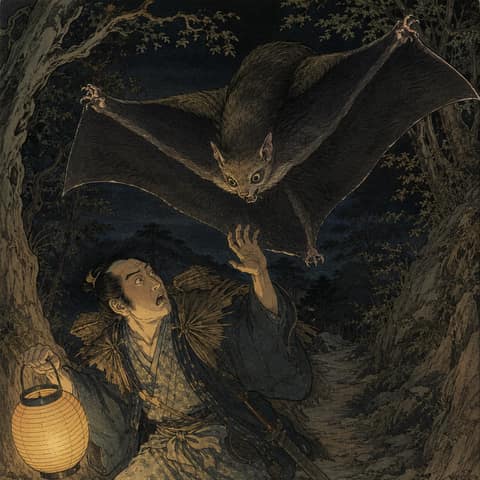
Confusion with Toriyama Sekien's Nobusuma: an important error. Online yokai introductions often say that Fusuma was included in Toriyama Sekien's Konjaku Gazu Zoku Hyakki (An'ei 8, 1779), but the being in the lower volume is Nobusuma[3]. Nobusuma is a beast apparition related to flying squirrels or momonga, gliding down to cover a person's face and block the eyes and nose. It belongs to a completely different line from the cloth-type Fusuma of Sado and Tosa. Because the names are easy to confuse, recent secondary materials have circulated the mistaken claim that Fusuma comes from Sekien. Sekien drew Nobusuma; he did not draw a bedding-type Fusuma.
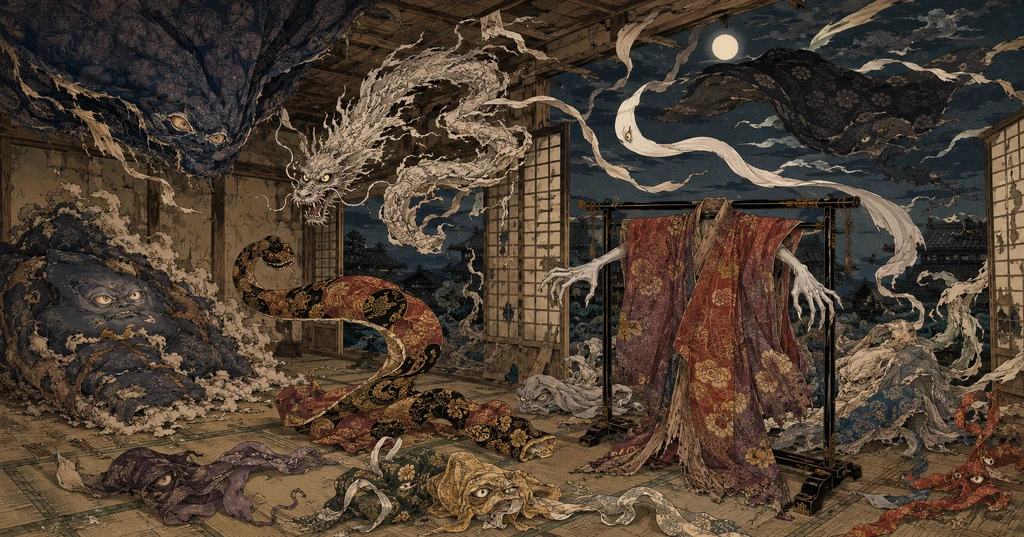
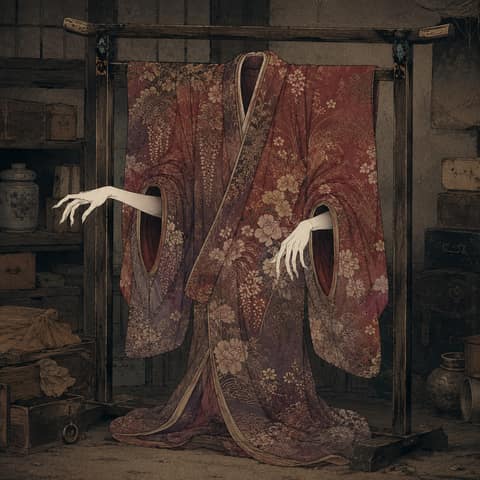
Related yokai: the lineage of cloth apparitions. Fusuma is closely related to other types in which cloth or bedding covers the face and suffocates a person: Ittan-momen of Ōsumi in Kagoshima, a long strip of white cloth flying through the night sky; Futon-kabuse of Sakushima in Aichi, a futon that comes down over a person; and Toriyama Sekien's Kosode no Te, in which hands extend from a kosode robe on a clothing rack. Ittan-momen is a long bolt of cloth, Fusuma is a square cloth about the size of a wrapping cloth, and Futon-kabuse is bedding, but all share the same basic pattern: at night, cloth flies in, covers the face, and cuts off breath. Kosode no Te is exceptional because it is personified as a tsukumogami, with the owner's feelings dwelling in the garment. Fusuma, Ittan-momen, and Futon-kabuse can instead be grouped as ownerless cloth made uncanny, not as spirits born from a particular person's emotions.
Modern reception. After Fusuma was included in Mizuki Shigeru's yokai encyclopedias, it became a regular entry in yokai reference books. In Fujita Kazuhiro's manga Ushio and Tora (1990-1996), it appears as a being weak to fire and ohaguro, a portrayal that influenced later subculture works. The unusual method of biting it apart with blackened teeth remains the most memorable feature for many modern yokai fans, making Fusuma an interesting example of how premodern tooth-blackening culture continues to be referenced through yokai.
This version focuses on the better-known white-cloth type from Sado, rather than the Tosa form. It centers on the circumstances in which Fusuma appears on night roads, the method of resisting it with ohaguro, and the legendary connection to the custom of men using kane tooth dye. In Sado, on night roads, snowy paths, or around inns, a white cloth about the size of a wrapping cloth is said to drift down without sound, as if floating in the moonlight, and cover a person from head to shoulders. Blades cannot cut it. Only when someone with ohaguro in their mouth bites through one edge does the apparition wither and fall away. It is true that some men on Sado used kane tooth dye into the Meiji period, and elders preserved the explanation that this was a remnant of measures against Fusuma. Yet the male ohaguro custom also has other possible motives, including festival dress and rites of adulthood. The claim that it existed specifically to defeat Fusuma should be read as partly containing later rationalization. In winter Sado, when wind rises over snowy fields, white cloth from eaves or drying racks can be swept up and blown across one's view. Such natural experiences may also have been retold locally under the name Fusuma.
Character Profile
This section is our own creative profile for storytelling. It is not historical fact or scholarship.
The diagram below is a diagnostic evaluation chart for The White Cloth of the Night Road: Sado Fusuma. The higher the value of each item, the stronger that characteristic is expressed.