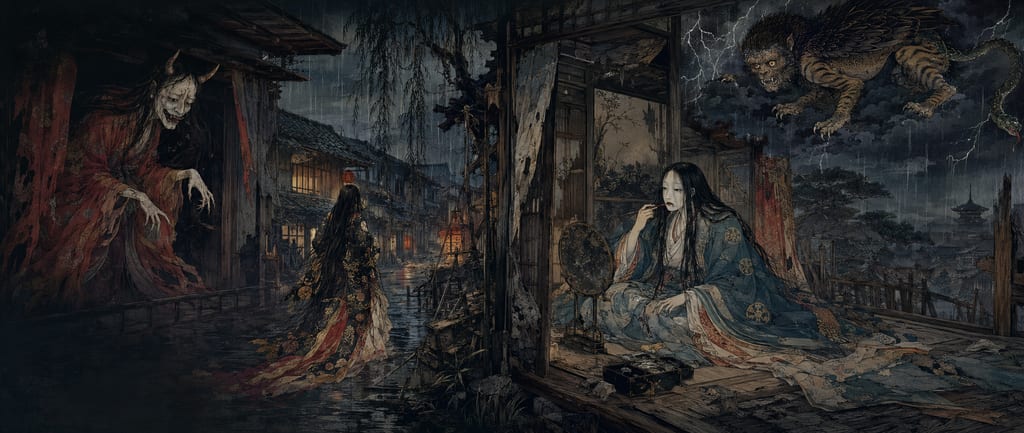
Nobusuma is a small beast yōkai said to glide through mountains and fields after dark. Although its name contains the word *fusuma*—here meaning bedding—it belongs to a different tradition from the cloth yōkai Fusuma of Sado and Tosa. In early modern usage, *nobusuma* could also denote flying squirrels such as the musasabi and momonga. Their gliding membrane, stretched between the forelegs and hind legs, supplied the creature's defining image. Toriyama Sekien included Nobusuma in *Konjaku Gazu Zoku Hyakki*[1], giving visual form to a membrane-winged beast of the wild. Later yōkai encyclopedias[2] often describe it springing at travelers at night, smothering the face and blocking sight and breath, or even sucking blood. The essential distinction is that Nobusuma is not a piece of cloth that has learned to fly: it is a wild animal whose cloth-like membrane has become uncanny. Animal vocabulary, fear of the night wilderness, and stories of face-covering attacks converge in this gliding-beast yōkai. It also sits near Nodeppō, Momonjii, and momonga in the shifting vocabulary of mountain creatures and monsters. Because its terror begins with a real small animal dropping toward a human face, Nobusuma makes the border between fauna and yōkai unusually thin. Its setting is therefore best understood through Edo print culture together with a broader Japanese fear of nocturnal animals, rather than as the possession of one village alone.
Folklore & Legends
Behind Nobusuma lies early natural-history knowledge of real gliding mammals. In encyclopedic works in the tradition of Terajima Ryōan's *Wakan Sansai Zue*[3], musasabi and momonga were discussed among birds and beasts, with particular attention to their nocturnal, seemingly airborne movement through trees. By daylight they are only small mammals. On a dark road, however, a shadow falling from overhead can feel like a sheet of cloth snapping open. The name Nobusuma—literally a *fusuma* of the wild—turns that bodily feature into the outline of an apparition.
Sekien's “Nobusuma”[1] helped establish this transformation as a yōkai image. Published in Edo during the An'ei era, *Konjaku Gazu Zoku Hyakki* had a remarkable ability to recast natural phenomena, objects, animals, and wordplay as individual monsters. Nobusuma is not presented as a neutral zoological specimen, but in a form readily imagined dropping over someone's face in the dark. Sekien's brief caption is revealing: this is less a creature attached to one detailed village legend than an iconographic yōkai assembled from an animal name, the shape of a gliding membrane, and the fear of having one's face covered.
Its unstable terminology is part of the story. Depending on time and place, musasabi, momonga, nobusuma, and related words could name animals, frighten children, or refer to uncanny beings of the mountains. Precise zoological classification mattered less than three impressions: a small creature flying at night, a shadow with no visible point of origin, and something that seems about to cling to the face. Nobusuma emerged from that ambiguity, which also explains its later confusion with the cloth-shaped Fusuma.
The Nodeppō[4] in *Ehon Hyakumonogatari* is indispensable to understanding this cluster of traditions. The book describes a mami-like monster of the northern mountains that drinks human blood, and it also relates the idea that an aged bat becomes a Nobusuma. Read together, these stories show how late Edo-period tales grouped flying squirrels, mami, and bats as small beastly monsters that leap out and cover the face. Nobusuma is therefore both an independent yōkai and a point of contact among Nodeppō, Momonjii, and Fusuma.
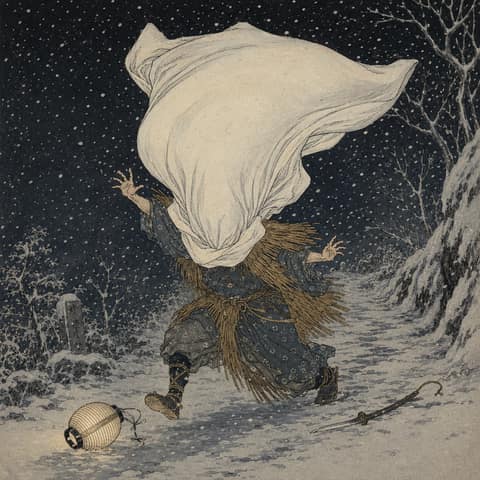
Treating Nobusuma as a separate encyclopedia entry also clarifies what it is not. Fusuma is a white cloth or article of bedding that envelops people and is organized around local traditions in Sado and Tosa. Nobusuma, by contrast, is a beast of the mountains shaped by Sekien's imagery and by animal names. Fixing it to a single modern prefecture would distort that history. On a map, Edo print culture provides the firmest anchor, while its imagined habitat remains the nocturnal mountains and forests of Japan more broadly.
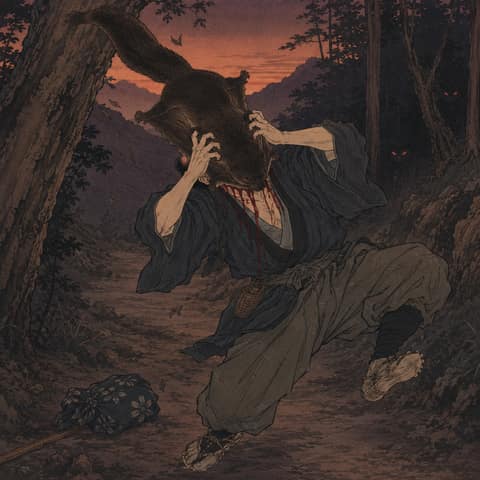
This Nobusuma is a small animal that slips from the treetops and presses a cloth-like gliding membrane across a traveler's face. Its terror lies less in teeth or claws than in the instant loss of sight and breath. Something falls from above on a mountain path; a damp membrane clings to the skin; eyes and nose are covered, and direction disappears. That chain of bodily sensations is what turns an ordinary flying squirrel into a yōkai.
Sekien's image[1] does not make the creature enormous. Nobusuma is frightening precisely because it is small, agile, and hard to distinguish in the dark. Rather than confronting a victim like a serpent or oni, it drops from branches, eaves, or the shadow of a cliff at an angle the traveler has not considered. Its spread membrane resembles cloth, but is not cloth. That is the decisive difference from Fusuma: the white-cloth yōkai begins with an ownerless textile, whereas Nobusuma is born in the instant when an animal's body is mistaken for one.
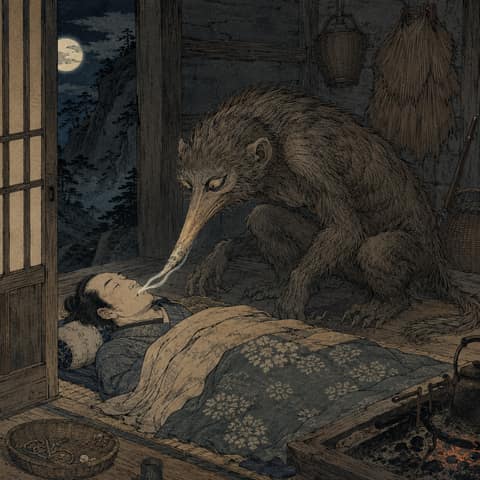
Understanding its attack as “covering the face” also reveals its closeness to the Nodeppō[4]. Nodeppō is said to spit out something bat-like that covers a person's face and shuts their eyes. Nobusuma is variously linked to that projectile or described as the transformation of an old bat. Either way, the sequence is similar: first vision is taken, then breathing and orientation are disturbed, and finally blood or vitality may be drained. A moment of losing one's bearings on a mountain road has been rearranged into the behavior of a monster.
Nor can Nobusuma be dismissed simply by saying that a real flying squirrel explains everything. The animal exists, but a person who sees a shadow glide overhead at night may not be able to identify it. In the mountains, bird and beast, cloth and shadow, wind-shaken branch and living body can collapse into one impression. Nobusuma inhabits that interval of uncertainty. Natural histories supplied the animal name, Sekien converted it into an image, and strange tales added blood drinking and the smothered face: knowledge did not erase the uncanny, but furnished it with material.
This version preserves Nobusuma's position between a small mountain animal and a cloth tsukumogami. Its body is beast, its appearance cloth, and its conduct yōkai. The traveler has almost no time to decide which is which; fear arrives before the name. Nobusuma is therefore most vivid not as the hero of a grand legend, but as an apparition compressed into a single second on a dark road. Keeping it small makes the attack feel closer: it seems near enough to brush away by hand, yet cannot be shaken loose.
Geographically, Nobusuma does not belong neatly to one prefecture. The cloth Fusuma can be tied to traditions in Sado and Tosa, but Nobusuma bears the stronger imprint of Edo publishing, which reworked a nocturnal mountain animal into a yōkai. This version begins from that print culture while placing the creature in forests, ravines, and wooded edges near settlements. What waits there is not a giant monster displaying itself in full, but a small patch of darkness already against the face by the time it has been noticed.
Character Profile
This section is our own creative profile for storytelling. It is not historical fact or scholarship.
Small and cunning, it avoids a frontal threat. It drops from above or closes in from behind, covering the victim's face before panic can turn into resistance.
Compatibility
It preys most easily on solitary travelers who hurry along dark roads without watching the canopy. A steady lantern, attention overhead, and the calm needed to keep a clear line of sight make an approach much harder.
Abilities
Glides on its membrane and pounces from overheadCovers the face, eyes, and nose to block visionDisrupts breathing and spatial awarenessIn the Nodeppō tradition, is linked to draining blood or vitalityConceals its identity by being mistaken for the cloth yōkai Fusuma
Weaknesses
Bright light, vigilance toward the canopy, and the composure to make an opening for breath even after the face is covered. Classical sources do not provide a consistent method of defeating it with fire or blades.
Habitat
The visual world of Edo print culture; mountain forests, ravines, and wooded edges near settlements after dark. It belongs to a broad conception of nocturnal beasts rather than to one village tradition.