
野衾顔を覆う山野の飛膜獣・野衾
のぶすま
Detailed Description
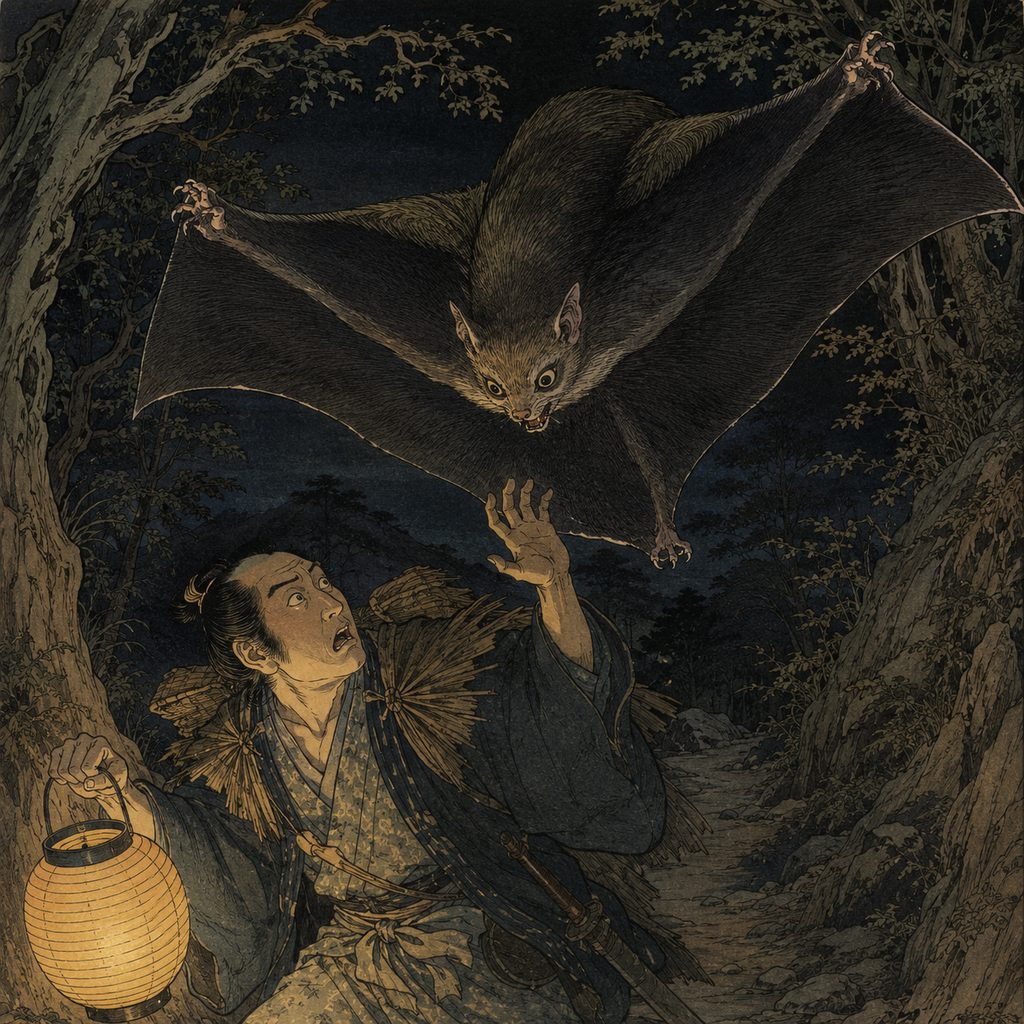
In this form, the Nobusuma should be read as a small beast that flutters down from the treetops to press a cloth-like gliding membrane against a traveler's face. The core of its terror lies not in fangs or claws, but in instantly snatching away the ability to "see and breathe." On a mountain path, something drops from above, a damp membrane sticks to the face, the eyes and nose are sealed, and all sense of direction is lost. This sequence of physical sensations elevates the Nobusuma from a mere flying squirrel to a yokai.
Sekien's illustration[1] does not make the Nobusuma overly gigantic. In fact, it is terrifying precisely because it is small, agile, and has an indistinct outline in the dark. It does not attack head-on like a giant snake or an oni, but drops from the shadow of branches, roofs, or cliffs at an angle the traveler does not anticipate. Its form with spread membranes looks like cloth, yet it is not cloth. Therein lies the decisive difference from the pre-existing Fusuma. While the white-cloth Fusuma is an ownerless cloth turned spectral, the Nobusuma is a yokai of misrecognition born the instant an animal's body is mistaken for cloth.
If we consider the Nobusuma's ability as "covering the face," its closeness to the Nodepo[2] becomes clear. The Nodepo is said to spit something bat-like from its mouth to cover a person's face and block their eyes. The Nobusuma is described either as being akin to that spat-out object or as the transformation of an old bat. Either way, the function of the attack is the same: first, steal the vision; next, disrupt the breathing; finally, suck the blood or life force. This sequence can be read as a reconstruction of the terror of suddenly losing one's bearings on a mountain road into the behavioral pattern of a yokai.
Furthermore, the Nobusuma cannot be simply rationalized away by saying, "If you know the real animal, you won't be scared." Flying squirrels do exist, but it is not guaranteed that someone seeing a shadow gliding overhead at night can correctly identify it. In the mountains, the distinction between bird or beast, cloth or shadow, a branch moved by the wind or a living creature blurs in an instant. The Nobusuma inhabits that time of unidentifiability. The progression where old natural history books record the animal's name, Sekien translates it into a yokai illustration, and bizarre tales add the traits of blood-sucking and face-covering perfectly demonstrates that knowledge does not erase superstition—knowledge itself becomes the raw material for anomalies.
What this version emphasizes is the liminality of the Nobusuma, ending up neither simply as a "small mountain animal" nor a "cloth tsukumogami." Its body is a beast, its appearance is cloth, and its behavior is a yokai. From the traveler's perspective, there is almost no time to judge what it is. The instant the face is covered, terror arrives before the name. Therefore, it is best read not as a protagonist yokai with a grand narrative even in encyclopedias, but as an anomaly condensed into a single moment on a night road. The more it maintains its small size, the more the unsettling closeness of the attack stands out. The crucial element is that distance—feeling as if you could brush it away with a hand, yet you cannot—more than any massive monster.
Geographically, the Nobusuma is difficult to pin down to a single prefecture. While the cloth-type Fusuma can be established as local folklore in Sado or Tosa, the Nobusuma strongly retains the character of Edo's commercial publishing having reassembled a nocturnal mountain beast into a yokai. Therefore, this version takes Edo publishing culture as its starting point, while treating its habitat as mountain forests, ravines, and forest edges near human settlements. What lurks there is not a grand yokai showing its full form, but a tiny darkness already plastered to your face the moment you think you saw it. In YOKAI.JP, positioning this Nobusuma as a "Gliding Beast of the Wild" is the most natural fit.
Source Information
種類全体の出典reference
妖怪事典
著者: 村上健司
年代: 2000
出版社: 毎日新聞社
種類全体の出典reference
絵本百物語 5巻
著者: 桃山人 作・竹原春泉 画
年代: 1841
出版社: 天保12年刊
種類全体の出典primary
和漢三才図会
著者: 寺島良安 編
年代: 正徳3年序刊本の複製(1970)
出版社: 東京美術/国立国会図書館デジタルコレクション
種類全体の出典primary
続百鬼(角書:今昔畫圖続百鬼)
著者: 鳥山石燕
年代: 江戸時代(安永期)
出版社: 国立国会図書館
バージョン固有出典 (顔を覆う山野の飛膜獣・野衾)reference
妖怪事典
著者: 村上健司
年代: 2000
出版社: 毎日新聞社
バージョン固有出典 (顔を覆う山野の飛膜獣・野衾)reference
絵本百物語 5巻
著者: 桃山人 作・竹原春泉 画
年代: 1841
出版社: 天保12年刊
バージョン固有出典 (顔を覆う山野の飛膜獣・野衾)reference
和漢三才図会
著者: 寺島良安 編
年代: 正徳3年序刊本の複製(1970)
出版社: 東京美術/国立国会図書館デジタルコレクション
バージョン固有出典 (顔を覆う山野の飛膜獣・野衾)reference
続百鬼(角書:今昔畫圖続百鬼)
著者: 鳥山石燕
年代: 江戸時代(安永期)
出版社: 国立国会図書館
Personality
Small and cunning, it prefers to invite confusion by covering the victim's face from overhead or behind, rather than threatening them head-on.
Compatibility
Incompatible with those who hurry alone along night roads, or those who fail to watch the canopy in the woods. It is hesitant to approach those who carry a lantern and calmly secure their line of sight.
Abilities & Skills
Weaknesses
Strong lights, a walking style that stays alert to the overhead, and the composure to create a breathing gap even if the face is covered. Unlike the cloth-type Fusuma, classical texts do not provide a definitive method of extermination using fire or blades.
🔮Test your compatibility with 野衾 now!
Analyze your personality and values to get a detailed compatibility rating with this yokai.
Free, simple, and results in just minutes.