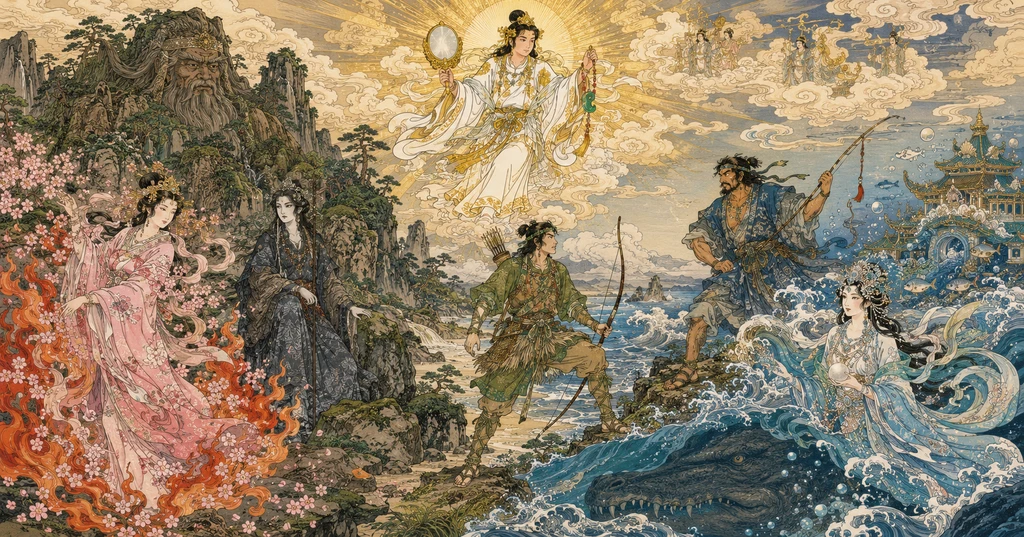
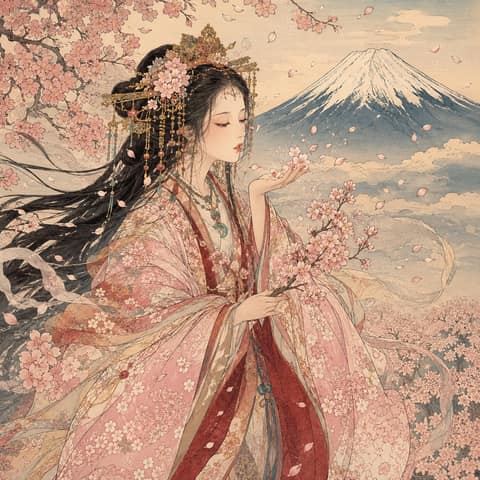
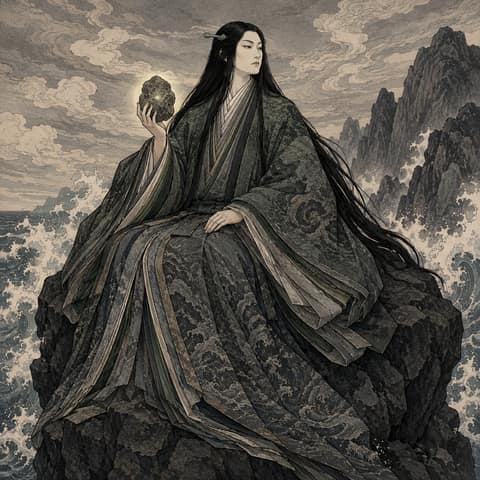
Konohanasakuyahime is a goddess in Japanese mythology and the principal deity (Asama Okami) of Mount Fuji, Japan's greatest sacred peak, enshrined in Asama Shrines nationwide. Her divine name means "a woman as beautiful as cherry blossoms in full bloom," and she boasts immense popularity as a goddess symbolizing the Japanese aesthetic sense and view of nature. In mythology, she is the daughter of Oyamatsumi-no-kami and became the wife of the Heavenly Grandson, Ninigi-no-mikoto. When her husband doubted her chastity after she became pregnant from a single night's encounter, she proved her purity through a fierce myth: she set fire to a windowless delivery hut and safely gave birth amidst the roaring flames. Because of this, she is worshipped as a deity of safe childbirth and child-rearing, while simultaneously embodying the aspects of a "fire goddess" who conquered the raging flames, and a "water goddess (Deity of Water Virtue)" who quells volcanic eruptions.
Folklore & Legends
The Origin of "Cherry Blossom Fleetingness" Rather Than "Eternity". In mythology, her father Oyamatsumi sent her elder sister, Iwanaga-hime, to marry alongside her, but Ninigi-no-mikoto sent the ugly sister back and took only the beautiful Konohanasakuyahime. Angered by this, Oyamatsumi declared, "The lifespan of the Heavenly Grandson, which was meant to be eternal like a rock, will now scatter fleetingly like cherry blossoms." This narrative serves as an origin myth explaining "why human lifespans are short rather than eternal like the gods" (a banana-type myth). Folklore studies place great importance on Konohanasakuyahime as an entity embodying human "views of life and death" and "the finitude of life."
Volcanic Protection and the Evolution of "Fuji Worship". While the image of "Goddess of Mount Fuji = Konohanasakuyahime" is firmly established today, this connection actually became clear only after the Edo period. In the Middle Ages, Mount Fuji was a site of severe mountain asceticism centered on Shugendo, worshipped under Shinto-Buddhist syncretism as "Asama Daibosatsu" or Dainichi Nyorai. However, during the Edo period, as popular faiths like "Fuji-ko" (Mount Fuji pilgrimage associations) explosively spread, Konohanasakuyahime was theoretically established and cemented as the deity of Mount Fuji. This was due to her "water virtue" capable of quelling the mountain's raging eruptions (the power of fire) and her mythological background of giving birth amidst roaring flames.
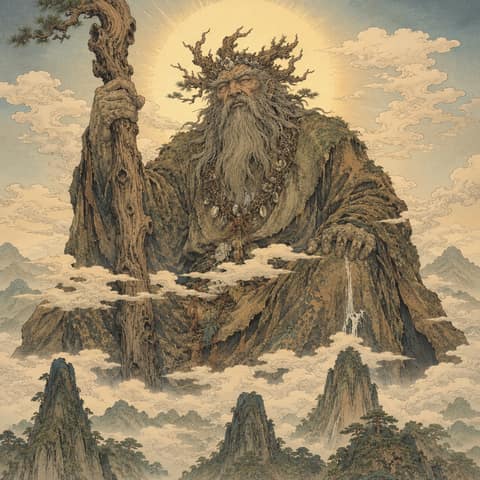
The Goddess of "Water" That Nurtures Life. Despite being a goddess of a volcano, "water" is always at the core of her worship. As symbolized by the "Wakutama Pond" within the precincts of the Fujisan Hongu Sengen Taisha, the natural system where snow and rain falling on Mount Fuji are purified over many years to become clear springs that nourish the foothills has been worshipped as her "water virtue." The power to transform a raging mountain of fire into a mountain of water that nurtures life is the very essence of Konohanasakuyahime's divinity.
The Embodiment of Beauty Pregnant with Roaring Flames. Konohanasakuyahime is not merely a "delicate and beautiful goddess." The myth of her willingly entering a burning delivery hut to clear her husband's doubts reveals an overwhelming pride and fierce passion (intense like volcanic magma) hidden within her. Her beauty is a fierce and dangerous one, shining only in extreme situations adjacent to death—much like cherry blossoms blooming on the slopes of an active volcano (Mount Fuji) that could erupt at any moment.
The Ruler of the Boundary Between Life and Death (The Delivery Hut). In ancient Japan, "childbirth" was an extremely dangerous act adjacent to the impurity of death (a magical space of blood and fire). The story of Konohanasakuyahime giving birth to Hoderi-no-mikoto (Umisachihiko) and others in the flames is a metaphor for the victory of life force itself—bringing forth new life by overcoming the danger of death (fire). Consequently, she garnered fanatic devotion as the absolute "guardian deity of safe childbirth and child-rearing" from women striving to sustain life amidst harsh realities.
Fuji Worship and the Salvation of the Common People. In the "Fuji-ko" faith popular during the Edo period, the worship of Konohanasakuyahime (Asama Okami) evolved into a massive folk religion encompassing not just safe mountain climbing, but everything from worldly benefits to posthumous salvation. It seems contradictory at first glance to install a goddess as the principal deity of Mount Fuji, which was originally closed to women (Nyonin Kinsei). However, this symbolizes the dynamism of Japanese religious history, where a harsh mountain of asceticism gradually transformed its nature into a mountain of affection embracing the common people (including women).
Character Profile
This section is our own creative profile for storytelling. It is not historical fact or scholarship.
Contrary to her glamorous and fleeting appearance like a cherry blossom, she hides a fierce temperament and strong will, willing to plunge into roaring flames to protect her pride. She is full of affection like pure water, but when angered, she becomes as violent as a volcano.
Compatibility
She grants deep affection and inspiration to those facing the birth of life (childbirth and child-rearing) and those pursuing art and beauty. However, she is merciless toward those who wound her pride, or those who deny the natural cycle (lifespan and fleetingness) and greedily seek eternity.
Abilities
An extreme, dualistic power over nature, simultaneously manipulating the magma (fire) of an active volcano and the pure spring water (water) that quells it.Governs the concept of the 'finitude of lifespan (fleetingness)', possessing the power to make beautiful things scatter at their most beautiful moment.Absolute divine protection over the birth of life (safe childbirth) and child-rearing, based on the myth of giving birth to life amidst roaring flames.
Weaknesses
Her fundamental adversarial relationship with her elder sister, Iwanaga-hime, who symbolizes "eternity (rock)". Because her power always presupposes the finitude that things "will eventually scatter," she is weak against phenomena that require immutability or eternity.
Habitat
Asama Shrines across Japan, most notably at the summit of Mount Fuji. Places where cherry blossoms bloom, or clear watersides where the spring water of Mount Fuji gushes forth.
The diagram below is a diagnostic evaluation chart for Goddess of Mount Fuji and Cherry Blossoms. The higher the value of each item, the stronger that characteristic is expressed.