Folklore & Legends
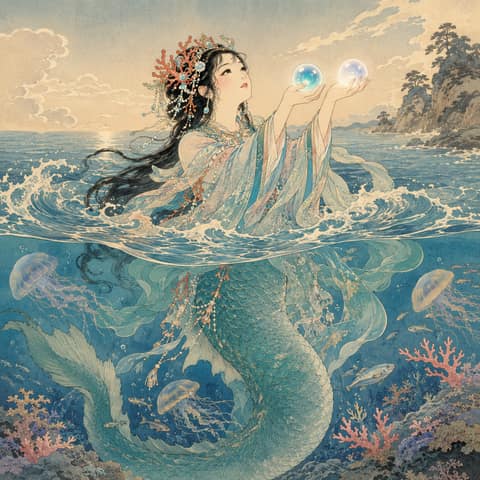
Toyotama-hime's true identity is the daughter of the sea god Watatsumi-no-Okami, who appears at the end of the first volume of the *Kojiki* and in the tenth and eleventh sections of the *Nihon Shoki*'s Age of the Gods[1]. Regarding the meaning of the divine name 'Toyotama', the Classical Culture Project of Kokugakuin University offers two theories: ① 'Toyo' = an honorific, 'Tama' = a maiden possessed by divine spirits → 'a sacred shrine maiden'; ② 'Tama' = pearls, the treasures of the sea god → 'a shrine maiden adorned with many pearls'. Her younger sister's name, Tamayori-bime, means 'a shrine maiden possessed by spirits'. This paired naming is considered a reflection of ancient Japan's sister shrine maiden system (multiple sisters serving a deity).
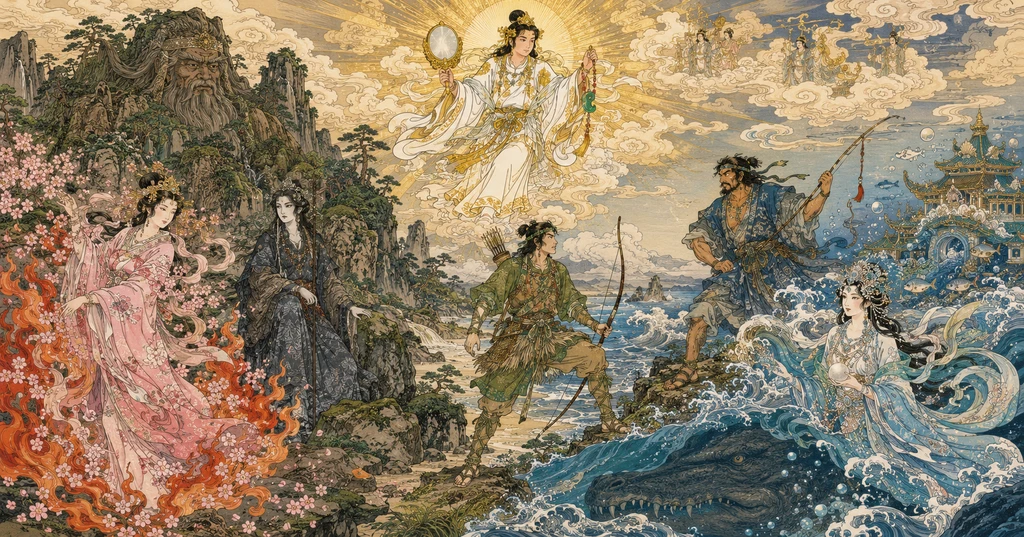
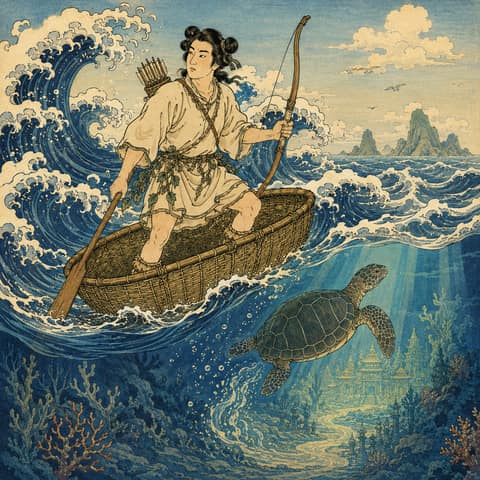
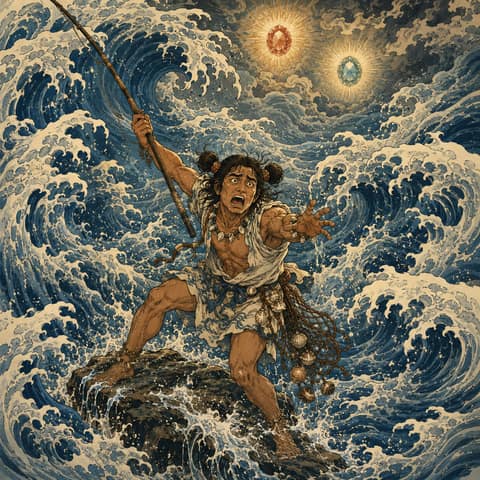
The core of her story is her romance with Yamasachihiko at the Sea Palace and the tragic breaking of the 'do not look' taboo. Yamasachihiko, having lost his older brother Umisachihiko's fishhook, visited the Sea Palace (the palace of Watatsumi-no-Okami) with the help of the deity Shiotsuchi-no-Oji, where he met and married Toyotama-hime. Yamasachihiko stayed at the Sea Palace for three years, but then remembered his homeland. Receiving the Tide-Ebbing and Tide-Flowing Jewels from the sea god, he returned to the surface world with the lost fishhook. The pregnant Toyotama-hime followed Yamasachihiko to the shore. She warned him of the taboo: 'When people of other lands give birth, they take the form of their native land. Therefore, I will now give birth in my true form. I beg of you, do not look at me,' and secluded herself in a birthing hut thatched with cormorant feathers[2]. Overcome with curiosity, Yamasachihiko peeked in, and saw that Toyotama-hime had taken the form of an eight-fathom wani (a giant shark) in the *Kojiki*, writhing and crawling on the ground. Ashamed, Toyotama-hime left her child (Ugayasukiaezu-no-Mikoto), closed the sea boundary (Unasaka), and returned to the Sea Palace.
The tenth and eleventh sections of the *Nihon Shoki*'s Age of the Gods record her true form differently in the main text and its variant accounts (Issho)[3]: the main text says 'dragon', the first variant says 'eight-fathom giant bear-wani', and the third variant says 'eight-fathom giant wani'. The abundance of variant traditions itself indicates the fluidity of ancient sea beast worship and traces of the central compilers of the mythologies integrating the traditions of regional seafaring clans. Since crocodilians did not inhabit ancient Japan, the 'wani' in the *Kojiki* is commonly understood to be a shark—a theory popularized when historian Sadakichi Kida wrote it as 'wanizame'. The ancient word 'wani' is thought to have referred to 'large aquatic animals' in general. On the other hand, the *Nihon Shoki*'s main text recording her as a 'dragon' shows the influence of continental culture (Chinese dragon worship) and is an important academic point regarding the syncretism of ancient Japanese sea beast and sea god worship.
The 'do not look' taboo falls under the globally distributed 'Melusina-type' inter-species marriage folklore in academic classification[4]. The structure is universal: a non-human wife issues a 'do not look' warning → the husband breaks the taboo → the wife leaves for her original homeland → the descendants left behind prosper. Similar examples in Japanese mythology include Izanagi and Izanami (visiting the underworld and seeing the rotting corpse), Urashima Taro and Otohime (opening the tamatebako), and the Crane's Return of a Favor (peeking at the weaving). Overseas examples include Orpheus and Eurydice in Greek mythology. Some researchers argue that 'the original Umisachihiko and Yamasachihiko myth did not contain the Toyotama-hime marriage tale; it was inserted during the compilation of the *Kojiki* to add elements of the imperial lineage.'
Toyotama-hime's position in the imperial lineage is of critical importance: Watatsumi-no-Okami (sea god) → Toyotama-hime (Yamasachihiko's wife) → Ugayasukiaezu-no-Mikoto (Tamayori-bime's husband) → Emperor Jimmu (the first emperor). Toyotama-hime is Emperor Jimmu's paternal grandmother. Her sister Tamayori-bime was sent to the surface as a wet nurse, later marrying the grown Ugayasukiaezu and giving birth to Jimmu. Thus, Tamayori-bime is Jimmu's mother (= from Toyotama-hime's perspective, her granddaughter-in-law and sister). This is an important mythological genealogy where the ancient imperial family incorporated the sea god clan into their maternal ancestry, indicating the linkage of the imperial line with the seafaring Azumi clan.
The most prominent shrine dedicated to her is Udo Jingu (3232 Miyaura, Nichinan City, Miyazaki Prefecture)[5]. The main hall sits within a cavern on a coastal cliff, traditionally said to be the very spot where Toyotama-hime built the birthing hut and gave birth to Ugayasukiaezu. The 'Ochichi-iwa' (Breast Rock) is said to have been formed when Toyotama-hime, returning to the sea palace, attached her left breast to the rock to nourish her divine child. The 'ochichi-ame' (breast candy) made from the dripping 'ochichi-mizu' (breast water) remains a famous sacred item today.
Watadzumi Shrine (55 Nii Wamiya, Toyotama-cho, Tsushima City, Nagasaki Prefecture) is said to be the historic site of the Sea Palace that Yamasachihiko reached[6]. It is a prominent shrine listed in the Engishiki. Records show that in 859, Emperor Seiwa granted it the divine rank of Junior Fifth Rank, Upper Grade. The main deities are the divine couple Hikohohodemi-no-Mikoto (Yamasachihiko) and Toyotama-hime-no-Mikoto. Five torii gates extend from the front of the main hall toward the sea (two standing in the water), creating a mystical landscape where one can walk to the base of the gates at low tide. On the shrine grounds are two three-pillar torii gates, and a scaly rock reef called 'Isora-ebisu' is passed down as the grave of Azumi-no-Isora (the ancestor of the seafaring Azumi clan)[7]. Azumi-no-Isora is considered the ancestral deity of the Azumi clan in the medieval *Taiheiki* and shrine legends. One theory equates him with Ugayasukiaezu (=Toyotama-hime's child), and he holds a legend of guiding Empress Jingu's ships during her expedition to the Three Han States.
Additionally, Tamasaki Shrine (3048 Ichinomiya, Ichinomiya-cho, Chosei-gun, Chiba Prefecture), the chief shrine of Kazusa Province, enshrines her sister Tamayori-bime as the main deity and Toyotama-hime alongside her, featuring a rare black-lacquered Gongen-style main hall. Toyotama-hime Shrine (Shimojuku Otsu, Ureshino-cho, Ureshino City, Saga Prefecture) has a catfish as its divine messenger, holding a legend of a giant catfish that rules the Ureshino River and protects the village. As the guardian deity of Ureshino Onsen (one of Japan's three best hot springs for beautiful skin), it attracts prayers for the healing of skin diseases and for beautiful skin.
In folk religion, Toyotama-hime is widely revered as the goddess of safe childbirth, safe voyages, bountiful catches, matchmaking, and beautiful skin. Her diverse blessings stem from the birthing hut legend and the Breast Rock faith (Udo Jingu) for safe childbirth and fertility; her essence as a sea god's daughter for voyages and fishing; her marriage tale with Yamasachihiko for matchmaking; and the symbolism of pearls plus Ureshino Onsen for beautiful skin. As the model for the figure of Otohime in the later Urashima Taro tales, she is deeply rooted in the Japanese imagination. As the grandmother deity of the Azumi clan of Tsushima and Iki (the head clan of the seafaring people, whose main shrine is Shikaumi Shrine on Shika Island), her positioning as the 'grandmother deity of the seafaring clan' forms the core of studies on ancient seafaring peoples.