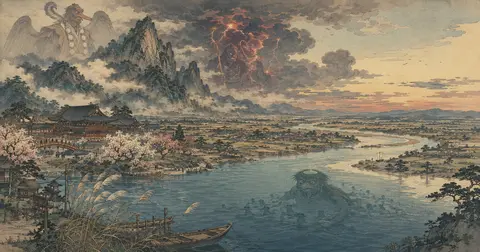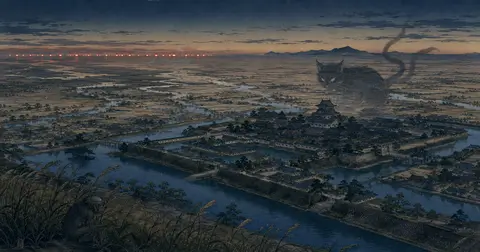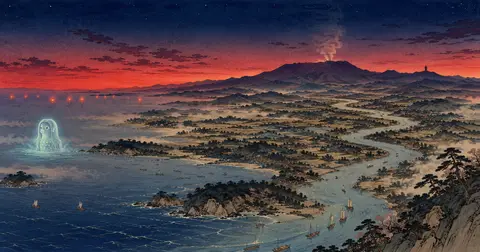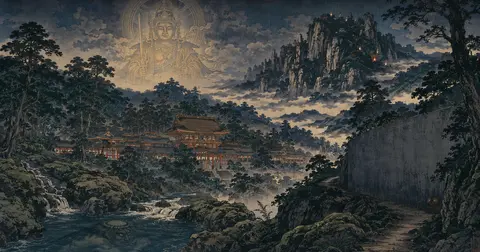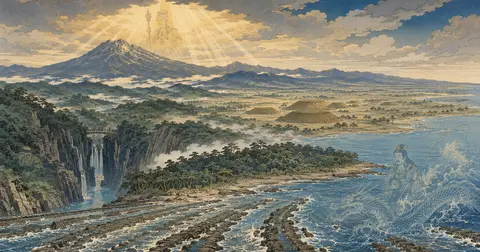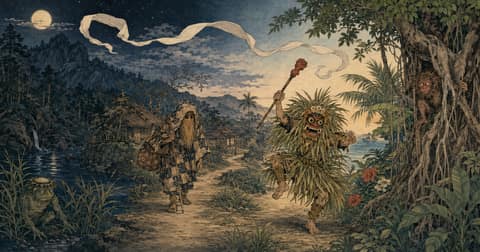
Nagasaki Prefecture is one of the prefectures most deeply embraced by the sea in all of Japan. Its territory consists of peninsulas jutting out from the western edge of the Kyushu mainland, along with a chain of remote islands, both large and small, such as Tsushima, Iki, and the Goto Islands. It boasts the highest number of inhabited islands in the country and an incredibly intricate coastline whose total length ranks second nationally, behind only Hokkaido. The ocean is visible from nearly anywhere within the prefecture, and since ancient times, the livelihoods of its people have been tied to fishing, seafaring, and an enduring awe of what comes from beyond the sea.
Because of this, the yokai of this land are rarely mountain oni or village tanuki; instead, almost all are anomalies of the sea and islands. The ocean palace of Tsushima where the sea god's daughter returned to her dragon form, the foundational shrine in Iki dedicated to the moon god, the Umibozu of the Goto Islands that beg for oil or a ladle while attempting to sink ships, and the Iso-onna that crawl along mooring lines at anchorages to suck blood—all stand at the boundary between land and sea, between the living and the dead. This article explores why this "prefecture of islands and seas" nurtured such a rich culture of maritime anomalies, distinguishing between historical facts and passed-down folklore as we trace our way from island to island, from Tsushima to Goto.
A Prefecture Carved by the Sea:
Geography that Nurtured Yokai
To understand the yokai of Nagasaki Prefecture, one must first recognize its extraordinary geography. Nearly 90 percent of the prefecture consists of peninsulas, capes, and remote islands facing the ocean, leaving very little flat land. Deep, complex ria coastlines cut into the shores, dotted with countless small coves. The people who lived there had no choice but to entrust their livelihoods to the sea stretching out before them rather than to scarce arable land. Fishing, maritime transport, and trade with the Asian continent—the entire way of life in this prefecture was mediated by the sea.
In a land where the sea is the livelihood, anomalies too rise from the waves. While mountainous inland prefectures speak of tengu, yamanba, and village foxes and tanuki, Nagasaki speaks of sea gods and dragon palaces, Umibozu and Funayurei, female coastal anomalies, and stranded outsiders. This is not a mere thematic bias. The sea provides bounty, but once a storm hits, it mercilessly takes lives. It was common for those who set out to sea never to return, and deaths by shipwreck were far from rare. Anomalies functioned as a mechanism to give meaning to those inexplicable, unreasonable deaths, allowing people to come to terms with the ocean.
Furthermore, a unique trait of Nagasaki is that the sea was simultaneously an "otherworld" and a "foreign nation." Tsushima and Iki had been gateways to the continent since ancient times, and during the Edo period under national isolation, Nagasaki was the sole port open for foreign trade. Beyond the horizon lay a mythological otherworld like the Dragon Palace, and at the same time, literal foreign countries—Joseon Korea, China, and the lands of the "Southern Barbarians" (Europeans). The mythological otherworld and the geopolitical foreign lands overlapped on the very same horizon. This duality lends a unique depth to Nagasaki's maritime anomalies. Below, we trace these anomalies as we hop from island to island: from Tsushima to Iki, the Goto Islands, Hirado, and finally the port of Nagasaki.
Daughter of the Sea God:
The Dragon Palace of Tsushima's Watatsumi Shrine
To discuss Nagasaki's yokai culture, one must begin at the northernmost point of the prefecture: Tsushima, an island closer to the Korean Peninsula than to the Kyushu mainland. Tsushima is long and narrow from north to south, its coastline carved by countless ria inlets. At its center, in the Nii district facing Asou Bay, sits Watatsumi Shrine.
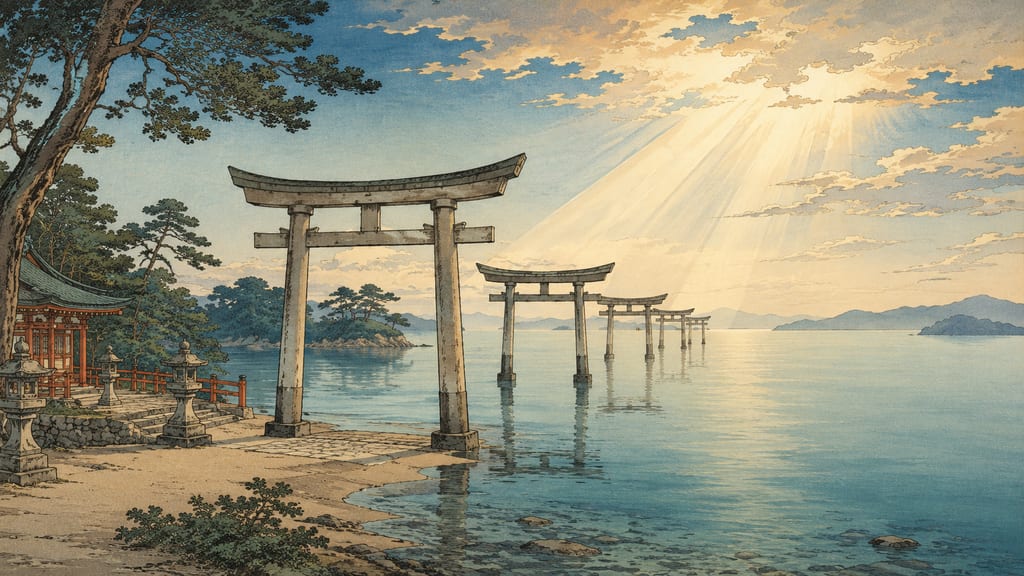
Five torii gates stand in a straight line extending from the front of the main sanctuary toward the sea, and when the tide rises, the bases of the two gates closest to the water are submerged. At low tide, a tidal flat appears, allowing visitors to walk all the way out to the first torii. The sight of seawater pressing right up to the shrine buildings at high tide is majestic, evoking the very image of the Dragon Palace. This shrine is dedicated to Hikohohodemi-no-Mikoto (Yamasachihiko) and Toyotama-hime, and is said to be the ancient site of the ocean palace—namely, the Dragon Palace—where Yamasachihiko arrived and spent three years[1].
That Toyotama-hime is the very deity who stands at the center of Nagasaki's ocean worship. Instances where myth, geography, and shrine tradition overlap so densely in a single place are rare.
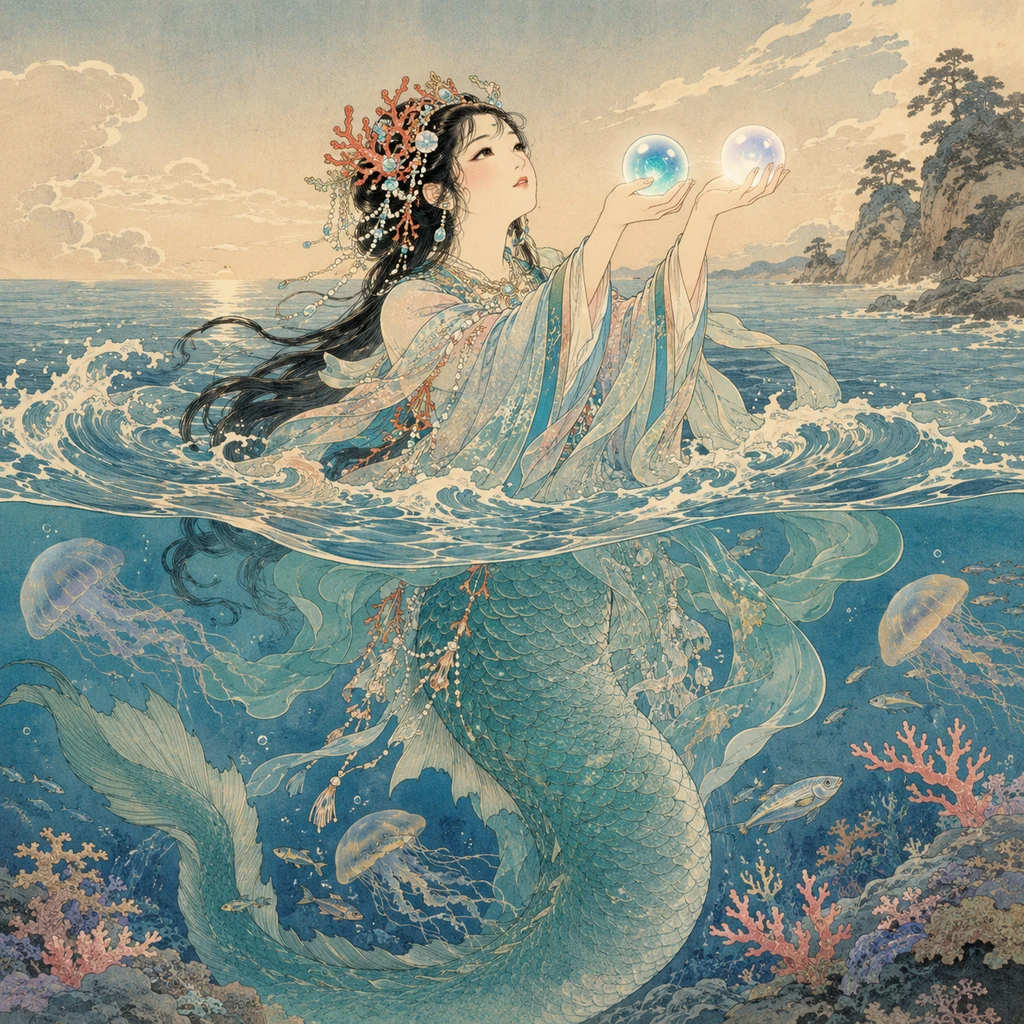
Toyotama-hime
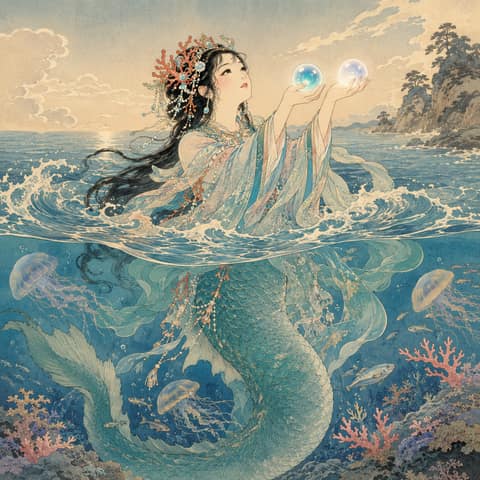
The daughter of the sea god Watatsumi-no-Okami in Japanese mythology. Known for her tragic marriage to Hoori (Yamasachihiko) at the Sea Palace and the broken "do not look" taboo. She holds a crucial intersection in the imperial lineage as the paternal grandmother of Emperor Jimmu (the first emperor). Her true form is a giant wani (a shark in the Kojiki, a dragon in the Nihon Shoki). She is widely worshipped as the goddess of safe childbirth, fertility, beautiful skin, and as the ancestral deity of the seafaring Azumi clan.
Read moreAppearing at the end of the first volume of the *Kojiki* and in the Age of the Gods section of the *Nihon Shoki*, Toyotama-hime is the daughter of Watatsumi-no-Okami, the deity who rules the sea[2]. Research from Kokugakuin University offers two theories regarding the meaning of the divine name "Toyotama." One suggests that "Toyo" is an honorific and "tama" refers to a maiden possessed by a divine spirit, reading the name as "sacred miko (shrine maiden)." The other views "tama" as pearls—the sacred treasures of the sea god—reading it as "a miko adorned with many pearls." Contrasted with her younger sister Tamayori-bime, whose name means "a miko possessed by a spirit," this naming is also thought to reflect ancient systems of sister-priestesses.
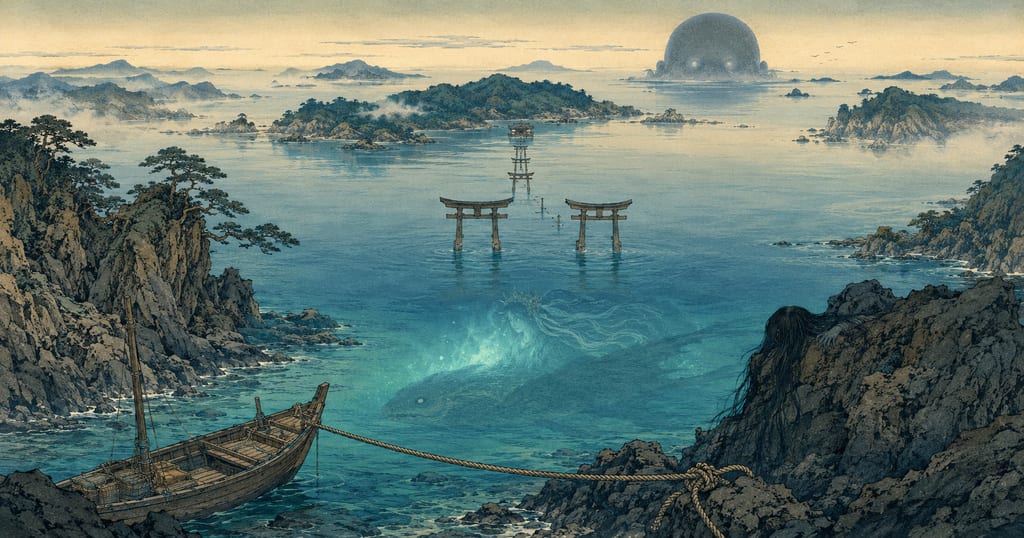
The core of the tale lies in the ocean palace narrative, where Yamasachihiko, having lost his older brother's fishhook, descends into the sea, reaches the ocean palace guided by Shiotsuchi-no-Kami, and unites with Toyotama-hime. After spending three years in the ocean palace, Yamasachihiko receives the tide-ebbing and tide-flowing jewels from the sea god to control the tides, and returns to the surface world. Soon, the pregnant Toyotama-hime follows her husband to the shore and has a parturition hut built on the beach. Here, she tells him, "When people from foreign lands give birth, they return to the form of their homeland. I will do the same, so please do not look." However, when Yamasachihiko breaks his promise and peeks in, what he sees is an eight-hiro *wani*, meaning his wife writhing in the form of a dragon or a giant shark[3]. Ashamed at being seen, Toyotama-hime leaves her newborn child on the beach, returns to the sea, and seals the path that connected the ocean and the land.
It is deeply significant that this tragedy of the "taboo against looking" is seared into the land of Tsushima. Toyotama-hime is not just a character in a myth; she is an entity who came from the otherworld across the sea—the Dragon Palace—and, upon being seen, returned to her dragon form. Watatsumi Shrine, with its torii gates sinking into the sea, can be called a mechanism that maps the ocean palace directly onto the earthly realm. For people living on remote islands and depending on the sea, the ocean was a source of inexhaustible bounty, yet simultaneously an otherworld holding territories one must not peer into. The myth of Toyotama-hime crystallizes this dual-sided awe into its most noble form.
Furthermore, the child Toyotama-hime left on the shore is Ugayafukiaezu-no-Mikoto, who is said to be the father of Emperor Jimmu, the legendary first emperor of Japan. Toyotama-hime is the imperial grandmother, and the *Kojiki* and *Nihon Shoki* recount that her sister Tamayori-bime raised the child in her stead and eventually became his wife, giving birth to Jimmu. This genealogy, which incorporates anomalous beings of the sea into its ancestry, demonstrates how the worldview of maritime people cuts all the way down to the roots of ancient royal origin myths. The tide-controlling jewels that Yamasachihiko received from the sea god also embody the very sensibility of island fishermen, who entrusted their lives to the ebb and flow of the tide. The sea-submerged torii gates of Watatsumi Shrine continue to perform that myth before our eyes through the actual rising and falling of the tides today.
Watatsumi Shrine also carries a tradition that Toyotama-hime's father, Toyotama-hiko, took up residence there, and behind the main hall remains an ancient form of worship focused on a scale-like rock called "Isora Ebisu." The feeling that the palace of the sea god's clan was built in this area permeates the terrain and the shrine's lore. In addition to Watatsumi Shrine, ancient shrines dedicated to sea gods dot Tsushima, leaving the entire island bathed in the lingering echoes of the ocean palace. The fact that the land of myth still exists today, not just as a concept but as an actual tidal cove—this is what makes Tsushima's yokai culture truly irreplaceable.
The Island That Reads the Moon:
The Origin Shrine of Iki's Tsukiyomi Shrine
Floating between Tsushima and the Kyushu mainland, Iki, alongside Tsushima, was a vital node on the sea route connecting the Asian continent and Japan since ancient times. Recorded as "Iki-koku" in the *Gishi Wajinden* (Record of the Wei: Account of the Wa), it still hosts the ruins of Harunotsuji, a massive moat-encircled settlement from the Yayoi period. Because it was an island where every seafarer was bound to stop, it is here that the ancient shrine considered the source of nationwide Tsukuyomi (moon god) worship resides.
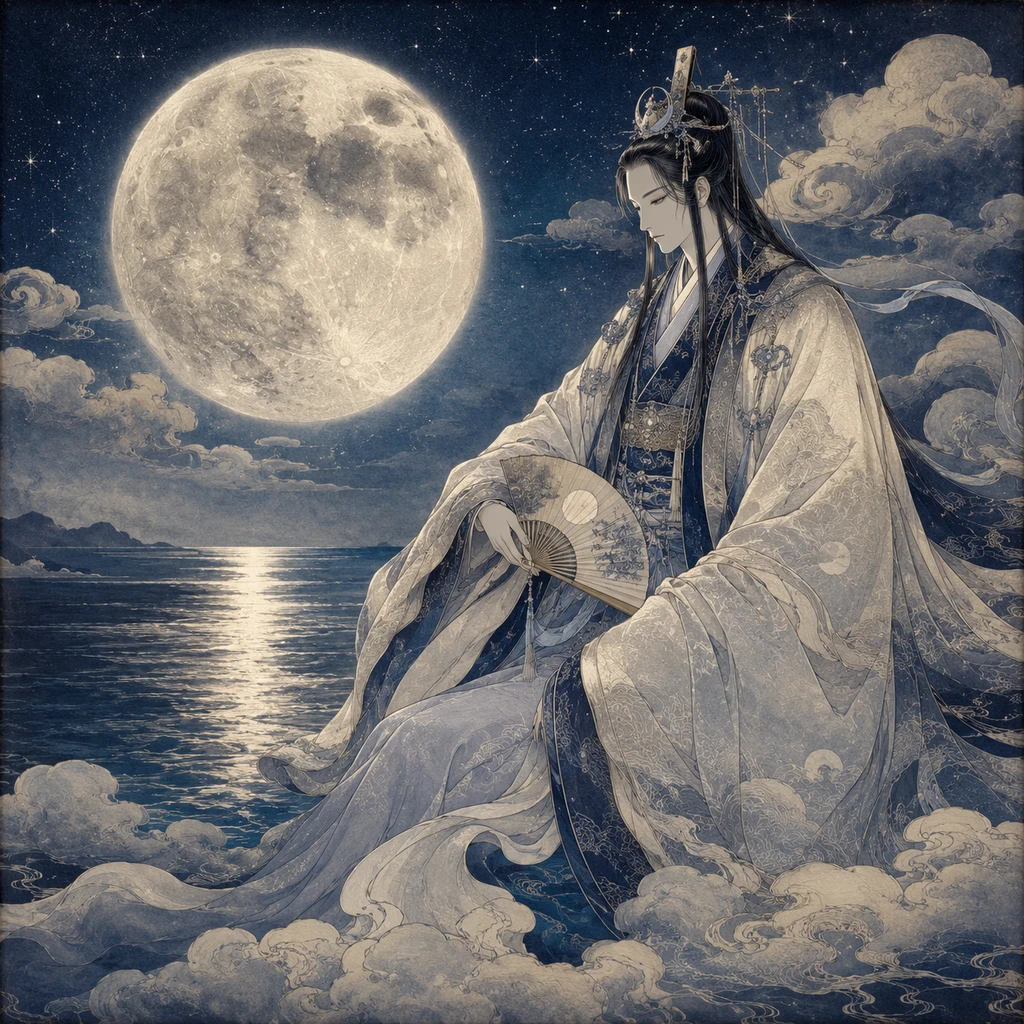
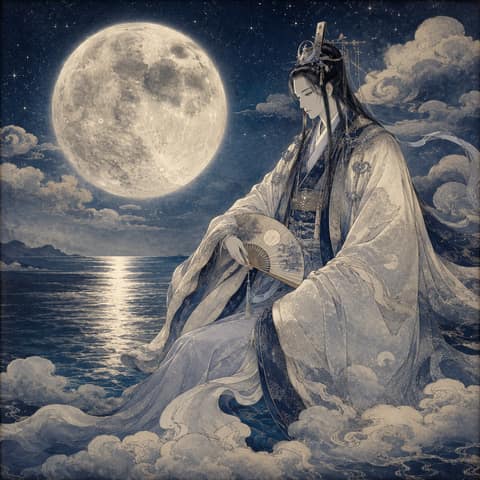
Tsukuyomi-no-Mikoto is the deity born from the right eye[2] of Izanagi-no-Mikoto when he cleansed himself of the defilement of Yomi (the underworld). Praised as one of the Three Precious Children, alongside Amaterasu-Omikami born from the left eye and Susanoo-no-Mikoto born from the nose, he was entrusted by his father with the realm of the night—the domain of night, the moon, and the tides. Compared to the sun goddess Amaterasu, the descriptions in the *Kojiki* and *Nihon Shoki* are remarkably sparse, and he has almost no independent narrative. Even his name's notation varies wildly in the *Nihon Shoki*—written with different characters meaning Moon God, Moon Bow Deity, Moon Night Viewer, and Moon Reader[3]—suggesting that ancient moon worship was far from uniform. Yet, this very quietness gives him a depth fitting for a god of the moon. His name has been interpreted as "reading the movement of the moon," meaning the origin of the calendar.
According to the tradition of Tsukiyomi Shrine in Iki, around the 3rd year of Emperor Kenzo (c. 487 CE), the moon god delivered an oracle to Ahe-no-Omi Kotoshiro, an envoy traveling to Mimana on the Korean Peninsula, saying, "I am the god of the moon; enshrine me in the capital, and the nation will prosper." The imperial court accepted this, summoned the ancestor of Iki's local lords to the capital to enshrine the moon god, and designated the shrine in Iki as the original shrine for all Tsukuyomi shrines nationwide[4]. The destination of this enshrinement was Matsunoo (Matsuo) in Kyoto, and due to this history, Iki is sometimes called the "birthplace of Shinto." One must not overlook that the oracle was delivered to an envoy embarking on a sea voyage to Mimana. The moon god was transmitted to the capital through a seafarer.
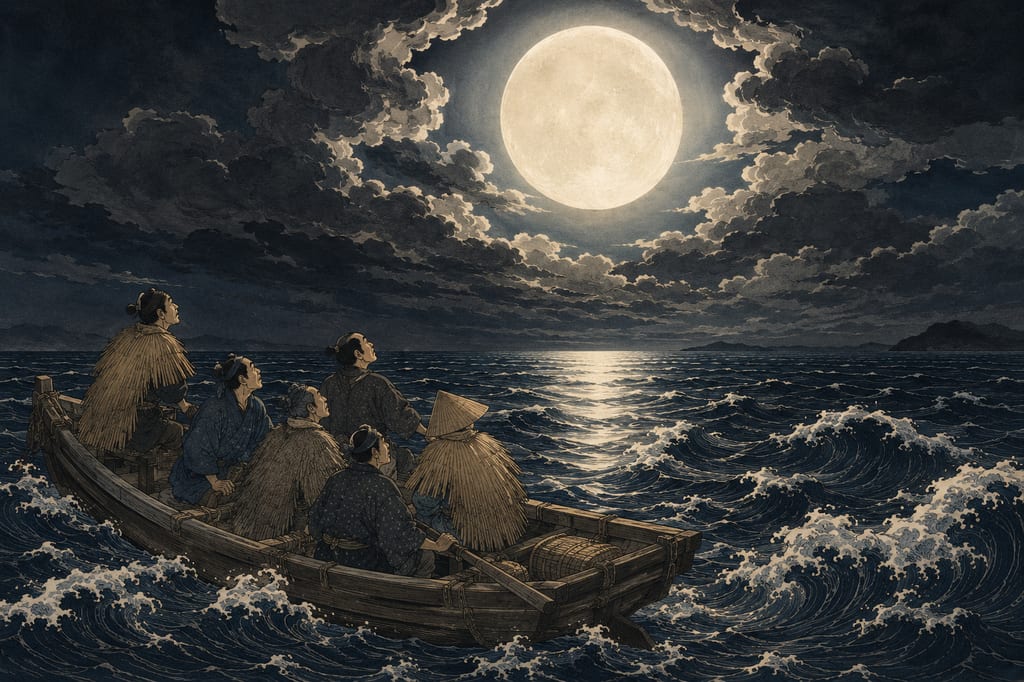
Crucially, this worship of the moon god was inseparable from the calendar of the sea. For an island living on fishing and seafaring, reading the waxing and waning of the moon and the ebb and flow of the tide literally meant the difference between life and death. For those launching boats into the darkness of the night, the moon was their only lantern and their clock. It is by no means a coincidence that an island was the earliest to enshrine the deity governing the moon. Toyotama-hime, who commands the tides at Tsushima's ocean palace, and Tsukuyomi-no-Mikoto, who governs the moon and tides in Iki—these two divine figures stand as the twin pillars of Nagasaki's remote island faith, both ruling the "time of the sea." The chain of islands that enshrine the daughter of the sea god and the god of the moon in their deepest strata is the very foundation of this prefecture's yokai culture.
Additionally, in an alternate version recorded in the *Nihon Shoki*, there is an episode where Tsukuyomi-no-Mikoto, acting on Amaterasu's orders, visits Ukemochi-no-Kami (the goddess of food). Disgusted when she serves him food produced from her mouth, he slays her in anger. From the slain body of Ukemochi sprang horses, cows, silkworms, and the five grains, giving rise to an origin myth for food. It is said that ever since this incident, the sun and moon separated into day and night, refusing to look at each other. This is the only fierce side shown by the otherwise silent Tsukuyomi, and it is intriguing for conveying the connection between the moon, agriculture, and food. The weight of Iki's Tsukiyomi Shrine being recognized as the oldest stronghold for this complex deity is immense.
Beings Standing in the Seas of Goto:
Umibozu and Iso-onna
In contrast to the mythological seas of Tsushima and Iki, the waters of the Goto Islands—scattered in an arc to the west of the Kyushu mainland—belong to the realm of more visceral anomalies. Goto comprises over 140 islands of various sizes, featuring deeply indented coves as well as fishing grounds open to the open ocean. Here, rather than gods, the tales speak of anomalies that physically stand in the way of fishermen.
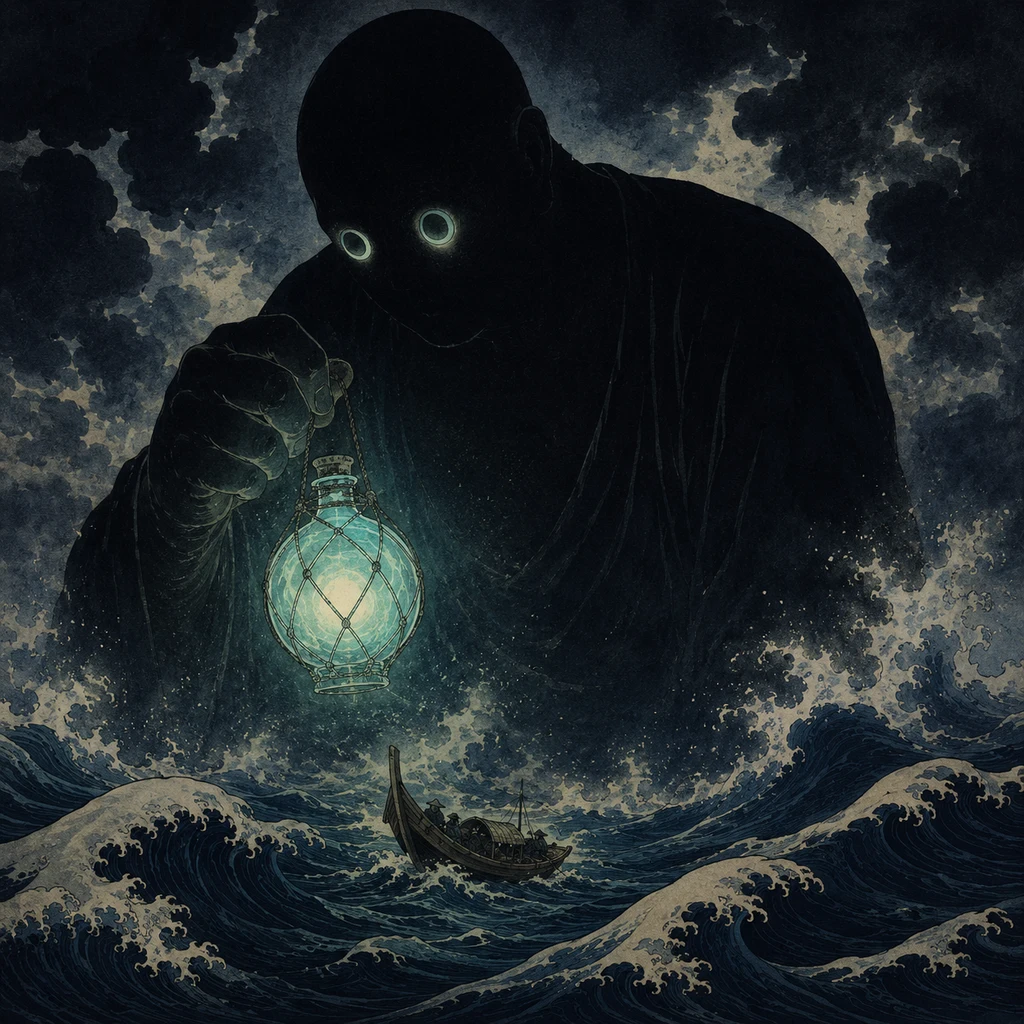
Umibōzu
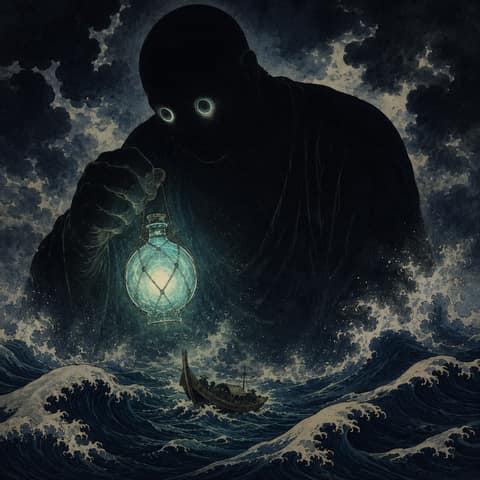
Umibōzu is a maritime apparition known along coasts throughout Japan and long feared especially by fishers. A calm sea is said to heave without warning, becoming an immense black shadow or the bald form of a Buddhist monk that blocks a vessel's path. Accounts rarely show a whole body; most describe only a head and shoulders rising above the water. It appears at night or in heavy seas, overturning boats and dragging people into the depths. Edo-period sources including the Wakan Sansai Zue (1712) and the Butsurui Shōko (1775) also record the name of a giant apparition standing at sea.
Read moreThe Umibozu appears when the calm surface of the night sea suddenly swells, taking the shape of a massive, black shadow with the shaven head of a monk. Its size is said to range from a few meters to dozens of meters. Though it is widely distributed across fishing villages nationwide—including the Goto Islands, Ehime, Okayama, Tottori, Wakayama, and Miyagi[5]—its nature varies by region. While some areas describe it as a monster with immense strength that blocks ships and snaps nets and oars, tales from Goto in Nagasaki and Chita in Aichi tell of it demanding, "Lend me a ladle," and if given one, it will repeatedly scoop seawater into the boat in an attempt to sink it[6]. It is said that fishermen survived by handing over a ladle with the bottom knocked out, escaping while the creature fruitlessly tried to scoop water that wouldn't pool. Its true identity has been described as the ghost of a drowned person, or as a fallen dragon or sea god seeking a sacrifice. Although Toriyama Sekien did not draw the Umibozu itself, he included the Umi-zato—a blind monk standing on the sea—in his *Gazu Hyakki Yagyo* (The Illustrated Night Parade of a Hundred Demons), showing how the fear of the sea repeatedly coalesced into images in early modern yokai art. The massive head and the incomprehensible black mass can almost be called the manifestation of "the terror of the sea itself."
The Goto Islands harbor another unforgettable female anomaly of the seaside. If the Umibozu stands far out in the open ocean, this creature stands precisely on the boundary between land and sea.

Iso-onna
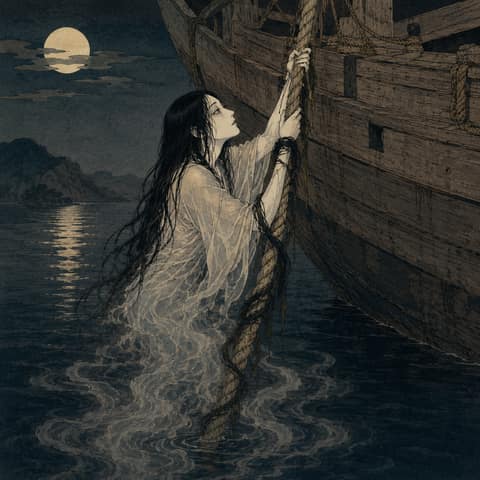
Iso-onna is a female sea apparition found along the northwestern coast of Kyūshū, including Amakusa, Shimabara, Tsushima, and Kakarashima. She approaches beaches, rocky shores, and moored boats, entangling people in her long hair and drinking their blood. Her upper body resembles a beautiful woman, while her lower half is said either to fade from view or to be serpentine; from behind, she may look like nothing more than a wet rock. Names vary by region, including Iso-joshi, Nure-joshi, Ama, and Umi-hime. She appears when the sea is calm and is sometimes linked with the resentful dead of maritime disasters. Some traditions also pair her with Ushi-oni, another dangerous being of the shore.
Read moreThe Iso-onna is a female anomaly that stands in the space between the offshore waters and the land—on rocky shores and at anchorages. In Minami-Shimabara, Nagasaki, it is said that the Iso-onna stares out at the sea, and if anyone speaks to her, she lets out a piercing shriek, entangles them in her hair, and sucks their lifeblood. In Amakusa, it was customary when at an unfamiliar port to drop only the anchor and avoid tying a mooring line, because the creature was known to creep aboard ships at night using the mooring lines, covering sleepers with her hair to kill them[5]. On the Shimabara Peninsula, it is also passed down that one can ward her off by sleeping with three pieces of thatch laid over one's kimono. The fact that defensive measures remain as specific customs speaks volumes about how desperately real this anomaly was believed to be. In Ojika in the Goto Islands, there is a theory that the Iso-onna is the spirit of a drowned person, while northern Kyushu holds a variant where she is the incarnation of a crab, and along the Fukuoka coast, tales say she walks on water. Unlike the Umibozu or Funayurei, which directly attack boats offshore, the Iso-onna stands on rocky shores or anchorages—the very border between land and sea—and crystallized into an image unique to the coastlines of western Japan as a female sea anomaly centered around hair and blood. The motif of being ensnared by long hair and drained of blood likely represents the dread and the need to pacify the souls of those who died at sea, coalesced into a female form.
Swarms of Spirits Floating off Hirado:
Funayurei
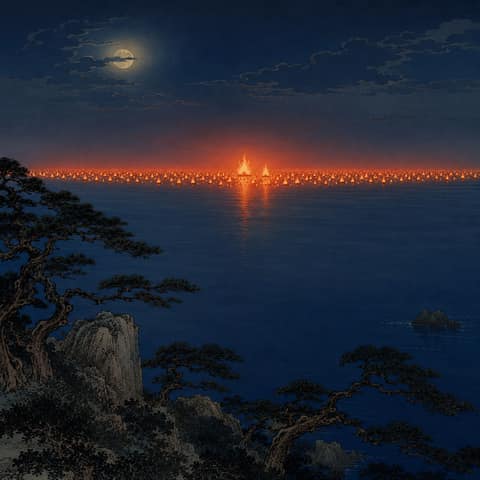
If the Umibozu and Iso-onna are "singular monsters," the Funayurei are an aggregate of spirits—a massive swarm of the countless people who have died at sea. The memories of shipwrecks in Nagasaki are most heavily etched into this anomaly.

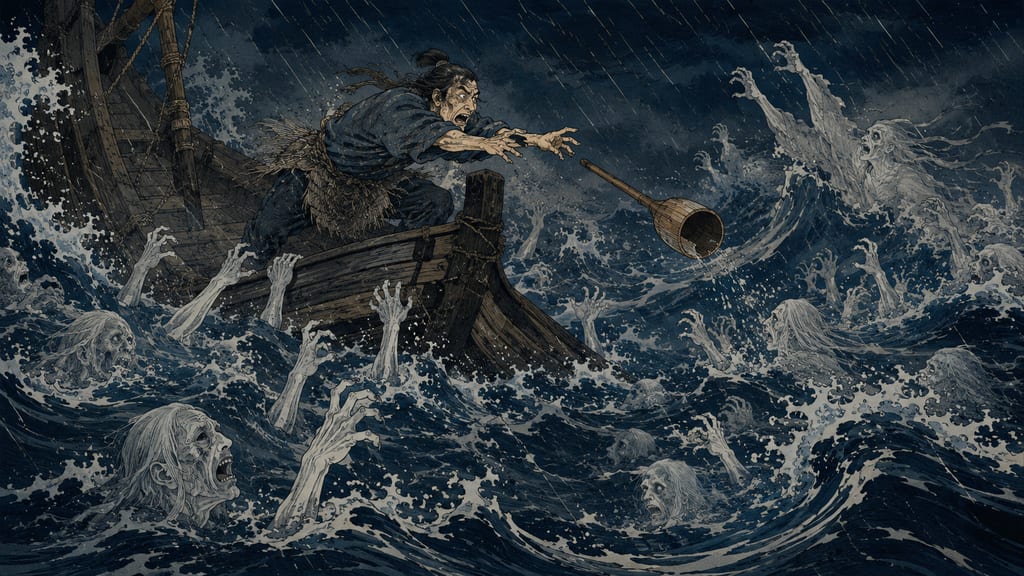
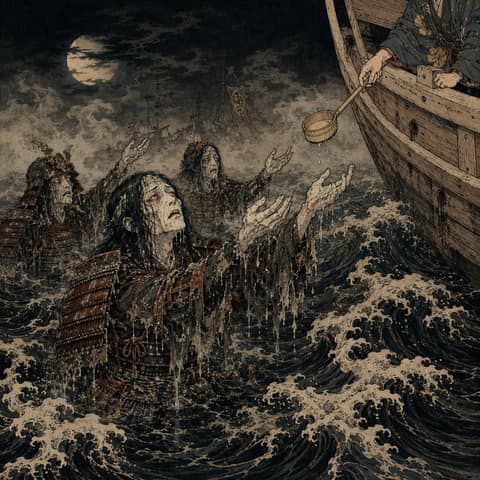
Takehara Shunsensai's *Ehon Hyakumonogatari* (Picture Book of a Hundred Tales) depicts the Funayurei that appear in the western seas as the vengeful spirits of the Heike clan, drawing armored ghosts near the Kanmon Strait's Dan-no-Ura demanding, "Give me a bucket." The custom of proactively knocking the bottom out of a bowl or ladle and handing it over when asked—as a means of survival—is passed down not only at Dan-no-Ura but also along the coast of Fukushima Prefecture, in Hirado, Nagasaki Prefecture, and on Goshoura Island, Kumamoto Prefecture[7]. Defensive measures vary widely by region: in Miyagi, stopping the boat and glaring at them makes them vanish; in Kochi, throwing ashes or mochi works; and in Kozushima, Izu, offering incense, flowers, and dango (dumplings) pacifies them. In Nagasaki, it is said they were repelled by throwing thatch or ash into the sea. Furthermore, there was a taboo that if one set out in a boat on the sixteenth day of the Obon festival, the dead would gather at the sides of the ship and try to sink it. The Funayurei were feared as the swarming spirits of those drowned at sea, appearing exactly when the sea was rough or during Obon.
Hirado was a thriving trade port since the medieval period. During the Sengoku period, Portuguese and Dutch ships frequented it, and boats constantly rowed out to the open ocean. The more prosperous a port, the more people were swallowed by the sea. The modest yet desperate ritual of preparing a bottomless ladle was the very embodiment of the resolve of fishermen who never knew when they themselves might join the swarm of spirits clinging to the sides of a boat. The unresolved grief for those lost at sea reaches up from the surface as the hands of the dead begging for buckets and ladles—the Funayurei represent the final form of dialogue exchanged between those who live on the sea and those who died in it.
The Funayurei beg, "Lend me a ladle"; the Umibozu utters the exact same words; the Iso-onna crawls along mooring lines. When lined up like this, Nagasaki's sea anomalies all swarm around the tiny vessel of a boat. A boat was the lifeline for those living on the ocean, and at the same time, it was their most vulnerable point. Preparing a bottomless ladle, dropping anchor instead of tying a mooring line, throwing thatch and ash into the waves—each of these customs was a modest, earnest method of self-defense woven by humans against the unreasonableness of the sea. Yokai are not absurd fantasies; they were passed down as the flip side of the wisdom needed to cross paths with the ocean.
Why Were Mountain Anomalies So Rarely Spoken Of?
Up to this point, we have listed only anomalies of the sea, but naturally, Nagasaki has land as well. The Shimabara Peninsula holding Mount Unzen, the castle towns of Omura and Isahaya, the valleys carved with terraced rice paddies—it is not that tales of tengu or mountain anomalies are entirely absent there. Yet, what makes Nagasaki stand out in the nationwide distribution of yokai is undeniably the overwhelming density of sea monsters. Why is the presence of mountain anomalies so faint?
One reason is that the geography, lacking flat lands and deep, dense forests, did not possess the "deep interior" (oku) where mountain yokai breed. The mountains of Nagasaki drop steeply toward the sea, leaving no broad buffer zone of mountainous terrain between human settlements and the coast. Rather than the darkness of deep mountains where anomalies dwell, the darkness of the sea opening up right before their eyes was a far more pressing reality for the people's livelihoods.
Another reason that cannot be avoided when discussing Nagasaki's spiritual history is the legacy of the Hidden Christians. From the 16th century onward, numerous believers emerged in Hirado, Nagasaki, Goto, and Shimabara, enduring the Shimabara-Amakusa Rebellion and the long era of hidden faith. While this is not yokai folklore itself, it means that the people's imagination toward the invisible world flowed into circuits entirely different from indigenous yokai. Because this article focuses on yokai, we will not delve deeply into it, but when discussing Nagasaki's anomaly culture, one must keep in mind that this distinct layer of faith lies in the background.
In any case, the center of gravity of Nagasaki's anomalies lies immovably in the sea. Instead of seeing demons in the mountains, they see the otherworld beyond the horizon—that direction of their gaze is the very core of this prefecture's yokai culture.
Those Who Come From Beyond the Sea:
Kaijin and the Worldview of Remote Islands
Finally, we should touch upon another facet of Nagasaki's yokai culture: the gaze directed at the "outsiders" who come from beyond the sea.
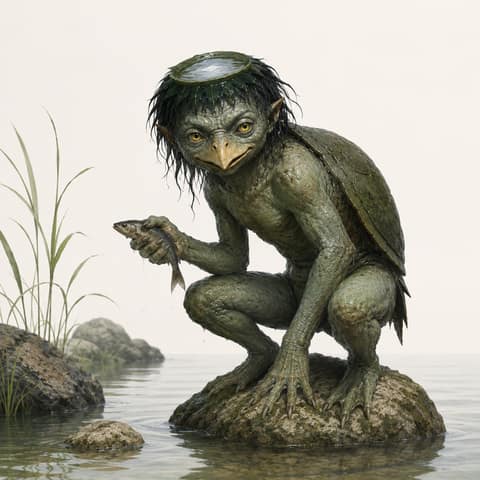
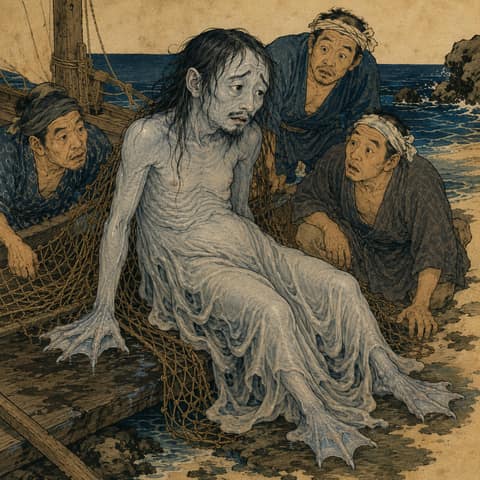
The Kaijin is an aquatic anomaly recorded in Edo-period natural history books. Beginning with Kaibara Ekken's *Yamato Honzo* (1709), works such as *Nagasaki Kenbunroku* and *Honzo Komoku Keimo* contain records of creatures caught in the sea that looked remarkably human[6]. According to descriptions, their appearance was close to that of a human, they had webbed fingers, and the loose skin over their entire body looked like hakama trousers. The traditions vary; some accounts state they did not understand language, refused the food and drink offered, and died within a few days, while other conflicting theories claim they were used for manual labor and lived a long time. There is a theory that their true identity was marine mammals—such as sea lions or dugongs—but there is no definitive conclusion.
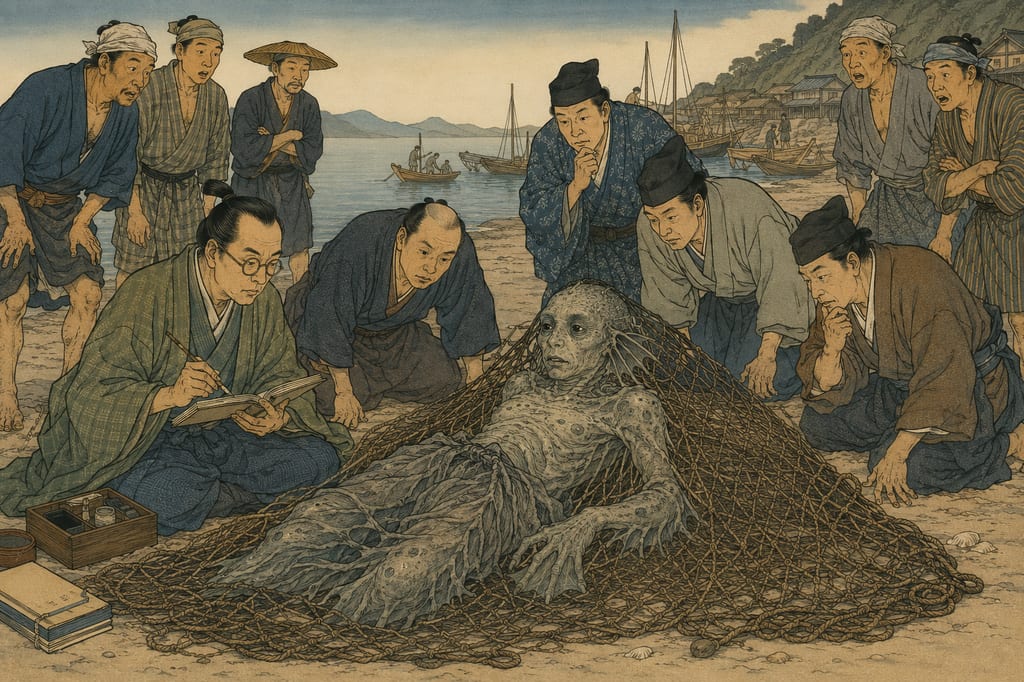
It is no coincidence that records of these Kaijin are concentrated in Nagasaki. During the Edo period, Nagasaki was Japan's only window open to overseas. Unknown creatures, foreign medicines, and exotic knowledge all arrived at the port of Nagasaki from across the ocean. Naturalists took up their brushes to classify the oddities brought before them, and the Kaijin was jotted down amidst that effort. The Kaijin can be described as the surprise and awe toward "the unknown coming from beyond the sea," documented in the calm language of natural history. Rather than a yokai, it is a trace of early modern knowledge encountering the otherworld of the sea.
The geography of remote islands decisively shapes this worldview. Tsushima and Iki did not merely receive bounty and mythology from beyond the sea. During the two Mongol Invasions in 1274 (Bun'ei 11) and 1281 (Koan 4), it was these islands that the armies from the continent struck first. On Iki, the deputy governor Taira no Kagetaka and his men barricaded themselves in Hinozume Castle and fought valiantly, but heavily outnumbered, they are said to have been entirely wiped out[8]. From beyond the sea comes bounty, but also dragons, foreigners, and armies—this inescapable duality was precisely the sensation the remote islands of Nagasaki carried for over a thousand years.
In modern Nagasaki, these maritime anomalies are being brought into the light once again. Tsushima's Watatsumi Shrine attracts many worshippers with the spectacular view of its torii gates standing in the sea, while Iki has positioned tours of its ancient shrines, led by Tsukiyomi Shrine, as a pillar of tourism under the banner of the "Birthplace of Shinto." The Goto Islands, alongside their World Heritage Hidden Christian sites, are reevaluating the memories of the islands that pass down tales of the Iso-onna and Umibozu as tourism resources. Even if the terror that birthed the sea monsters has faded, their stories undeniably remain as the intrinsic character of the land, continuing to invite people to the islands today.
The sea of Tsushima where Toyotama-hime returned to a dragon; the sea of Iki where Tsukuyomi-no-Mikoto read the tides; the seas of Goto and Hirado where the Umibozu, Iso-onna, and Funayurei stand; and the port of Nagasaki where the Kaijin washed ashore. The yokai of Nagasaki Prefecture are born, without exception, from this awe of the ocean. Rather than seeing oni in the mountains, seeing the otherworld beyond the horizon—that is the form of anomalies unique to this prefecture, the one most deeply embraced by the sea in all of Japan.