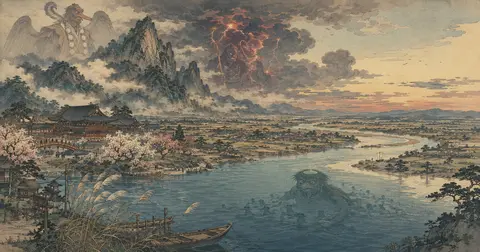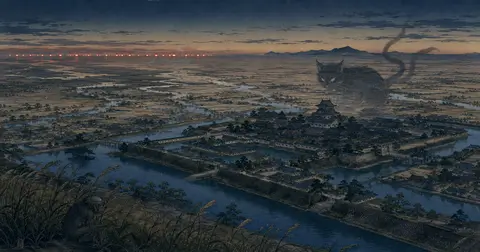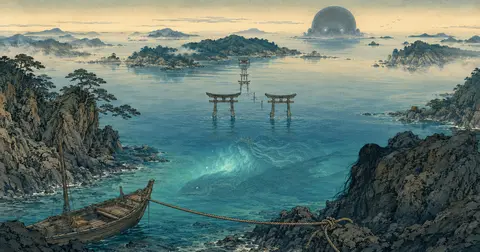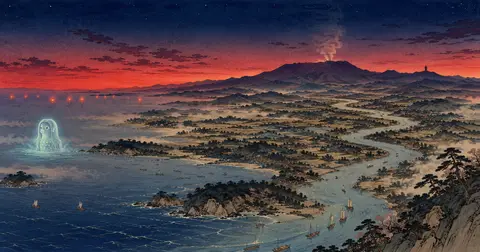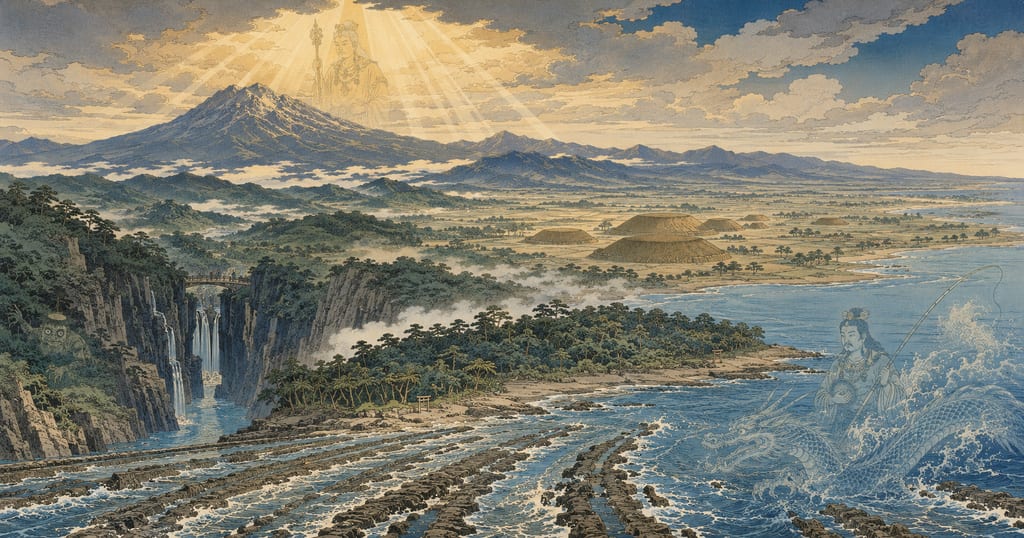
Located in the southeast of Kyushu with a long coastline facing the Hyuga-nada Sea, Miyazaki Prefecture was formerly known as Hyuga Province. True to its name, meaning "the land facing the sun," this is the stage where the heavenly gods were sent down to earth in the *Kojiki* and *Nihon Shoki*[1][2]. Amaterasu's grandson, Ninigi-no-Mikoto, descended onto the peaks of Takachiho. His sons, Umisachihiko and Yamasachihiko, saw their fates diverge on the shores of Hyuga-nada, and in the generation of his grandson, the first Emperor Jimmu embarked on his journey eastward ── the narrative of the origin of Japan is predominantly told in this land.
Because of this, the "yokai" of Miyazaki possess a unique aspect. While in many regions, yokai are grotesque figures emerging in the dark or at crossroads, what is passed down here is first and foremost the lineage of the gods. The protagonists of the myths continue to reside in the masks of Takachiho's Yokagura dances, sleep in the ancient tombs of Saitobaru, and are enshrined along the shores of Aoshima even after more than a millennium. This article centers on the pantheon of the *Kojiki* and *Nihon Shoki* myths, while bringing together local strange beings like the fierce deity Kihachi of Takachiho and the kappa Hyosunbo lurking in the rivers of Hyuga, to trace how the "yokai culture of the land of myths" was formed.
Takachiho ── The Gorge Where the Heavenly Grandson Descended
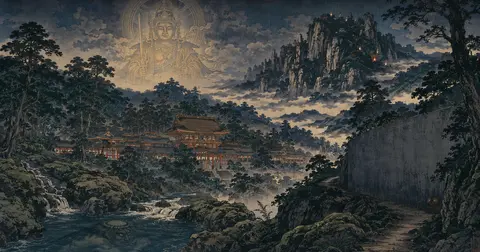
To speak of the myths of Miyazaki, one must begin with Takachiho. Encompassing the deep gorge (Takachiho Gorge) carved by the Aso mountain range, Takachiho Town in the Nishiusuki District is one of the two major legendary sites of the heavenly descent[3]. The other is Mount Takachiho (elevation 1,574 meters)[4] in the Kirishima mountain range towering on the border of Kagoshima Prefecture, at whose summit still stands the bronze Ama-no-Sakahoko (Heavenly Reversed Halberd) said to have been thrust into the ground by Ninigi-no-Mikoto during his descent. In the final days of the Edo period, Sakamoto Ryoma and his wife Oryo climbed this peak, and the anecdote of him pulling out the halberd as a prank is known as "Japan's first honeymoon." A prop of mythology became the target of a late-Edo patriot's mischief, and is now a modern tourist attraction ── this single halberd perfectly demonstrates how myth and reality are seamlessly connected.
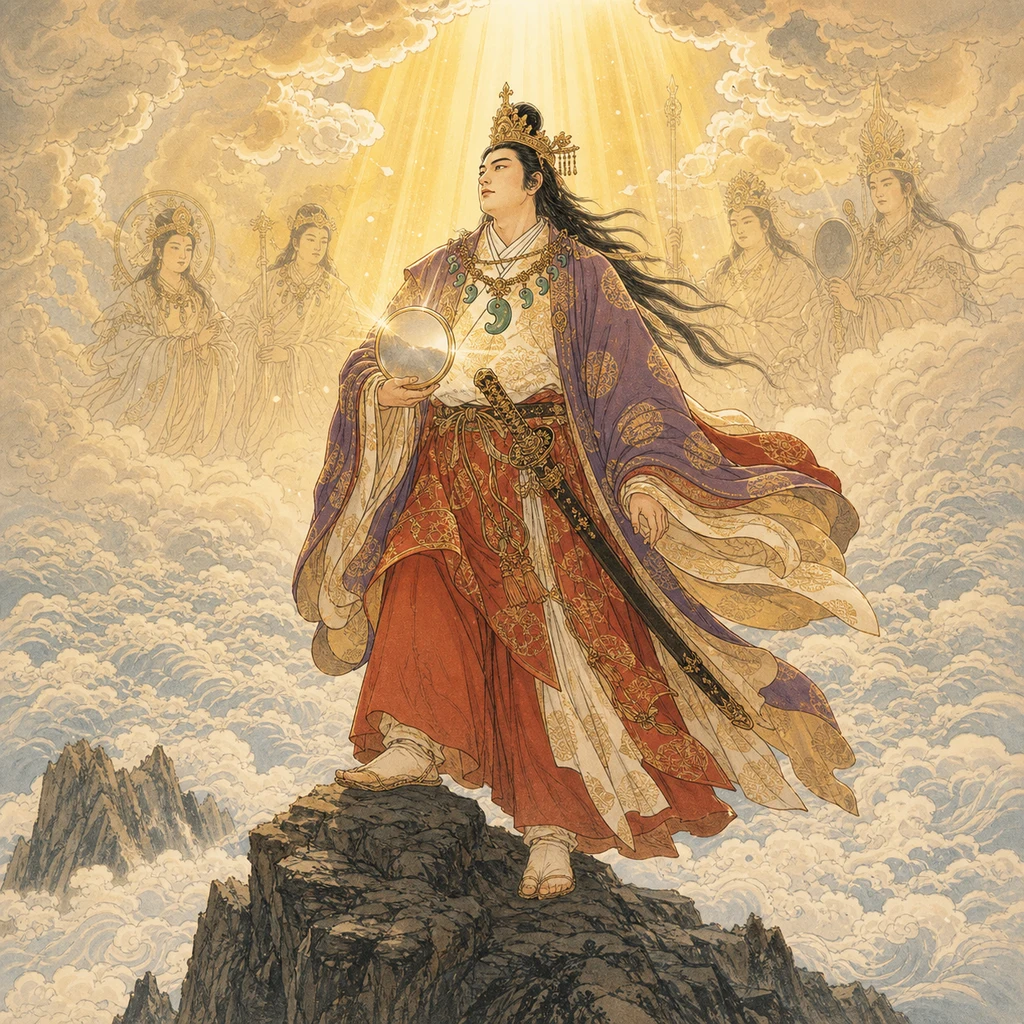
Ninigi-no-Mikoto
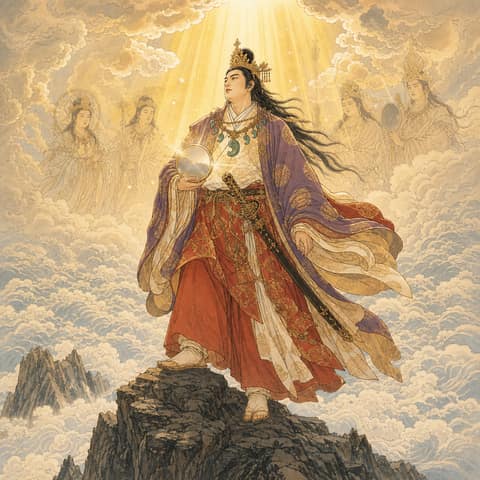
Ninigi-no-Mikoto is the central figure of the "Tenson Korin" (Descent of the Heavenly Grandson) in Japanese mythology, the founding ancestor god who descended from Takamagahara (the High Celestial Plain) to Ashihara no Nakatsukuni (the Japanese earthly realm) as the grandson of Amaterasu Omikami. In the Kojiki, he is recorded with the longest divine name in Japanese mythology, "Ame-nigishi-kuni-nigishi-amatsuhiko-hiko-ho-no-ninigi-no-mikoto," symbolizing the bountiful harvest of rice ears. Under the decree of Amaterasu, he descended to the peak of Takachiho in Hyuga, carrying the Three Sacred Treasures (the Yata no Kagami mirror, the Yasakani no Magatama jewel, and the Kusanagi sword) and leading the five pillar gods of rituals and arts (including Amenokoyane). On earth, he married Konohanasakuya-hime, the daughter of Oyamatsumi, becoming the father of Umisachi-hiko and Yamasachi-hiko, and the great-grandfather of the future Emperor Jimmu. Furthermore, the tale of his choosing Konohanasakuya-hime over the immortal Iwanaga-hime is known as the origin of why "Emperors and humans have a limited lifespan." He is an incredibly important deity who symbolizes the legitimacy of the ancient Japanese state and the roots of Japanese aesthetic consciousness.
Read moreThe descending chief god, Ninigi-no-Mikoto, received the Three Sacred Treasures (the Yata Mirror, the Yasakani Jewel, and the Kusanagi Sword) from Amaterasu, and accompanied by deities such as Ame-no-Uzume-no-Mikoto, Sarutahiko-no-Mikoto, and the five accompanying deities presiding over rituals, he descended to "Takachiho in Hyuga of Tsukushi"[1]. His divine name in the *Kojiki* is "Ame-no-Nigishikuni-Nigishiamatsuhidaka-Hikoho-no-Ninigi-no-Mikoto[1]" ── the longest divine name in Japanese mythology, interpreted as "the god who makes heaven and earth softly prosperous, flourishing like ears of rice." The core of the descent myth lay in the moment heavenly authority was transferred to the earth along with rice cultivation. The debate over whether Takachiho Town or Kirishima is the "authentic" site of the descent has continued since ancient times, but rather than a factual dispute to be settled, it is more reasonable to view it as the result of the entire Hyuga Province sharing the descent myth ── the *Kojiki* and *Nihon Shoki* only record up to "Takachiho in Hyuga," and all current identified locations belong to shrine traditions and place-name lore of later eras (we should distinguish the *Kojiki* and *Nihon Shoki* accounts as FACT and the identified locations as LEGEND).
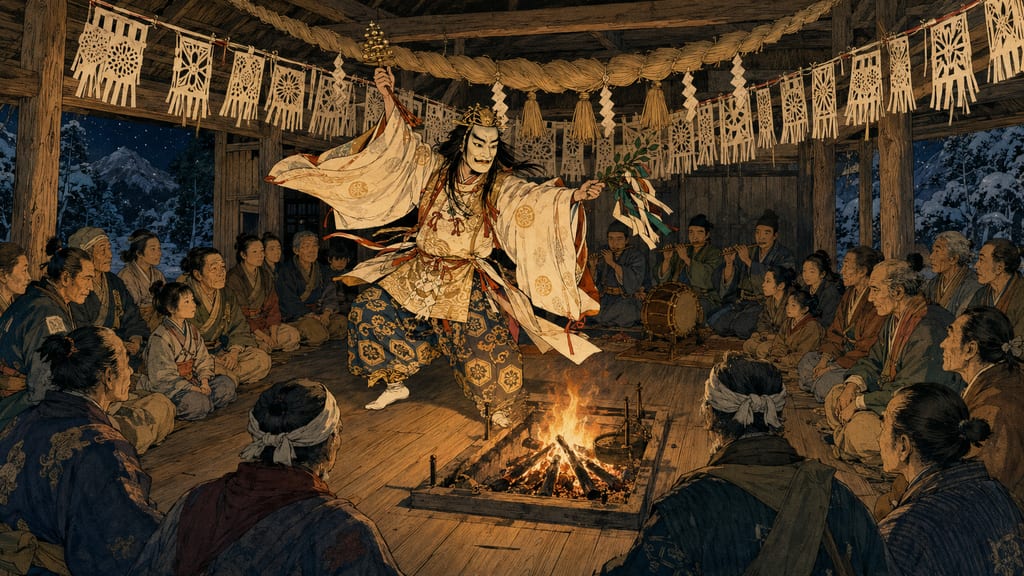
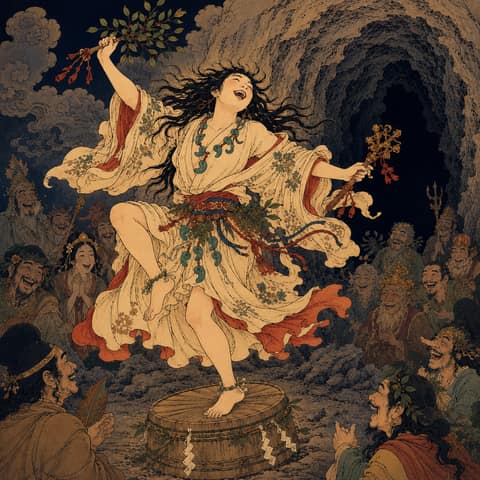
What makes one feel most strongly that the myths of Takachiho are "alive" is the Yokagura. Designated as an Important Intangible Folk Cultural Property, the Takachiho Yokagura sees about 20 villages in the town welcome their tutelary deities into private homes and dedicate thirty-three dances throughout the night from mid-November to early February every year[5]. The front room of a private house, which becomes the "Kagura-yado," is decorated as the divine stage (*kouniwa*). The dances begin with a prayer for the descent of the gods, purifying the land, and sequentially venerating the gods of fire, water, mountains, the five grains, and the sea. Deep in the night, the young men sing the Kagura *seri-uta*. The Dance of Tajikarao, the Dance of Uzume opening the rock door, and the Dance of the "Goshintai" where Izanagi and Izanami exchange cups of sake ── scenes from the Heavenly Rock Cave myth are re-enacted overnight through masks and ritual props, concluding at dawn with the "Kumo-oroshi" (bringing down the clouds) where the sacred ropes are cleared away. Kagura is not mere entertainment, but an apparatus to update the memory of the land by "re-performing" the myths every winter. At the Kagura Hall of Takachiho Shrine, four representative dances are performed publicly every night for tourists, allowing visitors to still witness the scene of the myths today.
The stage of the Heavenly Rock Cave myth itself is also located in Takachiho Town. The myth tells of Amaterasu hiding in a rock cave lamenting the violent behavior of her brother Susanoo, plunging the world into darkness ── the Amanoiwato Shrine, which enshrines that very rock door as its object of worship, and the cave of Amano Yasukawara, where it is said the myriad gods consulted, sit along the gorge of the Iwato River. Including this story of "the world turning dark once and regaining light again," which serves as the prehistory to the descent myth, Takachiho is a rare land that embodies the opening of the *Kojiki* and *Nihon Shoki* myths as geography.
Kihachi ── The Fierce Deity Calmed by Takachiho Shrine
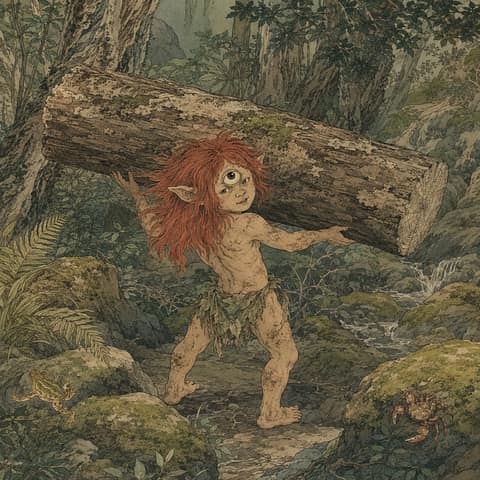
The enshrined deity of Takachiho Shrine is not only Ninigi-no-Mikoto. Mikeirino-no-Mikoto, the older brother of Emperor Jimmu, is also enshrined, and the fierce deity said to have been defeated by this Mikeirino-no-Mikoto is Kihachi[6].
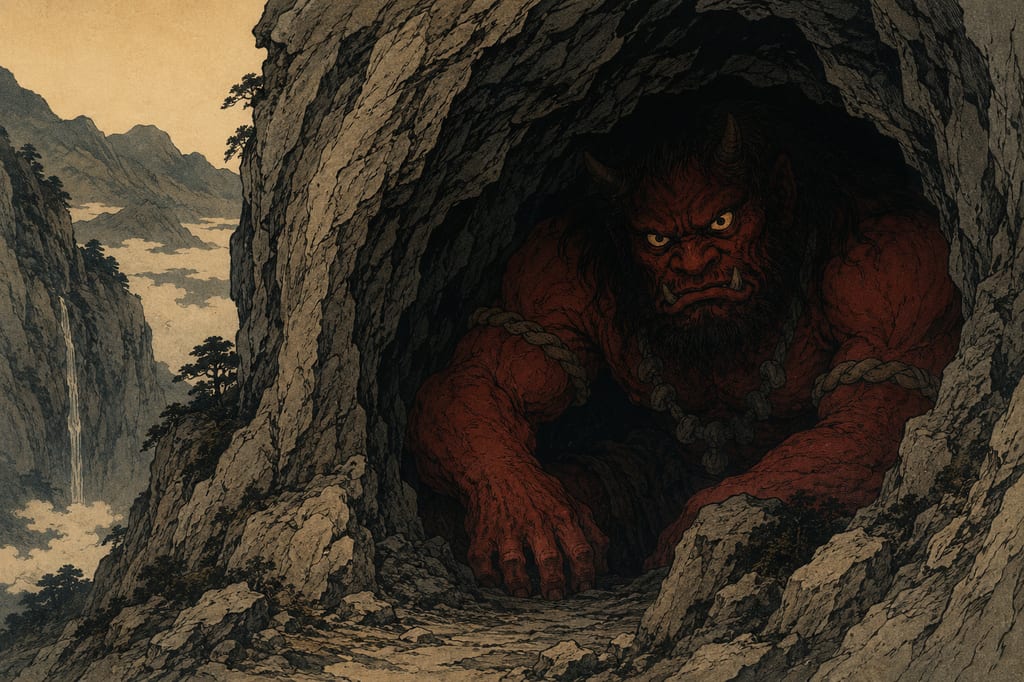
Kihachi is said to be an evil god who lived in a rock cave on Mount Futagami, kidnapped villagers, and abducted and hid Princess Unome. Mikeirino-no-Mikoto fought fiercely with Kihachi to save the princess, and to ensure he would never revive, cut his corpse into three pieces and buried them separately ── in Takachiho Town, the mounds for his head, torso, and limbs remain scattered today as the "Kihachi Mounds." Yet the curse of Kihachi was still feared, and to calm his spirit, the "Shishikake Festival" (Boar Offering Festival) has been held annually at Takachiho Shrine.
Kihachi is also connected to the lore of Aso in Kumamoto Prefecture (an oni chased by Takeiwatatsu-no-Mikoto), and is considered to be the form of a mountain god spanning Aso and Takachiho that was retold by the foreign imperial gods as a "fierce deity to be defeated." What is noteworthy is that the remains of the slashed Kihachi were divided into three and buried. Because it was feared he would curse them if buried whole, his head, torso, and limbs were sealed in separate mounds ── this conveys the idea of ancient *goryo* (vengeful spirit) beliefs, physically dividing a powerful vengeful spirit to pacify it. Kihachi, who continues to be pacified in festivals even after his defeat, vividly shows the form of a local deity incorporated into the myth of the conquerors, teaching us that right behind the lineage of the gods waits a "yokaified god of the land." Deep in the mountains of Takachiho, in Shiiba Village and the mountain villages of Mera, legends of the fleeing Heike clan and worship of mountain gods remain strong, indicating that this area is the bosom of the Kyushu mountains, conveying to the present day the "indigenous beliefs not painted over by myths."
Saito ── The Basin of the Flower Goddess and Giant Kofun
Descending the gorge of Takachiho and emerging into the basin of the Hitotsuse River, you reach Saitobaru, where ancient burial mounds spread across the plateau. The Saitobaru Kofun Cluster, with about 300 kofun, features two of the largest tombs in southern Kyushu, built in the early 5th century. Osahozuka, a 176-meter-long scallop-shaped kofun (the largest of its kind in the archipelago), and Mesahozuka, a 176-meter-long keyhole-shaped kofun (the largest in Kyushu), were designated by the Imperial Household Agency in 1895 as the reference tombs of Ninigi-no-Mikoto and Konohanasakuya-hime, respectively[7]. The actual individuals interred are considered to be the great chieftains who ruled southern Kyushu in the 5th century, and there is no historical evidence directly linking the mythical deities to the masters of the kofun. However, the very fact that they have been passed down as the "tombs of the heavenly grandson and his wife" speaks to how deeply this land has embraced the memory of the myths.
Konohanasakuyahime
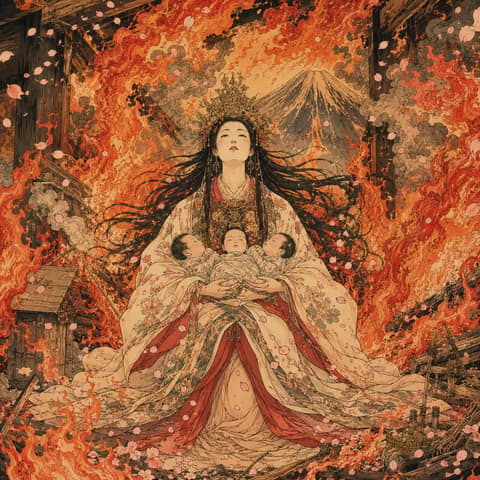
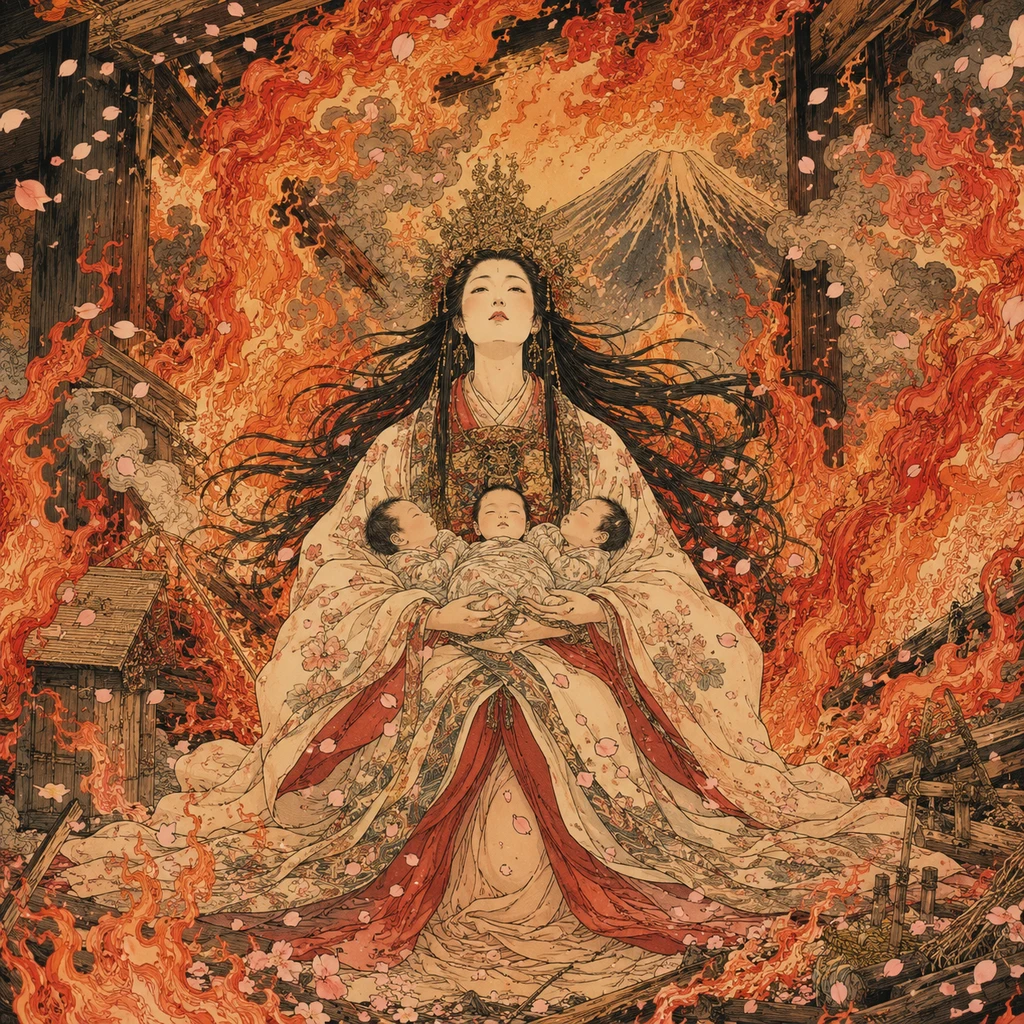
Konohanasakuyahime is a goddess who appears in the *Kojiki* and *Nihon Shoki* as the daughter of Oyamatsumi (the great mountain god) and the consort of Ninigi-no-Mikoto, the heavenly grandchild who descended to earth. Her name means "princess as beautiful as blooming tree flowers," and she is revered as the symbol of cherry blossoms. In the *Kojiki*, she is also known as Kamu-atatsu-hime. When Ninigi-no-Mikoto proposed to her, her father offered both her and her older sister, Iwanagahime (Princess of Eternal Rocks). However, Ninigi-no-Mikoto chose only the beautiful Konohanasakuyahime and sent back the ugly older sister. Because of this, it is said that the descendants of the heavenly grandchild (meaning humans) would flourish beautifully like cherry blossoms but would inevitably fall, thus gaining a finite lifespan. When Konohanasakuyahime became pregnant after just one night, Ninigi-no-Mikoto suspected her of infidelity. To prove her purity, she set fire to her delivery hut and safely gave birth to three deities—Hoderi (Umisachihiko), Hosuseri, and Hoori (Yamasachihiko)—amidst the roaring flames, an event known as her birth-in-fire. Originating from this myth of surviving the flames to give birth, she is worshipped as the goddess of safe childbirth, fire prevention, and bountiful harvests. She is also the primary deity of approximately 1,300 Asama Shrines across Japan, which venerate Mount Fuji as their sacred object of worship. Toman Shrine in Hyuga Province (present-day Miyazaki Prefecture) is an ancient shrine dedicated to her, and the local place name "Tsuma" (Wife) is said to originate from the site where she met and married Ninigi-no-Mikoto.
Read moreThe deity enshrined at Toman Shrine in Saito City is Konohanasakuya-hime, considered the master of that Mesahozuka[8]. According to shrine tradition, when the descended Ninigi-no-Mikoto met Konohanasakuya-hime here and told her, "I want to make you my wife," the area came to be called "Tsuma" (wife) ── the place name itself derives from the mythological marriage. The name Konohanasakuya-hime means "the princess as beautiful as the blossoming of tree flowers (cherry blossoms)," and she is a goddess embodying the peak and transience of cherry blossoms[9].
This goddess is associated with two myths that touch the roots of the Japanese view of life and death. One is the origin tale of the human lifespan. When Ninigi-no-Mikoto proposed, her father, Oyamatsumi-no-Kami, presented both her and her older sister Iwanaga-hime[10] together, but Ninigi-no-Mikoto returned the ugly older sister and married only the beautiful younger sister. Because he rejected the older sister, who symbolized eternal life like a rock, the descendants of the heavenly grandson ── meaning humans ── were burdened with a finite life that blooms and scatters like a flower. The other is her giving birth in fire. Konohanasakuya-hime, who became pregnant after a single night's union, was suspected of infidelity by her husband. She set fire to a delivery room with no doors and safely gave birth to three deities, Hoderi-no-Mikoto (Umisachihiko), Hosuseri-no-Mikoto, and Hoori-no-Mikoto (Yamasachihiko) in the blazing flames, proving her innocence[9]. Through this childbirth surviving the peril of fire, she became the goddess of safe childbirth and protection from fire, eventually linking to the Sengen faith of Mount Fuji in anticipation of her power to calm eruptions, expanding her sphere of worship to become the primary enshrined deity of approximately 1,300 Sengen shrines nationwide[10]. The goddess of the mountains and flowers of Hyuga became the guardian deity of Japan's greatest sacred peak ── the distant starting point of that journey is this basin in Saito.
Furthermore, a monument marking the "birthplace of Japanese sake" stands in the precincts of Toman Shrine. It is based on the tradition that Konohanasakuya-hime brewed sweet sake and fed it to the three princes as a substitute for breast milk. The narrative unique to this land, that the mother goddess of mythology is also the god of the origin of sake, breathes here.
Hyuga-nada ── The Shores Where Umisachi and Yamasachi Parted Fates
Heading south from Saito, following the coastline of Hyuga-nada. The second act of Miyazaki's myths is the story of the brothers born in the flames by Konohanasakuya-hime, Umisachihiko and Yamasachihiko. One day, the older brother who gathered the bounty of the sea and the younger brother who gathered the bounty of the mountains exchanged their tools, setting in motion the most famous sibling tale in Japanese mythology[11].
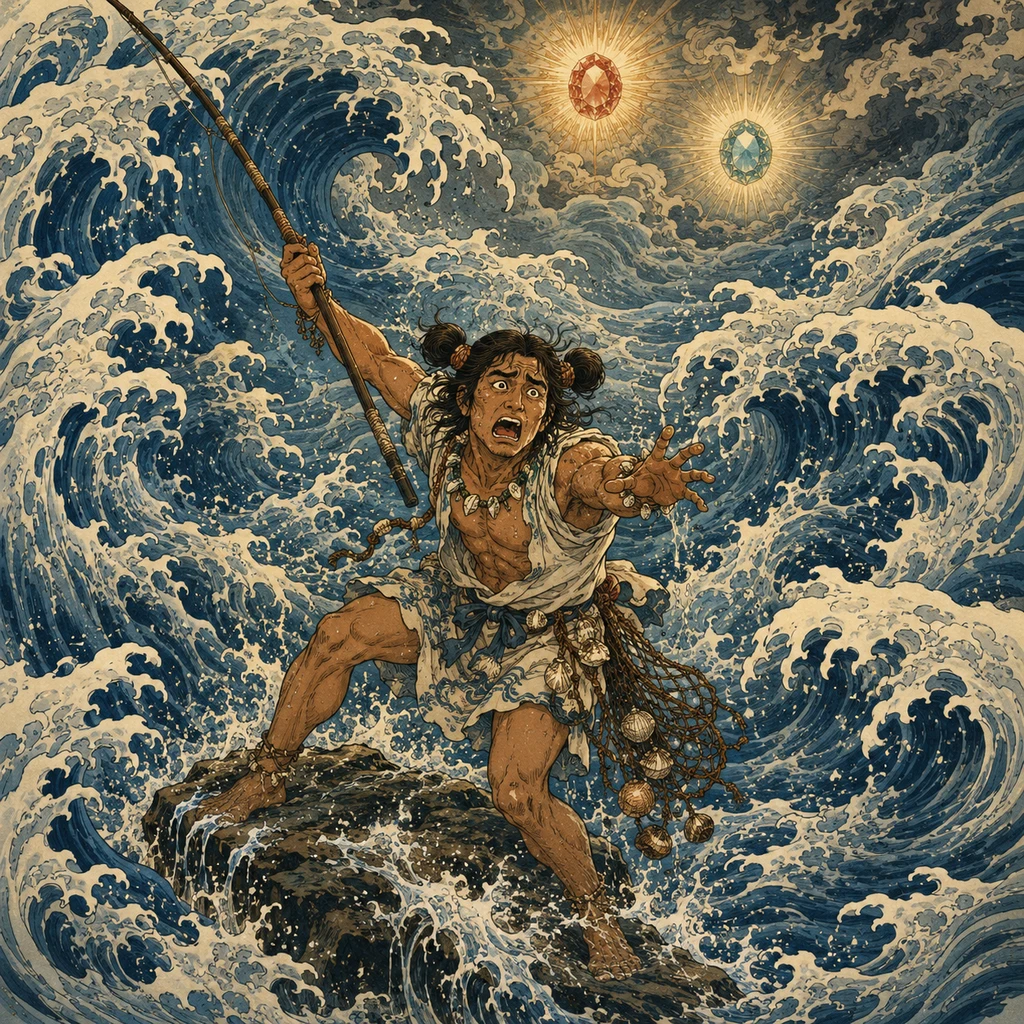
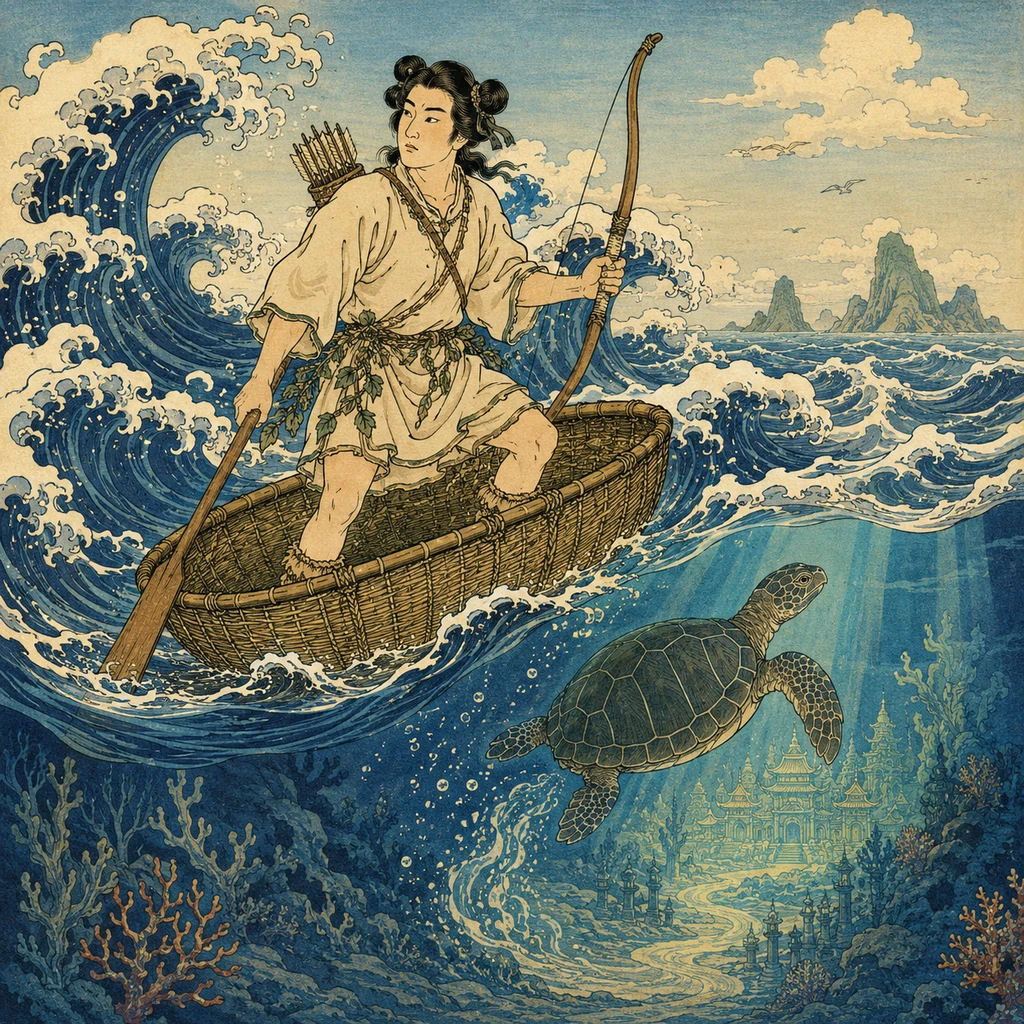
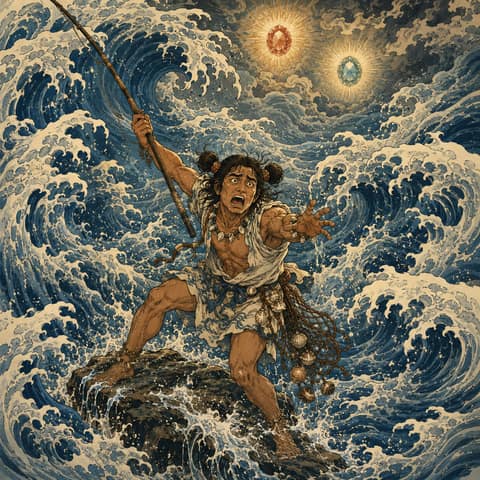
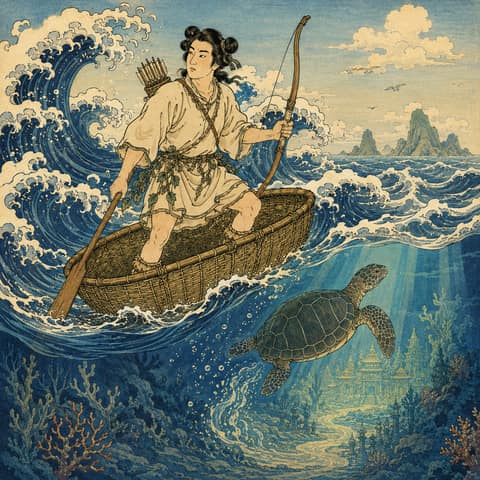
The younger brother, Yamasachihiko, lost the borrowed fishhook in the sea, and the older brother, Umisachihiko, stubbornly refused to forgive him, insisting, "Return the original fishhook, I will not accept a different hook[12]." Yamasachihiko made a thousand substitute hooks but was still rejected, and wept on the beach at a loss. Then, Shiotsuchi-no-Kami appeared and placed him in a tightly woven basket without gaps, delivering him to the palace of the sea god, Watatsumi-no-Okami. At the sea palace, Yamasachihiko met and married the sea god's daughter, Toyotama-hime, and spent three years there[13]. Eventually, for Yamasachihiko, who was overcome with homesickness, the sea god found the lost fishhook from the throat of a sea bream, and further bestowed upon him two magical pearls, the Shiomitsu-tama and Shiofuru-tama, which controlled the ebb and flow of the tide[14].
Returning to land, Yamasachihiko gave the fishhook back to his brother with words of a curse. Thereafter, as Umisachihiko became impoverished and attacked, Yamasachihiko used the Shiomitsu-tama to raise the tide and drown him, and the Shiofuru-tama to recede the tide and save him ── repeating this to force his submission. The defeated older brother, Umisachihiko, swore to serve his younger brother for eternity, and his flailing gestures of drowning are said to be the origin of the later court ritual, the Hayatomai dance[15].
This sibling tale is not just a myth. Yamasachihiko (Hoori-no-Mikoto) is the grandfather of the first Emperor Jimmu through his child Ugayafukiaezu-no-Mikoto, positioned as a direct ancestor of the imperial line[16]. On the other hand, the older brother Umisachihiko is considered the ancestral deity of the Hayato people who lived in southern Kyushu[17]. In other words, the asymmetry of "victorious younger brother = imperial line" and "defeated older brother = frontier Hayato" forms the framework of this story. Academically, it is interpreted that the history of the ritsuryo state of the 7th and 8th centuries subjugating the Hayato of Satsuma, Osumi, and southern Hyuga was translated into the form of the myth of the brothers' victory and defeat. While the myth cannot be taken at face value as historical fact, it is certain that the myth harbors the political memory of "who rules whom."
This sea palace tale continues with another unforgettable scene. Toyotama-hime, who was to give birth on land, asked her husband Yamasachihiko, "Please do not look into the delivery room," but Yamasachihiko broke the taboo and looked, seeing the true form of his wife writhing as a Yahiro-wani (a giant crocodile, or dragon in the Nihon Shoki). Toyotama-hime, ashamed of being seen, returned to the sea and never came back. The left-behind divine child, Ugayafukiaezu-no-Mikoto, was raised by Toyotama-hime's younger sister, Tamayori-hime. This myth of losing a wife because of breaking a "do not look" taboo has been repeatedly discussed in folklore studies as the archetype of later inter-species marriage tales like the Crane's Return of a Favor. At Udo Shrine in Nichinan City, there is the "Ochichi-iwa" (Breast Rock), which Toyotama-hime is said to have attached to the rock to nourish her child as she returned to the sea, and the "Ochichi-ame" candy made from the water dripping from it is still known today as a holy token ── the sad parting of the myth has been transformed and passed down as prayers for breast milk and safe childbirth.
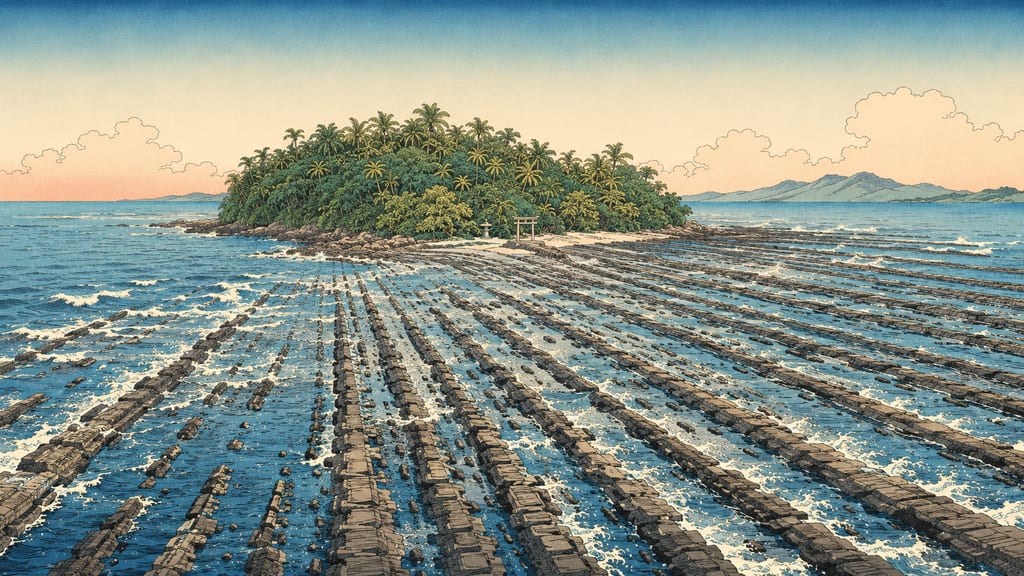
The asymmetry concerning the brothers appears exactly as it is in the scale of the shrines that venerate them. The imperial ancestor Yamasachihiko (Hikohohodemi-no-Mikoto) is enshrined in multiple grand shrines, such as Udo Shrine, which has its main hall in a rock cave on a coastal cliff, and Aoshima Shrine in Miyazaki City[18]. Aoshima Shrine, in particular, is transmitted as the place where Yamasachihiko landed from the sea palace, and the entire island, with a circumference of 1.5 kilometers, constitutes the precincts[18]. The strange rocks surrounding the island ── the "Demon's Washboard" (uplifted sea bed and deformed wave-cut marks), where alternating layers of sandstone and mudstone have been carved by the waves and arranged like a washboard, are the Miyazaki Group strata from about 24 million to 2 million years ago that were uplifted and exposed, and were designated as a national natural monument in 1934[18]. The shore of the myth where Yamasachihiko returned from the sea god's palace directly overlaps with the natural monument of geology ── a landscape unique to Miyazaki where myth and science meet on the same beach.
In contrast, there is only one shrine nationwide that holds the defeated Umisachihiko as its primary enshrined deity. That is the Ushiodake Shrine in Kitago-cho, Nichinan City[19], said to be enshrined in the place where Umisachihiko arrived after being defeated in the battle with his brother[19]. The victor in three grand shrines, the loser in one ── the scale of the rites itself reflects the structure of dominance and submission in the myth. The names of the brothers, Umisachihiko's name "Hoderi," Yamasachihiko's name "Hoori," and the middle child's "Hosuseri," all bearing "Ho" (fire), originate from the fire birth where their mother Konohanasakuya-hime bore the three in the flames, and are read as inscribing the three stages of the fire's momentum in the brothers' names: Hoderi (blazing) → Hosuseri (peak) → Hoori (subsiding). Sea and mountain, victor and loser, blazing fire and subsiding fire ── multiple layers of contrast woven into a single pair of brothers is the depth of this story. Recently, however, there is an academic movement to reinterpret this "story of the loser" from the perspective of the center (the victor) and re-evaluate it from the side of the Hayato (the frontier). The fact that the ancestral deity of the conquered side has continued to be enshrined for more than a millennium, even if only at a single shrine, speaks volumes about the multi-layered nature of the land of Hyuga.
The Waters of Hyuga ── The Kappa Hyosunbo and Water God Beliefs
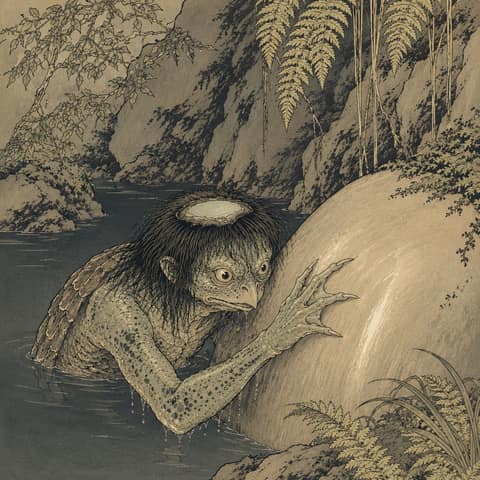
If the lineage of the gods is the main street of Miyazaki's myths, a much more earthy kind of strange being dwells in the waters of its back alleys. It is a type of kappa transmitted mainly in the Hyuga region and southern Kyushu, the hyosunbo (or hyosubo)[20].
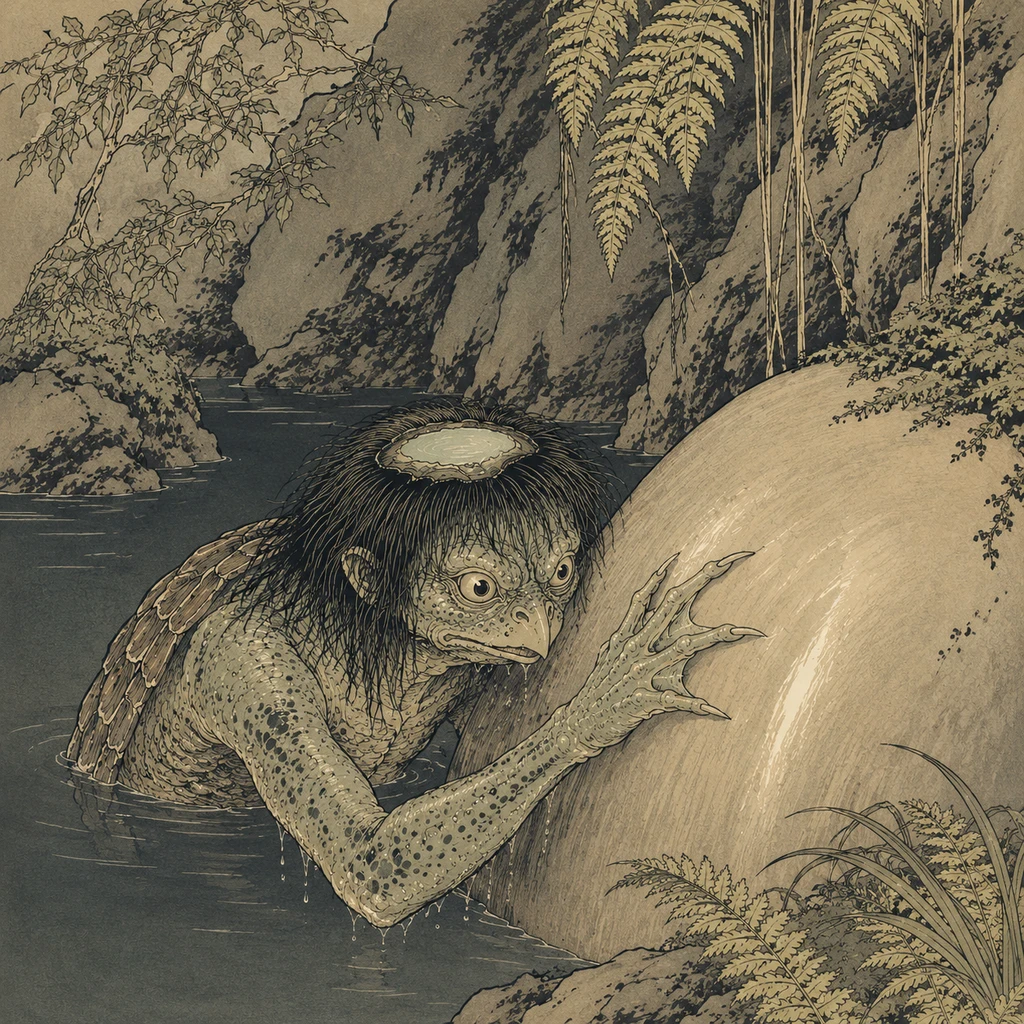
Hyousunbo
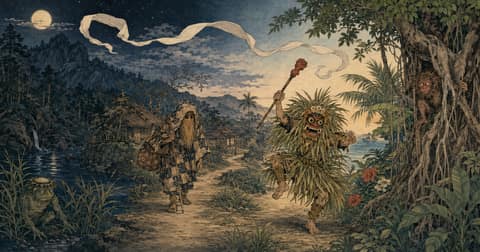
Hyousunbo is a type of kappa transmitted primarily in the Hyuga region of Miyazaki Prefecture and across southern Kyushu. Its name is said to derive from the "hyoi, hyoi" sound it makes while swimming in the water, and it corresponds to the "hyosube" dialectal family used to refer to kappa throughout Kyushu. It lived near the water and was feared as a malicious trickster that dragged children swimming in the river to their deaths. Legend says it lived in the Shiiya River flowing through the Warabi district of Togo-cho in Hyuga City, and is famous for making a promise with the villagers: "I will not take the lives of the river's children until a certain rock rots away completely." The hyousunbo touched the rock so many times to check its decay that the rock became smooth and polished as if rubbed, earning it the name "Hyosubo Rock" (later buried during river improvement works). This folklore is accompanied by the belief in seasonal migration—living in the river from spring to autumn and moving to the mountains in winter—and it is said that sumo matches dedicated to the water god were held every year at the Suijin-buchi (Water God's Abyss) of the Tsuboya River. Among the southern Kyushu lineage that calls kappa "garappa" or "kawantaro," the hyousunbo is a water apparition unique to Hyuga, possessing specific legends of a promise and a rock.
Read moreThe name is said to derive from the "hyoi, hyoi" sound it makes while swimming in the water[20]. Kappa are called variously in Kyushu, such as hyosube, garappa, and kawantaro, and hyosunbo is the Hyuga dialect form of these. That they were feared as mischief-makers who lurk in the water and drown swimming children is no different from kappa nationwide. However, the hyosunbo of Hyuga have delicate traditions unique to this land.
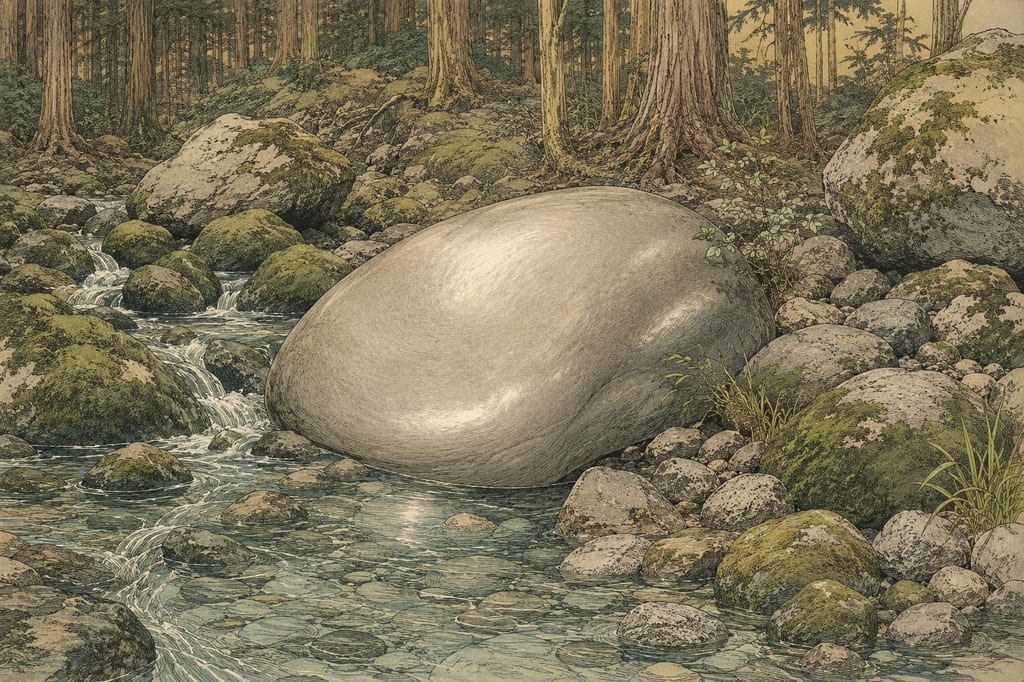
In the Shiiya River flowing through the Warabi district of Togo Town, Hyuga City, it was feared that a hyosunbo who drowned children lived[20]. The troubled villagers made a promise with this kappa: "I will not take a child's life until a certain rock by the river rots away." The hyosunbo dutifully touched the rock with its hands countless times to see if it had rotted yet. Stroked over many years, the rock became as smooth as if it had been polished, and the villagers called it the "Hyosubo Rock" (regrettably, it is said to have been buried by later river renovations). A contract exchanged between humans and yokai, and a single rock as proof of it ── a modest, localized tale of negotiation with a water god, in stark contrast to the grand lineage of the gods.
It was also believed that the hyosunbo moved back and forth between the mountains and the rivers via waterways, staying in the river from spring to autumn, and moving to the mountain in winter[20]. This links to the belief in southern Kyushu that sees the kappa as a water god/mountain god that changes form and migrates with the seasons. At the "Suijin-buchi" (Water God Pool) of the neighboring Tsuboya River, it is also said that sumo matches dedicated to the water god were held every year ── an instance where the nationwide concept that kappa love sumo overlapped with the local ritual of comforting the water god with sumo. While standing in the lineage of southern Kyushu kappa like the garappa of the Sendai River in Kagoshima and the Kawantaro of Hitoyoshi in Kumamoto, the hyosunbo possesses details unique to Hyuga: the name crying "hyoi," the promise of the Hyosubo Rock, and the dedicatory sumo of the Tsuboya River. In a corner of the land of myths, such water monsters have quietly played the role of "yokai-like yokai."
The Yokai of the Land of Myths ── In Conclusion
Miyazaki Prefecture's yokai culture flows divided into two layers. One is the pantheon of the *Kojiki* and *Nihon Shoki* myths ── Ninigi-no-Mikoto who descended to Takachiho, Konohanasakuya-hime who sleeps in Saito, and Umisachihiko and Yamasachihiko who parted fates in the Hyuga-nada Sea. They are deities clearly documented in the *Kojiki* and *Nihon Shoki* (this is FACT), and the sites identified as their places of descent, marriage, and tombs, such as Mount Takachiho, Toman Shrine, the Saitobaru Kofun Cluster, Aoshima, and Ushiodake, are all sacred sites supported by shrine traditions and place-name lore of later eras (we want to distinguish these as LEGEND). The other layer consists of the local strange beings living at the feet of those myths ── the fierce deity Kihachi, who continues to be calmed in festivals even after being defeated, and the kappa hyosunbo, who carved a promise into a river rock.
The protagonists of the myths that tell the origin of the country and the kappa that threaten children by the village watersides coexist in the same memory of the "Land of Hyuga" ── this is the core of Miyazaki's yokai culture. While the neighboring Kagoshima Prefecture (Satsuma and Osumi), which is the other legendary site of the heavenly descent, strongly retains the memory from the side of the conquered Hayato people, Miyazaki is a land that has prominently displayed the "myth of the victors" as the starting point of the imperial line. Yet, the fact that the defeated Kihachi and the hyosunbo who dutifully keeps his promise have continued to be passed down without fading allows us to hear the indigenous voices that could not be completely painted over by the myth.
Precisely because it is the land where the gods descended, fierce deities and water monsters continue to be passed down as the shadow of that myth, and in the masks of the Yokagura, in the silence of the Saitobaru Kofun Cluster, on the shores of Aoshima, and in the touch of the "Hyosubo Rock" by the river, the yokai of Miyazaki continue to live on today. By not mistaking myth for historical fact, yet carefully unraveling the memories of the land that the myths have embraced, the land of Hyuga will reveal its richest face.