Umisachihiko
うみさちひこ
Elder Brother of Sea Bounties & Hayato Ancestor, Umisachihiko
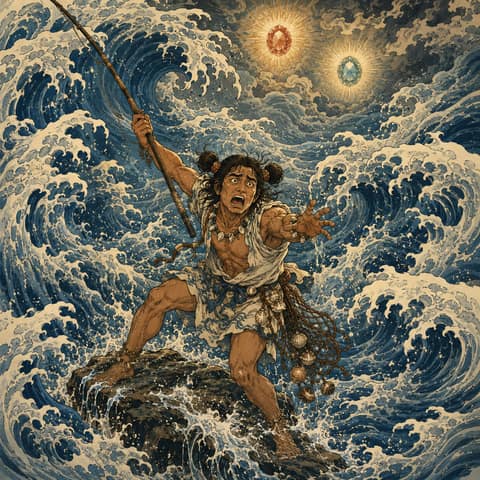
The true identity of Umisachihiko is Hoderi-no-Mikoto, the protagonist of the final section of the upper volume of the Kojiki and the tenth section of the Age of the Gods in the Nihon Shoki (also known as Honosusori-no-Mikoto in the Nihon Shoki). Born in a fire, he is the eldest of three sons of Ninigi-no-Mikoto (the Heavenly Grandson) and Konohanasakuya-hime (daughter of Oyamatsumi-no-Kami). The middle son is Hosuseri-no-Mikoto, and the youngest is Hoori-no-Mikoto (Yamasachihiko). The prefix "Ho" (fire) in all three names stems from the myth that their mother gave birth in a blazing delivery room to prove her purity after a single night's conception. The name "Hoderi" means the most intense stage of fire, while "Honosusori" similarly implies the height of flames. The common name "Umisachihiko" is an occupational title meaning "the male deity who presides over the bounties of the sea," indicating his role as a god of fishing. The core of his story lies in his position as the older brother in the myth of Umisachihiko and Yamasachihiko. Umisachihiko presided over the sea's fish, while Yamasachihiko presided over the mountain's game, each making a living with their respective tools. One day, Yamasachihiko exchanged tools with his brother and went to the sea, but lost the fishhook. The older brother strictly refused, saying, "Return the original fishhook, I will not accept any other," and even rejected a thousand replacement hooks. Yamasachihiko then went to the sea palace of Watatsumi, received the tide-flowing and tide-ebbing jewels, and returned to hand back the hook while chanting a curse. Thereafter, Umisachihiko gradually became impoverished. Holding a grudge, he attacked Yamasachihiko, but Yamasachihiko used the tide-flowing jewel to drown him, then used the tide-ebbing jewel to save him when he begged for his life. By repeating this, he forced Umisachihiko into submission. Umisachihiko finally swore to serve Yamasachihiko eternally as a "person of wazaogi" (entertainer). It is one of the most dramatic sibling tales in the Kojiki and Nihon Shoki, epitomizing ancient curse culture, divine manifestations, and submission rituals. Umisachihiko is positioned as the ancestral deity of the Hayato people in southern Kyushu. The Hayato were indigenous people living in ancient Satsuma, Osumi, and southern Hyuga, who served the court as guards, ritualists, and performers under the Ritsuryo system. The myth of his submission created a decisive asymmetrical structure: Yamasachihiko became the grandfather of Emperor Jimmu (the direct ancestor of the imperial line), while Umisachihiko became the ancestor of the subjugated border people. This is academically interpreted as the political mythologization of the 7th-8th century Ritsuryo state's subjugation of southern Kyushu. The "Ashiura" gestures Umisachihiko made while drowning—rubbing his feet, chest, and cheeks—are said to be the origin of the Hayato-mai, a court ritual. The Hayato-mai was a dance performed by the Hayato for the emperor during the Daijosai, Niinamesai, and New Year ceremonies. The Engishiki records its movements, which are partially inherited by the modern Imperial Household Agency. Thus, his submission myth functioned as the mythological basis for ancient Japanese court rituals. The center of his worship is Ushiodake Shrine (Kitago, Nichinan City, Miyazaki), the only shrine nationwide where he is enshrined as the primary deity. It is said to be located where he arrived after losing to his brother, symbolizing the localization of his legend. The fact that the shrine is located in the mountains, away from the sea, reflects the folklore interpretation of Umisachihiko being "driven into the mountains as a loser" and the geographic distribution of Hayato clans. The asymmetry between Yamasachihiko being enshrined in three major shrines and Umisachihiko in only one vividly reflects the myth's dominance/submission structure in shrine worship. In folk belief, he is deeply worshipped as a local guardian of fishing, maritime transport, and Hayato-lineage clans, especially in southern Miyazaki and Kagoshima. Modern discussions re-evaluate his "tale of the loser," deconstructing the central vs. border dichotomy. In pop culture, he frequently appears alongside his brother as the tragic older brother.