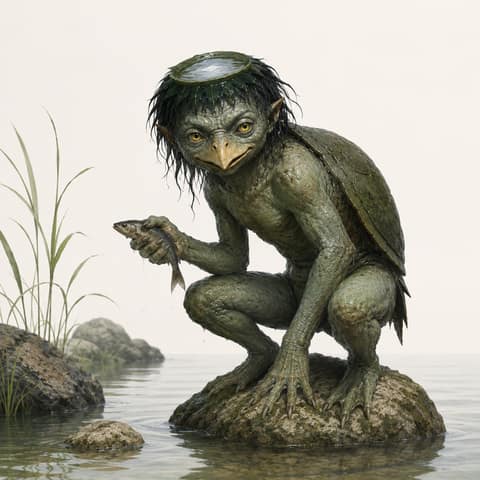
The *Yamawaro* (Mountain Child) is a mountain monster, sometimes said to have one eye and one leg, passed down as dwelling in the mountains of Kyushu. Terajima Ryoan's *Wakan Sansai Zue* (1712)[1] records that *Yamawaro* exist in Chikuzen Province (Fukuoka Prefecture) and the Goto Islands[1], describing them as resembling humans with round faces, long red hair covering their eyes, pointed dog-like ears, and a single eye on their nose. Said to be about the height of a ten-year-old child, they appear in mountain huts to steal salt and are fond of eating crabs and frogs. While they help with woodcutting and charcoal-making, demanding sake or rice balls in return, they are also known for their mischievous nature—challenging people to sumo wrestling, playing tricks on livestock, and entering baths without permission. The tradition that kappa move to the mountains and transform into Yamawaro[2] is widely distributed across Kyushu.
In the Goto Islands, just as the *Wakan Sansai Zue* early recorded their habitation, the image of the *Yamawaro* as a mountain monster and the *kappa* (*gataro*) of the seaside and rivers have been spoken of as a continuum. The *Yamawaro* is said to let out a high-pitched whistle in the mountains, inviting people to sumo and stealing the vitality of the loser, but conversely, is also told of as a protector of mountain work[3]. Its one-eyed, one-legged grotesque form is superimposed on the *Shansei* (mountain spirits) imported from China and the *Ippon-datara* of Kii and Shikoku, positioning it as a mountain monster of the western provinces in early modern natural history and yokai knowledge. The belief in the *Yamawaro*, which is two sides of the same coin with the *kappa*, reflects the mindset of people who feared the waterside and the mountains as a continuous sacred land.
Kunio Yanagita recorded this coming and going of *kappa* and *Yamawaro* in his *Santo Mintan-shu* (Collection of Mountain and Island Folktales) as the "Migration of the Kappa" [4]. It is considered a remnant of an ancient belief that the god of the river and the god of the mountain change their forms with the seasons. The *Yamawaro* is said to make a strange sound like falling trees (Tengu-daoshi), and mimic human singing or the sounds of work; there is also folklore that if you build a house on their path, they will get angry and poke holes in the walls. They are called by various regional names such as Yamanbo, Yamantaro, Seko, and Kashanbo, blending their image with other small mountain yokai.
While the *Yamawaro* is a mountain monster unique to the mountainous regions of Kyushu, its greatest originality lies in the fact that it forms two aspects of a single body with the *kappa*. The fact that Terajima Ryoan noted the habitation of *Yamawaro* in Chikuzen and Goto in *Wakan Sansai Zue*[1] is evidence that early modern intellectuals incorporated the folklore of grotesque beings from the western mountains into the framework of natural history, showing that the Goto Islands were designated early on as a land of *Yamawaro* traditions.
In the migration belief, it is said that the *kappa* of the river and the *Yamawaro* of the mountain switch places at the boundary of the spring and autumn equinoxes[2], which is thought to be a crystallization of the agricultural calendar, water god worship, and mountain god worship into a single existential image. Its assistance to woodcutters and the reward of rice balls, its love of sumo, its dietary preference for salt and crabs, and its grotesque form with dog ears, red hair, and a single eye are all supported by the *Wakan Sansai Zue*[1] and the oral traditions of various parts of Kyushu. Amidst life in the Goto Islands, surrounded by sea and mountains, the *Yamawaro* has become inextricably linked to the *kappa* (*gataro*), becoming an entity that embodies the local spirituality penetrating both the waterside and the mountains.
Character Profile
This section is our own creative profile for storytelling. It is not historical fact or scholarship.
Mischievous and capricious. Loves sumo wrestling, and while it helps woodcutters, it curses those who break their promises. A seasonal spirit that travels back and forth between the mountains and rivers every equinox.
Compatibility
河童(ガラッパ・ガータロー)と表裏一体。山精や一本だたらと一つ目・一本足の像を共有する。
Abilities
Superhuman sumo strengthTransformation migrating between mountains and rivers at the equinoxesAssistance with woodcutting workPossession of humans
Weaknesses
Loses power if the water in the dish on its head (a remnant of its kappa phase) dries up. Obeys if made to keep a promise.
Habitat
The mountains of the Kyushu mountainous region (Chikuzen, Goto Islands, Higo, Hyuga), and by the rivers during the equinoxes.
The diagram below is a diagnostic evaluation chart for The Mountain Child of Kyushu Migrating Between Mountains and Rivers: Yamawaro. The higher the value of each item, the stronger that characteristic is expressed.