Iso-onna
iso-onna
Iso-onna, the Shore Woman Who Climbs a Mooring Line
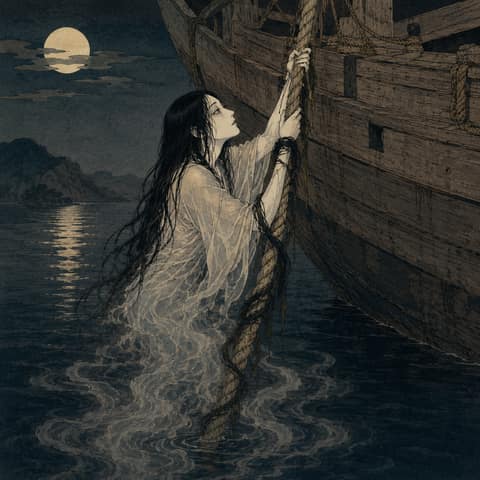
Iso-onna is a female sea apparition of northwestern Kyūshū. Above the waist she looks like a young woman with long black hair soaked in seawater. Below it, her outline dissolves into mist and waves without leaving footprints, or else lengthens into a serpent's body. Seen from behind, she can be mistaken for a wet rock. In Minamishimabara, Nagasaki, she stands gazing offshore; anyone who speaks to her is answered with a piercing cry, then caught in her hair and drained of blood. Her most feared habit is boarding vessels at anchor. In Amakusa, Kumamoto, Iso-onna climbs a stern mooring line after dark and covers a sleeping person's face with her hair. Boats spending the night in an unfamiliar harbor therefore lower the anchor but leave the stern untied from shore. The very line joining boat and land becomes her path aboard. Other safeguards survive around the region. On the Shimabara Peninsula, three stems pulled from a thatched covering were laid on a person's clothing before sleep so that Iso-onna's hair could not catch them. The Sōgō Nihon Minzoku Goi, edited under the supervision of Yanagita Kunio, records this coastal female apparition under names including Iso-onna and Iso-nyōbō. Iso-onna differs from Umibōzu and Funayūrei, which more often attack in open water. Her defining territory is the rocky shore or anchorage, where land and sea touch. Many communities connect her with drowned women or with a woman who died while waiting for her husband to return. In western Japan, she may also appear beside Ushi-oni, approaching first to lower a victim's guard before the other creature attacks. Hair, blood, and the shoreline boundary form the core of her image. The story of her climbing a mooring line, and the practical customs of anchoring without tying the stern or placing three reeds on one's clothing, preserve both a fishing village's fear of the night sea and its knowledge of how to live beside it.