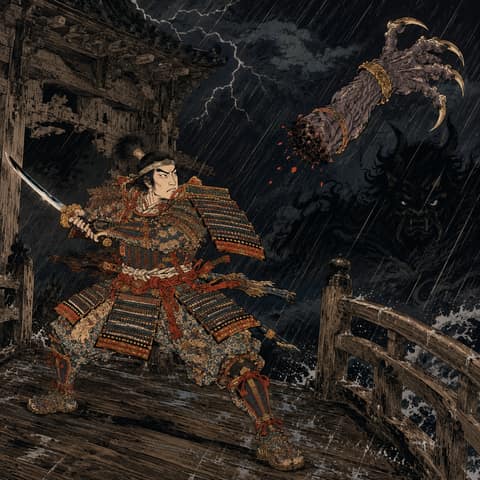
Watanabe no Tsuna
watanabe-no-tsuna
The Warrior Who Severed the Demon Arm of Rashomon: Watanabe no Tsuna
In this version, we read Watanabe no Tsuna as "the boundary warrior who severed the demon's arm." What etched Tsuna's name most strongly in history is the story of him encountering a demon at Rashomon or Ichijo Modoribashi and cutting off its arm. It is no coincidence that the location is a gate or a bridge. A gate divides the inside and outside of the capital, and a bridge connects this shore and the other shore. The demon appears precisely at that boundary. Tsuna's bravery does not completely erase the demon with a single stroke. He can sever the arm, but the demon itself escapes. The remaining arm is both a trophy and evidence that the anomaly has not yet ended. Here lies the fascination of the demon arm tale. The severed arm enters the mansion as an object and is placed under human management, but the demon returns to the human world to take it back. The revisit by the demon disguised as an old woman reveals Tsuna's weakness. He is excellent in martial force, but he finds it hard to lose courtesy toward an opponent taking the form of a relative. The demon strikes at that point. In yokai subjugation tales, the insight to see through anomalies is just as important as martial power. While Tsuna succeeded in cutting the arm, he cannot completely fend off the disguised demon. This imperfection makes him a human-like hero. As one of Yorimitsu's Four Heavenly Kings, Tsuna also occupies an important position in the Mt. Oe subjugation. In his solitary tale, he slashes the boundary demon; in the group tale, he heads for Shuten-doji under Yorimitsu's command. In other words, Tsuna is the figure who connects individual bravery with team demon subjugation. His blade participates in both one-on-one anomaly events and grand subjugation narratives. This version of Tsuna stands between victory and letting the enemy escape. The scene of cutting the demon arm is vivid, but the development of the demon reclaiming the arm shows that anomalies cannot be simply sealed away. Even if the monster is slashed at the boundary, the monster returns inside the house, into the form of a relative, into memories. Watanabe no Tsuna's story simultaneously tells of the exhilaration of demon subjugation and the tenacity with which demons still infiltrate the human world. The demon arm is an object that has crossed boundaries. The moment it is detached from the demon's body, it remains a part of the otherworld while being kept in a human mansion. Tsuna holds the arm as proof of victory, but that arm also serves as a beacon for the demon to return. The trophy is simultaneously a cursed object. The demon disguised as an old woman attacks Tsuna's humanity. A warrior is strong against demons, but cannot discard courtesy toward relatives. Here the story shifts from a contest of strength to a contest of perception. If he knows it is a demon, he can slash it. But when the demon borrows a family member's face, a person cannot easily swing a blade. This version of Tsuna is not a flawless subjugator, but a hero who wins at the boundary and wavers inside the house. That is exactly why the folklore gains depth. Demon subjugation does not end outside; it starts over once back in daily life because of what was brought back, the person trusted, and the seal that was opened. Tsuna's charm lies in his nature as a warrior that includes this wavering. If he were simply strong, the ghost story would end quickly. But he is strong, and at the same time, deceived. Therefore, the story moves from a single stroke of the sword to a conversation in the mansion, deepening from external demon subjugation to internal suspicion. That lingering resonance keeps Tsuna's martial valor from being just a simple victory tale.