From Bird Name to Monster
The name Nue is older than the monster in Yorimasa’s slaying tale. The Yachihoko-no-kami song in Book One of the Kojiki, with its line “On the green mountain, the nue cries,”[1] sets a scene of a nue calling on a green mountain. It is not a monster assembled from monkey, tanuki, tiger, and snake, but a calling bird. Although it is often identified today with White’s thrush, the ancient poetic word and the later composite beast are easier to understand as separate layers that share a name.
Medieval stories in which Yorimasa shoots a Nue already take different forms. In section 10-56 of Book Ten of Jikkinshō[2], Yorimasa judges the Nue calling in Emperor Takakura’s palace hall to be “a small bird even by day.” Because he cannot see it on a rainy night in the fifth month, he listens closely for its call before releasing his arrow; this is not a story in which he sees and defeats a monster with a monkey’s head or tiger’s limbs. Here the bird name nue is directly joined to the martial skill of a master archer.
The “Shape-Shifter” That Fell from a Black Cloud
The scene most familiar today appears in the Konoe-in episode in Book Four of The Tale of the Heike.[5] Whenever a mass of black cloud rises from the direction of Higashi-Sanjo Forest and covers the palace hall, Konoe-in is terrified around the Hour of the Ox. Minamoto no Yorimasa waits with his retainer Ino Hayata and shoots down the strange thing in the cloud with a pointed arrow fletched with mountain-pheasant tail feathers. The widely circulated textual line describes it as having “the head of a monkey, the body of a tanuki, the tail of a snake, and the limbs of a tiger.” Yet the text first calls it a shape-shifter and says that its cry resembles the bird called nue.
The latter half of the same section[5] then recounts another incident in Emperor Nijō’s reign: a “shape-shifting bird called a Nue” calls inside the palace, and Yorimasa shoots it once again. In the first episode, the strange monster is compared to a bird’s cry; in the second, the uncanny bird itself is called a Nue. Read separately, the two show how tales of the composite beast and the uncanny bird were transmitted alongside one another around Yorimasa’s name.
A Body That Changes
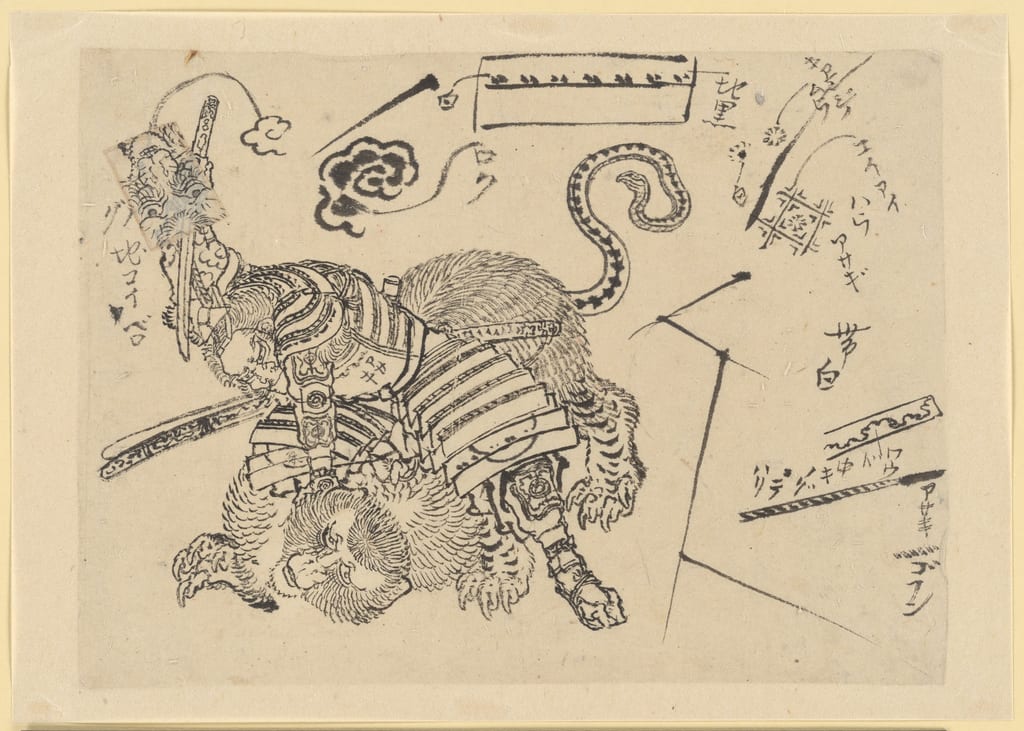
The Nue’s body is not the same in every text. Yorimasaki, introduced by the National Archives,[3] gives it the appearance of a monkey, the face of a tanuki, the tail of a fox, the belly of a snake, and the feet of a cat. An illustration in the National Archives’ undated printed edition of The Tale of the Heike, by contrast, shows a monkey’s head, tanuki’s body, snake’s tail, and tiger’s limbs. Monkey, tanuki, tiger, and snake make up the most familiar arrangement, not a single blueprint shared across all copies.
This instability is not a flaw. The marvel begins with a nocturnal cry, hides its appearance in black cloud, and has its parts counted only after it falls; each retelling therefore clothes the Nue in different animals. The fact that name and form never settle into a fixed correspondence also leads, in later times, to the figurative use of nue for something whose true identity or affiliation cannot be determined.
The Boat That Gave the Nue a Voice
The Tale of the Heike says that the defeated thing was put into a hollow boat and sent adrift, but gives no place name for its arrival. The Noh play Nue[4] brings that boat to the shore at Ashiya in Settsu Province. The boatman who appears before a traveling monk identifies himself as the Nue’s departed spirit; after receiving sutra recitation, he assumes the monster’s form and recounts his end. Yorimasa receives reward and fame, while he is forced into a crude boat and sent toward dark depths. He mourns that misfortune and asks for memorial rites.
From the warrior’s side, the slaying of the Nue is a tale of martial prowess and courage. Noh adds the memory and voice of the defeated. Its grief and plea for salvation should not be understood as traits of composite beasts in general, but as the expression of a departed spirit created by Noh; that distinction preserves the appeal of each telling.
How Places and Pictures Shaped the Nue
The brief account of the hollow boat’s being sent adrift grew into substantial local traditions from the early modern period onward. Nue Mound in Miyakojima Ward, Osaka,[6] says that the body floated down the Yodo River to the shore of Sawakami-e and was buried by villagers. Nue Mound in Hamaashiya-chō, Ashiya,[7] likewise stands against traditions of arrival and burial found in works such as Setsuyō Gundan and Settsu Meisho Zue. Neither is a grave designated by the text of The Tale of the Heike; rather, they show how different places took up the story and made it into a visible memorial site.
Toriyama Sekien’s Konjaku Gazu Zoku Hyakki is a yōkai picture book published in 1779.[8] Warrior prints from the late Edo period onward also recomposed, in vivid form, the black cloud, the palace, Yorimasa’s bow, Ino Hayata, and the combined body. In Yorimasa Shooting the Nue, attributed to Katsushika Hokusai, the monster peering from dark cloud and Yorimasa aiming his arrow share one picture plane. An ancient bird name; a tale of shooting a small bird; a shape-shifter fallen from black cloud; an uncanny bird with a name; a departed spirit seeking salvation at Ashiya: because all of these have been held within one name, Nue is richer than any fixed monster.
Character Profile
This section is our own creative profile for storytelling. It is not historical fact or scholarship.
Yokai Type - Traditional Yokai
Category - Animal Shapeshifters
Rarity - Legendary
Personality - The Tale of the Heike gives no detailed account of its character. In the Noh play Nue, it appears as a departed spirit who laments its death and misfortune after being set adrift and asks a monk to perform rites for it.
Compatibility - The sources do not establish any universal pattern of human affinity. This account may especially reward readers who can appreciate Yorimasa’s martial achievement and the pathos that Noh gives to the departed spirit as distinct narrative perspectives.
Abilities - No ability common to every Nue is established by the sourcesIn the Konoe-in tale, it is described as a marvel that appears over the palace hall with a black cloudIn the widely circulated textual line, its cry is said to resemble that of the bird called nueIn Noh, the departed spirit recounts its death and asks for memorial rites
Weaknesses - No weakness common to the kind is known. One individual in the Konoe-in episode of The Tale of the Heike is shot down by Yorimasa’s arrow and pursued by Ino Hayata.
Habitat - No fixed habitat is recorded. The palace, the direction of Higashi-Sanjo Forest, the shore at Ashiya in Settsu Province, and Nue mounds in different places are settings belonging respectively to texts, Noh, and local tradition.