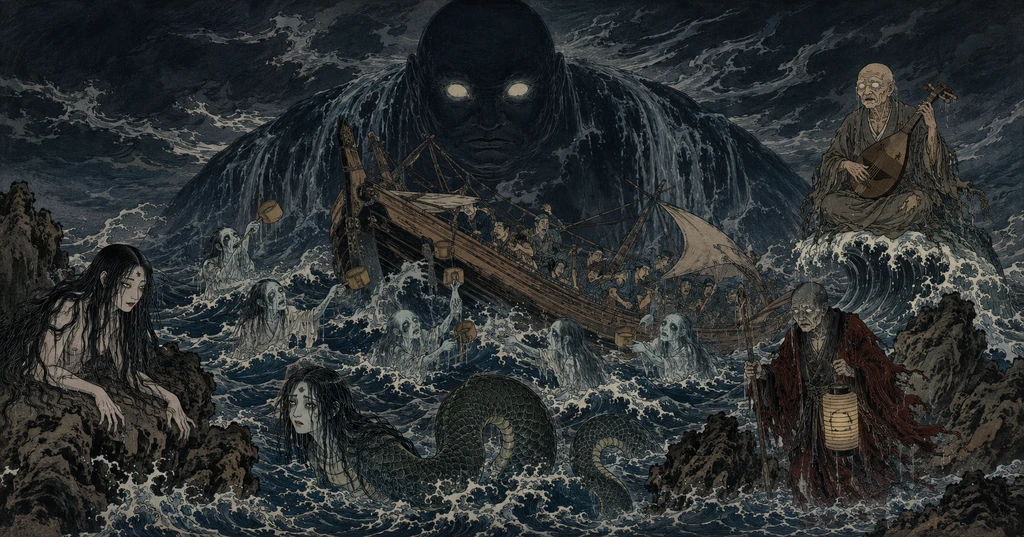
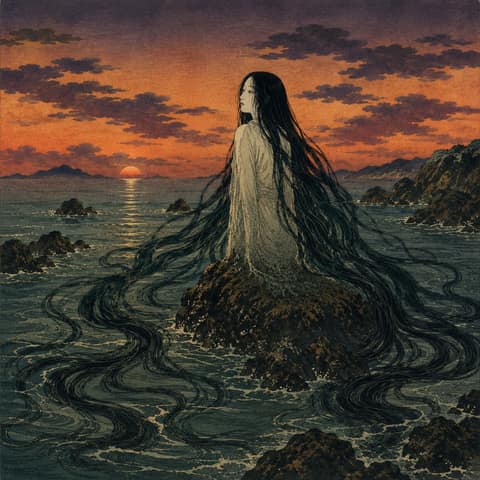
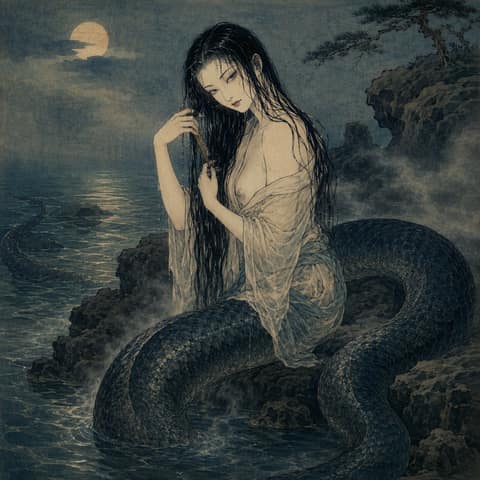
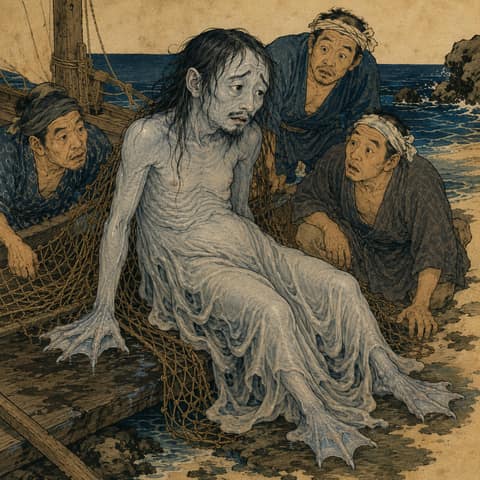
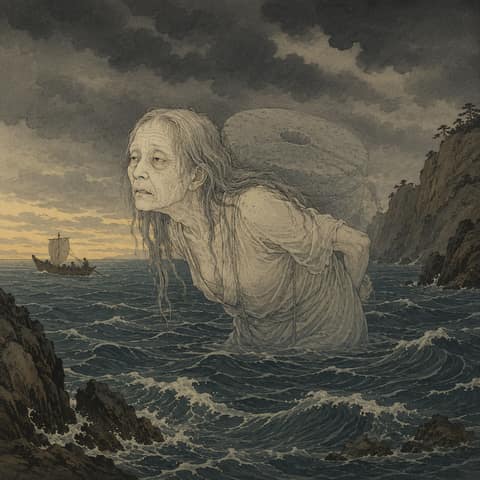
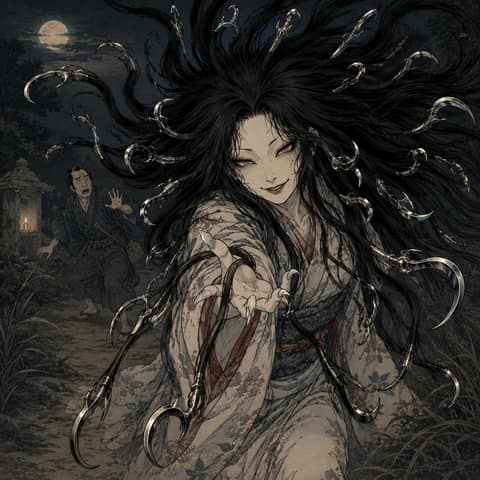
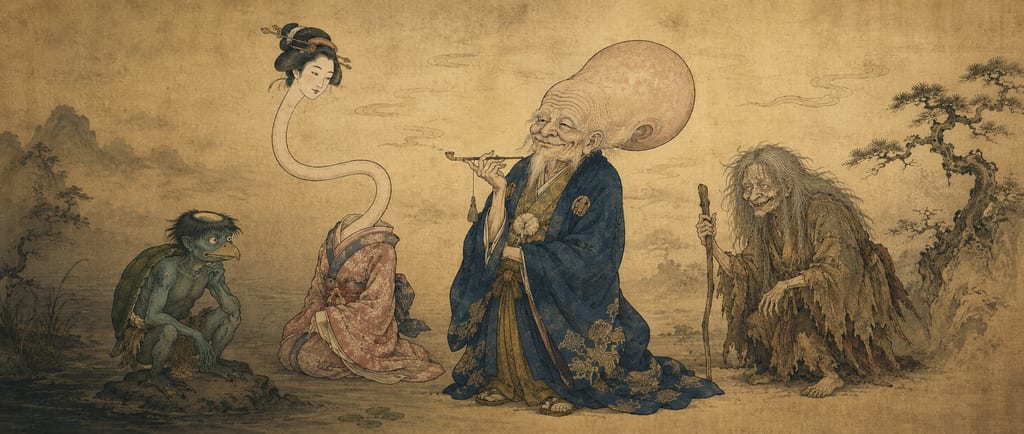
Nure-onna is a waterside apparition with a woman's head and the body of a serpent. Below the waist, an immense scaled body replaces human legs; above it hangs the perpetually wet black hair that gives her the name 'Wet Woman.' In the wind volume of Toriyama Sekien's Gazu Hyakki Yagyō, she appears as a female face on a serpent's body, her long hair trailing in the water. Serpentine women also appear in earlier Edo picture scrolls such as Sawaki Sūshi's Hyakkai Zukan[2], showing how artists passed the image from one work to another.
Stories from western Japan give Nure-onna a different but equally memorable role. She presses the baby in her arms upon a passerby; the moment it is accepted, it becomes as heavy as stone and leaves the victim unable to move. In some versions, Ushi-oni then attacks. Nure-onna is often discussed alongside Kyūshū's Iso-onna and regional traditions of Nure-onago[3], and has also been interpreted as a sea serpent transformed. Yet the serpent body is supported chiefly by paintings, and primary evidence directly linking every local tale to that image is scarce. Wet hair, the water's edge, and a child that binds the recipient are the more stable features shared across western Japan's female water apparitions.
Folklore & Legends
In the Iwami region of Shimane, Nure-onna appears on the shore, hands her baby to a passerby, and returns to the sea. Ushi-oni then emerges to attack. Once accepted, the child becomes a heavy stone that cannot be put down, holding the victim in place until Ushi-oni devours them. An Ōda story says that a cornered Ushi-oni cried, 'What a pity,' in the same voice as Nure-onna, supporting the idea that the two were one being.
No known primary source, however, directly joins the serpent-bodied woman of the picture scrolls to Iwami oral tradition. The image and the story may have traveled along separate paths. Fujisawa Morihiko's Yōkai Gadan Zenshū: Nihon-hen[4] mentions a Nure-onna tale from Echigo in the Bunkyū era, but does not identify its original source. The familiar modern figure was therefore shaped in part by later researchers gathering scattered accounts.
Wet hair, a serpent's body, and the child used to immobilize a traveler also overlap with Iso-onna on the Kyūshū coast and Nure-onago traditions in Shikoku and the Chūgoku region[3]. Nure-onna is best understood as one form within a wider family of female waterside apparitions rooted in coastal life, women divers, and the hazards of the shore. Her sudden arrival from the sea and the binding act of accepting a child turn the uncertain boundary between land and water into a lasting tale of danger.
Nure-onna appears beside the sea or a river as a woman with long, soaking-wet hair. The stories vary by region. In one form, she asks a passerby to hold her baby; once accepted, the child becomes as heavy as stone and leaves the person unable to move. In another, she is an imposing water creature with a serpent's body and an immense tail.
Edo-period yokai paintings frequently show Nure-onna as a serpentine woman, although narrative evidence for that exact body is limited. In Iwami, she belongs to a cycle of stories involving Ushi-oni, and people are warned not to accept her burden with bare hands. She is sometimes confused with the related Iso-onna, and both her name and her traits shift from one coastal tradition to another.
Character Profile
This section is our own creative profile for storytelling. It is not historical fact or scholarship.
Silent and relentless once she fixes her attention on someone near the water.
Compatibility
She is dangerous to people who approach an unfamiliar shore, rocky beach, or riverbank without caution.
Abilities
Luring and immobilizing a passerby through the baby in her armsBlending a soaked body into the waterside landscapeBinding a victim with long hair or an immense serpent tail
Weaknesses
Do not accept the child in her arms with bare hands, and keep a safe distance from an unfamiliar water's edge.
Habitat
Sea coasts and rocky shores, riverbanks, inlets, and lagoon shores.
The diagram below is a diagnostic evaluation chart for Nure-onna, the Wet-Haired Woman of the Shore. The higher the value of each item, the stronger that characteristic is expressed.