When viewing the Hari-onna as the "hook-haired woman of the Uwajima night roads," the fear of this yokai is not just that "her hair becomes a weapon." What appears first is the form of a beautiful woman; she does not threaten her victim from afar, but builds a connection by offering a smile. When smiled at by a stranger on a dark road, a person might smile back as a greeting. The Hari-onna takes that small response as a signal to undo her hair and expose the hooks. The anomaly only begins to move after waiting for the victim's reaction.
The design of having fishhook-like barbs at the ends of her hair is so clear that it practically explains the name Hari-onna (Needle Woman). Needles are for piercing, but here they function at the tips of her hair to snag. They are not blades for cutting, but hooks for entangling those who flee. Disheveled hair is a sign of disorder and terror, and at the same time, it is the reversal of a beautiful woman's hair instantly changing into a capturing tool. Even though her hair was seen as part of her face and adornment, the moment she draws near, it becomes external hands that seize the victim's body.
Treating the location in detail, the Hari-onna can be read as a yokai of the night roads in the Uwajima region, southern Ehime Prefecture. The official explanation on Mizuki Shigeru Road lists the location as the Uwajima region, Ehime Prefecture, and general summaries also append the name of Sakuraoka in the former Johen Town. However, the Hari-onna is not a yokai fixed to a specific shrine or ancient battlefield. Her location is the living sphere of the "Uwajima region," and her scene is the night road. Therefore, it is best to place the Uwajima region as the main axis on the map, and explain the details in the text. Rather than forcing a pin into an unverified point, positioning her as a mystery encountered on the roads of Nanyo fits this yokai better.
When speaking of the Hari-onna, one cannot avoid the overlap with the Nure-onago. The Nure-onago is also known as a female yokai who smiles at people and stalks those who respond. Kenji Murakami states that because the traits of the Hari-onna are common with the Nure-onago of the Uwajima region, it is possible that Shigeru Mizuki emphasized the traits of the Nure-onago to create the "Hari-onna." This observation does not diminish the value of the Hari-onna. Rather, it is a prime example showing how a yokai is renamed and visually sharpened within an illustrated encyclopedia. If the Nure-onago is a yokai of smiles and obsession, the Hari-onna is a yokai given a memorable form in a single stroke with her "hooked hair."
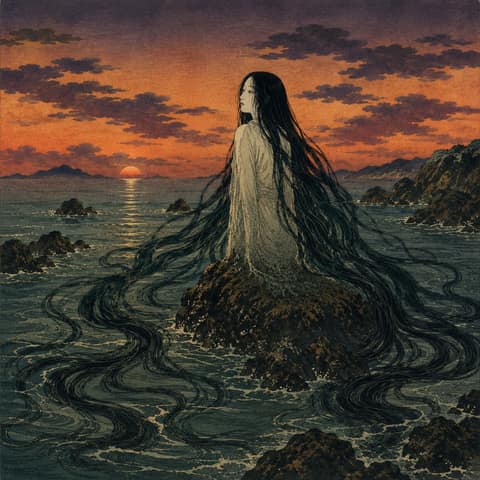
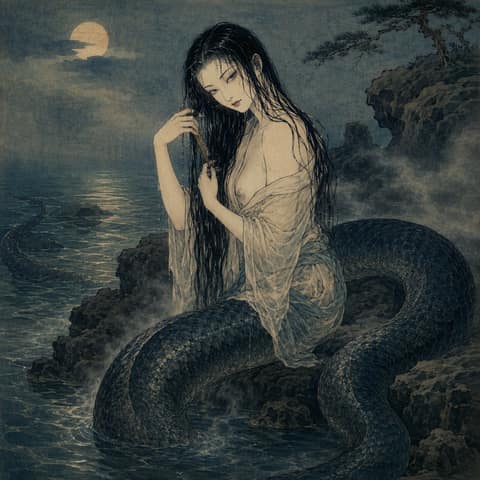
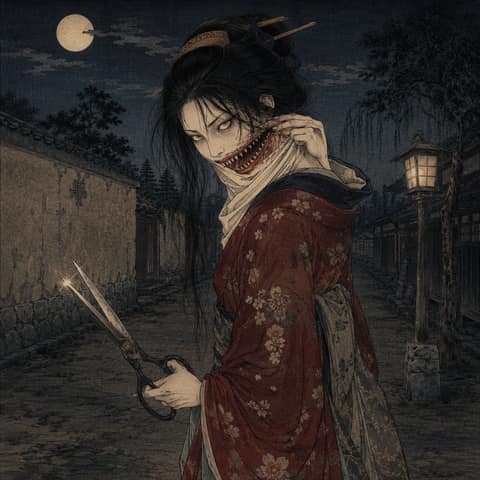
Comparing her to similar yokai makes the Hari-onna's position easy to see. The Iso-onna is spoken of as a female yokai who attacks people with her hair on the beach, and the Nure-onna is tied to the waterside and the grotesque form of a snake's body. The Kuchisake-onna creates modern urban horror through a question and facial reversal. The Ohaguro-bettari reveals a faceless visage with blackened teeth from beneath beautiful attire. The Hari-onna sits somewhere in between; she does not tear her face itself, but transforms her hair. She does not carry the strong presence of the sea like waterside female monsters, nor is she as modern as urban legends. She is a yokai who stands on the night roads of Nanyo with nothing but a smile and her hair.
For this reason, keeping her description free from excessive added abilities makes it stronger. Explanations of her sucking massive amounts of blood, devouring souls, or flying around cities might be possible as later creative works, but they are not the core directly supported by the materials. Her solid outline consists of a woman's appearance, a smile, hooked hair, snagging and dragging men away, and the location of the Uwajima region. With smaller yokai, keeping this outline intact retains their scariness. The Hari-onna is a brief, sharp female yokai who makes victims realize—in the instant they return a friendly expression on a night road—that their expression was the very signal for her to capture them.
Character Profile
This section is our own creative profile for storytelling. It is not historical fact or scholarship.
Yokai Type - Traditional Yokai
Category - Half-Human Beings
Rarity - Rare
Personality - Quietly approaching in the guise of a beautiful woman, she waits for the victim to smile back. Rather than screaming directly, she closes the distance the moment a facial expression is returned; a yokai who knows the proper distancing of a night road.
Compatibility - Close to female yokai of the waterside and night roads like the Nure-onago, Iso-onna, and Nure-onna. She is also easily aligned with yokai who create terror through a woman's appearance and an instant reversal, such as the Kuchisake-onna and the Ohaguro-bettari.
Abilities - Appearing on night roads as a beautiful womanClosing the distance with a returned smile as the signalFreely thrashing about disheveled hairSnagging victims with fishhook barbs at the ends of her hairDragging away captured menVarying the smiling folklore of the Nure-onago lineage into a hook-haired anomaly
Weaknesses - She is spoken of in the context of fleeing into a house, shutting sturdy doors, and waiting until morning. The source materials do not clearly mention spells or extermination tools.
Habitat - The Uwajima region in southern Ehime Prefecture, especially night roads and sparsely populated routes. Names around Sakuraoka in the former Johen Town are also passed down, but on the map, she is placed at the broad anchor of the Uwajima region.