Yokai Encyclopedia

Encyclopedia of Japanese Yokai

28 Yokai|14 Category|Page 2 of 2
Localization in Progress - More content available in Japanese version
View Japanese
Sort by: NameAscending
鬼・巨怪
  • Ryōmen Sukuna

    Ryōmen Sukuna

    Legendary

    RYOH-men SKOO-nah

    Hida's Two-Faced Sukuna: Chronicle and Local Tradition

    Demons & GiantsGifu

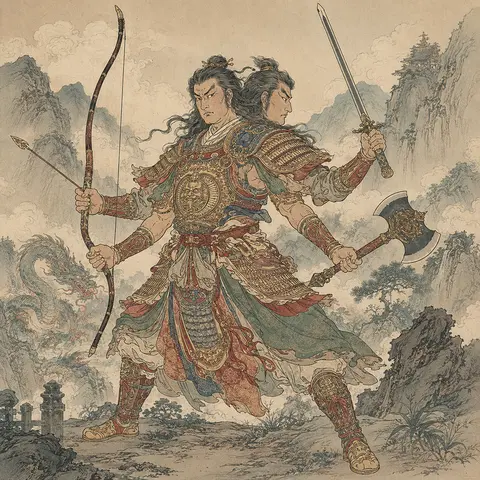
    The original text of the Nihon Shoki etches Sukuna's body in remarkable concreteness: "one body with two faces, each turned away from the other; their crowns joined so that there is no nape; limbs on either side; knees, yet no hollows behind them and no heels." One torso, two faces set back to front, no nape where the heads meet, and limbs on each side—read plainly, four hands and four feet alike, an eight-limbed marvel. Yet most of the images that survive locally are carved as "two faces, four arms"—two faces, four arms, two legs. That the Shinsen Mino-shi records the founder of Nichiryūbu-ji as a "two-faced, four-armed stranger" belongs to the same strain, and the discrepancy between the textual description (eight limbs) and the iconographic tradition (four arms, two legs) is not to be overlooked in reading the Sukuna image. It was Enkū who raised that iconography into art. The seated Ryōmen Sukuna at Senkō-ji sets its two faces side by side rather than front and back, one wearing wrath, the other compassion. This form, salvation glimmering within fury, resonates with the belief that Sukuna was an incarnation of Guze or Senju Kannon. His historical reality demands caution. Naniwa no Neko Takefurukuma, named as his vanquisher, properly belongs to the section on Empress Jingū, so his placement in the Nintoku chronicle is itself anachronistic. That a Kannon-incarnation tale should attach to Nintoku's reign—supposedly before Buddhism's arrival—is likewise a later construction, and the view that the whole account is a fabrication of the editorial stage carries weight (Nagafuji Yasushi). Nagafuji reads Sukuna as the original deity of Mt. Kurai, a hero hidden away by the central histories, while Hōga Toshio traces him genealogically to the ancestor of the Hida no Miyatsuko. As for the monstrous body, Haga Susumu reads it as the misperceived and exaggerated gear—shin guards and the like—of Hida's mountain folk. The name, too, invites many theories. From the sound "Sukuna," some traditions argue a tie to Sukunabikona, and Ōbayashi Taryō offered a comparative-mythology framework treating Sukunabikona as Ōkuninushi's "second self." The motif of a god who appears in pairs chimes with the two-faced form of Sukuna. Some also overlay the image of the uncanny Sukuna onto the fact that ancient Hida was a singular "land of craft" that sent its artisans (Hida no Takumi) to the center, though there is no direct documentary link between the two. What is certain is that a single name has been handed down in opposite directions by center and province, and that this very split is what gives the being called Ryōmen Sukuna its shape.

  • Sanki Daigongen

    Sanki Daigongen

    Epic

    sanki-daigongen

    Japan's Only Demon God Guarding Mount Misen, Sanki Daigongen

    Oni/Giant MonsterHiroshima

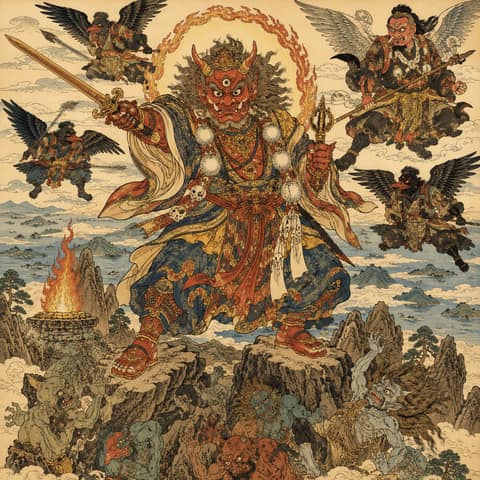
    The core of Sanki Daigongen lies in its reversed divine nature, transforming the originally feared oni into a "guardian deity that wards off evil." The three demon gods—Tsuicho, Jibi, and Mara—each govern fortune, wisdom, and subjugation, with Dainichi Nyorai, Kokuzo Bosatsu, and Fudo Myoo as their original Buddhist forms. This trinity structure demonstrates the fusion of the Honji Suijaku (original reality and manifested traces) thought of Shingon esoteric Buddhism with mountain asceticism and tengu worship. The fact that it commands large and small tengu as familiars is directly connected to folk tales of Mount Misen being a spiritual mountain of tengu (like the tale of Masanori Fukushima's tengu extermination). It embodies the sacredness of Mount Misen itself, characterized by Kukai's founding, the unextinguishable spiritual fire, and the strange rock formations likened to Mount Sumeru. The Itsukushima Shrine (Ichikishima-hime and Benzaiten) on the sea and Sanki Daigongen on the mountain form a pair as the guardian deities of the two poles of Miyajima—the sea and the mountain.

  • Saru-oni (Ape Ogre)

    Saru-oni (Ape Ogre)

    Uncommon

    SAH-roo-OH-nee

    Legend-Conform Noto Saru-oni

    Demons & GiantsIshikawa

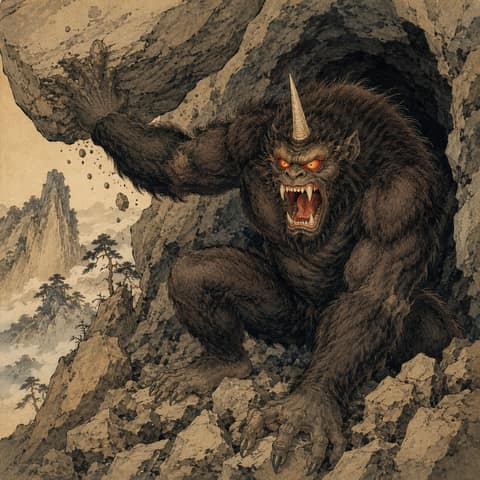
    Based on the Noto region’s distinctive image of the saru-oni. It has an ape-like body crowned with a single horn and dwells in rock caves, menacing livestock and people near settlements. It appears under cover of night and is feared as a boundary breaker between the mountains and the village. Communities sought the protection of local tutelary deities, and tales of subjugation by bow and arrow are tied to place-name origins. After its defeat, its horn is said to have been enshrined, and memorial shrines were established, pairing awe with appeasement. The saru-oni is told as a singular creature rather than a pack. Its range centers on cave mouths and the satoyama borderlands, its presence marked by a bestial stench and legends of black blood.

  • Smiling Hannya

    Smiling Hannya

    Uncommon

    wah-RAH-ee HAHN-nyah

    Edo Painting Traditions Edition

    Demons & GiantsNagano

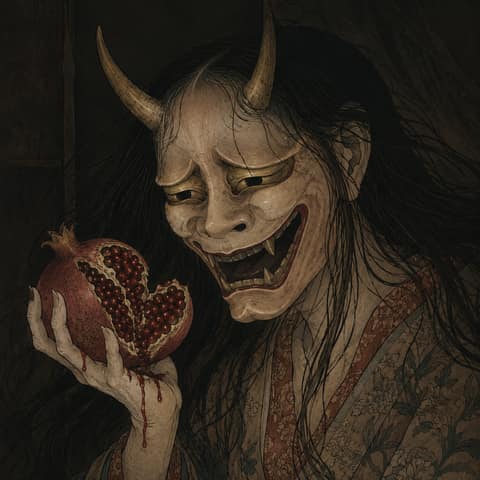
    An edition distilled from late Edo-period ukiyo-e and comic prints depicting the smiling Hannya. Horns, fangs, bristling hair, wide staring eyes, and a strained grin form its core. Objects in its hands often allude to life and death, unsettling viewers with deliberate motifs. The demon-woman is understood to have once been human, transformed by accumulated jealousy, resentment, and attachment, aligning with the concept behind the Hannya mask. Specific local legends are sparse, yet it was treated in night-time tales and picture books as a symbol of fear and admonition, preserved as an image of the extreme of a woman’s grudge. In local oral tradition sometimes only the name remains, with the transmission of its form relying mainly on pictorial sources.

Showing 25 - 28 of 28 yokai