YOKAI.JP

Ogetsuhime-no-Kami

おおげつひめのかみ

Ogetsuhime-no-Kami

Ogetsuhime-no-Kami

Their soul is listening — speak, and they will answer.

Basic Description

Ogetsuhime-no-Kami is a goddess of food appearing in the *Kojiki*, possessing multiple faces: she is the name of Awa Province, a deity born during the Kamiumi (birth of the gods), a goddess murdered by Susanoo-no-Mikoto to give rise to grain, and a mother goddess in the genealogy of O-toshi-no-Kami. The Kokugakuin University Deity Name Database lists her reading as "Ohogetsuhime-no-Kami / Ogetsuhime-no-Kami" and gives aliases such as Ogetsuhime, Ogetsuhime-no-Kami, Ogetsuhime, and Ogetsuhime-no-Kami (written with different kanji). Regarding the meaning of her name, "O" is an honorific prefix, "ge" is a sequential voicing (rendaku) of "ke" meaning food, and "tsu" is an attributive particle, establishing her divine nature as a goddess governing food.

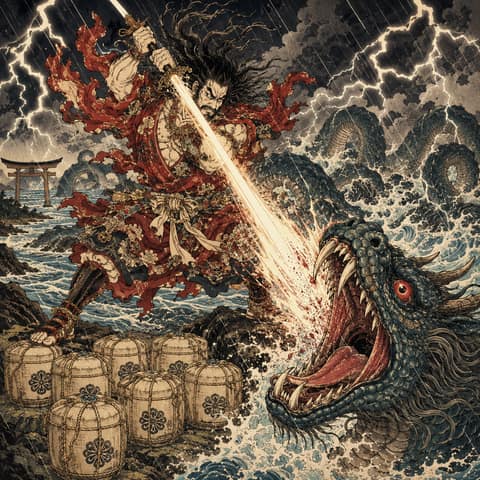
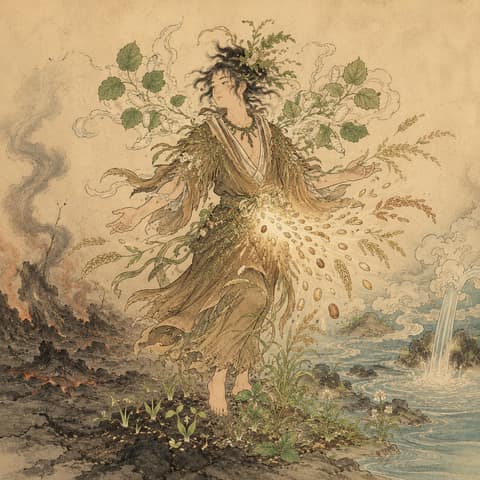
Her most powerful scene is the myth of the origin of grains, placed in the episode of Susanoo's banishment. Asked for food, Ogetsuhime produced various foods from her nose, mouth, and rectum, cooked them, and offered them. However, Susanoo, witnessing this, thought she was doing something filthy and killed her. From her murdered body, silkworms grew from her head, rice seeds from both eyes, millet from both ears, adzuki beans from her nose, wheat/barley from her genitals, and soybeans from her rectum. Kami-musubi-no-Mioya-no-Mikoto then had these seeds collected. Food does not suddenly appear as a pure offering; it becomes seeds through the body, death, and decomposition. Ogetsuhime is the deity who bears this dark transformation.

Ogetsuhime is similar to Ukemochi-no-Kami, who carries the same myth of the origin of food, but simply equating them obscures their differences. In the *Nihon Shoki*, Ukemochi is killed by Tsukuyomi-no-Mikoto, linking the separation of the sun and moon with the origins of agriculture and sericulture. On the other hand, in the *Kojiki*, Ogetsuhime appears after Susanoo's banishment; in the interstitial space transitioning from the Takamagahara myth to the Izumo myth, she brings forth the seeds of food that will support the creation of the earthly realm. Including her name 'Awa' (millet) Province, her association with slash-and-burn crops, and her children with Haya-mato-no-Kami, she is a food goddess unique to the *Kojiki* who unites Awa, the mountains, food, and generation from a corpse.

Folklore & Legends

Ogetsuhime is not a simple deity explained only once in the *Kojiki*. The Kokugakuin University Deity Name Database lists her appearances as Volume 1: "Birth of the Land and Gods," "Banishment of Susanoo-no-Mikoto," and "Genealogy of O-toshi-no-Kami". In the "Birth of the Land," "Ogetsuhime" appears as the name of Awa Province, one of the four faces of the island of Iyo-no-Futana. In the "Birth of the Gods," she is born as "Ogetsuhime-no-Kami." Furthermore, in the genealogy of O-toshi-no-Kami, she and Haya-mato-no-Kami give birth to eight deities: Wakayamakui, Wakatoshi, Wakasaname, Mizumaki, Natsutakatsuhi, Akibime, Kukutoshi, and Kukiki-wakamuro-tsunane. A place name, a deity name, and a mother goddess in a genealogy are all superimposed under the same name of food.

Her connection to Awa Province pulls her away from being a merely abstract "food deity." The "Various Theories" section of Kokugakuin introduces theories regarding why Awa Province (one face of Iyo-no-Futana) is called Ogetsuhime: one theory sees it as a naming based on "Awa" (millet) as a food deity, while another suggests the name of the food deity was given after associating the pronunciation of the province's name with millet. Regardless, here the place name and the food name attract each other. The "Awa" of Awa Province and the "awa" of millet function to make the reader perceive the land itself as the body of food within the myth.

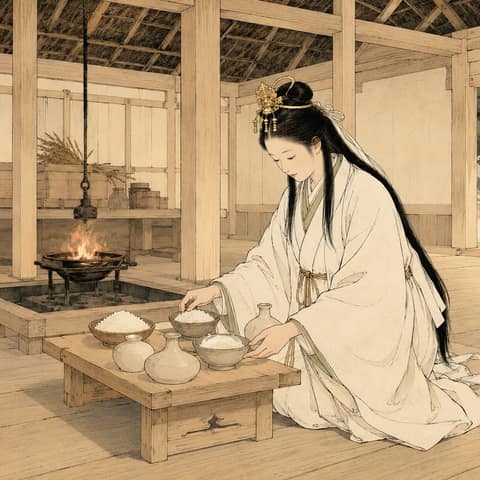
The murder tale placed in Susanoo's banishment episode decisively determines Ogetsuhime's divinity. After the Heavenly Rock Cave myth, before the story of Susanoo—banished by the myriad gods—moves to the earthly realm, Ogetsuhime is asked for food. She produces various foods from her nose, mouth, and rectum, cooks them in various ways, and offers them—a feast from the body. The eeriness of this scene, like that of Ukemochi, comes from food being too close to the inside of the body. For Ogetsuhime, the body itself is the source that generates food, and the feast is a manifestation of her divine ability. However, to Susanoo, it appeared as a defiled act.

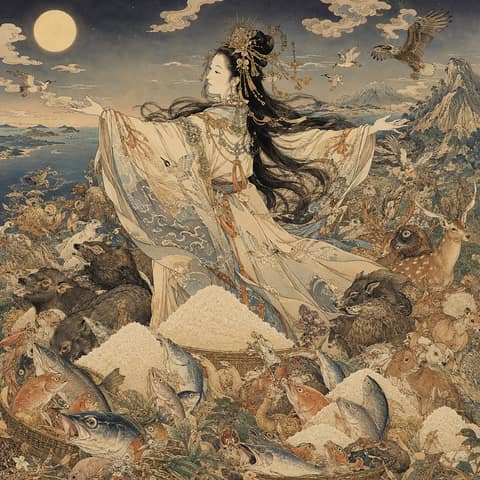
After her murder, the myth moves more clearly toward the origin of grains. From Ogetsuhime's corpse, silkworms grow from her head, rice seeds from both eyes, millet from both ears, adzuki beans from her nose, wheat/barley from her genitals, and soybeans from her rectum. Kami-musubi-no-Mioya-no-Mikoto has these seeds collected. What is important here is that rice is not placed alone at the center. The line-up of millet, adzuki beans, wheat/barley, soybeans, and silkworms strongly carries the atmosphere of dry-field farming, slash-and-burn agriculture, and sericulture, rather than just paddy-field rice cultivation. The Kokugakuin's "Various Theories" section introduces a theory that views the prototype as a myth of the origin of crops cultivated by slash-and-burn, since many of the generated items are slash-and-burn crops—indicating its relationship with slash-and-burn agricultural culture.

This murder tale also leaves a mystery in its narrative placement. Kokugakuin's commentary notes that while this story is placed between the episode of the myriad gods banishing Susanoo in the Heavenly Rock Cave myth and the episode of the banished Susanoo descending to earth, it gives the impression of not being directly connected to what comes before and after. Thus, there is a theory that it was originally a separate tradition added episodically—a debate over its episodic placement. At the same time, some view it as bridging the Takamagahara myth and the Izumo myth, and by narrating the origin of agriculture, laying the foundation for the subsequent land-creation by Okuninushi and others. Ogetsuhime can be read as the deity who places the seeds of earthly life in the chaotic world following Susanoo's banishment.

A comparison with Ukemochi in the *Nihon Shoki* further highlights the characteristics of this deity. Kokugakuin summarizes that in the Ukemochi myth (Nihon Shoki, Book 5, Alternate Writing 11), Tsukuyomi visits Ukemochi by order of Amaterasu. Because Ukemochi entertains him with food produced from her mouth as if vomiting, he becomes angry and kills her. From her corpse spring cattle, horses, millet, silkworms, barnyard grass, rice, wheat, soybeans, and adzuki beans—a comparison with the Ukemochi myth. While Ukemochi connects to the separation of sun and moon and Amaterasu's agricultural order, with Ogetsuhime, the focus shifts to Susanoo's roughness, Awa Province, and the trajectory toward the earthly creation of the land. Though they share a similar mythic type, the narrative's center of gravity is not exactly the same.

Furthermore, Kokugakuin introduces research comparing the myths of Ogetsuhime and Ukemochi as Hainuwele-type myths, where crops spring from a corpse. In the myth of the girl Hainuwele from Seram Island in Indonesia, tubers grow from the fragments of the murdered girl's body. Of course, comparison does not immediately determine origin. Kokugakuin cautions that due to the lack of clarity regarding traditions prior to the *Kojiki* and *Nihon Shoki* and insufficient regional data, it is difficult to limit the origin to a specific region or period. Still, the fact that Ogetsuhime represents a Japanese manifestation of the widespread mythological sense that "food comes from a dead body" is a crucial clue for interpretation.

When reading Ogetsuhime, it is vital not to separate defilement from fertility. She is a god who gives food, but her giving is not a neatly packaged gift. She produces food from the boundaries of the body—the nose, mouth, and rectum. When murdered, her body turns into a map of seeds. The parts—head, eyes, ears, nose, genitals, rectum—are allocated to silkworms, rice, millet, adzuki beans, wheat, and soybeans. Eating is not established by distancing oneself from the body; it is established while embracing the danger of coming too close to the body. Ogetsuhime is the goddess who takes this danger entirely upon herself to open up the earthly world of food.

Related Yokai

Yokai deeply tied to this one in legend.

Detailed Analysis

The fascination of Ogetsuhime lies in how land, food, and body are superimposed onto a single name. In the "Birth of the Land" in the *Kojiki*, Awa Province—one face of the island of Iyo-no-Futana—is named Ogetsuhime, acting as Ogetsuhime as the name of Awa Province. In the "Birth of the Gods," Ogetsuhime-no-Kami is born. Then, in the episode of Susanoo's banishment, she produces food from her body and is killed, giving rise to the five grains and silkworms. This overlapping indicates that ancient storytellers felt the land not merely as a map, but as a body that generates food. Awa Province is read not just as a place name, but as the name of a food goddess.

Her feast begins from the exact opposite of pure, pristine sacred offerings. Asked for food, Ogetsuhime produces various items from her nose, mouth, and rectum, and cooks them to serve—providing food from the nose, mouth, and rectum. Here, the body's orifices are simultaneously places of defilement and the gates through which food enters the world. That Susanoo viewed this as filthy was not simply a misunderstanding; it expresses a fundamental revulsion toward food being too close to the body. Food sustains life, but its roots touch flesh, blood, and excretion. Ogetsuhime offers it without erasing this uncomfortable proximity.

Through her murder, the deity's body transforms into a catalog of seeds. Silkworms grow from her head, rice seeds from both eyes, millet from both ears, adzuki beans from her nose, wheat from her genitals, and soybeans from her rectum—forming seeds generated from body parts. This is a grotesque corpse transformation, yet it perfectly illustrates how agricultural societies perceived food. Seeds do not come from nothing. They appear as what remains after something is broken, torn apart, and dies. By having Kami-musubi have these seeds collected, the corpse is not merely a loss, but is transferred into a cultivatable future.

Placed alongside Ukemochi-no-Kami, Ogetsuhime's outline becomes starker. Ukemochi in the *Nihon Shoki* is killed by Tsukuyomi, and Amaterasu incorporates what grew from her corpse into the order of agriculture and sericulture—the origin of the five grains and sericulture from Ukemochi. There, even the separation of day and night is narrated. In Ogetsuhime's case, the murderer is Susanoo, and the story is placed at the turning point where the narrative moves from Takamagahara to Izumo. Rather than in the silence of the moon god, the seeds of food are placed in the void just before the banished, violent god heads for the earth. Because of this difference, Ogetsuhime leans much more deeply toward the beginning of the land and agriculture than toward cosmology.

As Kokugakuin's commentary points out, this story is difficult to connect directly with the surrounding context, leading to the theory that it was originally a separate tradition added episodically—the theory of episodic placement. However, this very "inserted" quality tells of the myth's function. After the Heavenly Rock Cave, and before Susanoo fully enters the Izumo story, the *Kojiki* places a small, dark story about the origin of food. Before entering the heroic tales of land-creation, a world where humans could eat was necessary first. In the crevices of the story, Ogetsuhime prepares the conditions for earthly life.

Her figure appearing in the genealogy of O-toshi-no-Kami also cannot be overlooked. With Haya-mato-no-Kami, Ogetsuhime gives birth to Wakayamakui, Wakatoshi, Wakasaname, Mizumaki, Natsutakatsuhi, Akibime, Kukutoshi, and Kukiki-wakamuro-tsunane—her eight child deities with Haya-mato-no-Kami. This genealogy, lining up names associated with mountains, years, summer, autumn, and kuzu roots, prevents her from remaining merely a god killed once. Even after birthing the origin of grains, she supports the time of the food world as a mother goddess expanding into the seasons of the mountains, the cycle of crops, and year-round fertility.

From the perspective of comparative mythology, Ogetsuhime has long been read as a Hainuwele-type myth. Kokugakuin introduces the typology where various crops generate from a corpse, and notes the similarities between the myth of the girl Hainuwele from Seram Island in Indonesia and the Kojiki/Nihon Shoki myths of Ogetsuhime and Ukemochi—a comparison with Hainuwele-type myths. However, this comparison does not mean "it's simple to equate because it's foreign." Kokugakuin cautions that limiting the origin to one region is difficult due to the reality of pre-Kiki traditions and the limitations of data. What is important is that the sensation of staple foods being born from a dead body became a powerful form to narrate the origin of agriculture across the world.

The myth of Ogetsuhime does not narrate food solely as a bright blessing. Food is something to be grateful for, but it is also something that comes out of a body. Seeds open up the future, but they are also born from a corpse. The land feeds people, but it is carved with the name of the food goddess, Awa Province. Ogetsuhime is a deity who embraces all the defilement, death, dry fields, mountains, and seasons that lie behind eating. That is exactly why her fertility is not merely gentle. It is a strong fertility close to the soil, offered from the boundaries of the nose, mouth, and rectum, sprouting from a murdered body.

Character Profile

This section is our own creative profile for storytelling. It is not historical fact or scholarship.

Yokai Type
Kami
Rarity
Divine
Personality
A goddess of fertility close to the earth and the flesh, who offers food from her own body. Her affection does not maintain a clean distance, but manifests as the power to generate food from raw boundaries like the nose, mouth, and rectum.
Compatibility
Highly compatible with Awa Province, dry-field farming, slash-and-burn agriculture, sericulture, the myth of Susanoo's banishment, and corpse-generation grain origin tales. Suited for those who can accept the cycle of life, including its dark aspects as well as the light.
Abilities
Produces various foods from her nose, mouth, and rectum, cooking them to serve as a feastGenerates silkworms, rice seeds, millet, adzuki beans, wheat, and soybeans from her corpseOverlaps the name of Awa Province with her food divinity, revealing the land as the body of foodPlaces the seeds of earthly life in the scene transitioning from the Takamagahara myth to the Izumo mythGives birth to child deities related to mountains, seasons, and crops through her genealogy with Haya-mato-no-KamiConnects the boundaries between defilement and fertility, death and seeds, body and land
Weaknesses
Because her power to generate food is close to bodily excretion, it is misunderstood as filth by those who only wish to see pure offerings. The stronger her power to give, the more danger it holds of inviting violent rejection.
Habitat
Awa Province, the mythological space of Susanoo-no-Mikoto's banishment, and places that tell of the origins of dry-field farming, slash-and-burn agriculture, and sericulture. She dwells at the boundary where mountains, land, and food intersect.
For more detailed information and diagnosis results about Ogetsuhime-no-Kami, the Food Goddess of Awa Who Bears the Five Grains from Her Body, please click here.

Sources & References

2
  1. 大宜都比売神 – 國學院大學「古典文化学」事業 神名データベース國學院大學「古典文化学」事業(國學院大學) [学術データベース]大宜都比売神の読み・別名・登場箇所・梗概・諸説、保食神との比較、ハイヌウェレ型神話の研究史を整理する神名データベース。
  2. 日本書紀 神代上第五段一書第十一・保食神舎人親王ら(養老四年成立の勅撰正史, 720) [古典文献] Reference天照大御神が月夜見尊を保食神へ遣わし、食物生成・殺害・日月分離・五穀養蚕起源を語る一書。

Interested in this type of yokai?

Discover the yokai most similar to your personality with our yokai diagnosis

Start Yokai Diagnosis

Meet your guardian yokai at the shrine

Draw an omikuji fortune and discover the yokai watching over you today.