
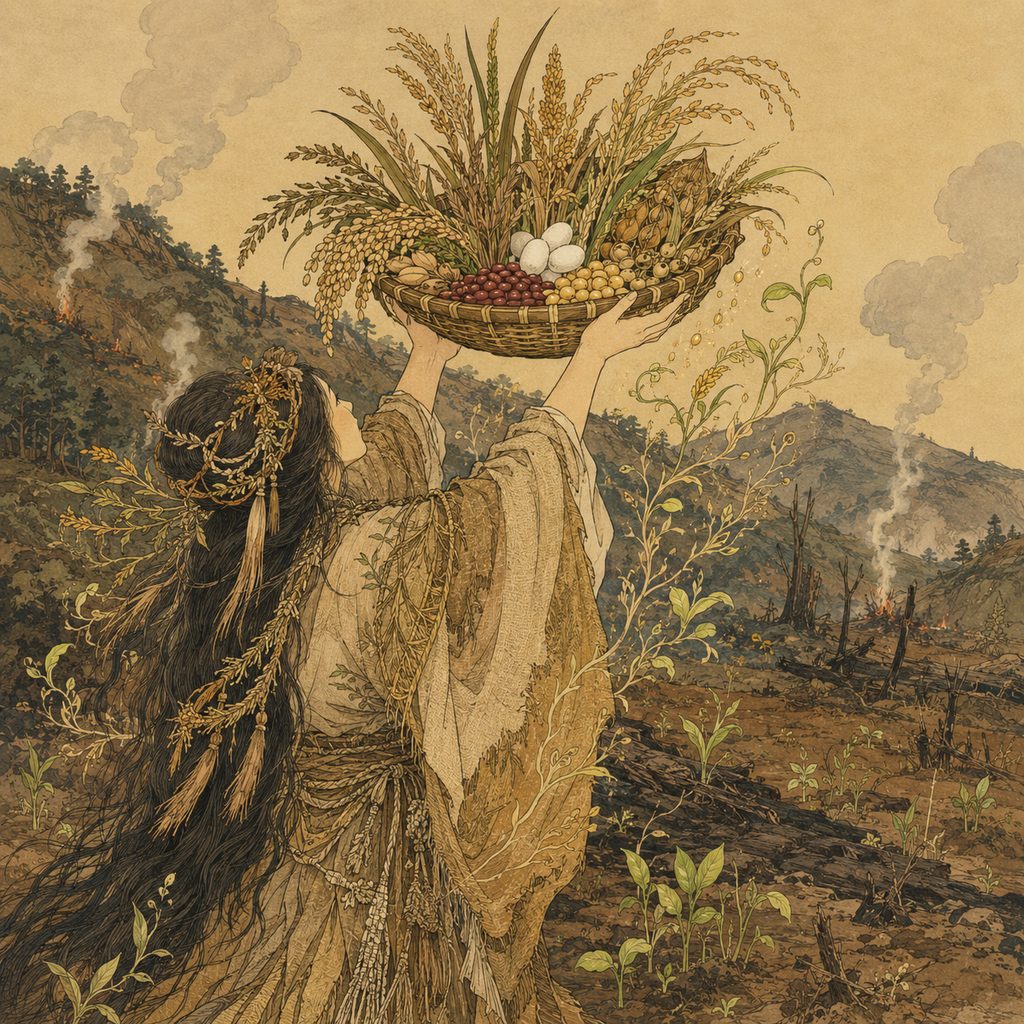
Ogetsuhime-no-KamiOgetsuhime-no-Kami, the Food Goddess of Awa Who Bears the Five Grains from Her Body
おおげつひめのかみ
Detailed Description
The fascination of Ogetsuhime lies in how land, food, and body are superimposed onto a single name. In the "Birth of the Land" in the *Kojiki*, Awa Province—one face of the island of Iyo-no-Futana—is named Ogetsuhime, acting as Ogetsuhime as the name of Awa Province[1]. In the "Birth of the Gods," Ogetsuhime-no-Kami is born. Then, in the episode of Susanoo's banishment, she produces food from her body and is killed, giving rise to the five grains and silkworms. This overlapping indicates that ancient storytellers felt the land not merely as a map, but as a body that generates food. Awa Province is read not just as a place name, but as the name of a food goddess.
Her feast begins from the exact opposite of pure, pristine sacred offerings. Asked for food, Ogetsuhime produces various items from her nose, mouth, and rectum, and cooks them to serve—providing food from the nose, mouth, and rectum[1]. Here, the body's orifices are simultaneously places of defilement and the gates through which food enters the world. That Susanoo viewed this as filthy was not simply a misunderstanding; it expresses a fundamental revulsion toward food being too close to the body. Food sustains life, but its roots touch flesh, blood, and excretion. Ogetsuhime offers it without erasing this uncomfortable proximity.
Through her murder, the deity's body transforms into a catalog of seeds. Silkworms grow from her head, rice seeds from both eyes, millet from both ears, adzuki beans from her nose, wheat from her genitals, and soybeans from her rectum—forming seeds generated from body parts[1]. This is a grotesque corpse transformation, yet it perfectly illustrates how agricultural societies perceived food. Seeds do not come from nothing. They appear as what remains after something is broken, torn apart, and dies. By having Kami-musubi have these seeds collected, the corpse is not merely a loss, but is transferred into a cultivatable future.
Placed alongside Ukemochi-no-Kami, Ogetsuhime's outline becomes starker. Ukemochi in the *Nihon Shoki* is killed by Tsukuyomi, and Amaterasu incorporates what grew from her corpse into the order of agriculture and sericulture—the origin of the five grains and sericulture from Ukemochi[2]. There, even the separation of day and night is narrated. In Ogetsuhime's case, the murderer is Susanoo, and the story is placed at the turning point where the narrative moves from Takamagahara to Izumo. Rather than in the silence of the moon god, the seeds of food are placed in the void just before the banished, violent god heads for the earth. Because of this difference, Ogetsuhime leans much more deeply toward the beginning of the land and agriculture than toward cosmology.
As Kokugakuin's commentary points out, this story is difficult to connect directly with the surrounding context, leading to the theory that it was originally a separate tradition added episodically—the theory of episodic placement[1]. However, this very "inserted" quality tells of the myth's function. After the Heavenly Rock Cave, and before Susanoo fully enters the Izumo story, the *Kojiki* places a small, dark story about the origin of food. Before entering the heroic tales of land-creation, a world where humans could eat was necessary first. In the crevices of the story, Ogetsuhime prepares the conditions for earthly life.
Her figure appearing in the genealogy of O-toshi-no-Kami also cannot be overlooked. With Haya-mato-no-Kami, Ogetsuhime gives birth to Wakayamakui, Wakatoshi, Wakasaname, Mizumaki, Natsutakatsuhi, Akibime, Kukutoshi, and Kukiki-wakamuro-tsunane—her eight child deities with Haya-mato-no-Kami[1]. This genealogy, lining up names associated with mountains, years, summer, autumn, and kuzu roots, prevents her from remaining merely a god killed once. Even after birthing the origin of grains, she supports the time of the food world as a mother goddess expanding into the seasons of the mountains, the cycle of crops, and year-round fertility.
From the perspective of comparative mythology, Ogetsuhime has long been read as a Hainuwele-type myth. Kokugakuin introduces the typology where various crops generate from a corpse, and notes the similarities between the myth of the girl Hainuwele from Seram Island in Indonesia and the Kojiki/Nihon Shoki myths of Ogetsuhime and Ukemochi—a comparison with Hainuwele-type myths[1]. However, this comparison does not mean "it's simple to equate because it's foreign." Kokugakuin cautions that limiting the origin to one region is difficult due to the reality of pre-Kiki traditions and the limitations of data. What is important is that the sensation of staple foods being born from a dead body became a powerful form to narrate the origin of agriculture across the world.
The myth of Ogetsuhime does not narrate food solely as a bright blessing. Food is something to be grateful for, but it is also something that comes out of a body. Seeds open up the future, but they are also born from a corpse. The land feeds people, but it is carved with the name of the food goddess, Awa Province. Ogetsuhime is a deity who embraces all the defilement, death, dry fields, mountains, and seasons that lie behind eating. That is exactly why her fertility is not merely gentle. It is a strong fertility close to the soil, offered from the boundaries of the nose, mouth, and rectum, sprouting from a murdered body.
Source Information
種類全体の出典primary
大宜都比売神 – 國學院大學「古典文化学」事業 神名データベース
著者: 國學院大學「古典文化学」事業
出版社: 國學院大學
種類全体の出典reference
日本書紀 神代上第五段一書第十一・保食神
著者: 舎人親王ら
年代: 720
出版社: 養老四年成立の勅撰正史
バージョン固有出典 (五穀を身から生む粟国の食物女神・大宜都比売神)primary
大宜都比売神 – 國學院大學「古典文化学」事業 神名データベース
著者: 國學院大學「古典文化学」事業
出版社: 國學院大學
バージョン固有出典 (五穀を身から生む粟国の食物女神・大宜都比売神)reference
日本書紀 神代上第五段一書第十一・保食神
著者: 舎人親王ら
年代: 720
出版社: 養老四年成立の勅撰正史
Personality
A goddess of fertility close to the earth and the flesh, who offers food from her own body. Her affection does not maintain a clean distance, but manifests as the power to generate food from raw boundaries like the nose, mouth, and rectum.
Compatibility
Highly compatible with Awa Province, dry-field farming, slash-and-burn agriculture, sericulture, the myth of Susanoo's banishment, and corpse-generation grain origin tales. Suited for those who can accept the cycle of life, including its dark aspects as well as the light.
Abilities & Skills
Weaknesses
Because her power to generate food is close to bodily excretion, it is misunderstood as filth by those who only wish to see pure offerings. The stronger her power to give, the more danger it holds of inviting violent rejection.
🔮Test your compatibility with Ogetsuhime-no-Kami now!
Analyze your personality and values to get a detailed compatibility rating with this yokai.
Free, simple, and results in just minutes.
Like this yokai?
Visit a shrine to discover your guardian yokai