
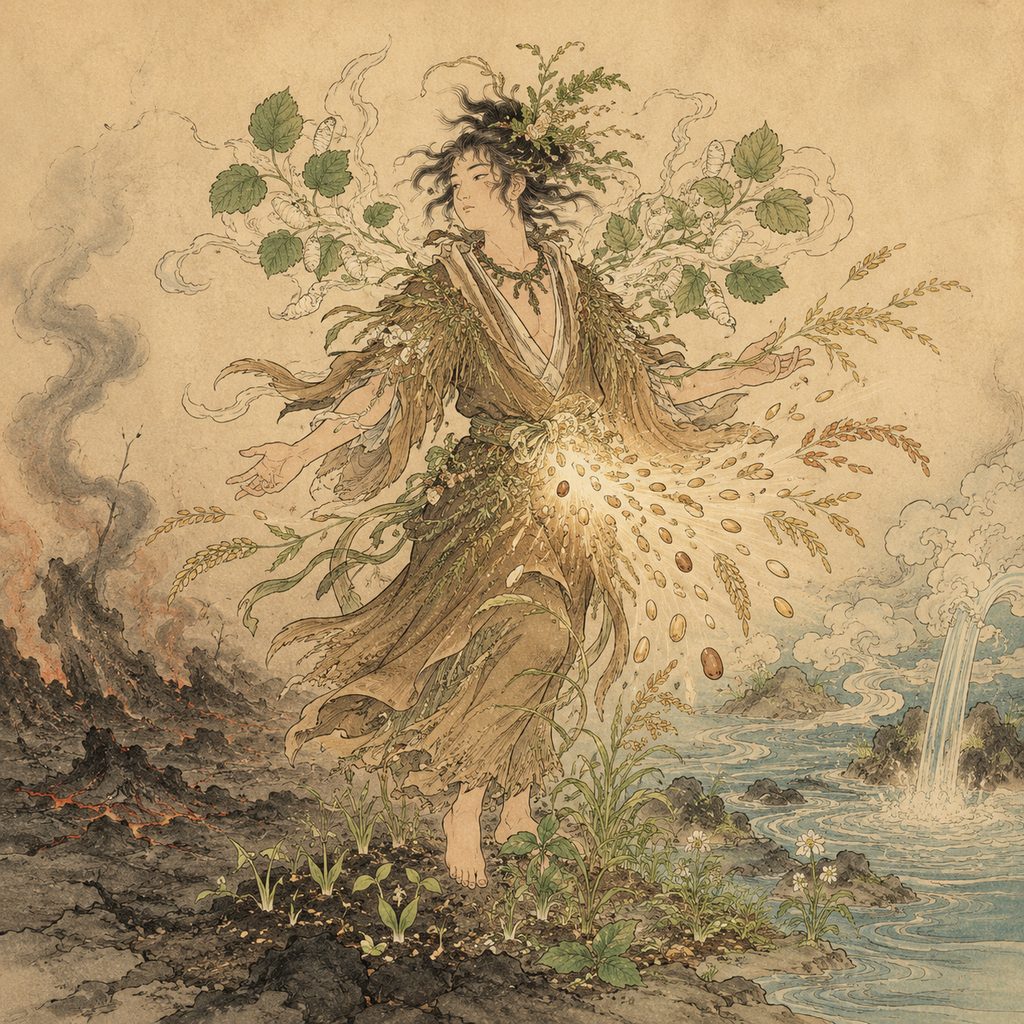
Wakumusubi-no-KamiWakumusubi-no-Kami, the Young Generative Spirit Tying Grain from Fire and Urine
わくむすひのかみ
Detailed Description
The true nature of Wakumusubi-no-Kami becomes visible not by viewing him as a frontline food deity, but as the underlying power that gives birth to food deities. In the *Kojiki*, when Izanami-no-Kami gives birth to Hinokagutsuchi-no-Kami, gets burned, and lies ill, Mitsuha-no-Me-no-Kami and Wakumusubi-no-Kami are formed from her urine—Wakumusubi-no-Kami formed from urine[1]. Here, gods do not descend from a pure sky. They arise from places close to life crises and impurity—burns, illness, and urine. Therefore, Wakumusubi-no-Kami's generative power is from the outset earthy, bodily, and close to agriculture.
The name "Waku" carries youthfulness. Using the *Nihon Shoki*'s character for "young" as a clue, Kokugakuin states that Waku means young[1] and considers "Musuhi" to be the same word as Takamimusubi-no-Kami and Kamimusubi-no-Kami. *Musuhi* is the power to generate, tie, and form things. If Takamimusubi-no-Kami and Kamimusubi-no-Kami are *Musuhi* close to the beginning of the universe, Wakumusubi-no-Kami is a young *Musuhi* standing in the scene where Izanami-no-Kami's body breaks down. Creation restarts not from completed order, but from the bottom of a wounded body.
That this deity is formed from urine is not merely a bizarre birth. Through the eyes of agriculture, urine and feces become fertilizer, water becomes irrigation, and fire leads to slash-and-burn farming and soil renewal. Kokugakuin introduces a theory viewing it as youthful agricultural productive power being born from receiving fire, fertilizer, and water, as well as a theory viewing it as a reflection of slash-and-burn agriculture—agricultural productive power born from fire, fertilizer, and water[1]. In this reading, Wakumusubi-no-Kami is not a deity who avoids impurity, but one who transforms impurity into crops. He can be said to be an existence that mythologizes the cycles at the base of life.
The *Nihon Shoki*'s Wakamusuhi demonstrates this character more concretely. Wakamusuhi is born between Kagutsuchi and Haniyamahime, and silkworms and mulberries grow on its head, and the five grains in its navel—Wakamusuhi harboring sericulture and the five grains[2]. Being born from the fire god and the earth goddess is also agricultural. The burning fire, the receiving earth, and the mulberry, silkworms, and five grains arising from there. While this differs from corpse transformation after murder like Ukemochi-no-Kami or Ogetsuhime-no-Kami, it shares a mythic sensibility that the source of food and sericulture dwells in body parts. Wakumusubi-no-Kami is the generative power at the preliminary stage of food origin myths.
The relationship with Toyoukebime-no-Kami firmly ties Wakumusubi-no-Kami to the genealogy of food deities. Kokugakuin's entry on Toyoukebime-no-Kami describes her as the child deity of Wakumusubi-no-Kami[3] and explains that "Uke" means food or rice. Toyoukebime-no-Kami is an important name when considering the later Toyouke-no-Okami faith, connecting to the realms of sacred offerings, food, and the rice spirit. As her parent deity, Wakumusubi-no-Kami does not become food himself, but bears the root function of making food form. Before the dining table is the rice paddy; before the rice paddy are water, fertilizer, and fire; and deeper still in myth stands Wakumusubi-no-Kami.
This deity also draws in readings related to water. Being formed from urine, the water goddess Mitsuha-no-Me-no-Kami being formed from the same urine, and the association of "Waku" with "springing forth" (waku) lead to theories surrounding the gushing of hot and cold springs—relationship with spring water and hot springs[1]. Just as volcanic activity shows fire and water simultaneously, in myth too, water and generative deities appear immediately after the birth of the fire god. Water and productive power emerge from a body burned by fire. This reversal well expresses the ancient sensation that resources supporting life appear after calamity.
In reading Wakumusubi-no-Kami, brevity of appearance is not a flaw. Rather, overlapping within the short description are the birth of the fire god, the death of Izanami-no-Kami, deities from excretions, Toyoukebime-no-Kami, the five grains, sericulture, slash-and-burn farming, water, and fertilizer. He is not a deity who shouts as a protagonist of a story, but one who connects multiple myths in the background. If Ukemochi-no-Kami and Ogetsuhime-no-Kami show that "food comes from the body and death," Wakumusubi-no-Kami declares that "the generative power to produce that food arises young from the depths of impurity." Therein lies the depth of the name "Young Generative Spirit" (Waku-musuhi).
Source Information
種類全体の出典primary
國學院大學古典文化学事業・豊宇気毘売神
著者: 國學院大學古典文化学事業
種類全体の出典primary
和久産巣日神 – 國學院大學「古典文化学」事業 神名データベース
著者: 國學院大學「古典文化学」事業
出版社: 國學院大學
種類全体の出典primary
日本書紀 神代上第五段一書第二・稚産霊
著者: 舎人親王ら
年代: 720
出版社: 養老四年成立の勅撰正史
バージョン固有出典 (火と尿から穀物を結ぶ若き産霊・和久産巣日神)primary
國學院大學古典文化学事業・豊宇気毘売神
著者: 國學院大學古典文化学事業
バージョン固有出典 (火と尿から穀物を結ぶ若き産霊・和久産巣日神)primary
和久産巣日神 – 國學院大學「古典文化学」事業 神名データベース
著者: 國學院大學「古典文化学」事業
出版社: 國學院大學
バージョン固有出典 (火と尿から穀物を結ぶ若き産霊・和久産巣日神)primary
日本書紀 神代上第五段一書第二・稚産霊
著者: 舎人親王ら
年代: 720
出版社: 養老四年成立の勅撰正史
Personality
A quiet deity who activates generative power in the depths of impurity, water, fire, and earth, rather than a deity who flamboyantly dispenses food. Re-ties youthful power even from a broken body, opening the path to grains and sericulture.
Compatibility
Highly compatible with contexts reading the birth of the fire god, Izanami-no-Kami's illness, agriculture, slash-and-burn farming, irrigation, fertilizer, hot springs, and the background of Toyoukebime-no-Kami and Toyouke-no-Okami.
Abilities & Skills
Weaknesses
Mythological appearances are brief, with few flamboyant anecdotes. Because his origins are tied to urine and illness, his core is difficult to see through a lens that seeks only pure fertility.
🔮Test your compatibility with Wakumusubi-no-Kami now!
Analyze your personality and values to get a detailed compatibility rating with this yokai.
Free, simple, and results in just minutes.
Like this yokai?
Visit a shrine to discover your guardian yokai