
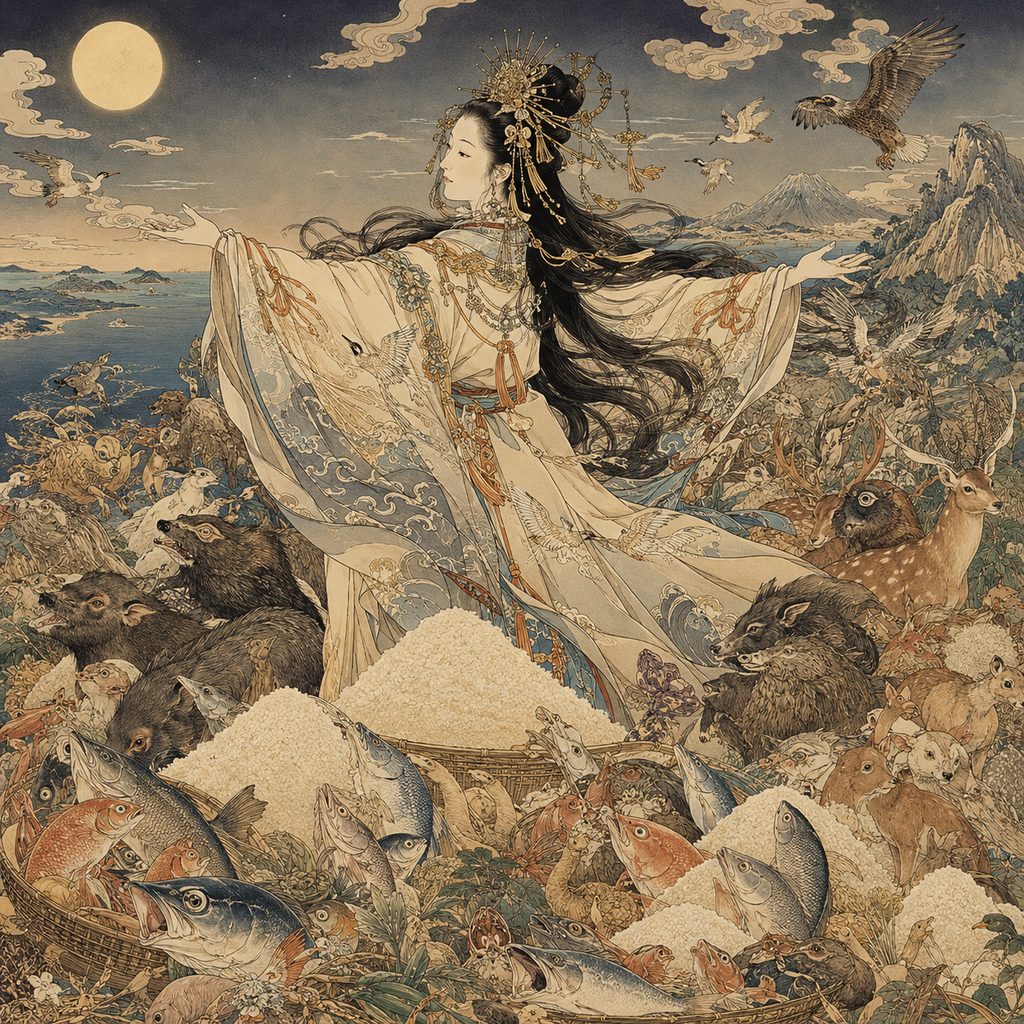
Ukemochi-no-KamiUkemochi-no-Kami, the Food Origin Deity Generating the Five Grains from Death
うけもちのかみ
Detailed Description
The core of Ukemochi lies in food being narrated not as a clean, finished product, but as something emerging from the body. Welcoming Tsukuyomi-no-Mikoto, Ukemochi does not bring rice out of a storehouse. Turning to the land, boiled rice comes from her mouth; turning to the sea, fish; turning to the mountains, beasts—food generated from the mouth[1]. This is not an act lacking courtesy, but shows that the god's body itself is the food storehouse of the mountains, sea, and land. Food in the natural world, before being arranged into the formats of human kitchens or sacred offerings, exists chaotically inside the god's body. Ukemochi offers this chaotic abundance to her guest.
However, Tsukuyomi did not see abundance there; he saw defilement. Food is the most intimate thing that sustains human life, but the moment it comes from the mouth, it takes on imagery of saliva and vomit. Myth does not hide this duality. Tsukuyomi's anger, while unreasonable, reflects the fear that food is inseparable from the body. Against a consciousness that wants to see the blessings of food only as pure offerings, Ukemochi bluntly presents the reality: to eat is inherently to touch other lives and the inside of the body. Therefore, the hospitality of this deity is a blessing, but simultaneously an unbearable proximity.
Through murder, the narrative is inverted. When Tsukuyomi strikes down Ukemochi, food does not disappear; rather, it appears as a fixed resource. Cattle and horses form from the crown of her head, millet grows from her skull, silkworms from her eyebrows, barnyard grass from her eyes, rice from her belly, and wheat, soybeans, and adzuki beans from her genitals—food generating from a corpse[1]. This enumeration of body parts assigned to livestock, grains, and sericulture is not merely a grotesque transformation. It gives mythic form to the sensation at the root of agricultural societies—that food is obtained by dismantling the life of the divine. Seeds are not pure abstractions; they come from the side of death.
The role of Amaterasu-Omikami is not merely to lament Ukemochi's death. Seeing what Ame-no-Kumahito brought back, Amaterasu receives them as things people will eat to live, dividing millet, barnyard grass, wheat, and beans as seeds for dry fields, and rice as seeds for wet paddies—seeds for dry and wet fields[1]. She further places cocoons in her mouth to draw thread, beginning the path of sericulture. Here, the result of violence is rewoven into the techniques of living by the hands of the sun goddess. Ukemochi's body becomes not just a corpse, but raw materials transferred to fields, livestock, mulberry silkworms, and seasonal labor. Amaterasu is a god who transforms what emerged from death into order.
This myth is heavy because the origin of food and the separation of sun and moon occur in the exact same scene. Hearing of Ukemochi's murder, Amaterasu rejects Tsukuyomi as an evil god and refuses to see him again. The *Nihon Shoki* narrates this as the origin of why the sun and moon came to be separated by a day and a night—the reason day and night separated[1]. That is, the establishment of a world where humans eat is also the event where the sun and moon can no longer exist in the same place. The origin of food overlaps with the origin of time. The daily routine of looking at the fields in the morning and the moon at night is a world ordered through the death of Ukemochi.
When compared to Ogetsuhime-no-Kami of the *Kojiki*, this difference becomes even clearer. The Kokugakuin University entry for Tsukuyomi notes that while the myth of a food god being murdered is also found in the *Kojiki*, there it is organized as Susanoo killing Ogetsuhime—the pattern of Susanoo and Ogetsuhime[2]. In Susanoo's case, the narrative gravity is on the violence of a rough god and the origin of grains. In Ukemochi's case, because the murderer is Tsukuyomi, the silence of the moon god, the rupture with the sun god, and the separation of day and night are unified. Despite being a similar pattern, the resonance of the myth is vastly different. Ukemochi expands the food myth all the way to the timetable of the cosmos.
Therefore, treating Ukemochi merely as a "convenient god who produces food" loses the most important darkness. Ukemochi is a god who narrates that food is always adjacent to death; that before a pure meal, there is the tearing of a body; and that an order is needed to transform that tearing into human living. When rice, millet, wheat, beans, fish, beast, and silk thread are lined up, they overlap with mythological violence and gratitude that cannot be diluted simply by the phrase "I humbly receive this life" (Itadakimasu). Ukemochi bears that overlap entirely upon herself. This is precisely why the food born from the death of this deity does not merely fill the stomach, but becomes the sustenance that supports the very world of humans living between day and night.
Source Information
種類全体の出典reference
月読命 – 國學院大學「古典文化学」事業 神名データベース
著者: 國學院大學「古典文化学」事業
出版社: 國學院大學
種類全体の出典primary
日本書紀 神代上第五段一書第十一・保食神
著者: 舎人親王ら
年代: 720
出版社: 養老四年成立の勅撰正史
バージョン固有出典 (死から五穀を生む食物起源神・保食神)reference
月読命 – 國學院大學「古典文化学」事業 神名データベース
著者: 國學院大學「古典文化学」事業
出版社: 國學院大學
バージョン固有出典 (死から五穀を生む食物起源神・保食神)primary
日本書紀 神代上第五段一書第十一・保食神
著者: 舎人親王ら
年代: 720
出版社: 養老四年成立の勅撰正史
Personality
A deity who gives excessively, offering food from her own body as hospitality. But because her fertility is too close to the body, it is misread as defilement, and only after her murder is it transformed into the order of fields and sericulture.
Compatibility
Resonates with food, agriculture, sericulture, offerings, the kitchen, corporeality, and stories of rebirth from death. She appeals to those who can look at not just purity, but the rawness and sacrifice behind food.
Abilities & Skills
Weaknesses
Because her method of generating food is too corporeal, it is rejected as defilement by those who only wish to see pure offerings. Her well-intentioned hospitality is misread as an insult, inviting violence.
🔮Test your compatibility with Ukemochi-no-Kami now!
Analyze your personality and values to get a detailed compatibility rating with this yokai.
Free, simple, and results in just minutes.
Like this yokai?
Visit a shrine to discover your guardian yokai