YOKAI.JP

高御産巣日神

たかみむすびのかみ

高御産巣日神

高御産巣日神

Their soul is listening — speak, and they will answer.

Basic Description

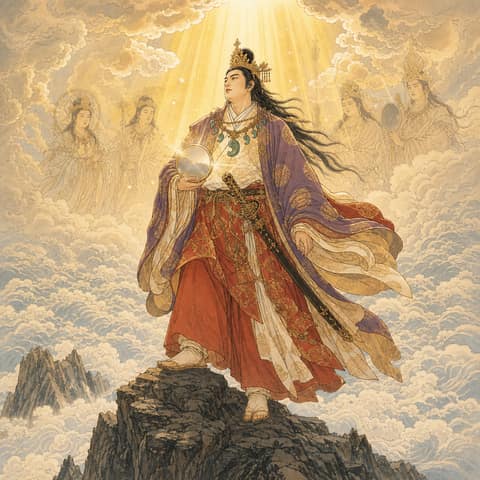
Takamimusubi-no-Kami is a deity of creation who appears at the beginning of the *Kojiki*, and later acts as the commanding deity of Takamagahara, issuing heavenly orders under the name Takagi-no-Kami. When heaven and earth first separated, Ame-no-Minakanushi was the first to appear in Takamagahara, followed by Takamimusubi, and then Kamimusubi. These three deities became hitorigami (solitary deities) and hid their forms. The divinity here is not that of a god who displays martial prowess, but something akin to the pure generative force lurking at the root of the world's formation. However, entering the pacification of Ashihara-no-Nakatsukuni (the earthly realm), this hidden creator god transforms into an entity that, alongside Amaterasu-Omikami, gathers the myriad deities, makes Omoikane deliberate, and takes measures for earthly rule. In the *Kojiki*'s episode of the returning arrow (kaeri-ya), it explicitly states that Takagi-no-Kami is another name for Takamimusubi. Thereafter, Takagi-no-Kami is involved in selecting envoys, judging the returning arrow, questioning Izumo, and ordering the Tenson Korin (Descent of the Heavenly Grandson), reinforcing Amaterasu's commands at major turning points in the myth. In the Tenson Korin, by the command of Amaterasu and Takagi-no-Kami, the mission to rule the earth is handed down first to Ame-no-Oshihomimi, and then to Ninigi-no-Mikoto. Furthermore, Ninigi is recorded as the child born from Takagi-no-Kami's daughter, Yorozuhata-Toyoakitsushi-Hime, casting Takagi-no-Kami's shadow over both command and lineage. The official explanation of the enshrined deity at Takagi Shrine notes that he is written as Takamimusubi in the *Kojiki* and Takamimusubi-no-Mikoto in the *Nihon Shoki*, and organizes it by stating that he appears under the name Takagi-no-Kami during the Tenson Korin and the pacification of Ashihara-no-Nakatsukuni. Takamimusubi is another heavenly authority behind the brilliance of the sun goddess Amaterasu, supporting decisions, dispatchments, and creation.

Folklore & Legends

The lore of Takamimusubi begins as a deity who "appears and hides." The *Kojiki*'s account of the beginning of heaven and earth states that when the world opened, Ame-no-Minakanushi, Takamimusubi, and Kamimusubi came into being in Takamagahara, designating these three as the Kotoamatsukami (Separate Heavenly Deities). The description of becoming a solitary deity and hiding one's form indicates not so much a personal divine action, but rather that the source generating the world does not leave its form on the surface of the world. While placed at the very beginning of the story, Takamimusubi temporarily retreats from the main stage.

This deity comes to the forefront again during the pacification of Ashihara-no-Nakatsukuni. When Ame-no-Oshihomimi returns after seeing the earthly turmoil, by the command of Takamimusubi and Amaterasu-Omikami, the myriad gods are gathered at the dry riverbed of Ame-no-Yasukawa, and Omoikane is made to think of a plan. Here, Amaterasu is not commanding alone. Takamimusubi stands alongside Amaterasu, opens the council, and acts as the authority determining who to send to the earth. The creator god returns to the political center of the myth.

When Ame-no-Hohi does not return, Takamimusubi and Amaterasu again question the gods. The *Kojiki* (Ashihara-no-Nakatsukuni Pacification II) records the scene where Takamimusubi and Amaterasu question the gods, and based on Omoikane's answer, Ame-no-Wakahiko is chosen. However, Ame-no-Wakahiko also marries Shitateru-Hime on earth and does not return for eight years. The development of sending the pheasant Nakime to interrogate him is a myth about heavenly commands being betrayed on earth, delayed, and eventually verified.

The episode of the returning arrow best shows the fearsomeness of Takamimusubi. The arrow Ame-no-Wakahiko shot at Nakime returns to heaven, reaching Amaterasu and Takagi-no-Kami seated at Ame-no-Yasukawa. The text reveals there that this Takagi-no-Kami is another name for Takamimusubi. Seeing blood on the arrow, Takagi-no-Kami declares that if Ame-no-Wakahiko harbors an evil heart, the arrow shall strike him, and throws the arrow back to earth. The arrow pierces the chest of the sleeping Ame-no-Wakahiko. Here, Takagi-no-Kami does not descend as a warrior, but is a deity who reads evidence, states conditions, and turns a returned weapon into judgment.

Even in the final phase of the Kuni-yuzuri (Transfer of the Land), Takagi-no-Kami's name stands alongside Amaterasu's. When Takemikazuchi and Ame-no-Torifune descend to Izumo and press Okuninushi to cede the land, the question is issued as the command of Amaterasu-Omikami and Takagi-no-Kami. Takamimusubi supports the legitimacy of the command behind the grand political myth of transferring earthly rule to the heavenly grandson. If Amaterasu's light is the visible center of the imperial ancestors, Takagi-no-Kami is the name that guarantees the command is a decision of the entirety of heaven.

In the Tenson Korin, this authority ties into both lineage and mission. Amaterasu and Takagi-no-Kami tell Ame-no-Oshihomimi that Ashihara-no-Nakatsukuni is the land he should rule, but he suggests that his newborn child, Ninigi-no-Mikoto, should descend. The text notes that Ninigi is the child born from joining with Takagi-no-Kami's daughter, Yorozuhata-Toyoakitsushi-Hime. In other words, Takagi-no-Kami is not only the commanding deity but is also involved in the maternal lineage of the descending grandson. The god of creation supports the Tenson Korin from both the aspects of political command and genealogy.

In regional faith from the early modern period onward, Takamimusubi is also enshrined in familiar shrines under the name Takagi-no-Kami. Takagi Shrine in Oshiage, Sumida Ward, Tokyo, explains its name by stating that the alternative name of its enshrined deity, Takamimusubi-no-Mikoto, is Takagi-no-Kami. In its official divine virtues, it lists the creation of all things, the fulfillment of wishes, and the successful conclusion of negotiations and consultations. The divinity that organized councils, selected envoys, and advanced earthly negotiations in ancient myth is received today as a deity who brings forth things and successfully concludes discussions.

Detailed Analysis

Takamimusubi, who issues commands as Takagi-no-Kami, has his core in the transformation of an unseen creator god into a political decision-maker. At the beginning of the *Kojiki*, Takamimusubi appears as the second deity to come into being in Takamagahara when heaven and earth began, but immediately hides his form as a solitary deity. Here, the name is placed but the form is not depicted. The power supporting the beginning of the world is shown not as personal martial prowess or emotion, but as the root action that generates existence.

However, entering the pacification of Ashihara-no-Nakatsukuni, this hidden deity emerges from silence. When Ame-no-Oshihomimi returns after seeing earthly turmoil, by the command of Takamimusubi and Amaterasu-Omikami, the myriad gods are gathered at Ame-no-Yasukawa. What is important here is that the command is issued not by Amaterasu alone, but jointly with Takamimusubi. If the sun goddess is the visible center, Takamimusubi is the unseen gravity that operates that center as a system.

The name Takagi-no-Kami is another entry point for understanding this deity. The *Kojiki* (Ashihara-no-Nakatsukuni Pacification III) explains that Takagi-no-Kami is another name for Takamimusubi in the scene where the returned arrow reaches Amaterasu and Takagi-no-Kami. The official explanation of the enshrined deity at Takagi Shrine also lists the names Takamimusubi (Kojiki), Takamimusubi-no-Mikoto (Nihon Shoki), and Takagi-no-Kami, introducing the understanding that he is the deification of a tall tree. A tall tree stretches vertically from earth to heaven. As an impression of the name, Takagi-no-Kami can be read as an axis passing heavenly commands to the earth.

In the story of the returning arrow, Takagi-no-Kami's judgment appears sharply. The arrow Ame-no-Wakahiko used to kill Nakime ascends back to heaven, reaching Takagi-no-Kami's hands stained with blood. Seeing it, Takagi-no-Kami declares that if Ame-no-Wakahiko has no evil heart, it shall not strike him, but if he does, it shall strike him, returning the arrow to earth. The arrow pierces Ame-no-Wakahiko. The fearsomeness of this scene lies in the fact that the deity does not punish out of anger, but reads the evidence, declares conditions, and reverses Ame-no-Wakahiko's own action into a judgment.

In the scene of the Kuni-yuzuri, Takagi-no-Kami acts like a signature on a command. When Takemikazuchi descends to Izumo and thrusts the question upon Okuninushi, that authority is expressed as the command of Amaterasu-Omikami and Takagi-no-Kami. This shows that the transfer of rule over Ashihara-no-Nakatsukuni is told not as mere armed force or negotiation, but as a legitimate heavenly decision. Takagi-no-Kami is not a sword-wielding deity, but stands behind the sword-bearing envoy, turning the question into a "mandate of heaven."

In the Tenson Korin, Takamimusubi's generative power also enters the lineage. Amaterasu and Takagi-no-Kami try to send Ame-no-Oshihomimi down to the pacified Ashihara-no-Nakatsukuni, but he suggests sending his newborn child, Ninigi-no-Mikoto. The text places Ninigi as the child born from Takagi-no-Kami's daughter, Yorozuhata-Toyoakitsushi-Hime. Takagi-no-Kami not only issues commands but is also involved in the maternal lineage of the heavenly grandson. Here, "generation" and "rule" are not separate. Being born itself creates the legitimacy to descend to earth.

The divinity of Takamimusubi resonates well with Omoikane. In the pacification of Ashihara-no-Nakatsukuni, Omoikane confers with the gods and undertakes the judgment of selecting envoys. Takamimusubi calls upon that thinking and stands on the side of convening the heavenly council. The god of wisdom devises the strategy, and the god of creation establishes the space for council and command. Reading this relationship, the politics of Takamagahara appears not as the single shout of a hero god, but as a system where generation, light, wisdom, force, and negotiation overlap and operate.

It is natural as a reading of the myth that Takagi-no-Kami is connected to the divine virtues of "creation of all things" and "successful consultations" in modern faith. The official divine virtues of Takagi Shrine list creation of all things, fulfillment of wishes, negotiations, and successful consultations for Takamimusubi. Looking at the generation at the beginning of heaven and earth, the council at Ame-no-Yasukawa, the dispatch of envoys, the Kuni-yuzuri, and the Tenson Korin as a single flow, this deity is not only a god who "births something" but a god who "places what is born into order." Takamimusubi is the generation before light, the consensus behind commands, and the deity who reties the story descending to earth from heaven.

Character Profile

This section is our own creative profile for storytelling. It is not historical fact or scholarship.

Yokai Type
Kami
Rarity
Divine
Personality
Without flaunting his presence, he issues commands only when necessary. A deity who quietly connects generative power, councils, dispatchments, and judgments, passing heavenly decisions down to earth.
Compatibility
Deeply compatible with planning, negotiations, organizational management, entrepreneurship, research, system design, mediation, inheritance, and work that passes families or projects on to the next generation.
Abilities
Generation at the Beginning of Heaven and EarthHiding of the KotoamatsukamiCommands of Takagi-no-KamiConvening the Ame-no-Yasukawa CouncilSelecting EnvoysJudgment of the Returning ArrowLegitimizing the Kuni-yuzuriLineage Support for the Tenson Korin
Weaknesses
Not a deity who personally steps to the forefront to embellish the story. In places where councils, evidence, and legitimacy are slighted, this power is hard to see.
Habitat
Takamagahara, the riverbed of Ame-no-Yasukawa, the heavenly councils surrounding the pacification of Ashihara-no-Nakatsukuni, the command scene of the Tenson Korin, and Takagi Shrine.
For more detailed information and diagnosis results about 高木神として命を下す造化神・高御産巣日神, please click here.

Sources & References

9
  1. 古事記ビューアー・天地初発國學院大學古典文化学事業(國學院大學) [古典文献]高御産巣日神が天地初発に成る神として現れ、別天神・独神・隠身として置かれる古事記本文と注釈。
  2. 古事記ビューアー・葦原中国平定③國學院大學古典文化学事業(國學院大學) [古典文献]高木神が高御産巣日神の別名であること、天若日子の返り矢の裁きが語られる古事記本文。
  3. 古事記ビューアー・天孫降臨①國學院大學古典文化学事業(國學院大學) [古典文献]天照大御神・高木神の命による天孫降臨、瓊瓊杵命と高木神の女・万幡豊秋津師比売命の系譜を確認する古事記本文。
  4. 高木神社公式・御祭神高木神社(高木神社) [神社公式]高皇産靈神を御祭神として掲げ、高御産巣日神・高皇産霊尊・高木神の名と、造化神としての性格を説明する公式ページ。
  5. 古事記ビューアー・葦原中国平定①國學院大學古典文化学事業(國學院大學) [古典文献]高御産巣日神と天照大御神が天安河に八百万の神々を集め、思金神に葦原中国平定の方策を考えさせる場面。
  6. 古事記ビューアー・葦原中国平定②國學院大學古典文化学事業(國學院大學) [古典文献]高御産巣日神と天照大御神が天菩比神・天若日子の不復奏を受けて諸神に問い、鳴女派遣へ進む場面。
  7. 古事記ビューアー・葦原中国平定⑤國學院大學古典文化学事業(國學院大學) [古典文献]建御雷神が出雲へ降り、天照大御神・高木神の命として大国主神へ国譲りを問う場面。
  8. 高木神社公式・御由緒高木神社(高木神社) [神社公式]高木神社の創祀、社名変更、御祭神である高皇産靈神の別名「高木の神」に由来する社名を説明する公式由緒。
  9. 高木神社公式・御神徳高木神社(高木神社) [神社公式]高皇産靈神の神徳として万物生成、心願成就、交渉・相談事の成就などを掲げる高木神社公式ページ。

Interested in this type of yokai?

Discover the yokai most similar to your personality with our yokai diagnosis

Start Yokai Diagnosis

Meet your guardian yokai at the shrine

Draw an omikuji fortune and discover the yokai watching over you today.