YOKAI.JP

Takuhatachijihime

よろずはたとよあきつしひめのみこと

Takuhatachijihime

Takuhatachijihime

Their soul is listening — speak, and they will answer.

Basic Description

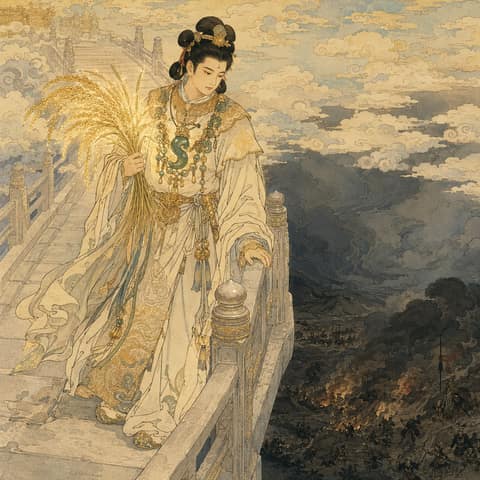
Takuhatachijihime (Yorozuhata-Toyoakitsushi-Hime-no-Mikoto) appears in the *Kojiki* account of the Tenson Korin (the descent of the heavenly grandchild) as the daughter of Takagi-no-Kami (Takamimusubi). She is the heavenly goddess who gave birth to Ame-no-Honoakari-no-Mikoto and Hikoho-no-Ninigi-no-Mikoto with Ame-no-Oshihomimi. In the text, when Ame-no-Oshihomimi, acting on the orders of Amaterasu and Takagi-no-Kami, reports that a child was born while he was preparing to descend, the name of Takagi-no-Kami's daughter, Yorozuhata-Toyoakitsushi-Hime is introduced as the child's mother. Thus, she is not merely inserted as the "mother of Ninigi", but serves as the crucial node connecting the bloodline of Amaterasu's child, Ame-no-Oshihomimi, with the lineage of Takamimusubi, converging in the heavenly grandchild. The Kokugakuin University Deity Name Database also summarizes her as the daughter of Takagi-no-Kami, who bore two deities with Ame-no-Oshihomimi. Since one of these two deities, Ame-no-Honoakari, branches off into a different lineage, while Ninigi proceeds with the Tenson Korin, her motherhood is not just a single familial relationship but the very point where multiple lineages of heavenly descendants diverge. The database explains that the word "hata" (幡) in her name is related to woven cloth or weaving. In various versions of the myths, names containing "hata", such as Takuhatachijihime, Yorozuhatabime, and Amayorozutakuhatachihatahime, overlap. Even if her name fluctuates across the different versions of the *Nihon Shoki*, her outline as the mother of the heavenly grandchild and a goddess of "hata" (cloth/weaving) is maintained. Therefore, her brief appearance causes the heavenly grandchild to be read not as a single hero, but as an existence woven from multiple heavenly authorities. The metaphor of weaving echoing behind her name expresses this role well. Just as threads cross to form cloth, Takuhatachijihime weaves together Amaterasu's light, Takagi-no-Kami's generative power, Ame-no-Oshihomimi's succession, and Ninigi's descent.

Folklore & Legends

The traditions of Takuhatachijihime are not long adventure stories, but are condensed into brief descriptions that determine the lineage of the Tenson Korin. In the first part of the Tenson Korin in the *Kojiki*, after the pacification of Ashihara-no-Nakatsukuni is complete, Amaterasu and Takagi-no-Kami order Ame-no-Oshihomimi to descend. However, Ame-no-Oshihomimi states that a child was born while he was preparing to descend, and suggests that this child should be sent down. Here, the text states that this child was born by joining with Takagi-no-Kami's daughter, Yorozuhata-Toyoakitsushi-Hime, and that they are the two deities Ame-no-Honoakari and Ninigi. Her name appears only for a moment, but through that instant, the heavenly grandchild inherits not only Amaterasu's lineage but also Takamimusubi's lineage.

Another core aspect of this goddess lies in the very fluctuation of her name. The Kokugakuin University Deity Name Database lists her names in the *Nihon Shoki*: Takuhatachijihime in the main text of Book IX, Yorozuhata-Toyoakitsuhime in the first alternate writing, Yorozuhatabime in the second and seventh, and Takuhatachijihime-Yorozuhatabime-no-Mikoto, Amayorozutakuhatachihatahime, and Takuhatachihatahime in the sixth. While the name changes depending on the version, the repetition of the word "hata" (cloth/loom) remains constant. This indicates that tradition remembered the mother of the heavenly grandchild not just as a biological mother, but as a goddess bearing the symbolism of cloth and weaving.

The interpretation of her name places her on the boundary between fertility and weaving. The various theories section of the database introduces a theory viewing "Yorozuhata" as meaning "many pieces of cloth", taking "hata" as woven cloth. Regarding "Toyoakitsushi", theories suggest "Toyo" is an honorific and "akitsu" a metaphor for dragonflies or fine cloth, or that it implies fertility, similar to Oyamato-Toyoakitsushima (Great Yamato, the Fertile Island of Dragonflies). The Tenson Korin is a myth of the heavenly grandchild descending to a land rich in rice ears; the inclusion of a mother goddess with a name signifying cloth, banners, and fertility ("Toyoakitsu") superimposes earthly abundance with heavenly lineage.

In the context of the *Kojiki*, Takuhatachijihime connects the two centers of Amaterasu and Takamimusubi. Ame-no-Oshihomimi, Amaterasu's child, does not descend to earth alone, but passes the mission to Ninigi, his child with Takagi-no-Kami's daughter. The Deity Name Database introduces a classification viewing the *Kojiki*'s Tenson Korin myth, where both Amaterasu and Takamimusubi appear, as an intermediary tradition between the Amaterasu and Takamimusubi lineages. She is a goddess who personifies that "intermediary", weaving the legitimacy of the heavenly grandchild from both the paternal and maternal sides.

In later rituals, this name does not remain a mere footnote in myth. The Deity Name Database notes that the *Kotai Jingu Gishikicho* (Record of Ceremonies of the Grand Shrine) from the early Heian period records that Yorozuhata-Toyoakitsuhime is enshrined in the same hall as Amaterasu-Sume-Okami, alongside Ame-no-Tajikarao. Furthermore, Tsubaki Grand Shrine in Suzuka City, Mie Prefecture, officially states that it enshrines the heavenly grandchild Ninigi-no-Mikoto and Takuhatachijihime-no-Mikoto in the *aidono* (companion shrine) of its principal deity, Sarutahiko-Okami. The fact that the mother of the heavenly grandchild is enshrined alongside him in the shrine of Sarutahiko, who guides the Tenson Korin, shows that the deities of the descent myth continue to resonate with each other within current spaces of worship.

Related Yokai

Yokai deeply tied to this one in legend.

Detailed Analysis

The key to deeply understanding Takuhatachijihime lies in the fact that she is an "unspoken center". In the main text of the *Kojiki*, she only appears in the lineage explaining the transition from Ame-no-Oshihomimi to Ninigi-no-Mikoto, without speaking a word. Yet, for the protagonist of the Tenson Korin to shift from Ame-no-Oshihomimi to Ninigi, her existence is indispensable. Amaterasu's child does not descend directly; instead, the child born with Takagi-no-Kami's daughter, Yorozuhata-Toyoakitsushi-Hime descends. By this single sentence, the heavenly grandchild becomes a direct descendant of the sun goddess while simultaneously inheriting the blood of the creator god Takamimusubi.

Therefore, defining her divinity merely with the word "mother" is too narrow. Ame-no-Oshihomimi is established as Amaterasu's child through the *ukehi* and chosen as the prince to rule Ashihara-no-Nakatsukuni. Meanwhile, Takagi-no-Kami issues commands alongside Amaterasu during the pacification, reinforcing heavenly political authority. Takuhatachijihime connects these two authorities through marriage and childbirth, integrating them into the person of Ninigi-no-Mikoto. She is not a god who commands from the front, but acts as the "loom of lineage" establishing the legitimacy of the Tenson Korin.

The strong presence of weaving in her name resonates well with this role. The Kokugakuin University Deity Name Database explains that the "hata" in "Yorozuhata" refers to woven cloth, and that "hata" can also indicate weaving itself. Cloth is not a single thread. Only when the warp and weft intersect and repeat does it become a surface. Takuhatachijihime's function in myth is similar. She layers Amaterasu's lineage and Takamimusubi's lineage, heavenly commands and earthly fertility, the branching lineage of Ame-no-Honoakari and the royal lineage continuing to Ninigi, like a single piece of woven cloth.

The abundance of variant names does not just blur her image; rather, it indicates the thickness of the myth's ancient layers. The database organizes the names appearing in the *Nihon Shoki*, such as Takuhatachijihime, Yorozuhatabime, and Amayorozutakuhatachihatahime, emphasizing that they all share "hata" (cloth/loom) in their names. *Taku* (paper mulberry) evokes the material of cloth, while *chiji* (thousand, thousand) suggests fine layering. Although Yorozuhata and Takuhatachiji may not share exactly the same etymology, the perception of the heavenly grandchild's mother as a "cloth-making woman" is universal.

Furthermore, she simultaneously gives birth to two streams: Ame-no-Honoakari and Ninigi-no-Mikoto. The first part of the Tenson Korin in the *Kojiki* lists Ame-no-Honoakari-no-Mikoto. Next, Hikoho-no-Ninigi-no-Mikoto, two deities, and it is the latter who descends. This order suggests that the Tenson myth is not a monolith, but encompasses multiple clan memories and divine lineages. Because Takuhatachijihime is placed at this branching point, reading her is also reading how the Tenson Korin myth wove multiple lineages together.

Her connection to the Amaterasu faith cannot be overlooked. The database notes that the *Kotai Jingu Gishikicho* describes Yorozuhata-Toyoakitsuhime being enshrined in the same hall as Amaterasu-Sume-Okami, and presents a theory viewing the deity of "Yorozuhata" as a weaving goddess connected to Amaterasu worship. This shows that the mother of the heavenly grandchild was not merely understood as a daughter of Takamimusubi, but was a deity who entered Amaterasu's ritual space. Just as the death of the weaving maiden brought darkness in the Heavenly Rock Cave myth, weaving and the order of the sun are deeply intertwined in Takamagahara.

The rituals at Tsubaki Grand Shrine transfer this divinity to the present space of worship. The shrine explains that it enshrines the principal deity Sarutahiko-Okami, and in the *aidono* (companion shrine), it enshrines Ninigi-no-Mikoto and Takuhatachijihime-no-Mikoto. Sarutahiko is the god who guides the Tenson Korin, and Ninigi is the descending heavenly grandchild. When the mother goddess is enshrined beside them, the descent is seen not as a mere movement, but as an order passed down like cloth from mother to child, from heaven to earth. Takuhatachijihime has a quiet voice in the story, but she is the goddess who supports the very weave of the Tenson myth.

Character Profile

This section is our own creative profile for storytelling. It is not historical fact or scholarship.

Yokai Type
Kami
Rarity
Divine
Personality
Rather than stepping forward to issue commands, she quietly ties the threads of lineage, ritual, and fertility, weaving multiple divine genealogies into a single myth of descent.
Compatibility
Resonates deeply with the deities who support the legitimacy of the Tenson Korin, such as Amaterasu-Omikami, Takamimusubi, Ame-no-Oshihomimi, and Ninigi-no-Mikoto.
Abilities
Medium of Lineage Connecting Amaterasu and TakagiMotherhood Branching the Heavenly Descendants (Honoakari and Ninigi)Order Formation Symbolized by Banners, Cloth, and WeavingPower Supporting Tenson Legitimacy from the Maternal SideFertility and National Omen Dwelling in the Name ToyoakitsuRitual Nature Connecting Amaterasu and Weaving Goddess Worship
Weaknesses
She has few spoken lines or independent actions in the narrative, and materials directly depicting her appearance or personality are limited. The outline of her divinity must be read carefully from lineages, divine names, and ritual examples.
Habitat
Her name remains in the lineage of heavenly descendants in Takamagahara, the maternal line of the Tenson Korin myth, and the ritual spaces around Ise and Suzuka.
For more detailed information and diagnosis results about Takuhatachijihime, the Mother Goddess Who Weaves the Heavenly Grandchild, please click here.

Sources & References

3
  1. 古事記ビューアー・天孫降臨①國學院大學古典文化学事業(國學院大學) [古典文献] Reference天照大御神・高木神が天忍穂耳命に降臨を命じ、天忍穂耳命が御子・瓊瓊杵命を降すべきだと申す場面。
  2. 神名データベース・万幡豊秋津師比売命國學院大學古典文化学事業(國學院大學) [研究データベース]万幡豊秋津師比売命の読み、他文献での異名、梗概、神名解釈、皇太神宮儀式帳での祭祀例を整理する神名データベース項目。
  3. 椿大神社について・御創立の由来椿大神社(椿大神社) [神社公式資料] Secondary椿大神社の御祭神説明。相殿に瓊々杵尊と栲幡千々姫命を祀ると明記する公式ページ。

Interested in this type of yokai?

Discover the yokai most similar to your personality with our yokai diagnosis

Start Yokai Diagnosis

Meet your guardian yokai at the shrine

Draw an omikuji fortune and discover the yokai watching over you today.