YOKAI.JP

Tsubaki Okami Yashiroつばきおおかみやしろ

2 yokai rooted in Tsubaki Okami Yashiro. Explore the legends tied to this land.

  • Takuhatachijihime

    Takuhatachijihime

    Divine

    よろずはたとよあきつしひめのみこと

    Takuhatachijihime, the Mother Goddess Who Weaves the Heavenly Grandchild

    神霊・神格Takamagahara / Tsubaki Grand Shrine (Present-day Yamamoto-cho, Suzuka City, Mie Prefecture)

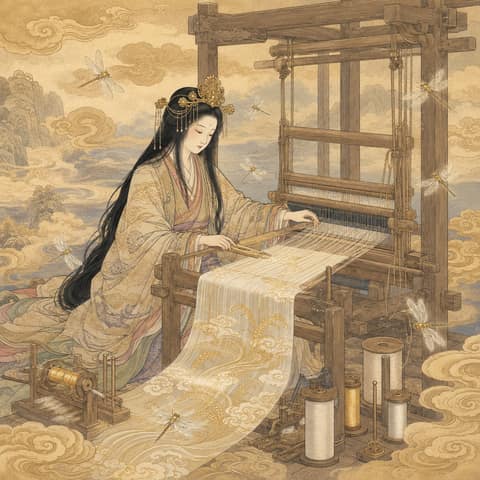
    The key to deeply understanding Takuhatachijihime lies in the fact that she is an "unspoken center". In the main text of the *Kojiki*, she only appears in the lineage explaining the transition from Ame-no-Oshihomimi to Ninigi-no-Mikoto, without speaking a word. Yet, for the protagonist of the Tenson Korin to shift from Ame-no-Oshihomimi to Ninigi, her existence is indispensable. Amaterasu's child does not descend directly; instead, the child born with Takagi-no-Kami's daughter, Yorozuhata-Toyoakitsushi-Hime descends. By this single sentence, the heavenly grandchild becomes a direct descendant of the sun goddess while simultaneously inheriting the blood of the creator god Takamimusubi. Therefore, defining her divinity merely with the word "mother" is too narrow. Ame-no-Oshihomimi is established as Amaterasu's child through the *ukehi* and chosen as the prince to rule Ashihara-no-Nakatsukuni. Meanwhile, Takagi-no-Kami issues commands alongside Amaterasu during the pacification, reinforcing heavenly political authority. Takuhatachijihime connects these two authorities through marriage and childbirth, integrating them into the person of Ninigi-no-Mikoto. She is not a god who commands from the front, but acts as the "loom of lineage" establishing the legitimacy of the Tenson Korin. The strong presence of weaving in her name resonates well with this role. The Kokugakuin University Deity Name Database explains that the "hata" in "Yorozuhata" refers to woven cloth, and that "hata" can also indicate weaving itself. Cloth is not a single thread. Only when the warp and weft intersect and repeat does it become a surface. Takuhatachijihime's function in myth is similar. She layers Amaterasu's lineage and Takamimusubi's lineage, heavenly commands and earthly fertility, the branching lineage of Ame-no-Honoakari and the royal lineage continuing to Ninigi, like a single piece of woven cloth. The abundance of variant names does not just blur her image; rather, it indicates the thickness of the myth's ancient layers. The database organizes the names appearing in the *Nihon Shoki*, such as Takuhatachijihime, Yorozuhatabime, and Amayorozutakuhatachihatahime, emphasizing that they all share "hata" (cloth/loom) in their names. *Taku* (paper mulberry) evokes the material of cloth, while *chiji* (thousand, thousand) suggests fine layering. Although Yorozuhata and Takuhatachiji may not share exactly the same etymology, the perception of the heavenly grandchild's mother as a "cloth-making woman" is universal. Furthermore, she simultaneously gives birth to two streams: Ame-no-Honoakari and Ninigi-no-Mikoto. The first part of the Tenson Korin in the *Kojiki* lists Ame-no-Honoakari-no-Mikoto. Next, Hikoho-no-Ninigi-no-Mikoto, two deities, and it is the latter who descends. This order suggests that the Tenson myth is not a monolith, but encompasses multiple clan memories and divine lineages. Because Takuhatachijihime is placed at this branching point, reading her is also reading how the Tenson Korin myth wove multiple lineages together. Her connection to the Amaterasu faith cannot be overlooked. The database notes that the *Kotai Jingu Gishikicho* describes Yorozuhata-Toyoakitsuhime being enshrined in the same hall as Amaterasu-Sume-Okami, and presents a theory viewing the deity of "Yorozuhata" as a weaving goddess connected to Amaterasu worship. This shows that the mother of the heavenly grandchild was not merely understood as a daughter of Takamimusubi, but was a deity who entered Amaterasu's ritual space. Just as the death of the weaving maiden brought darkness in the Heavenly Rock Cave myth, weaving and the order of the sun are deeply intertwined in Takamagahara. The rituals at Tsubaki Grand Shrine transfer this divinity to the present space of worship. The shrine explains that it enshrines the principal deity Sarutahiko-Okami, and in the *aidono* (companion shrine), it enshrines Ninigi-no-Mikoto and Takuhatachijihime-no-Mikoto. Sarutahiko is the god who guides the Tenson Korin, and Ninigi is the descending heavenly grandchild. When the mother goddess is enshrined beside them, the descent is seen not as a mere movement, but as an order passed down like cloth from mother to child, from heaven to earth. Takuhatachijihime has a quiet voice in the story, but she is the goddess who supports the very weave of the Tenson myth.
  • Sarutahiko-no-Mikoto

    Sarutahiko-no-Mikoto

    Legendary

    さるたひこのみこと

    Grotesque Guiding God of the Tenson Korin / Sarutahiko-no-Mikoto

    Divine Spirit / DeityUpper reaches of the Isuzu River in Ise Province (present-day Ise City, Mie Prefecture) / Azaka (present-day Matsusaka City, Mie Prefecture, place of drowning) / Sarutahiko Shrine

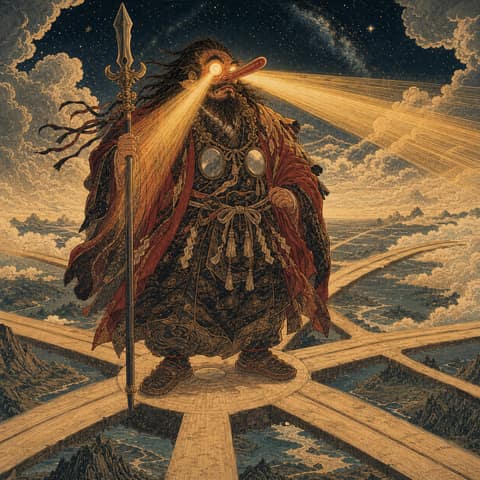
    Special Position in Ancient Mythology as the 'Grotesque Guiding God'. While the basic description touches on Sarutahiko-no-Mikoto's main myth, this detailed explanation delves into his unique position as a 'grotesque guiding god' in ancient Japanese mythology. His bizarre appearance, with a nose seven ata long and eyes shining like the Yata-no-Kagami, is extremely visual and concrete even among the descriptions of deities in ancient myths, serving as the ultimate religious expression of 'a deity standing at the boundary between the otherworld and this world.' The fact that such a strong contrast between the noble Amaterasu-lineage deities and a grotesque Kunitsukami was placed at the core moment of the Tenson Korin, the central ancient Japanese state myth, can be interpreted as an intentional narrative device by the myth's compilers. Grotesqueness is not just visual oddity; it is the concrete embodiment of universal religious feelings such as protection from the otherworld, crossing boundaries, and reconciling with the heterogeneous. Prototype of the Tengu ── Development into Shugendo and Mountain Beliefs. Sarutahiko-no-Mikoto's grotesque description (long nose, red face, glowing eyes) is folklorically positioned as the prototype of the later Tengu (shugendo-related mountain yokai). The Tengu beliefs of the Heian and medieval periods inherited Sarutahiko's grotesque nature while intricately intertwining with Buddhism, shugendo, and mountain worship to undergo unique development. The hierarchical system of Tengu, such as Daitengu, Karasu Tengu, and Konoha Tengu, can be understood as the medieval refinement of the 'grotesque deity' originating from the ancient Sarutahiko. The relationship between Sarutahiko and the Tengu is a crucial genealogical theory in Japanese yokai studies, serving as core material for examining the continuity between ancient mythology and medieval yokai culture. Reconciliation and Cooperation between 'Amatsukami and Kunitsukami'. In the political and religious event of the Tenson Korin, where 'Amatsukami (deities of the heavenly realm) descend into the territory of Kunitsukami (deities of the earthly realm),' Sarutahiko-no-Mikoto stands out as a rare Kunitsukami who proactively welcomed the Amatsukami. In contrast to Okuninushi's yielding of the land, which was a 'forced transfer,' Sarutahiko's guidance occupies the contrasting position of 'voluntary cooperation.' This represents two aspects of religious integration between the center (Amatsukami lineage) and the periphery (Kunitsukami lineage) in ancient Japan. The contrast between forced integration (Okuninushi) and voluntary cooperation (Sarutahiko) reflects the editorial intent of the ancient state myths and the complex multiplicity of ancient Japanese political history. The Tragedy of the Hirabu-gai ── Vulnerability of the Deity and the Meaning of His End. The ending where Sarutahiko-no-Mikoto drowns after being caught by a hirabu-gai is a unique tale in ancient mythology that expresses the vulnerability of deities, human contingency, and the unknowability of fate. The ironic conclusion in which the great guiding god receives a fatal wound from a small natural object like a shell mythologizes universal themes in ancient Japan, such as 'confrontation with nature,' 'the limits of heroes,' and 'the unknowability of fate.' Furthermore, the specific circumstance of 'an accidental death while fishing' includes a religious reflection of marine, fishing, and coastal life in ancient Japan, symbolically demonstrating Sarutahiko's essence as a god standing at the boundary of sea and land, the intersection of life and death. The ending of the myth is not merely a tragedy but an advanced symbolic device that narrates the essential attributes of the deity. The Core of Doso-jin and Crossroads Deity Beliefs ── The Heart of Nationwide Folklore. From the Middle Ages onwards, Sarutahiko-no-Mikoto was widely venerated as the guardian deity of village boundaries, crossroads, mountain passes, and barriers through syncretism with Doso-jin, Funado-no-Kami, and Sae-no-Kami. The fact that Sarutahiko is positioned at the center of folk religion, such as Doso-jin stone monuments, phallic stones, crossroads Jizo, and Sae-no-Kami festivals distributed nationwide, demonstrates the continuous inheritance from ancient state myths to medieval folk religion. Doso-jin worship is not merely a religious ritual but a folkloric practice that gives meaning to universal anthropological themes of 'boundaries, new beginnings, protection, and harmony' through ancient myths. As a deity supporting the roots of Japanese people's sense of life, movement, and boundaries from ancient times to the present, Sarutahiko possesses a cultural reach that transcends a single deity appearing in a myth. Association with Koshin Belief ── Popular Religion in the Edo Period. During the Edo period, due to the phonetic association of 'Saru' (monkey) in Sarutahiko, he was linked to the Koshin belief (originating from Chinese Daoism, involving an all-night gathering every 60 days to defeat the Three Corpses), and Koshin towers, Sarutahiko Koshin mounds, and the three wise monkeys (see no evil, hear no evil, speak no evil) spread nationwide. This is a representative example of the multilayered fusion of ancient mythology, medieval Doso-jin, early modern Daoism, and Edo popular religion, demonstrating the typical Japanese religious culture of 'syncretism through phonetic association.' The combination of Koshin and Sarutahiko beliefs functioned as a core institution supporting the collective religious life, village society, and nighttime socializing of commoners in the Edo period, leaving traces in the modern landscape of the three wise monkeys and Koshin mounds. Sarutahiko-no-Mikoto in the 21st Century ── Modern God of Travel, Guidance, and New Beginnings. Today in the 21st century, Sarutahiko-no-Mikoto is widely cherished as the god of 'roads, travel, new beginnings, and guidance,' serving as an object of prayer for new car purchases, traffic safety, starting new businesses, safe travels, and major life milestones. Pilgrimages to Tsubaki Grand Shrine, Sarutahiko Shrine, and Futamiokitama Shrine continue ancient customs, and the religious structure of the ancient myth of 'visiting Amaterasu-Omikami under the guidance of the guiding god' has been inherited to this day. Even in a modern society marked by globalization, informatization, and individualization, the universal theme of 'life's paths, choices, and guidance' continues to impart new modern meanings to the ancient guiding god. As a rare deity whose presence bridges ancient mythology and modern Japanese spiritual culture for over two thousand years, he bears a living inheritance in religion, culture, and tourism in the 21st century.