Takiyasha-hime
takiyasha-hime
The Sorceress Princess of Soma's Ruined Palace: Takiyasha-hime
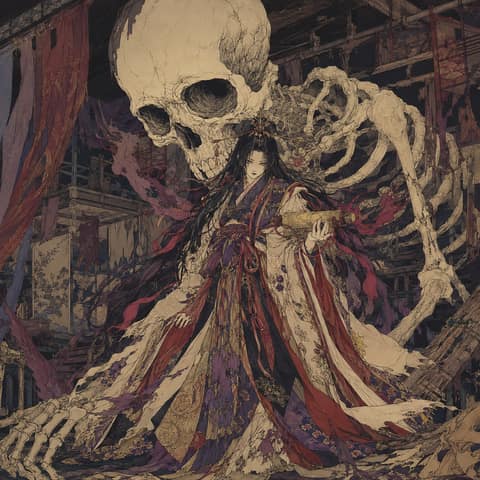
In this version, we read Takiyasha-hime as "the sorceress princess of the ruined palace of Soma." She is not a figure directly copied from the historical daughter of Masakado, but a being born when the imagination of yomihon and theatre seeped into the blanks of the Masakado legend. Therefore, to understand Takiyasha-hime, one must look not only at whether she existed, but why later generations needed her. The story of Takiyasha-hime concentrates the memory of the defeated onto female sorcery. Taira no Masakado is a rebel, a vengeful spirit, and also a hero of the eastern provinces. The princess, said to be his daughter, inherits her father's defeat and aims for a resurgence from the ruins. Here, sorcery works not merely as magic, but as a power to call a lost political dream back to the stage. Kuniyoshi's "Soma no Furudairi" pushed this princess to the center of yokai iconography. The giant skeleton can be read on a narrative level as a summoned beast, but looking deeper, it is also a visualization of the dead and the grudges accumulated in the ruins of Soma. With the skeleton standing behind the princess, personal revenge expands into the memory of a clan and a battlefield. The charm of Takiyasha-hime lies in the fact that fear and beauty are not separated. She does not merely attack like a demoness; she simultaneously wears the pride of a ruined house, the loneliness of a woman, the glamour of sorcery, and the darkness of the ruins. The viewer cannot process her merely as a villain. This is because the story of the defeated side rises up along with the skeleton. Takiyasha-hime in this version is not a historical figure, but a phantom born of history. Departing from historical fact does not mean her value is low. Rather, she is important in showing what people saw in the gaps of history. In the place where the darkness of Soma's ruined palace, Masakado's name, and the iconography of the giant skeleton overlap, Takiyasha-hime transforms the memory of defeat into a yokai-like beauty. Takiyasha-hime is also unique as a female sorcery-user. Instead of a male warrior taking revenge with a sword, the princess uses ruins, curses, and phantoms. This can be read as a story where the defeated, stripped of direct military power, regains power in another form. Her sorcery is not the flip side of weakness, but an alias for lost power. The stage of Soma no Furudairi strongly supports her existence. "Dairi" (palace) is originally a word evoking the center of political power. Yet it has become old, ruined, and a nest of anomalies. Takiyasha-hime is a princess standing in a ruined political space, and with the appearance of the giant skeleton there, the dead of the past return to the stage of power once more. In this version, we do not confine Takiyasha-hime as an "evil woman." She is clad in rebellion and grudges, but behind her is her defeated father, the memory of her clan, and the pride of the eastern provinces. This is precisely why the viewer feels regret along with fear. Takiyasha-hime, before being a sorceress to be struck down, is first and foremost another stage dreamed of by the side defeated by history. Takiyasha-hime, having passed through Kuniyoshi's brush, transcended being a character in a story to become a yokai of the visual itself. The composition of the princess standing before a giant skeleton is unforgettable once seen. There, before the logic of text, defeat, death, and beauty bear down as a single picture.