Nyozō and the Quiet Religious Tale
Following Takiyasha-hime’s story back to its deeper layers leads first not to a ruined palace or a gigantic skeleton but to Nyozō. Nyozō appears in Book 17, Tale 29 of the *Konjaku Monogatari-shū*[1] as a woman who lives near Enichi-ji in Mutsu Province, becomes a nun, and worships Jizō. She is identified as the third daughter of Taira no Masayuki and is the protagonist of a tale in which faith brings salvation.
In the entry on Nyozō in Book 18 of the *Genkō Shakusho*[2], her father changes to Taira no Masakado. The medieval Buddhist history gives her a new genealogy: after Masakado’s death in defeat, his daughter flees to Ōshū and becomes a nun. Neither the name Takiyasha-hime nor sorcery has appeared, but the idea that Masakado’s daughter survived left fertile space for later storytellers.
Nyozō’s quiet prayer and Takiyasha-hime’s later violent rebellion do not belong to the same scene. Between them lie centuries in which Masakado’s defeat was repeatedly retold. Takiyasha-hime is compelling not because a fully formed yokai remained unchanged from antiquity, but because the tale of a nun eventually acquired an entirely different and dramatic life.
Takiyasha-hime Takes Her Stand in 1806
In 1806, the first part of *Uto Yasukata Chūgiden*, written by Santō Kyōden and illustrated by Utagawa Toyokuni, was published[3]. The ruined Sōma Palace, Masakado’s surviving children, and toad magic were woven into one long narrative. Nun Kisaragi enters the rebellion under the name “Takiyasha-hime,” written 滝夜刃姫. The figure known today as Takiyasha-hime first assumes a clear outline in this early modern yomihon.
According to Takagi’s research, Kyōden drew on the *Genkō Shakusho* and *Zen Taiheiki* to connect Taira no Yoshikado, Nikushisen, Nun Kisaragi, and Takiyasha-hime[4]. Yoshikado is the central figure who receives toad magic from Nikushisen on Mount Tsukuba. His training joins the plot in which Takiyasha-hime takes part in the Sōma Palace rebellion, producing a supernatural tale in which Masakado’s children seek to set their father’s dream in motion once more.
Sōma Palace is not a historical site that can be fixed to one point on a modern map. The word *dairi*, with its echoes of sovereign authority, is transformed into both a ruined former palace and a base for restoring Masakado’s cause. It becomes a literary palace where history’s defeated can rise again, and Takiyasha-hime brings human tenacity and sorcery together within its dark halls.
She Becomes the Courtesan Kisaragi in Kabuki
In *Shinobu Yoru Koi wa Kusemono*, first performed in 1836[5], Takiyasha-hime appears before Ōya Tarō Mitsukuni as “the courtesan Kisaragi.” She entices him with the allure of a glamorous courtesan and demands that he join her side. When he refuses, she reveals herself as Masakado’s daughter and fights him. The moment her secret identity unravels onstage is itself one of the dance’s great dramatic turns.
Disguise and magic are closely entwined here. She shifts from beautiful courtesan to rebel princess and then to a sorceress accompanied by a giant toad, before the spectacle of a collapsing set surrounds the audience. By recasting the yomihon’s extended narrative through the performer’s body, costume, music, and stage machinery, kabuki gave Takiyasha-hime not only terror but glamour and sorrow.
The courtesan Kisaragi is the name and form chosen by kabuki. It does not belong to every episode about Nun Nyozō or every scene in the yomihon. Seen as the stage tradition’s own incarnation, it reveals how Takiyasha-hime acquired a different appeal in every medium she entered.
Kuniyoshi Turns a Horde into One Giant Skeleton
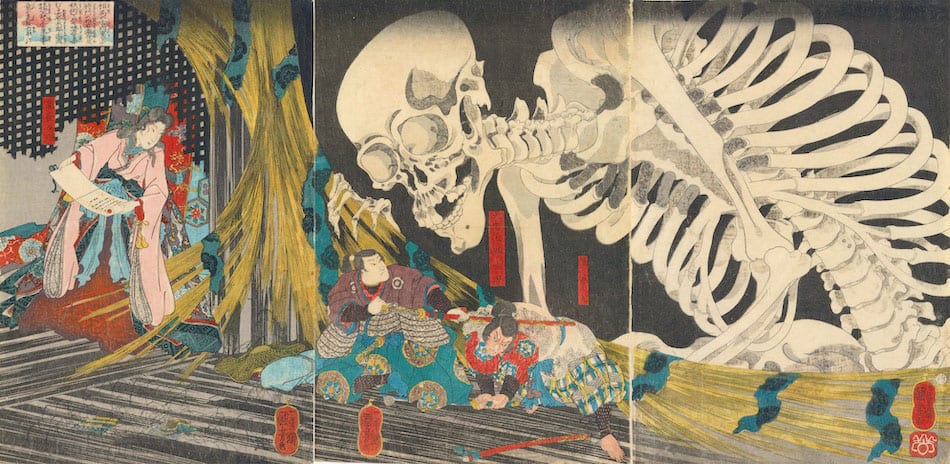
Utagawa Kuniyoshi’s *Princess Takiyasha Calling up a Monstrous Skeleton Specter at the Old Palace in Soma* is a triptych of large-format woodblock prints created around 1845–46[6]. A vast white skeleton tears through the blinds and looms over Ōya Tarō Mitsukuni in the wide composition. Takiyasha-hime stands at one edge holding a scroll, the still center of the supernatural scene she commands.
In Kyōden’s yomihon, hundreds of skeletons attack Mitsukuni. Kuniyoshi condensed the horde into a single colossal skeleton and used the triptych’s width to make viewers feel as if they stood in the creature’s space. The skull’s teeth, the arcs of its ribs, and the torn blinds run across the sheets, conveying the princess’s magic as an instant of shock rather than an explanation.
The giant skeleton is a visual invention born from Kuniyoshi’s composition. Takiyasha-hime’s story had not always placed one colossal skeleton under her command. By boldly transforming the scene in its literary source, the print made the princess and the skeleton an inseparable image.
How Kuniyoshi’s Giant Skeleton Became Associated with Gashadokuro
Kuniyoshi’s skeleton is now often called Gashadokuro. Yet research has traced the name and yokai figure of Gashadokuro to postwar publishing culture[7]. Kuniyoshi in the 1840s was not depicting a yokai known by that name.
The two became closely linked in part because Kuniyoshi’s image was so powerful. For later yokai encyclopedias explaining a gigantic skeletal yokai, *Princess Takiyasha Calling up a Monstrous Skeleton Specter at the Old Palace in Soma* offered an ideal representative image. A print originally showing the confrontation between Takiyasha-hime and Mitsukuni was consequently reread as the classic portrait of a newer yokai.
From Nyozō’s prayers to Kyōden’s rebellion, kabuki disguise, Kuniyoshi’s giant skeleton, and the postwar Gashadokuro, each encounter between an older story and a new medium generated another supernatural form around Takiyasha-hime. She is at once a princess bearing Masakado’s defeat and a figure who illuminates the passage of Japanese supernatural imagery from narrative to stage, from stage to image, and eventually into the yokai encyclopedia.
Character Profile
This section is our own creative profile for storytelling. It is not historical fact or scholarship.
Yokai Type - Traditional Yokai
Category - Half-Human Beings
Rarity - Epic
Personality - A resolute princess who carries the hope of restoring Masakado’s cause. She joins the rebellion in the yomihon; in kabuki, she becomes the courtesan Kisaragi to test her opponent’s intentions, then reveals herself and fights with magic.
Compatibility - For readers drawn to stories that preserve the memory of the defeated, dazzling transformations, and the supernatural beauty created by kabuki and ukiyo-e.
Abilities - Acts alongside Yoshikado and his allies as a princess of the Sōma Palace rebellion in the 1806 yomihonApproaches Mitsukuni in the guise of the courtesan Kisaragi in the 1836 kabuki danceUses sorcery to fight Mitsukuni in the 1836 kabuki danceAppears in a stage spectacle accompanied by a giant toad in the 1836 kabuki danceIs linked to the image of a giant skeleton in Kuniyoshi’s print of around 1845–46
Weaknesses - No single method of defeating her or weakness of her powers is shared across all works. The course of her defeat, the origin of her magic, and her appearance differ among yomihon, kabuki, and ukiyo-e.
Habitat - Sōma Palace, the fictional ruined palace depicted in a late Edo-period yomihon